AI is transforming how marketers predict content ROI. Instead of waiting weeks for results, machine learning tools now forecast traffic, engagement, and conversions before content is even published. This shift allows marketing teams to allocate resources more effectively and focus on content that delivers measurable results.
Key takeaways:
- Predictive content analytics: Machine learning analyzes data to assign probability scores for performance metrics like traffic and conversions.
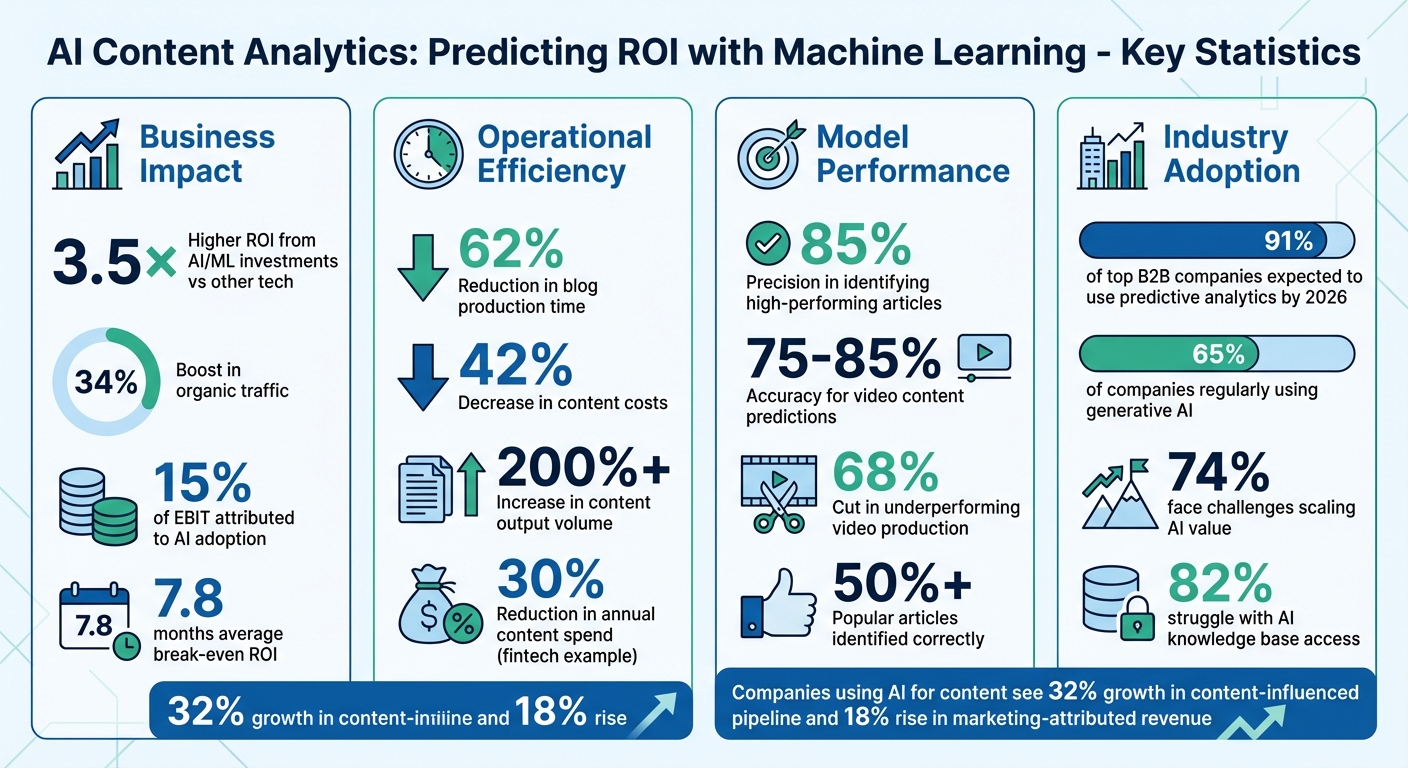
- Higher ROI: Companies using AI report a 3.5× higher ROI and a 34% boost in organic traffic.
- Better attribution: Advanced models, like multi-touch attribution, credit all content influencing a buyer’s journey.
- Efficiency gains: AI reduces blog production time by 62% and content costs by 42%.
AI Content Analytics ROI Statistics and Performance Metrics
Machine Learning Models for Predicting Content ROI
Overview of Machine Learning Models
When it comes to predicting content ROI, machine learning offers a variety of approaches tailored to different needs.
Regression analysis is the backbone of most ROI prediction systems. By connecting variables like topic, content length, and keyword density to financial outcomes, these models use historical data to make forecasts. Linear regression shines when predicting continuous metrics like traffic trends or seasonal fluctuations, though it struggles with more intricate, non-linear relationships.
Natural Language Processing (NLP) steps in to handle unstructured data that regression models can't process. By analyzing customer feedback, forum discussions, and social sentiment, NLP uncovers themes and patterns tied to successful content. This approach doesn't just tell you what works but helps explain why certain topics click with your audience.
Classification models, such as Random Forest, Gradient Boosting, and XGBoost, excel at categorizing data to predict specific outcomes. These models tackle tasks like estimating "Likelihood to Buy" or "Likelihood to Churn" with impressive accuracy. For example, one study showed that classification models could identify over 50% of popular articles with 85% precision. They balance strong performance with reasonable engineering demands, making them a solid choice for teams with moderate budgets.
Time-series models like ARIMA and LSTM (Long Short-Term Memory) focus on how content value evolves over time. These models are ideal for predicting ad performance trends or determining whether a piece of content will maintain relevance or fade quickly. Deep learning techniques like RNNs (Recurrent Neural Networks) are particularly effective for tracking traffic changes, though they require significant computational resources.
Each model offers unique insights into content performance, showcasing the growing role of AI in marketing. Below is a comparison of these models and their contributions to predicting content ROI.
Comparison of Machine Learning Models
| Model Type | Function | Application in Content ROI | Notes |
|---|---|---|---|
| Regression | Predicts numerical values | Forecasting traffic volume and revenue attribution | Easy to interpret but struggles with complex patterns |
| NLP | Analyzes text and sentiment | Identifying high-value topics from customer feedback | Handles large-scale unstructured data in real time |
| XGBoost / Random Forest | Classification and ranking | Predicting "Likelihood to Buy" and targeting prospects | Initial error rates around 35%; improves with tuning |
| ARIMA / LSTM | Time-series forecasting | Predicting trends in ad performance and content longevity | Offers long-term accuracy with proper training |
| Hybrid Models (LOLA) | Content experiments/A/B testing | Optimizing content delivery for maximum engagement | Outperforms traditional A/B testing methods |
The choice of machine learning model depends on both your budget and the scale of your operations. For smaller datasets, spreadsheets or linear models suffice. XGBoost is a great option for mid-sized budgets, while AutoML pipelines are ideal for high-scale environments. Notably, using machine learning for personalized recommendations can increase email and landing page conversion rates by 125%, and models focused on identifying "Likelihood to Pay Full Price" customers can boost profit margins by over 25%.
sbb-itb-a759a2a
Predictive Analytics Techniques for Content Performance
ROI Forecasting and Performance Metrics
Predictive analytics has revolutionized content planning by transforming it into a data-driven process. With modern tools, historical data is analyzed to generate probability scores for key metrics like traffic, engagement, and conversions - even before the content is created.
The process relies on four key data sources: historical performance (e.g., past traffic and conversions), audience behavior (such as reading habits and churn risks), competitive analysis (including competitor launches and market gaps), and external factors like seasonality or trending news. By combining these elements, regression models predict numerical outcomes like view counts, while classification models determine whether content will hit performance targets or fall short.
By 2026, 91% of top B2B companies are expected to use predictive analytics to forecast their content's success before production. Companies adopting these systems have already reported a 62% reduction in blog production time and a 34% boost in organic search traffic. Predictive models for video content have been shown to achieve 75–85% accuracy, cutting underperforming video production by as much as 68%.
"What initially seemed like an expensive implementation has delivered a 42% reduction in our overall content production costs while simultaneously increasing our output by over 200%. The payback period was just under seven months."
– VP of Marketing, Manufacturing Sector
The financial benefits of predictive analytics are hard to ignore. Marketing and sales leaders report that 15% of their EBIT is now directly tied to AI adoption. Moreover, investments in AI and machine learning deliver 3.5× higher ROI compared to other tech categories. Companies using these predictive systems have seen an average 32% growth in content-influenced pipeline and an 18% rise in marketing-attributed revenue.
With these forecasts in hand, machine learning dives even deeper into engagement signals.
Identifying Engagement Patterns with Machine Learning
Machine learning takes predictive analytics a step further by uncovering patterns in audience engagement that human analysis might miss. These systems analyze massive datasets, including details like topic, format, length, and tone, to determine what drives content success .
One standout application is early trajectory analysis, where machine learning evaluates the first 30 minutes to 48 hours of traffic to predict how a piece of content will perform in the long term. This allows teams to double down on successful pieces or pivot away from underperformers quickly . In fact, machine learning models can identify high-performing articles with 85% precision based on early engagement data.
Beyond predictions, prescriptive analytics provides actionable recommendations. For instance, these systems might suggest reallocating budget toward high-performing areas, tweaking publishing schedules, or experimenting with new thumbnails based on the data. Teams can also use priority scoring formulas to objectively rank content ideas by weighing factors like predicted impact, production cost, and strategic importance.
"Predictive scoring turns content into a prioritized portfolio, not a hope-driven pipeline."
– Editorial Team, Scaleblogger
This shift from reactive to proactive strategies is reshaping how organizations approach content. Traditional analytics looks backward, like a rearview mirror, while predictive analytics acts like a GPS, guiding teams toward future success. On average, companies see a break-even ROI within 7.8 months of implementing predictive AI frameworks for content.
Case Studies: Real-World Applications of Predicting Content ROI
Industry-Specific ROI Gains
Real-world examples highlight how machine learning is reshaping content ROI across different industries, delivering measurable results.
Take Netflix, for instance. Its recommendation engine is a powerhouse, responsible for driving 80% of all watched content on the platform. This is a clear demonstration of how predictive analytics can influence user behavior on a massive scale.
In e-commerce, machine learning has brought impressive returns. Conversion rates have jumped by 10–15%, while average order values increased by 12–18%. Streaming services have also benefited, reporting a 30–40% decrease in churn and a 25–35% boost in session times. Meanwhile, B2B sales platforms saw a 20–30% reduction in content search time and a 15–25% increase in content utilization rates.
The financial services sector provides another compelling example. One CMO shared:
"We've seen a 42% increase in SQL generation from our resource center since implementing our generative AI content strategy".
Other success stories include a fintech company that slashed its annual content spend by 30% without sacrificing quality, and a CPG brand that sped up content production by a factor of three compared to traditional workflows. Additionally, a content marketing team reported a staggering 187% increase in organic search traffic after adopting predictive analytics systems.
Table of ROI Improvements by Industry
| Industry | Key Metric | Reported Improvement |
|---|---|---|
| E-commerce | Conversion Rate | 10–15% increase |
| E-commerce | Average Order Value | 12–18% increase |
| Media/Streaming | Session Time | 25–35% increase |
| Media/Streaming | Churn Reduction | 30–40% decrease |
| B2B Sales | Content Utilization | 15–25% increase |
| B2B Sales | Search Time Reduction | 20–30% decrease |
| Content Marketing | Organic Search Traffic | 187% increase |
| Fintech | Annual Content Spend | 30% reduction |
| CPG | Content Turnaround Speed | 3× faster |
| Manufacturing | Cost per Content Unit | 42% reduction |
| Manufacturing | Content Output Volume | 200%+ increase |
| Financial Services | SQL Generation | 42% increase |
Cost and Payback Periods
The time it takes to see returns varies depending on the approach. SaaS-based solutions typically achieve payback in 3–4 months, while custom-built platforms may take 8–12 months due to higher development costs, which range from $80,000 to $150,000. Despite these upfront costs, the long-term benefits are striking. AI and machine learning investments deliver 3.5× higher average ROI compared to other tech categories. Marketing and sales leaders report that AI contributes 15% of their EBIT on average.
These examples make it clear: machine learning is driving tangible improvements in content ROI, offering businesses a powerful tool to optimize their strategies and outcomes.
Challenges and Future Directions in Predicting Content ROI
Data Quality and Model Explainability
Machine learning models have shown promise in predicting content ROI, but they’re far from perfect. A striking 74% of companies report difficulties in scaling meaningful value from their AI efforts, largely because their data isn’t up to the task.
One of the biggest hurdles is attribution complexity. Today’s customer journeys often involve multiple touchpoints - like a blog post, a webinar, and a sales email - all before a conversion happens. Pinpointing which piece of content deserves the credit is challenging. On top of that, many organizations struggle with integrating AI content generation into their CMS and incomplete data collection, leading to gaps that make predictions less reliable.
Another issue is the accuracy of large language models. Studies reveal that 89% of organizations face problems with factual accuracy and maintaining brand voice when using AI, requiring constant human oversight to fix errors. These hidden costs often aren’t factored into traditional ROI models. And then there’s the "zero-click" phenomenon: nearly 60% of Google searches now end without a single click, up from 26% in 2022. This shift makes traditional metrics like click-through rates less relevant. With AI-powered search delivering answers directly on results pages, marketers are forced to rethink how they measure success.
These challenges highlight the importance of Explainable AI (XAI). Marketers need to understand why a model predicts certain content will perform well instead of blindly trusting its output. Without this transparency, campaign decisions can suffer. Miles De Feyter, Director of SEO / Customer Engagement at Brightspot, sums it up well:
"Clicks are no longer the gold standard for SEO. Ranking doesn't guarantee reach. The win is being in the answer itself."
Improving data quality and transparency is critical to refining machine learning models for more accurate ROI predictions.
Advancements in AI for Better Predictions
To tackle these challenges, new AI tools are emerging that provide clearer insights and more reliable forecasts. For instance, Explainable AI frameworks like SOMONITOR now pair large language models with transparent decision-making processes. This allows marketers to identify key content pillars - like target audiences and customer needs - while also understanding how predictions are made. Advanced systems are also using causal inference modules to separate the effects of marketing efforts from organic trends, making attribution more precise.
Structured knowledge management systems are another game-changer. Companies that optimize their data for AI access report a 76% boost in content accuracy. These systems also address a common issue: 82% of organizations struggle to give AI tools proper access to their internal knowledge bases.
Looking ahead, hybrid neural architectures are set to revolutionize content prediction. By combining Graph Neural Networks with Temporal Transformers, these systems can analyze complex content diffusion patterns and even forecast market trends in real time. There’s also a growing trend toward meta-AI applications - tools that evaluate the performance of AI-generated content before it’s even published.
Human-in-the-loop (HITL) workflows are becoming the gold standard for addressing attribution and accuracy issues. These workflows ensure that human editors validate AI outputs for accuracy and maintain E-E-A-T (Experience, Expertise, Authoritativeness, and Trustworthiness). This balance between automation and human oversight helps prevent errors that could distort ROI data.
As these technologies evolve and organizations adopt more sophisticated systems, early adopters are gaining a competitive edge, positioning themselves to get the most out of their content investments.
How to Model and Predict ROI from Content Marketing: David Khim (Omniscient Digital)
Conclusion
Machine learning is changing the way marketers evaluate ROI. Instead of just looking back at past performance, it predicts the likelihood of traffic, engagement, and conversions before content even goes live. This forward-looking approach helps teams focus their top talent and resources on content that promises the greatest impact.
Here’s why this matters: Investments in AI and machine learning deliver, on average, 3.5× higher ROI compared to other technologies. Marketing and sales leaders report that 15% of their EBIT comes directly from adopting AI. For organizations using generative AI in B2B content marketing, the results are clear - break-even ROI is typically achieved in just 7.8 months, while blog production times shrink by 62%, and costs per content piece drop by 42%.
But it’s not just about efficiency. Machine learning also introduces advanced attribution models that give credit to every piece of content influencing a buyer’s journey. This is a game-changer for understanding the value of top-of-funnel content that traditional last-click models often overlook. Plus, real-time anomaly detection ensures marketers can quickly address performance issues before they hurt quarterly results. These capabilities emphasize the importance of having solid measurement frameworks in place.
To get the most out of AI content strategies, marketers should establish clear baselines, incorporate human oversight for quality control, and allow 8–12 weeks for SEO indexing and content authority to take hold. The payoff? A 34% boost in organic traffic and a 23% increase in content-to-lead conversions.
With 65% of companies now regularly using generative AI, early adopters are gaining a competitive edge by leveraging smarter, data-driven strategies. As efficiency improves, the next step is combining ML’s analytical power with human expertise. This collaboration paves the way for a new era of content marketing - one where precision and creativity drive both efficiency and revenue growth.
FAQs
What data do I need to predict content ROI accurately?
To get a clear picture of content ROI, start by gathering data on content performance - this includes metrics like traffic, engagement, conversions, and revenue. Next, track costs, such as production time, resources used, and distribution expenses. Another critical piece is attribution data, which connects specific content pieces to conversions or revenue.
When you combine all of this - performance metrics, cost data, and attribution insights - you can use machine learning models to forecast ROI with greater accuracy. This approach not only sharpens your predictions but also helps marketers fine-tune their strategies to get the best possible returns.
Which machine learning model should I start with for content ROI forecasting?
When it comes to forecasting content ROI, a regression model is a solid starting point. These models are commonly used to predict numerical outcomes, making them a great choice for spotting trends and estimating future performance. Their simplicity and reliability make them especially useful for this kind of analysis.
How can I measure content ROI when attribution is multi-touch and searches are zero-click?
Measuring the return on investment (ROI) for content in multi-touch, zero-click scenarios demands a more nuanced approach. Relying solely on traditional last-click attribution often overlooks the value of indirect interactions that contribute to a customer’s journey. Instead, methods like multi-channel attribution models - such as data-driven approaches - or incrementality testing can provide deeper insights into how various touchpoints impact results.
Machine learning tools are also proving invaluable in these cases. By analyzing customer journeys, assessing brand visibility, and tracking mentions in AI-driven contexts, these tools help quantify the impact of interactions that don't result in immediate clicks. When these strategies are combined, they offer a more comprehensive understanding of ROI in even the most intricate attribution landscapes.