AI email personalization has reshaped how e-commerce businesses connect with customers. Here's why it matters:
- Higher Engagement: AI-driven emails achieve 13.44% click-through rates, compared to 3% for older methods. AI-optimized subject lines boost open rates by 50%.
- Increased Revenue: Personalized campaigns can generate up to 760% more revenue. Automated emails, while only 2% of total send volume, drive 41% of email revenue.
- Better Segmentation: AI creates dynamic customer profiles, predicting behaviors like purchase likelihood or churn risk, leading to 28% higher conversions.
- Customer Trust: Transparency and privacy are critical. 76% of consumers want to know when AI is used, and clear data policies improve trust.
AI transforms email marketing by analyzing real-time behaviors, tailoring content, timing, and offers to individual needs. Businesses using AI see measurable improvements in engagement, sales, and customer loyalty.
Benefits of AI Email Personalization for E-commerce
Higher Engagement Rates
AI-powered email campaigns consistently outperform traditional methods. While standard campaigns often see a 3% click-through rate, those driven by AI average an impressive 13.44% - over four times higher. This success comes from AI's ability to optimize three essential factors simultaneously: timing (Send-Time Optimization), content (Dynamic Product Recommendations), and presentation (Generative Subject Lines).
AI-optimized subject lines alone deliver 50% higher open rates compared to manually crafted ones. For example, a UK retailer conducted a six-month test and found AI-generated subject lines achieved 83% accuracy, far outpacing human-generated alternatives. Managing this level of precision manually, especially with large subscriber lists, is simply unfeasible.
What makes AI so effective? It analyzes real-time intent signals like browsing habits, cart activity, and session behaviors to ensure emails land when recipients are most likely to engage. This boost in engagement often translates into measurable revenue growth.
Increased Sales and Revenue
AI personalization has a dramatic impact on sales. Personalized and segmented campaigns can generate up to 760% more revenue than generic email blasts. Even more striking, AI-powered automated emails account for just 2% of total send volume but drive 41% of total email revenue. The reason? AI ensures messages are more relevant by tailoring offers, content, and timing to match individual customer needs.
"Segmented email campaigns generate 760% more revenue than non-segmented campaigns. The extraordinary multiplier effect results from improved relevance - recipients receive offers, content, and messaging aligned with their specific interests." - G2 Email Marketing Research
Real-world examples highlight this impact. EasyJet saw its personalized campaigns perform 14x better at evoking emotional responses, with 7.5% of recipients booking flights within 30 days. Meanwhile, Amazon credits 35% of its total revenue to AI-powered product recommendations. Similarly, Showmax achieved a 204% increase in subscribers and a 37% boost in ROI using AI-driven segmentation.
AI achieves these results through tools like behavioral triggers, predictive recommendations, dynamic content tailored to price sensitivity, and personalized send times. For instance, AI-powered product recommendations alone can contribute up to 31% of total e-commerce revenue, while personalized calls-to-action convert 202% better than generic ones.
Better Customer Segmentation
AI doesn't just improve engagement and revenue - it also refines how businesses segment their audiences. Instead of relying on static demographic categories, AI creates dynamic, predictive segments like "high purchase probability within 7 days" or "at risk of churn within 14 days". This allows brands to act proactively, such as launching win-back campaigns before losing a customer or offering exclusive perks to retain high-value shoppers.
AI-driven segmentation leads to 28% higher conversions compared to manual methods, with revenue per recipient increasing between 18% and 45%. For instance, Force of Nature experienced 140% year-over-year revenue growth after adopting an AI-powered segmentation approach. Similarly, Willow Tree Boutique used Klaviyo's Predictive CLV to target high-value customers, achieving 53.1% half-over-half revenue growth.
AI excels at "micro-segmentation", analyzing hundreds of behavioral and predictive signals simultaneously - something human marketers can't replicate at scale. For example, Showmax implemented a system with over 600 metadata tags to deliver highly personalized messages, resulting in a 12% higher win-back rate. Meanwhile, Pit Boss Grills used AI to profile customers based on their grill models and purchase history, generating $76,717 from a single back-in-stock email campaign. AI even tailors messaging based on customer motivations, distinguishing between discount-driven and aspiration-driven buyers to ensure the right message reaches the right audience.
| Metric | Manual / Batch Campaigns | AI-Driven / Automated |
|---|---|---|
| Revenue Per Recipient | Baseline | 30x Increase |
| Average Click-Through Rate | 1.2% - 2.1% | 3.75% - 8.79% |
| Revenue Lift | Average | 40% Higher |
| Conversion Rate | 3% | 12% |
sbb-itb-a759a2a
Research Evidence for AI Personalization
Performance Metrics from Studies
Research consistently shows that AI-driven personalization can dramatically enhance the effectiveness of e-commerce emails. For instance, a March 2025 study led by Mike Brachten, which involved over 5,500 participants from a professional services organization, found that AI-personalized emails using employee data increased click-through rates from 13% to 57%. Even more strikingly, conversion rates jumped from 2% to 20% compared to generic emails.
Other studies echo these findings. AI-personalized emails report 29% higher open rates than their generic counterparts, with some cases showing up to an 82% surge in total opens. These emails also deliver six times higher transaction rates and a median return on investment (ROI) of 122%. Additionally, AI's predictive modeling - capable of distinguishing casual browsers from returning buyers - pushes conversion rates to a range of 25% to 60%, far surpassing the 15% rate seen in generic campaigns. On top of that, AI personalization has been linked to a 20–40% boost in average order value.
These statistics highlight the tangible benefits AI brings to personalization, and real-world applications further validate these results.
AI Tools in Practice
The practical use of AI tools underscores how these technologies can deliver measurable results. A good example is Backstroke, a next-generation AI email platform. By analyzing data from over 10,000 B2C brands, Backstroke optimizes subject lines, email content, and visuals. This approach typically results in a 20% increase in email revenue for e-commerce clients.
"AI performs best when it has access to extensive, high-quality data that's relevant to your brand and industry." – Bridget Johnston, Backstroke
Grubhub provides another compelling case. In December 2020, the company launched its "Taste of 2020" campaign using Braze's AI and API tools. By leveraging 32 custom attributes per user to craft personalized year-in-review experiences, the campaign achieved a 100% increase in social media mentions and an 18% rise in word-of-mouth referrals. These AI systems analyze real-time behavioral signals - like browsing habits, cart activity, and purchase history - to create content that aligns perfectly with individual customer intent.
AI Revolutionizes Email Personalization for Klaviyo Users
Consumer Trust and Purchase Decisions
Consumer trust plays a big role in shaping purchase decisions, especially when it comes to AI-driven personalization. Studies reveal that when consumers trust AI personalization (β = 0.52), their likelihood to make a purchase increases significantly (β = 0.46). But trust doesn’t happen by accident - it hinges on how well companies handle data and respect user privacy.
Here’s the tricky part: the "personalization-privacy paradox." While 71% of consumers expect personalized experiences, only 37% actually trust businesses with their personal data. This creates a tension. As AI boosts engagement and sales through data-driven optimization, companies must address privacy concerns to maintain trust. Why? Because privacy worries weaken the trust-building power of personalization (β = –0.18).
There’s also a disconnect between how companies and customers view trust. A whopping 84% of executives believe their customers trust them, but only 27% of consumers agree.
"Closing the trust gap helps create a more sustainably tight-knit relationship with customers." – Phil Regnault, PwC
This gap matters. Around 60% of consumers say they’ve already lost some trust in companies due to AI use. Clearly, trust isn’t just a nice-to-have - it directly supports the performance gains AI can deliver.
One way to build trust is through transparency. For example, 76% of consumers want companies to disclose when AI is being used, and 81% feel more comfortable sharing their data when they have clear privacy opt-outs. This demand for "Explainable AI" (XAI) reflects a desire for clarity - consumers want to know why they’re seeing specific recommendations.
"When our customers notice that their data is being used to provide them with better products or treatments… we can see that they feel much more confident in sharing their data with us." – Kavindra Mishra, CEO of Shoppers Stop
Shoppers Stop leveraged generative AI to engage with 9 million loyalty members while keeping a human-in-the-loop approach. This balance helped them scale personalization without crossing into "over-personalization", where consumers feel spied on instead of served. Striking the right balance between personalization and privacy is critical as AI continues to transform how businesses interact with their customers.
AI vs. Traditional Email Personalization
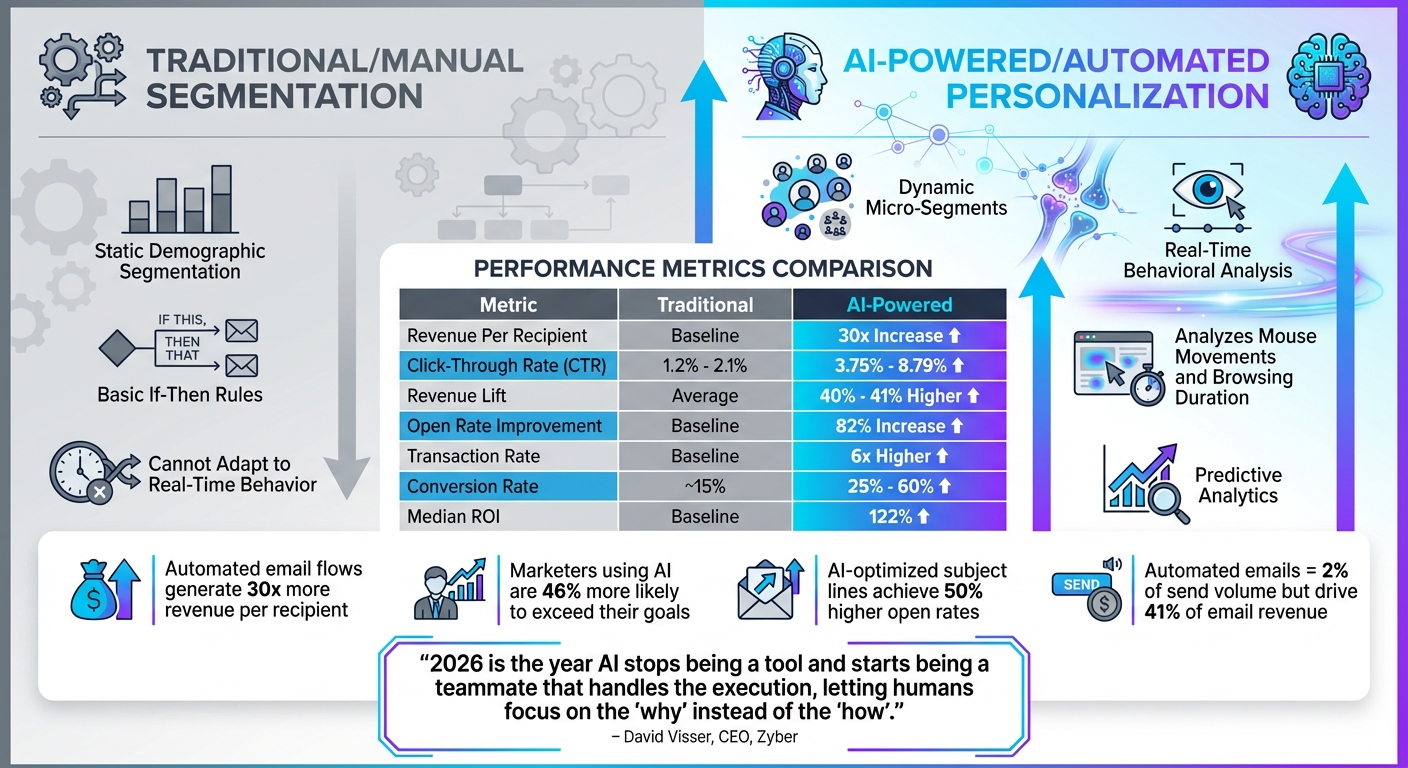
AI vs Traditional Email Marketing Performance Comparison
Traditional email personalization relies on static demographic segmentation and basic if-then rules. These methods fall short when it comes to adapting to real-time customer behavior. On the other hand, AI-powered personalization creates dynamic micro-segments, adjusting in real time by analyzing details like mouse movements and browsing duration. This shift highlights the measurable advantages AI brings to email personalization.
For example, automated email flows generate 30 times more revenue per recipient, and marketers using AI are 46% more likely to exceed their goals.
"2026 is the year AI stops being a tool and starts being a teammate that handles the execution, letting humans focus on the 'why' instead of the 'how'." – David Visser, CEO, Zyber
Here’s how the two approaches compare on key metrics:
| Metric | Traditional / Manual Segmentation | AI-Powered / Automated Personalization |
|---|---|---|
| Revenue Per Recipient | Baseline | 30x Increase |
| Click-Through Rate (CTR) | 1.2% - 2.1% | 3.75% - 8.79% |
| Revenue Lift | Average | 40% - 41% Higher |
| Open Rate Improvement | Baseline | 82% Increase |
| Transaction Rate | Baseline | 6x Higher |
| Conversion Rate | ~15% | 25% - 60% |
| Median ROI | Baseline | 122% |
AI doesn’t just speed up personalization - it makes it smarter. By leveraging predictive analytics, AI can identify high-value customers, optimize send times, and deliver highly relevant emails. For instance, replenishment reminders based on consumption patterns are timed perfectly, something traditional methods simply can’t achieve. These precision-driven strategies not only enhance customer engagement but also drive significant revenue growth.
Future of AI in E-commerce Email Marketing
AI is reshaping email marketing, and the future looks even more dynamic. Building on its current success in boosting engagement and revenue, AI is moving toward deeper, more tailored customer experiences. The days of static recommendations are giving way to autonomous AI shopping concierges. By 2030, we can expect AI to handle everything from drafting personalized subject lines using top AI tools for writing to orchestrating entire customer journeys. This means AI won't just pick from pre-written templates - it'll create unique content for each recipient, factoring in preferences, behavior, and context.
"The future of retail isn't about more choice - it's about the elimination of irrelevant choice through autonomous agents." – Stormy AI
This transformation is already underway. Next-generation systems now integrate real-time context, using signals like local weather, inventory levels, and browsing history to deliver hyper-relevant content. The boundaries between email marketing and on-site personalization are fading, replaced by unified systems where a single AI model informs every customer interaction. Companies that excel at this level of personalization see a 40% revenue boost compared to those that don’t.
At the same time, ethical concerns are becoming more pressing. As AI grows more powerful, brands must confront issues like algorithmic bias and shift toward using zero-party data - information customers willingly share, such as through quizzes or preference settings. With 76% of consumers expressing concerns about how their data is handled, transparency is non-negotiable. Tactics like pausing promotions during negative customer experiences (e.g., unresolved support tickets) and offering detailed opt-out options can help maintain trust without compromising personalization.
The road ahead requires finding a balance between innovation and ethical responsibility. Brands that address data silos, adopt send-time optimization - which can boost open rates by 31% - and ensure human oversight in tone and messaging will lead the charge. The gap between AI’s ability to craft personalized experiences and traditional segmentation methods is growing, offering a clear opportunity for those who embrace these advancements. AI-driven precision is setting a new standard, leaving traditional approaches struggling to keep up.
Conclusion
AI-powered email personalization is changing the game in e-commerce, driving noticeable improvements in engagement, revenue, and customer loyalty. Research shows that segmented, AI-driven campaigns outperform traditional "batch-and-blast" methods by a wide margin, delivering higher revenue and transaction rates. Even something as simple as AI-optimized subject lines can increase open rates by 50%. These results highlight a major shift in how businesses engage with their customers.
With AI, segmentation becomes proactive. It can predict churn before it happens and trigger automated win-back campaigns at just the right moment. Automated email flows, while making up only 2% of total send volume, generate an impressive 41% of email revenue. This proves that relevance matters far more than sheer volume. Real-world success stories, like Showmax achieving a 204% subscriber increase through lifecycle-based personalization, showcase the power of AI-driven automation. These outcomes not only confirm earlier findings but also point to the growing potential of AI in segmentation and predictive marketing.
"Traditional email automation was about drawing boxes and arrows; autonomous marketing is about setting goals and letting AI figure out the next best move." – Jackie Palmer, VP Product Marketing, ActiveCampaign
AI's ability to outperform traditional methods lies in its adaptability. While manual segmentation relies on static lists that quickly become outdated, AI continuously updates customer profiles using real-time behavioral data. This evolution from static to dynamic, predictive personalization gives businesses a competitive edge. By shifting from reactive to predictive marketing, brands can deliver the right message to the right person at the right time - without requiring constant manual input. With 87% of businesses already using AI for email workflows and adoption expected to hit 97% by 2030, acting quickly is essential.
E-commerce businesses should start small but smart. Quick wins like send-time optimization can boost open rates by 31%. Behavioral triggers for actions like abandoned carts or product restocks, combined with predictive analytics to identify high-value customers at risk of churning, can make a big impact. The companies that excel at AI-driven personalization now will define what exceptional customer experiences look like in the future.
FAQs
What data do I need to start AI email personalization?
To kick off AI-driven email personalization, you’ll need to gather data like behavioral patterns, purchase history, browsing activity, engagement trends, and predictive signals. This information allows you to craft email content that aligns with individual preferences, making your messages more impactful and relevant.
How can I use AI without creeping customers out?
To integrate AI into email marketing effectively and maintain customer trust, prioritize transparency, relevance, and privacy. AI can help craft timely and meaningful content tailored to customer behavior and preferences. For instance, it can optimize email send times or personalize subject lines to better resonate with individual recipients.
Be upfront about how customer data is being used and offer clear options for managing preferences. When used ethically and without crossing boundaries, AI can boost engagement while fostering trust and respect with your audience.
Which emails should I automate first for the fastest ROI?
Automating abandoned cart recovery emails is a smart first step. These emails are incredibly effective at gauging user intent and bringing back potential customers who didn’t complete their purchase. By setting up this automation, you can recover lost sales quickly and see an immediate improvement in your ROI.