AI is changing how we measure content performance by focusing on real-time, detailed insights instead of outdated metrics like page views or clicks. It predicts user behavior, analyzes micro-interactions, and measures the direct impact of personalization on revenue. Companies using AI-driven metrics report higher conversion rates, better engagement, and smarter budget allocation.
Key Takeaways:
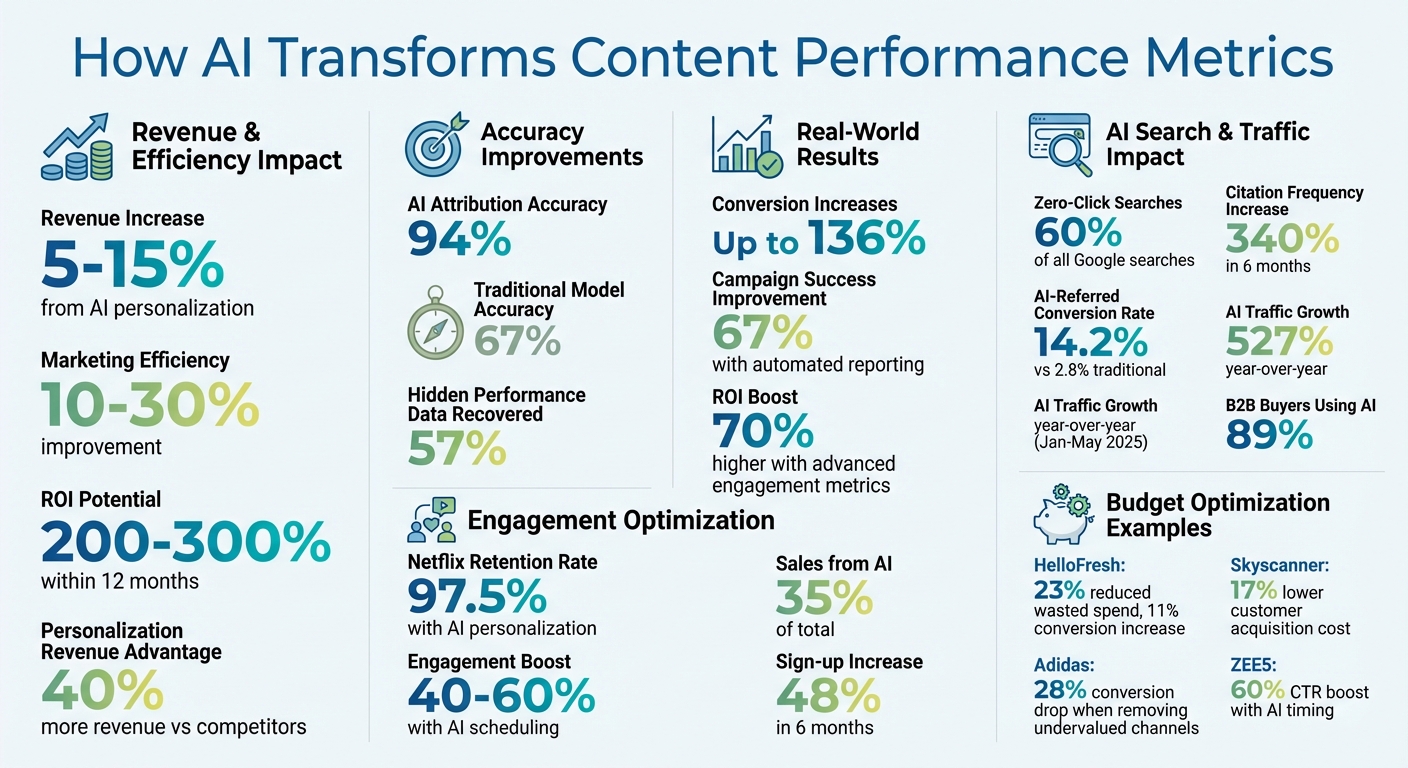
- Revenue Impact: AI personalization efforts can increase revenue by 5-15% and improve marketing efficiency by 10-30%.
- Better Attribution: AI-powered models achieve 94% accuracy in predicting user behavior vs. 67% with older methods.
- Real-Time Adjustments: AI tools dynamically adapt content and campaigns, avoiding delays from traditional A/B testing.
- Advanced Metrics: New AI metrics like "incremental lift", "engagement quality", and "AI share of voice" provide deeper insights into performance.
AI tools like chatbots, predictive models, and automated analytics are helping brands like TFG, HP Tronic, and Adidas achieve measurable results, including up to 136% increases in conversions. These advancements make AI essential for businesses aiming to stay competitive in the evolving content landscape.
AI-Driven Content Metrics: Key Performance Statistics and ROI Impact
Research Findings: How AI Improves Metric Accuracy
AI Predictive Models for User Behavior
Traditional analytics often rely on fixed credit assignments, which can miss critical nuances in user behavior. AI, on the other hand, leverages machine learning to dynamically distribute credit across every touchpoint. This approach not only captures user interactions more effectively but also probabilistically links users across devices, recovering 57% of performance data that would otherwise remain hidden. AI-powered attribution modeling achieves 94% accuracy in predicting conversion paths, far surpassing the 67% accuracy of traditional models. These improvements pave the way for more precise measurement of causal impacts.
Measuring Causal Impact and Uplift
AI also shines when it comes to measuring incremental lift - revenue generated solely through personalization efforts. The Unified Multi-Valued Treatment Network (UniMVT) helps separate confounding factors from genuine user preferences, effectively debiasing click-through rates and pinpointing the real impact of marketing strategies.
"Your self-reported attribution numbers will always look prettier than incrementality ones. But incrementality can be proven or disproven. That's where the real value lives." - Rajeev Nair, Co-Founder and Chief Product Officer, Lifesight
Stratified uplift modeling further validates these methods. By identifying "persuadable" customers - those who convert only when engaged - brands can avoid wasting resources on users who would have purchased without intervention. AI programs that align technical performance metrics with financial KPIs have demonstrated the potential to deliver a 200–300% ROI within 12 months.
Better Attribution Models with AI
AI takes attribution modeling to the next level by refining impact analysis across the customer journey. For example, Adidas adopted a Markov chain-based attribution model in 2019 and uncovered significant insights. Channels that appeared low-value under last-click attribution were found to have major upstream influence. When these channels were removed, total conversions dropped by 28%. Similarly, HelloFresh's AI model revealed that Pinterest played a crucial assist role in 31% of conversions, despite its weak performance in traditional reports. Adjusting their budget based on these findings reduced wasted spend by 23% and increased conversions by 11% in just one quarter.
Skyscanner, a travel platform, used Bayesian Probabilistic Inference to uncover that Meta ads were being over-credited by 40% due to last-click bias. By reallocating budgets to undervalued channels like email and price drop alerts, the company managed to reduce its blended customer acquisition cost by 17%. These examples highlight how AI can uncover non-linear patterns that traditional models often fail to recognize, leading to smarter budget allocation and improved results.
sbb-itb-a759a2a
How AI Makes Performance Tracking More Efficient
Real-Time Testing and Insights
Traditional A/B testing often drags on for weeks before producing actionable insights. AI changes the game by processing massive amounts of user data in milliseconds. It dynamically adjusts content based on factors like location, device type, and browsing habits. This shift from periodic testing to continuous evaluation allows businesses to reallocate traffic to high-performing variations while campaigns are still active, instead of waiting for post-campaign analysis.
AI tools simplify data collection by automatically pulling information from website analytics, social media, and CRM systems through API connections. This eliminates the tedious process of manual data extraction. In fact, companies using automated reporting frameworks report a 67% improvement in campaign success compared to those relying on manual methods. Additionally, machine learning models can spot patterns to predict future engagement trends, offering recommendations on the best times to publish or the most effective content formats before performance dips.
Real-time alert systems powered by AI notify teams immediately when performance metrics fall below acceptable levels. This allows for quick adjustments during active campaigns, avoiding the inefficiencies of post-mortem analysis. These capabilities make audience segmentation and campaign adjustments faster and more precise, as explored in the next section.
Detailed Segment and Cohort Analysis
AI has transformed audience segmentation from a static, quarterly task into a dynamic, real-time process. Instead of relying on traditional demographic categories that require constant manual updates, AI algorithms continuously analyze user behavior to uncover "hidden" micro-segments - subtle patterns that human analysts might overlook.
For example, in February 2026, ZEE5, a global streaming service, used CleverTap's AI-powered "Best Time to Send" feature to optimize message timing for South Asian content campaigns. This personalization effort boosted click-through rates by 60%, aligning content delivery with individual user engagement habits. Around the same time, Saudi fashion brand Blooming Wear leveraged AI cohort analysis to pinpoint where customers were dropping off in their purchasing journey. By introducing behavior-triggered messaging at these critical moments, they reduced drop-offs by 15% and increased repeat purchases by 10%.
Uplift modeling, another AI-driven technique, identifies which audience segments are most likely to respond to specific strategies, ensuring that personalization efforts are focused where they will have the greatest impact. Companies that embrace these tools see 40% more revenue from personalization compared to their competitors. Beyond segmentation, AI also streamlines data collection processes, as discussed below.
Automated Log Analysis and Metric Creation
AI removes the bottlenecks caused by manual tagging in performance tracking. Generative AI can scan visual assets and automatically populate attributes, creating new dimensions for performance analysis. According to recent surveys, 80% of CMOs report that AI has boosted productivity, with 30% prioritizing insight generation and 27% focusing on predictive analytics.
"The real magic of Content Analytics is the generative AI component that scans images and auto-populates attributes about the image, without the need to manually tag each asset." - Sanjay Vachani, Senior Director of Product Marketing, Adobe
A practical example of this is HSBC's adoption of Adobe Target's AI-powered tools in July 2020. The bank used these capabilities to optimize its digital customer journeys, cutting development time for new personalized experiences from six months to just a few weeks. Pre-configured server-to-server integrations between personalization tools and analytics platforms also reduced the need for IT involvement, empowering marketing teams to act quickly without waiting for developer support.
This move from reactive analysis to proactive, real-time adjustments marks a fundamental shift in how content performance is managed. AI enables businesses to stay ahead, making data-driven decisions faster and more effectively than ever before.
Adaptive Content Explained: How AI Personalizes Marketing in Real Time
New AI-Powered Metrics for Personalized Content
AI continues to reshape how we measure content effectiveness, focusing on deeper engagement, improved visibility, and the measurable impact of personalized experiences.
Engagement Quality Metrics
AI has moved beyond basic click metrics to evaluate how well content aligns with user intent. It now uses tools like predicted engagement scores and session satisfaction indices, which track behaviors like scroll depth, time spent reading, and interaction patterns.
This approach fills gaps left by traditional metrics. For instance, Netflix achieves a 97.5% subscriber retention rate by analyzing user engagement with personalized recommendations. Similarly, Amazon's AI-driven recommendation engine contributes to 35% of its total sales. Companies leveraging these advanced metrics report up to a 70% boost in ROI compared to those relying solely on older analytics methods.
AI also evaluates content performance before it goes live, using AI content optimization techniques to refine the output. It assesses factors like structure, readability (using tools such as the Flesch-Kincaid readability score), and tone consistency to ensure the content reflects your brand's voice.
AI Search Visibility and Influence Metrics
AI is also redefining how brands appear in search and conversational platforms. Traditional SEO metrics, such as keyword rankings and click-through rates, are becoming less relevant as zero-click searches - where users get answers directly - now make up nearly 60% of all Google searches in the US and EU. This shift has led to the development of new metrics that focus on how AI retrieves and recommends brands in its responses.
One such metric, Citation Rate, measures how often your brand is mentioned in AI-generated answers. Brands tracking Generative Engine Optimization (GEO) metrics have reported a 340% increase in citation frequency within six months. Position Quality goes a step further, scoring your brand's prominence in AI responses - whether as a primary recommendation or just a brief mention.
"Traditional SEO metrics tell you whether you're discoverable, but they don't tell you if your brand is visible inside answer engines." - Cassie Clark, AI Search Expert
AI Share of Voice is another useful metric, comparing your brand's mentions against total category mentions. Tools like Bing Webmaster Tools now provide dashboards for tracking metrics such as "Total Citations", "Average Cited Pages", and "Grounding Queries". It's worth noting that 36% of US ad buyers are now prioritizing AI-driven attention metrics over traditional page views.
Measuring Incremental Value of Personalized Content
AI also quantifies the direct impact of personalized content on conversions. Traffic referred by AI platforms often comes from high-intent users, resulting in conversion rates 4.4 times higher than traditional organic search traffic. In some cases, conversion rates from AI platforms have reached 14.2%, compared to 2.8% from standard searches. Between January and May 2025, AI-referred traffic grew by a staggering 527% year-over-year, and 89% of B2B buyers now use generative AI in their purchasing decisions.
However, many analytics tools still misattribute AI-referred traffic as "direct", overlooking its true origin.
"If you're still measuring marketing success purely through Google Analytics pageviews... you're operating with a critical blindspot." - Zach Chmael, CMO of Averi
How to Implement AI Metrics for Personalized Content
A Multi-Layer Measurement Framework
To effectively measure AI-driven content performance, divide your metrics into two categories: upstream signals (like passage relevance, citation rates, and bot activity) and downstream outcomes (such as AI-referred traffic, conversion rates, and brand loyalty indicators). This layered approach helps pinpoint both the reasons your content appears in AI-generated answers and the outcomes once it does.
Start by establishing a baseline. Use tools like Google Analytics 4 and Google Search Console to assess your current performance metrics. Once you have this foundation, add AI-specific tracking elements, such as visibility metrics and bot crawl patterns. Companies that adjust their KPIs to incorporate AI insights often see a 30-point lift in channel performance within six months.
This framework is particularly effective because most AI citations - 86%, to be exact - come from sources brands already control, such as their own websites. So, instead of starting from scratch, you're building on existing metrics. This approach creates a solid base for ongoing testing and refinement.
Best Practices for Testing and Evaluation
Regular testing and evaluation are key to improving your content's performance in AI-generated answers. Conduct weekly optimization sprints to monitor AI visibility. Use A/B testing or holdout experiments to confirm whether your updates lead to better citation rates or increased AI-driven conversions. Real-time anomaly detection can help catch ranking fluctuations or sudden visibility drops, allowing you to address issues before they significantly impact traffic.
Establish a consistent review cadence: daily health checks, weekly scorecard reviews, and monthly strategy sessions. This schedule helps you avoid overreacting to normal traffic variations while still catching genuine problems early.
While AI tools can streamline processes - reducing keyword research time by 80% and improving content optimization by 30% - human oversight remains critical. Guillaume Decugis, CEO of Linkfluence, emphasizes:
"Building systems where AI replaces humans 100% is really, really hard".
Always verify AI-generated outputs against reliable sources to catch errors before publication.
Using AI Metrics Tools in Your Workflow
Once you've fine-tuned your metrics and review processes, integrate AI tools directly into your workflow to automate insights. Many AI-powered analytics platforms now connect seamlessly with content management systems, CRMs, and marketing automation tools. This integration allows you to link content engagement metrics to individual customer profiles and even revenue outcomes.
For additional support, the AI Blog Generator Directory (https://aibloggenerators.com) offers a curated list of AI writing tools with built-in analytics features. These tools often include automated keyword research, SEO optimization, and CMS integration, simplifying the process of adopting AI-driven metrics into your existing systems.
To ensure accuracy, automate data collection using standardized naming conventions across all platforms. Implement UTM parameters for tracking before syncing data with AI analytics tools. This prevents issues like sampling errors or double counting, giving you a unified dashboard that combines traditional engagement metrics with AI-specific visibility insights.
Conclusion: What's Next for AI in Content Metrics
AI is reshaping how we measure content performance. The focus is shifting from basic metrics like keyword rankings to more advanced semantic measurements - evaluating whether AI models can accurately identify and categorize a brand. This marks a significant step forward in content analytics. By 2026, it's expected that 80% of digital user experiences will be AI-personalized, making these advanced measurement techniques a necessity rather than a luxury. This shift is transforming how content performance is assessed.
With real-time predictive analytics, brands can now pinpoint and optimize high-performing content instantly, avoiding the delays of monthly reporting cycles. AI-driven content scheduling has also proven to boost engagement by 40–60% compared to traditional fixed schedules. On top of that, automated attribute analysis can evaluate images and text based on specific creative elements - no manual tagging required.
"The brands that build durable AI visibility will be the ones that exist cleanly at the semantic layer, in ways models can reliably reuse across contexts and personalization scenarios." – Trackerly
Tools like the AI Blog Generator Directory (https://aibloggenerators.com) are pushing these innovations further. They provide content creators with AI-powered platforms that integrate analytics, SEO optimization, and automated keyword research into a single streamlined workflow. These tools introduce new KPIs like "Velocity to Index" and "Cost per Indexed Article", which traditional analytics often overlook. Teams that track these AI-specific KPIs report impressive results, including a 62% median increase in keyword lift and a 48% boost in sign-ups within just six months.
As content measurement evolves, the question will no longer be "Where did we rank?" but instead, "Does AI understand us?". The brands that embrace these advanced metrics and act on real-time insights will lead the way in this new era of content performance.
FAQs
What AI metrics matter most beyond clicks?
To assess the success of personalized content, it's important to look beyond just clicks. Metrics like User Engagement Score, Content Quality Score, Lead Generation Score, Reader Behavior Analysis, and Content Reach Measurement offer a more detailed picture. These indicators help analyze how effectively content resonates with the audience and guide adjustments to boost interaction and results.
How do I measure incremental lift from personalization?
To understand the actual impact of personalization, it's essential to measure incremental lift. This involves comparing the performance of personalized content against a control group that receives generic content. By focusing on specific metrics like conversion rates or click-through rates, you can pinpoint the difference personalization makes. This approach helps isolate its true effect, giving you a clearer picture of how much personalization contributes to your outcomes, without being skewed by unrelated factors.
How can I track AI-referred traffic correctly in GA4?
To monitor AI-referred traffic in Google Analytics 4 (GA4), you’ll need to set up some custom configurations. Start by creating a custom channel group or an exploration report. Then, apply regex filters to pinpoint traffic from AI platforms like ChatGPT, Bard, or Perplexity.
Additionally, when sharing links, make sure to use UTM parameters. This helps improve attribution, especially since some AI tools might not pass referrer data. By combining regex filtering with UTM tagging, you can achieve more precise tracking of visits driven by AI platforms.

