AI is reshaping how games are built, cutting costs, and creating dynamic player experiences. Procedural content generation (PCG), once reliant on basic algorithms, now integrates AI tools like machine learning to produce detailed, responsive game worlds. Here's the key takeaway: AI-driven PCG allows developers to generate vast environments, adaptive stories, and immersive gameplay efficiently.
Key Insights:
- Cost Efficiency: AI tools have reduced level design costs by up to 40% for mid-sized studios.
- Dynamic Content: Modern AI systems create branching dialogue using AI writing tools, adaptive quests, and more personalized player experiences.
- Industry Adoption: 89% of AAA studios use AI for tasks like regression testing, saving weeks of development time.
Game Examples:
- Rogue (1980): Pioneered dungeon generation but suffered from repetitive randomness.
- Minecraft: Used Perlin noise to create infinite, organic terrains.
- Spore: Blended player input with procedural systems for creature design.
- No Man’s Sky: Generated 18 quintillion planets from a single seed.
- Dwarf Fortress: Simulated entire civilizations, from histories to cultures.
Challenges:
- Repetition: Early PCG often felt monotonous without enough variation.
- Narrative Coherence: AI struggles to maintain emotional consistency in storytelling.
- Bias: AI systems can amplify biases present in training data.
Future Outlook:
AI is moving toward creating evolving worlds that react to player behavior in real-time. By blending AI automation with human oversight, developers are striking a balance between efficiency and quality. However, challenges like bias and narrative consistency remain areas for improvement. The next frontier? Fully integrated systems combining visuals, sound, and storytelling for seamless gaming experiences.
AI Generation VS Procedural Generation
sbb-itb-a759a2a
Case Studies of AI-Powered Procedural Generation in Games
The evolution of game design has been significantly influenced by procedural generation, transitioning from basic algorithms to systems that create dynamic, immersive worlds. These examples showcase how procedural techniques have shaped games, the hurdles developers faced, and how these innovations have transformed player experiences.
Rogue: The Birth of Procedural Dungeon Design
Released in 1980, Rogue was a pioneer in algorithmic dungeon generation. Using ASCII tiles, it crafted rooms, hallways, monsters, and treasures, inspired by tabletop RPGs like Advanced Dungeons & Dragons, which relied on dice rolls and branching tables for dungeon creation. This system allowed the game to generate new subterranean layouts and populate them with items as players progressed. The result? A game with endless replayability, as levels were freshly created each time.
However, Rogue encountered a common issue in early procedural design - what Kate Compton referred to as "procedural oatmeal", where the randomness lacked meaningful variety. Despite generating countless dungeons, many players felt the experiences were repetitive. Still, Rogue's approach laid the groundwork for the roguelike genre, which continues to thrive today.
Minecraft: Infinite Worlds with Perlin Noise
Minecraft revolutionized terrain generation by using Perlin noise, a gradient-based technique, to create natural-looking heightmaps and textures. By layering multiple noise patterns, developers controlled the frequency and amplitude to produce diverse landscapes. This method allowed the creation of expansive, seamless worlds that supported both survival gameplay and creative building.
What made Minecraft stand out was its simplicity and adaptability. Small development teams could deliver endlessly varied environments, while players expanded the game further through mods. This balance of technical ingenuity and player freedom has made Minecraft a global phenomenon.
Spore: Blending Player Input with Procedural Systems
Spore introduced a unique approach to procedural generation by combining player creativity with automated systems. Players could design creatures by defining their "DNA", and the game would handle the rest - generating movement, behaviors, and ecosystem integration. This hybrid model empowered players to shape their worlds while simplifying the complex task of designing interconnected systems, much like how advanced AI tools streamline modern content workflows.
No Man's Sky: Exploring an Infinite Universe

No Man's Sky took procedural generation to a cosmic scale, creating a universe with 18 quintillion planets using a deterministic engine based on a single random seed. Every player's experience stems from the same underlying code, but planets, flora, and fauna are generated in real time as they explore. This approach eliminates the need for massive storage while enabling players to discover new content without downloading additional data.
Despite its ambitious scope, ensuring meaningful variety across such a vast universe remains a challenge. Nevertheless, No Man's Sky has redefined exploration in gaming, offering players a near-endless frontier to uncover.
Dwarf Fortress: Simulating Histories and Cultures
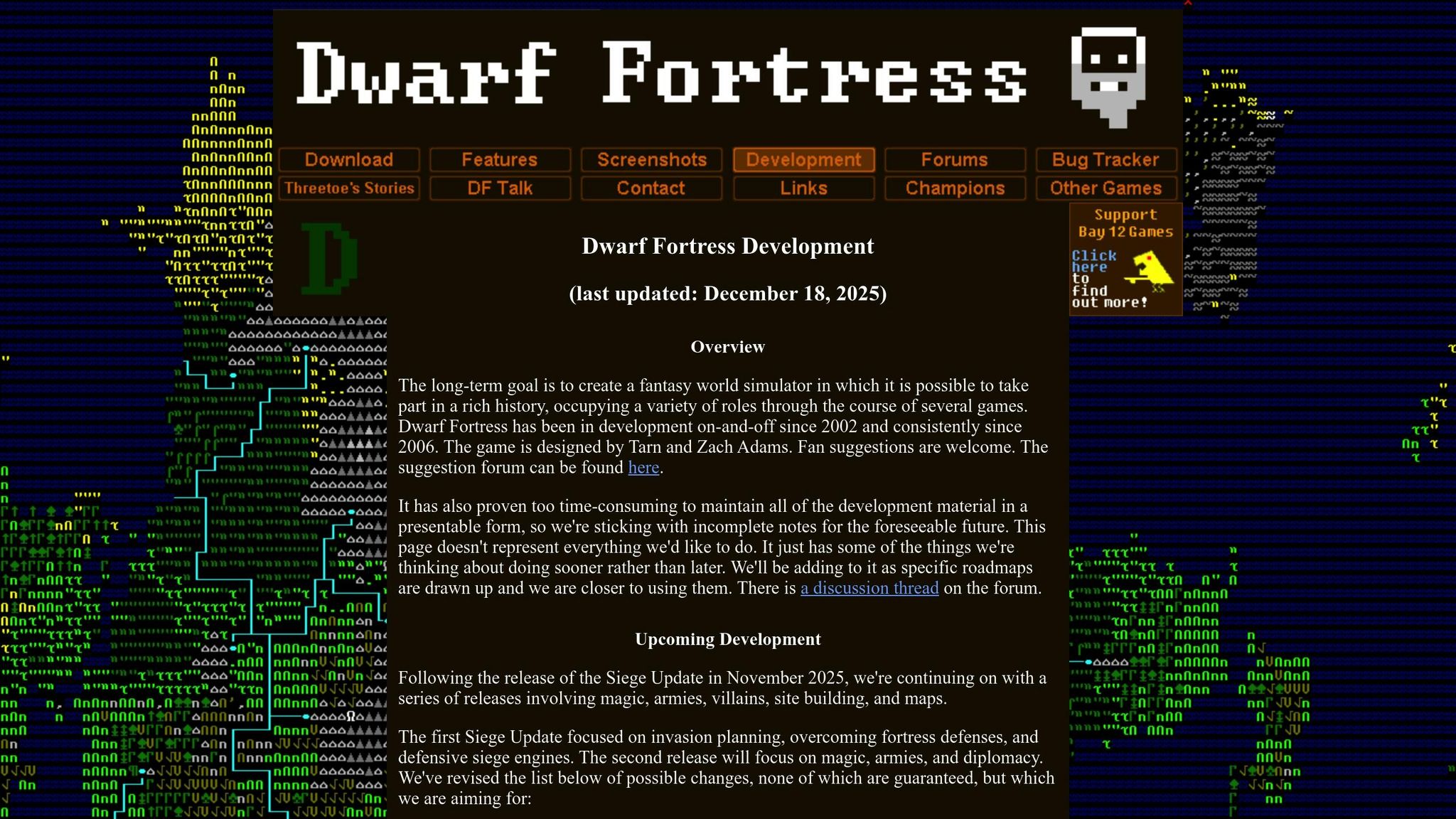
Dwarf Fortress goes beyond creating physical spaces - it generates entire civilizations, complete with histories, legends, and character biographies. Before gameplay even begins, the game simulates wars, family trees, and cultural developments, creating a richly detailed world that continues to evolve based on player actions. This level of narrative depth, achieved through procedural systems, would be nearly impossible to replicate manually.
Comparing Procedural Generation Techniques
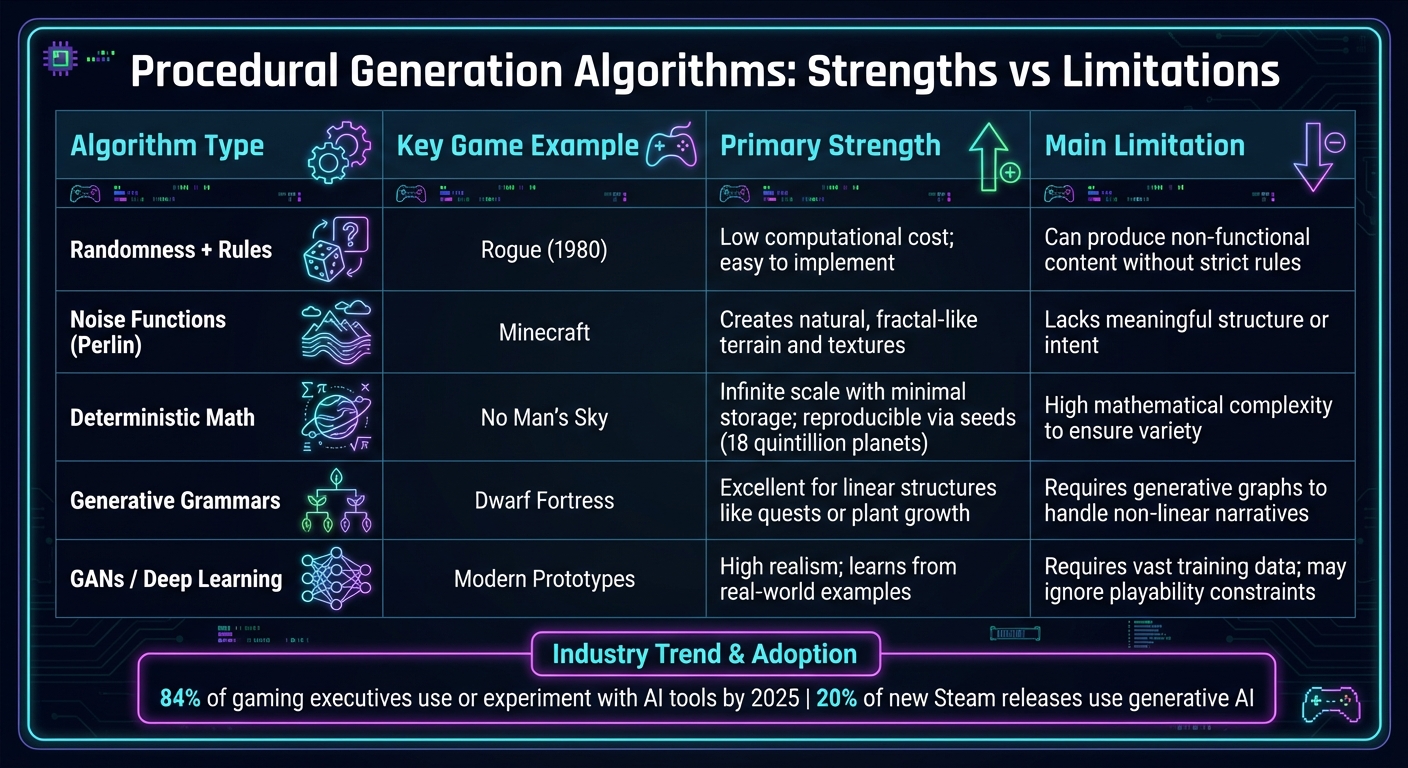
Comparison of Procedural Generation Algorithms in Gaming
The case studies reveal how different games utilize unique algorithms to shape their gameplay and development processes. Each method offers distinct advantages while presenting its own challenges, impacting both computational efficiency and the player experience.
Take Rogue, for example. It relies on simple randomization combined with rule-based logic. This lightweight method is easy on resources but risks creating unsolvable dungeons unless strict rules are applied. On the other hand, Minecraft uses Perlin noise to generate smooth, organic terrain that feels natural. While this approach excels at creating visually appealing landscapes, it lacks deeper structure or intentional design.
Then there’s No Man’s Sky, which employs deterministic mathematical models to produce a staggering 18 quintillion planets from a single seed. This method achieves massive scale with minimal storage requirements, but maintaining variety across such a vast universe demands highly complex formulas.
Dwarf Fortress introduces a different approach by using generative grammars and planning-based algorithms. This method simulates evolving histories and cultures, making it great for creating linear narratives and logical event sequences. However, it struggles with non-linear storytelling unless supplemented with graph-based systems. Meanwhile, modern prototypes are turning to GANs and deep learning. These techniques excel at creating high-fidelity assets by learning from real-world data, but they often overlook gameplay constraints and require extensive training datasets.
Algorithm Comparison Table
| Algorithm Type | Key Game Example | Primary Strength | Main Problem/Limitation |
|---|---|---|---|
| Randomness + Rules | Rogue | Low computational cost; easy to implement | Can produce non-functional content without strict rules |
| Noise Functions (Perlin) | Minecraft | Creates natural, fractal-like terrain and textures | Lacks meaningful structure or intent |
| Deterministic Math | No Man's Sky | Infinite scale with minimal storage; reproducible via seeds | High mathematical complexity to ensure variety |
| Generative Grammars | Dwarf Fortress | Excellent for linear structures like quests or plant growth | Requires generative graphs to handle non-linear narratives |
| GANs / Deep Learning | Modern Prototypes | High realism; learns from real-world examples | Requires vast training data; may ignore playability constraints |
These comparisons highlight the trade-offs developers face when choosing procedural generation techniques. The industry is increasingly adopting hybrid methods that blend these approaches, aiming to balance creativity and functionality. By 2025, 84% of gaming executives reported using or experimenting with top AI tools for writing and development, and 20% of new Steam releases disclosed the use of generative AI for creating art, dialogue, or code.
Development Insights and Lessons Learned
Game development often involves balancing two extremes: pure randomness, which can lead to chaotic and unsatisfying experiences, and overly constrained systems, which risk becoming dull and predictable. David Adams, Creative Director at Gunfire Games, summed up this challenge well:
"Randomization can only take you so far... If the game were completely randomized, the experience would be mediocre."
The key lies in curated randomness. By combining handcrafted elements - like prefabs - with procedural arrangement, developers can ensure variety without sacrificing quality. This approach also requires careful performance tuning to keep games running smoothly.
For performance optimization, developers rely on clever workarounds. For instance, Dwarf Fortress uses a component index to bypass resource-heavy pathfinding between regions, while The Riftbreaker employs terrain masks to dynamically swap material sets . These techniques reduce computational demands while maintaining a visually diverse environment.
Narrative Challenges and AI's Limitations
One of AI's most persistent weaknesses is maintaining narrative consistency. Beta tests for AI-driven NPC platforms revealed a 12–15% error rate in emotional coherence, showing how hard it is to craft seamless storytelling in procedurally generated worlds. Developers have found success by focusing on micro-stories - self-contained, smaller narratives that feel cohesive. As Neil Druckmann from Naughty Dog put it:
"AI can generate 100 level ideas in a second - but it can't tell which one makes players feel like reluctant heroes in a dying world."
Another pressing issue is bias amplification. Maria Chen from Square Enix noted:
"AI doesn't invent bias - it amplifies what's already in our industry."
When Square Enix reviewed AI-generated character backstories, they found that female characters were disproportionately assigned negative traits due to biased training data. To combat this, regular audits of training datasets have become crucial to avoid reinforcing harmful stereotypes.
The Value of Hybrid Workflows
Learning from these challenges, many studios now embrace hybrid workflows that combine AI automation with human creativity. AI takes on repetitive tasks, like environment dressing and bug detection. For example, Ubisoft's "Commit Assistant" identifies 70% of code errors before any human review. This frees up human developers to focus on storytelling and complex design work. Mid-sized studios adopting this model have even managed to cut level design costs by 40%.
Conclusion and Future Directions
AI-driven procedural generation is moving beyond traditional rule-based methods, like Perlin noise and fixed rulesets, to embrace learning-based systems that respond to player behavior in real time. While the older techniques served the gaming industry well for decades, modern machine learning is paving the way for dynamic, evolving worlds. By 2028, experts predict RPGs where every NPC leads a simulated life with real-time motivations, and maps regenerate hourly to reflect player activity trends. This evolution isn't just about gameplay - it’s about reshaping how games are designed and experienced, opening up possibilities for more integrated and interactive creative processes.
One of the most exciting advancements lies in cross-modality generation, which blends image, sound, and narrative models to create fully autonomous scenes. Tasks like environment dressing and bug detection are increasingly automated, giving human designers more freedom to focus on crafting engaging narratives. This partnership between human creativity and machine efficiency signals the rise of hybrid workflows, where AI complements, rather than replaces, human ingenuity.
As storytelling technology grows more sophisticated, so do player expectations for accountability. Future systems, powered by large language models, aim to deliver adaptive storytelling with branching dialogue that reacts to players' moral choices. For example, platforms like NVIDIA ACE are testing NPCs capable of retaining conversation history and adjusting behavior accordingly. Still, transparency is key - 61% of gamers express discomfort with AI-generated content that isn’t clearly labeled. To build trust, studios must ensure players know when AI is shaping their experience.
These advancements build on innovations seen in earlier games. AAA-quality tools are becoming more accessible, allowing indie developers to create high-quality content that once required massive budgets. Meanwhile, major studios are scaling production for expansive, always-online worlds. The real challenge ahead isn’t just technical - it’s finding ways for AI to enhance creativity without reducing it to what developers call "procedural oatmeal." By striking the right balance, the future of gaming could be more immersive and imaginative than ever before.
FAQs
When should a game use AI PCG vs classic algorithms?
AI-powered procedural content generation (PCG) shines when you need to create dynamic, intricate, and scalable content with minimal manual input - think dynamic levels or quests. Its strength lies in delivering a wide range of variety and boosting replayability. On the other hand, classic algorithms are better suited for tasks where predictability and performance are key, such as connecting pre-designed level blocks or ensuring consistent pacing. The choice comes down to your goals: if adaptability and complexity are the priority, AI is the way to go; for simplicity and control, stick with classic methods.
How do studios prevent “procedural oatmeal” repetition?
Studios tackle the issue of repetitive "procedural oatmeal" by using guided generation techniques. This method combines the strengths of AI with the creativity of game designers, who work together to shape content that feels engaging and purposeful. By blending human input with AI's capabilities, studios ensure their creations avoid shallow or overly repetitive patterns, resulting in more dynamic and captivating experiences.
How can developers reduce bias in AI-generated content?
Developers can tackle bias in AI-generated content by starting with diverse and representative datasets during training. This approach helps ensure the AI learns from a wide range of perspectives. Beyond that, regularly monitoring outputs is critical for catching unintended biases that might slip through.
Using fairness-aware algorithms and conducting continuous testing are key practices for identifying and addressing bias effectively. These steps help maintain a balance, ensuring the content stays fair and avoids reinforcing stereotypes or promoting homogenized views. As AI-driven procedural content generation advances, ongoing evaluation becomes even more important to keep the content inclusive and aligned with ethical standards.