Amazon Prime Video uses AI content writing tools and machine learning to simplify content discovery for over 200 million users. By leveraging tools like Amazon Personalize, the platform delivers tailored recommendations, improves search accuracy, and increases user engagement. Key highlights:
- AI-Powered Recommendations: Doubled relevance compared to older methods.
- Real-Time Updates: Adapts suggestions every two hours based on user activity.
- Personalized Search: AI-enhanced search boosts conversions by 2-3x.
- Data Privacy: GDPR-compliant, with user-controlled settings.
- Revenue Impact: Personalization drives a 10-15% revenue increase.
Through advanced machine learning and user behavior analysis, Prime Video creates a more engaging and intuitive streaming experience.
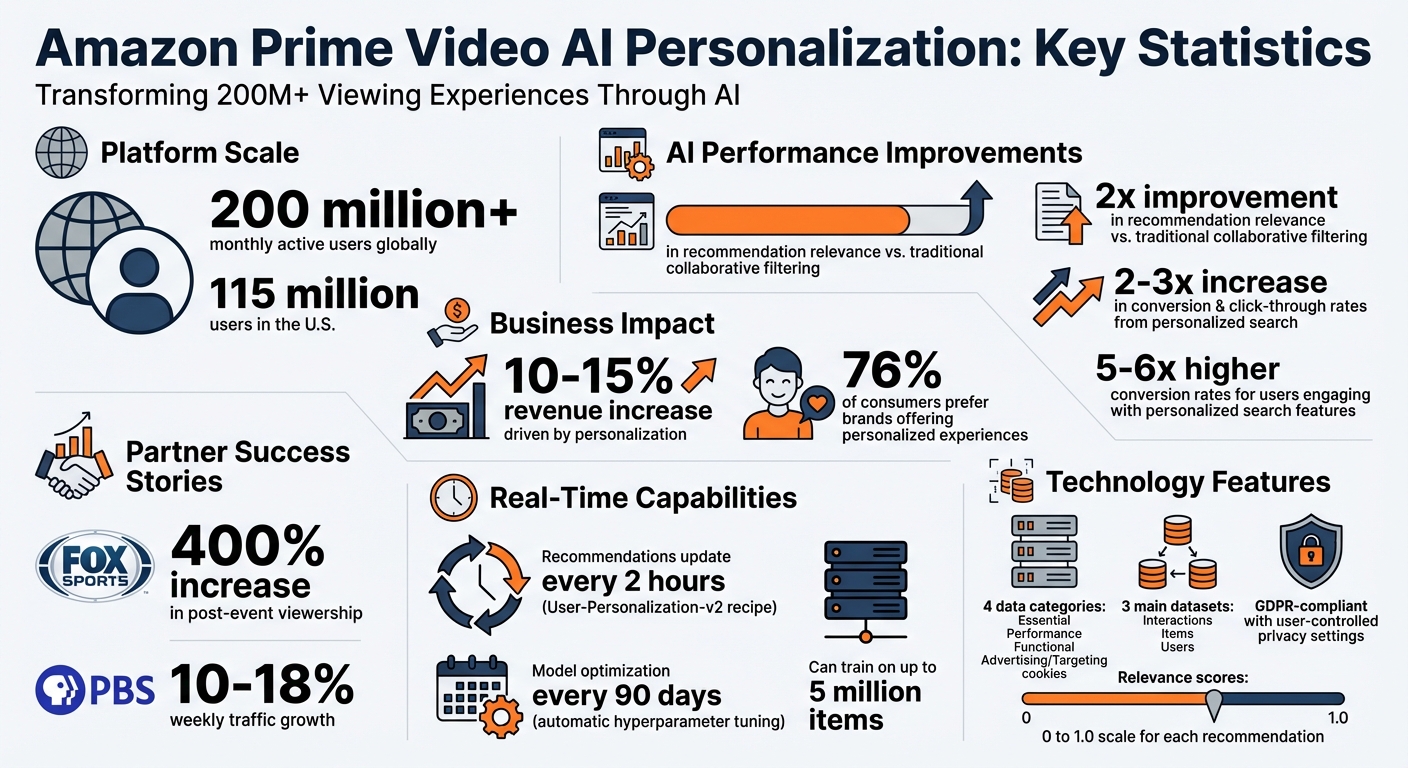
Amazon Prime Video AI Personalization Impact: Key Statistics and Results
Amazon Personalize: The Technology Behind Recommendations
Amazon Personalize is a fully managed machine learning service that powers the recommendation engine for Prime Video. It’s built on the same technology Amazon.com has relied on for over two decades. The service handles the entire machine learning workflow - covering everything from data processing and feature identification to algorithm selection, model training, and hosting - making it accessible even for teams without dedicated ML expertise.
At the heart of Amazon Personalize are "recipes" (preconfigured models). These recipes combine specific algorithms and hyperparameters tailored for different use cases, such as "Top picks for you", "More like X", and "Most popular" recommendations. Each recommendation is assigned a relevance score between 0 and 1.0, representing the likelihood of user interaction with that content. This scoring system is key to delivering precise, user-specific suggestions.
A standout feature of Amazon Personalize is its real-time adaptability. Using the PutEvents API and event trackers, the system captures live user interactions - clicks, video views, and watch time - and updates recommendations accordingly. The User-Personalization-v2 recipe refreshes every two hours, ensuring new content is quickly integrated into the recommendation pool. This keeps suggestions fresh and aligned with the latest catalog updates.
How Amazon Personalize Works
The User-Personalization-v2 recipe employs a transformer neural network to analyze user viewing history and predict what they might want to watch next. This architecture excels at understanding context and recognizing patterns in user interactions, turning past viewing data into tailored recommendations.
The system also uses metadata, like device type, location, and time of day, to fine-tune recommendations. For example, commuters using mobile devices might see shorter videos, while smart TV users in the evening may get suggestions for feature-length films. This contextual approach is especially helpful for new users with limited viewing history. Gilles-Kuessan Satchivi, an Enterprise Solutions Architect at AWS, highlights this benefit:
"Using a user's contextual metadata such as location, time of day, device type, and weather provides personalized experiences for existing users and helps improve the cold-start phase for new or unidentified users."
The recipe can train on up to 5 million items and incorporates recency bias, enabling it to quickly adjust to changing user preferences. These capabilities form the foundation for the personalized search and engagement features that follow.
Main Features of Amazon Personalize
Amazon Personalize offers a range of features designed to improve content discovery and user engagement.
- Automatic model updates: The system optimizes hyperparameters every 90 days (when automatic training is enabled), ensuring that recommendation accuracy continues to improve without manual effort. This automation spans the entire machine learning pipeline.
- Exploration capabilities: To avoid repetitive recommendations, the system includes lesser-known items in its suggestions. This helps users discover content outside their usual preferences. Platforms can adjust the "new item exploration weight" to strike a balance between familiar and fresh content.
- Dynamic filtering: Business rules can be applied in real time. For instance, Prime Video can exclude already-watched content or filter recommendations based on regional licensing restrictions. This ensures that suggestions remain relevant and compliant across different markets.
Amazon Personalize operates on a pay-as-you-go model, with no upfront costs. AWS also offers a free tier for the first two months, which includes 20 GB of data processing, 100 training hours, and 180,000 recommendation requests. This flexible pricing allows platforms to scale their personalization efforts based on actual usage.
sbb-itb-a759a2a
Data Collection and Model Training
Amazon Prime Video uses AI-driven personalization to tailor content for its audience of 200 million monthly active users, including 115 million in the U.S.. To achieve this, the platform collects a wide range of data, such as streaming history, search queries, ratings, and real-time clicks. It even tracks detailed interactions like scene preferences and moments when users skip ahead. By factoring in contextual details - like the time of day, device type, and user location - Prime Video ensures its recommendations are highly accurate. To protect this vast amount of data, the platform implements strict privacy measures.
User Data Collection and Privacy
Prime Video complies with GDPR regulations, ensuring that all data processing is based on user consent or legitimate interest. Users have control over their data through cookie preferences, which are divided into four categories: Essential, Performance, Functional, and Advertising/Targeting cookies. While Essential cookies are mandatory for the platform's functionality and security, users can choose to accept or decline the other three categories. These privacy settings are stored locally on the user's device and are valid for up to one year. This careful approach underscores Prime Video's focus on balancing personalization with user privacy. All data collected is used exclusively to enhance the platform's personalization features, adhering to GDPR guidelines.
Prime Video relies on three main datasets for its AI training: Interactions (user behaviors like clicks and viewing patterns), Items (catalog metadata, including genres and release dates), and Users (demographic details). Additionally, Amazon uses Natural Language Processing (NLP) to extract insights from unstructured data sources using advanced AI tools for content descriptions, user reviews, subtitles, and dialogue. Girish Bajaj, Vice President of Technology at Prime Video, highlights the importance of this approach:
We have streaming history that we get from customers and we derive their taste and habits through that.
Training AI Models with User Behavior and Content Data
These datasets serve as the foundation for training advanced AI models, enabling highly personalized recommendations. By combining behavioral data with semantic content analysis, Prime Video goes beyond basic genre tags. Instead, it uses Large Language Models (LLMs) via Amazon Bedrock to analyze plot details and character development, creating curated "Made for You" collections.
Before training begins, Amazon uses a Data Insights feature to ensure high-quality datasets. This tool identifies anomalies and suggests improvements, allowing the system to adapt quickly by adding new data columns without restarting the entire training process. For features like X-Ray Recaps, introduced in November 2024, Amazon applies specific guardrails to its AI models. These models analyze video segments, subtitles, and dialogue to create spoiler-free summaries tailored to the user's exact viewing progress. A dual-LLM system ensures quality: the primary LLM generates content, while a secondary evaluator LLM reviews it, creating a continuous feedback loop.
This approach has led to a 2x improvement over traditional collaborative filtering methods, as the models are trained on Amazon's entire content library. Personalized recommendations have a tangible impact, with an estimated 10% to 15% boost in revenue. Additionally, 76% of consumers are more likely to engage with brands that offer personalized experiences. By blending behavioral insights with deep content analysis, Prime Video not only enhances its AI training but also significantly increases user engagement and satisfaction.
OpenSearch Integration for Personalized Search
The search bar on Prime Video is one of the platform's most clicked features, making it a key driver of user engagement. To enhance search accuracy, Prime Video integrates Amazon OpenSearch Service with AI-powered personalization. This combination allows users to find what they’re looking for quickly - even when using abbreviations.
By leveraging vector embeddings, the system can interpret shorthand queries like "tnf" as "Thursday Night Football", delivering relevant live or upcoming games. This semantic approach is especially handy for live sports, where timing and seasonality are crucial. For example, a search for "soccer live" previously showed documentaries instead of live matches. Now, the system prioritizes live, upcoming, and recently concluded games.
Personalization goes a step further with the Amazon Personalize Search Ranking plugin, which reorders search results based on user behavior. For instance, searching for "Tom Cruise" might highlight drama titles like Jerry Maguire if they align with the user’s viewing history. Developers can fine-tune this feature using a weighting parameter (ranging from 0.0 to 1.0) to balance keyword relevance with personalized results. A higher weight prioritizes user-specific interests.
The impact has been clear. The AI-enhanced sports search has driven a statistically significant increase in search-attributed conversions, including streams, purchases, and subscriptions. Users who engage with search are up to twice as likely to convert compared to non-search users, and personalized search is expected to boost conversion and click-through rates by two to three times. Andy Huang, Head of AI/ML at Cognizant Servian, highlighted the benefits:
With the release of the new Amazon Personalize Search Ranking plugin within Amazon OpenSearch Service, we can now rapidly deploy and implement real-time user personalization to search results. We are highly confident that it will deliver improved customer experience and satisfaction as well as increase conversion and clickthrough rates by two to three times.
Results: User Engagement and Viewing Metrics
Measured Results from AI Implementation
AI-powered personalization has driven a noticeable surge in user engagement. For instance, Amazon's media partners have reported impressive viewership increases: FOX Sports experienced a staggering 400% rise in post-event viewership, while PBS saw weekly traffic grow by 10%-18%. These results underscore how personalization can enhance streaming experiences across a variety of platforms.
Additionally, data reveals that personalized search features can lead to conversion rates that are 5 to 6 times higher than those of users who don’t engage with such tools.
The success of these strategies is supported by continuous performance evaluation methods like Impact Measurement and A/B testing. Prime Video utilizes Impact Measurement - a feature within Amazon Personalize - to help developers assess how AI-driven changes influence user behavior and calculate return on investment. Furthermore, the platform regularly conducts A/B testing to refine its recommendation algorithms and interfaces, ensuring they meet viewer preferences. One standout example is the AI-powered X-Ray Recap feature on Prime Video's Fire TV app, which has become the platform's most-used tool, showcasing strong user interest in AI-generated content summaries.
User Feedback and Response
Beyond the numbers, user feedback has played a crucial role in shaping Prime Video's personalized experience. Kam Keshmiri, Vice-President of Design at Prime Video, emphasized this point:
We continuously review feedback, and users clearly demand an intuitive streaming experience.
Prime Video gathers insights from explicit feedback, such as user ratings and search queries, as well as implicit data, like viewing patterns, skipped scenes, and total watch time. This combination of feedback helps the platform fine-tune its personalization models, further validating the quantitative improvements.
One particularly effective innovation has been the shift from broad content categories to AI-curated micro-genres. Younger audiences, especially Gen Y and Gen Z, tend to leave platforms that fail to offer tailored experiences. Prime Video has responded by replacing generic labels like "Action" or "Comedy" with more specific themes such as "Love, Laughter, and Hijinks", which align better with user moods and preferences. Reflecting on these advancements, Girish Bajaj, Vice President of Technology at Prime Video, remarked:
We've been using traditional AI machine learning models for recommendations for many, many years, and generative AI has given us a new door to make it even more impactful and more meaningful to customers.
Conclusion
Amazon Prime Video's use of AI personalization directly tackles specific viewer challenges, boosting both engagement and retention. Instead of adopting AI for novelty, their approach focuses on solving practical problems - like improving dialogue clarity or helping users recall plot details. As Adam Gray, Vice President of Product at Prime Video, explained:
The idea of doing this across every title in a catalog of our scale is a solution that only happens with the power of AI.
This strategy has translated into tangible business outcomes. Personalization efforts have driven revenue increases of 10%–15% and scaled features like X-Ray Recaps, which quickly became one of Prime Video's most popular tools. Supporting this, 76% of consumers report preferring brands that deliver personalized experiences.
The key lies in real-time personalization that adapts to user behavior in the moment, rather than relying solely on static historical data. For example, shifting from general genres to hyper-specific micro-genres like "Love, Laughter, and Hijinks" allows for recommendations that resonate more deeply with individual preferences. By focusing on semantic understanding - analyzing plot points and character arcs instead of basic genre tags - Prime Video creates recommendations that feel more relevant and meaningful.
AI's impact also extends beyond streaming platforms. Content creators, for instance, can benefit from tools like the AI Blog Generator Directory, which offers resources for essential AI text creators, SEO enhancements, and personalization. These services simplify the machine learning process, enabling creators to leverage AI without needing advanced technical expertise.
As this case study illustrates, integrating AI into core business strategies yields the greatest rewards. Girish Bajaj, Vice President of Technology at Prime Video, highlighted this potential:
Generative AI has given us a new door to make it even more impactful and more meaningful to customers.
Organizations that embed AI into every aspect of their product decisions - and align those efforts with clear business goals - are best positioned to maximize their return on investment.
FAQs
How does Prime Video update recommendations so quickly?
Prime Video leverages machine learning to fine-tune its recommendation system. By examining user preferences, it organizes content into personalized categories called "AI Topics." This approach ensures that viewers receive quicker, more relevant suggestions, perfectly aligned with their unique interests.
What data does Prime Video use for personalization?
Prime Video uses a mix of data, including video segments, subtitles, and user viewing habits, to create tailored recommendations and insights. By analyzing preferences, it delivers more personalized content, making the viewing experience feel more relevant and engaging for users.
How does AI make Prime Video search results more accurate?
Prime Video uses machine learning to make its search feature more accurate and user-friendly. By analyzing viewer preferences, it creates personalized content recommendations, helping users find what they actually want to watch.
One standout feature is the introduction of tailored "AI Topics." These group movies and shows into categories that align with individual interests, making it easier for viewers to discover relevant content. This approach not only saves time but also enhances the overall viewing experience by offering more meaningful suggestions.