AI is transforming influencer marketing, making campaigns smarter, faster, and more effective. Brands like Nike, L'Oréal, and Artisse are using AI to select influencers, predict campaign outcomes, and optimize audience targeting. The results? Higher engagement, better targeting, and improved ROI.
Key Takeaways:
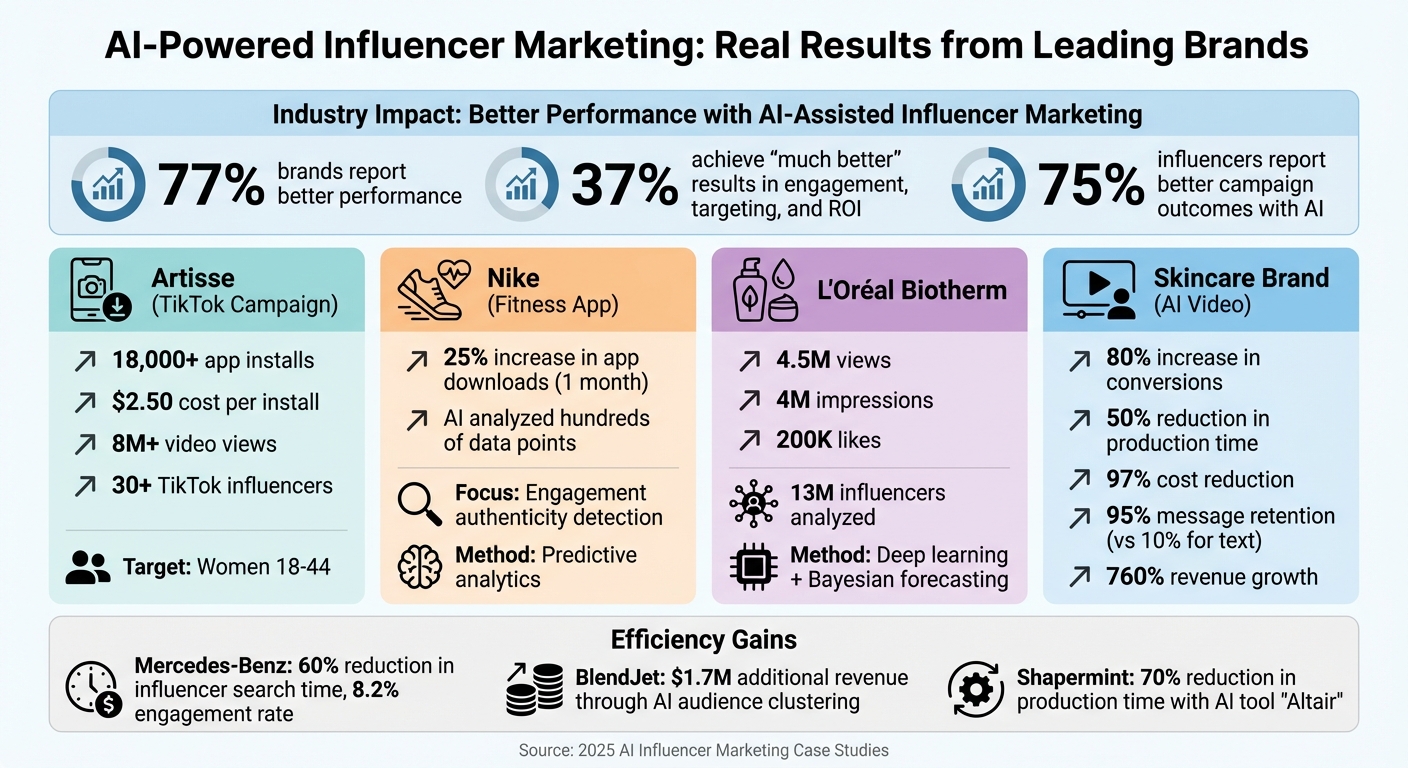
- Influencer Selection: AI analyzes millions of creators for engagement rates, demographics, and authenticity. Nike used this to increase app downloads by 25%.
- Audience Targeting: Predictive analytics helped L'Oréal generate 4.5M views and boost sales by aligning content with audience behavior.
- Content Creation: AI content generator tools cut production time by up to 50%, as seen in skincare brands using AI-generated video testimonials to increase conversions by 80%.
- Efficiency Gains: Mercedes-Benz reduced influencer search time by 60%, while BlendJet added $1.7M in revenue through AI-driven audience clustering.
AI is no longer optional for brands - it’s a data-driven solution that delivers measurable results in influencer marketing. Whether it’s identifying the right creators or improving campaign performance, AI is reshaping how brands connect with audiences.
AI in Influencer Marketing: Campaign Results and ROI Across 4 Major Brands
How AI and Marketing Are Transforming Influencer Strategies
Case Study 1: Artisse – Using AI to Drive App Installs with TikTok Influencers
Artisse, an AI-powered photo editing app, faced stiff competition in a crowded market. Its standout feature? The ability to transform regular selfies into polished, professional-quality images. In 2025, Artisse teamed up with House of Marketers to roll out a TikTok influencer campaign aimed at women aged 18–44 across key regions, including the US, Canada, UK, Australia, New Zealand, Singapore, and parts of Europe. Let’s dive into how Artisse used AI and influencer marketing to make an impact.
AI Features and Influencer Partnerships
The campaign focused on showcasing Artisse’s advanced AI tools for content creation. To do this, the brand collaborated with over 30 TikTok influencers, collectively known as the #TeamArtisse group. These creators came from niches like fashion, beauty, travel, and lifestyle. Through their content, they demonstrated how Artisse’s AI could turn everyday selfies into stunning, high-quality images. By combining organic influencer posts with carefully placed paid ads, the campaign reached a broad audience, helping Artisse stand out in a competitive space.
Campaign Results and Performance Data
The results were impressive. The campaign led to over 18,000 app installs, with a cost-per-install of just $2.50. On TikTok, the influencer-generated content racked up more than 8 million video views. These real-time demonstrations not only highlighted Artisse’s technology but also strengthened its visibility and appeal in the market.
Case Study 2: Nike – AI Analytics for Influencer Selection in Fitness App Marketing
When Nike set out to promote its fitness app, it moved beyond surface-level metrics like follower counts. Instead, the company turned to advanced tools capable of analyzing hundreds of data points, such as audience demographics and engagement authenticity, to identify the best influencer partners.
Using predictive analytics, Nike's system evaluated potential influencers by comparing them against historical success data. This allowed the brand to generate probability scores for desired outcomes while also detecting anomalies in engagement - such as signs of inauthentic interactions. This ensured that their chosen influencers connected with genuine audiences.
The results were impressive. Nike saw a 25% increase in app downloads within just one month. Real-time optimization further fine-tuned the campaign, boosting user acquisition even more. This success aligns with broader industry trends: 77% of brands report better performance with AI-assisted influencer marketing, and 37% say AI delivers "much better" results in engagement, targeting, and ROI.
Nike's campaign highlights the value of replacing shallow metrics with a thorough, data-driven vetting process to achieve measurable results.
Case Study 3: Cosmetics Brand – Predictive AI for Audience Targeting
Predictive Algorithms for Audience Targeting
L'Oréal took a page from Nike's data-driven playbook, applying AI to enhance audience targeting for its Biotherm Aquasource Gel campaign. Partnering with BENlabs, they tapped into a database of 13 million influencers to leverage AI-powered predictive analytics. Using deep learning, the system segmented audiences based on behavior patterns and applied clustering models to align these segments with the most relevant content. It even used Bayesian forecasting to predict future engagement rates, creating a highly targeted and efficient campaign strategy.
This precise audience segmentation laid the groundwork for a campaign that successfully drove both engagement and sales.
Sales Growth and Engagement Data
The results spoke volumes. The AI-optimized campaign racked up 4.5 million views, 4 million impressions, and 200,000 likes, showcasing strong audience interaction. By weaving AI-driven content into relatable skincare routines, L'Oréal gained notable traction in the market.
What set this campaign apart was its adaptability. As the campaign progressed, AI continuously analyzed performance data, refining messaging and adjusting strategies in real time. This allowed L'Oréal to double down on high-performing audience clusters while moving away from those that didn’t deliver. Reflecting industry trends, 37% of marketing leaders credit AI with improving targeting efficiency, and the same percentage of brands report increased engagement when AI identifies genuinely interested audiences.
sbb-itb-a759a2a
Case Study 4: Skincare Brand – AI Video Creation with Customer Testimonials
Using AI Video Tools with Customer Stories
Skincare brands have tapped into the power of AI video creation tools to turn written customer reviews into engaging visual content on a large scale. These tools use sentiment analysis to comb through customer reviews, support tickets, and social media comments, identifying the key insights that resonate most with their audience. Instead of leaning on generic marketing language, the AI-generated scripts address actual concerns and feedback shared by real customers.
AI avatars and digital twins make it possible to produce high volumes of content without the need for physical video shoots. With voice cloning technology, brands can replicate an influencer’s tone and emotions, creating new video content that feels authentic and relatable - all from AI-powered text inputs. A standout feature is hyper-personalization, where AI customizes elements like dialogue, on-screen text, and calls-to-action based on factors such as the viewer’s location or age.
"A text review is information; a video review is an experience. The viewer doesn't just read about a product's benefits; they see the influencer's genuine excitement, hear the conviction in their voice, and feel the emotional impact of their story." - TrueFanAI
This AI-driven approach slashed production time by 50% and cut costs by a staggering 97%. With this efficiency, brands could quickly create content aligned with trending topics, ensuring they stayed relevant while trends were still fresh.
Conversion Rate Results
The use of AI video tools didn’t just make production easier - it delivered impressive results. Testimonial videos increased landing page conversions by up to 80%. Video content proved far more effective at retaining attention, with viewers remembering 95% of the message compared to just 10% for text. Some brands even saw their revenue grow by as much as 760%.
Trust was a critical factor in these successes. Since 88% of global consumers trust recommendations from peers over traditional ads, these AI-enhanced video testimonials struck the perfect balance between scalability and credibility. Embedding video content on websites also had a massive impact on visibility, making those pages over 50 times more likely to rank on Google’s first page. This boosted organic reach and complemented paid advertising efforts, creating a powerful one-two punch for brand growth.
Lessons Learned from These Campaigns
What Made These Campaigns Work
The standout AI-powered influencer campaigns from the case studies shared a few key approaches that set them apart. First, data-driven influencer selection replaced guesswork with detailed analysis of metrics like engagement rates, audience demographics, and authenticity. For example, Mercedes-Benz leveraged AI to streamline their influencer search on Xiaohongshu, cutting the process by 60%. This efficiency helped their Smart One launch achieve an impressive 8.2% engagement rate, surpassing industry norms.
Another critical factor was real-time sentiment monitoring, which allowed brands to adapt on the fly by tracking audience reactions in real time. This capability shifted influencer marketing from a "set it and forget it" mindset to a more dynamic, responsive strategy.
Lastly, successful campaigns struck a balance between automation and maintaining a personal touch. Shapermint’s CMO, Massimiliano Tirocchi, introduced an AI tool called "Altair" to use AI tools for writing and storyboarding for 1,000 influencers, slashing production time by 70%. However, influencers still customized the content to ensure it reflected their individual style. As Nicole Greene from Gartner aptly put it:
"CMOs continue to be asked to do more with less... Gen AI is giving us that capability to do more".
Practical Steps for Marketers
These strategies highlight actionable steps for marketers looking to integrate AI into their campaigns. Start by pinpointing your biggest challenge - whether it’s finding the right influencers, scaling content production, or tracking performance. Focus AI efforts on solving that specific issue rather than over-automating. For instance, L'Oréal used AI to scan 13 million creators for its Biotherm campaign, leading to 4.5 million views by aligning the right influencers with the brand's goals.
Leverage predictive analytics to forecast campaign performance and set up sentiment analysis tools to catch negative feedback early. FitFlex, a fitness brand, used past data to predict that workout tutorial videos would outshine static posts, resulting in a 50% boost in engagement rates. This kind of foresight allows you to adjust strategies proactively.
Finally, keep human oversight at the core of your process. While AI can handle tasks like fraud detection, data crunching, and creating initial influencer lists, the final decisions on creative direction and brand alignment should remain with your team. Invest in training your team to understand AI insights so they can make informed, strategic choices.
Conclusion
The case studies make one thing clear: AI has become a game-changer in influencer marketing. Brands leveraging AI-powered tools report a 77% improvement in campaign performance, with 37% experiencing higher engagement rates. By analyzing massive datasets, AI can identify the best creators, predict audience behavior, detect fake accounts, and track sentiment in real-time. This allows human marketers to focus on creativity and building relationships.
Take L'Oréal's Biotherm campaign, for example. By using AI to sift through a pool of 13 million creators, they generated 4.5 million views. Mercedes-Benz also saw impressive results, reducing the time spent on influencer searches by 60% and achieving an 8.2% engagement rate for their Smart One launch. These successes were driven by predictive analytics and audience clustering models, which enabled smarter, more precise decision-making.
AI's impact resonates with influencers, too. A striking 75% report better campaign outcomes with AI, and 87% believe it will become essential to their work by 2027. This shared optimism between brands and creators highlights a major shift in the industry. AI doesn’t just improve efficiency - it does so without compromising the authenticity that’s critical for long-term success. In fact, 90% of marketing leaders agree that this balance will be key to sustaining value.
These results prove that manual methods - like relying on instinct or time-consuming searches - are no longer enough. To stay competitive, start by identifying your biggest challenge, whether it’s finding the right influencers, forecasting performance, or scaling content production with the best online content writing tools. Use AI to tackle these hurdles. Collaborate with creators who are comfortable using AI tools, as they tend to deliver more diverse content and quicker results. And remember, let AI manage the data so you can focus on the human connections that drive trust and conversions.
The most successful brands are those that combine AI’s precision with creative storytelling. Alana Willis from Later sums it up perfectly:
"AI adoption is moving from competitive advantage to competitive necessity".
The real question isn’t whether to adopt AI in influencer marketing - it’s how quickly you can integrate it to stay ahead of the competition.
FAQs
What AI data should I use to pick the right influencers?
To choose the best influencers with the help of AI, rely on data-driven insights such as audience relevance, engagement rates, and demographic alignment. AI tools can dig into details like the quality of an influencer’s followers, the genuineness of their content, and the integrity of their engagement. These tools ensure you're connecting with creators who truly match your brand's values. Plus, with features like natural language processing and predictive analytics, the process of finding influencers becomes faster and more precise, helping you form partnerships with creators who genuinely connect with your target audience.
How can AI predict influencer campaign ROI before launch?
AI helps brands estimate the return on investment (ROI) for influencer campaigns by examining key factors like audience demographics, engagement trends, and how well an influencer aligns with the brand. It predicts essential metrics such as potential reach and conversions, giving companies a clearer picture of expected outcomes.
By simulating campaign performance, AI tools pinpoint the most suitable influencers and refine strategies to make the best use of resources. This approach allows brands to make smarter decisions, boost campaign effectiveness, and improve their chances of hitting their goals.
How can I use AI content tools without losing authenticity?
To make AI-generated content feel more natural, infuse it with personality, warmth, and a tone that feels real. Edit the material to reflect your unique style, weaving in storytelling elements that resonate with your audience. Staying transparent about AI's involvement can also build trust, showing readers the balance between efficiency and your personal effort. By combining AI's capabilities with your own voice, you can create content that's both engaging and true to you.