Streaming platforms rely heavily on AI to personalize your viewing experience. These algorithms predict what you'll enjoy by analyzing your viewing habits, saving you time and helping companies retain subscribers. For example:
- 80% of Netflix viewing and 70% of YouTube content are driven by AI recommendations.
- Netflix saves $1 billion annually by using AI to reduce subscriber churn.
- Platforms use techniques like collaborative filtering, content-based filtering, and hybrid models to suggest niche content, from indie films to obscure documentaries.
- Real-time personalization adapts recommendations instantly based on your actions, like skipping intros or pausing.
- Advanced tools like computer vision and natural language processing (NLP) analyze visuals and text to make precise suggestions.
While these systems improve content discovery, they also raise concerns about privacy, filter bubbles, and algorithmic bias. The challenge for platforms is to balance personalization with user trust and diversity in recommendations.
What Is An AI Recommendation System? | How AI Recommendation Systems Work? | Simplilearn
sbb-itb-a759a2a
How AI Recommendation Systems Work
Streaming platforms rely on massive data collection to power their recommendation engines, gathering two types of information: explicit data and implicit data. Explicit data includes direct user actions, like giving a thumbs up or down, adding a title to a watchlist, or marking something as "not interested." On the other hand, implicit data comes from passive behaviors - such as how long you watch a title, whether you finish it, or if you skip through parts.
The magic lies in uncovering patterns from small, seemingly insignificant actions. Netflix, for example, tracks what it calls "micro-behaviors", including binge-watching habits, abandonment rates, and rewatching tendencies. These systems also consider contextual factors like the device you're using, the time of day, and even your internet speed. In March 2025, Netflix engineers Ko-Jen Hsiao and Sudarshan Lamkhede introduced a new Foundation Model for Personalized Recommendation. This system processes hundreds of billions of user interactions - on par with the token volume of Large Language Models - and uses sparse attention mechanisms to analyze thousands of events per user. Despite this complexity, it maintains lightning-fast response times for its 300 million users, ensuring recommendations are updated in real time.
"A 5-minute trailer play should not carry the same weight as a 2-hour full movie watch." - Netflix Technology Blog
Interestingly, some platforms take steps to avoid biases. For example, Netflix excludes demographic information like age and gender from its recommendation algorithms. By focusing solely on viewing behavior, they aim to reduce algorithmic bias while still delivering highly personalized suggestions.
Tracking User Behavior and Preferences
Every interaction you have with a streaming platform feeds into a detailed profile of your preferences. While watch history is a critical component, completion rates often carry more weight than simple views. For instance, if you start 10 shows but only finish two, the system learns to prioritize content similar to what you actually complete.
Context also plays a big role. The platform tailors recommendations based on your viewing environment. Watching on your phone during a quick lunch break? Expect lighter, shorter content suggestions. Watching on a smart TV on a Saturday night? You’re more likely to see recommendations for deeper, binge-worthy series. Hulu demonstrated the power of this approach in early 2025, reporting a 35% drop in cancellations after using predictive analytics to align recommendations with time-of-day patterns and viewer preferences.
While this level of personalization enhances the user experience, it also raises important questions about privacy, which are explored below.
Privacy Considerations in Data Collection
Finding the balance between personalization and privacy is one of the biggest challenges streaming platforms face today. Users appreciate accurate recommendations but are increasingly wary of how their data is collected and used. With regulations like GDPR in Europe and CCPA in California, platforms must ensure compliance while maintaining user trust. This is especially critical as churn rates for U.S. streaming services climbed to 5.5% in 2025, compared to just 2% in 2019.
However, the ethical concerns extend beyond compliance. Over-personalization risks trapping users in "filter bubbles", where they’re only exposed to content similar to what they’ve already consumed, limiting diversity in their viewing experience. Algorithmic bias can also skew recommendations, often favoring mainstream content over niche or independent options. To combat this, Spotify launched its "Amplify" initiative in 2024, using AI to elevate underrepresented genres and artists to its 713 million active users.
"Transparency and responsible AI will be essential to maintaining user trust." - Pavankumar Ponnaganti
AI Methods for Niche Content Recommendations
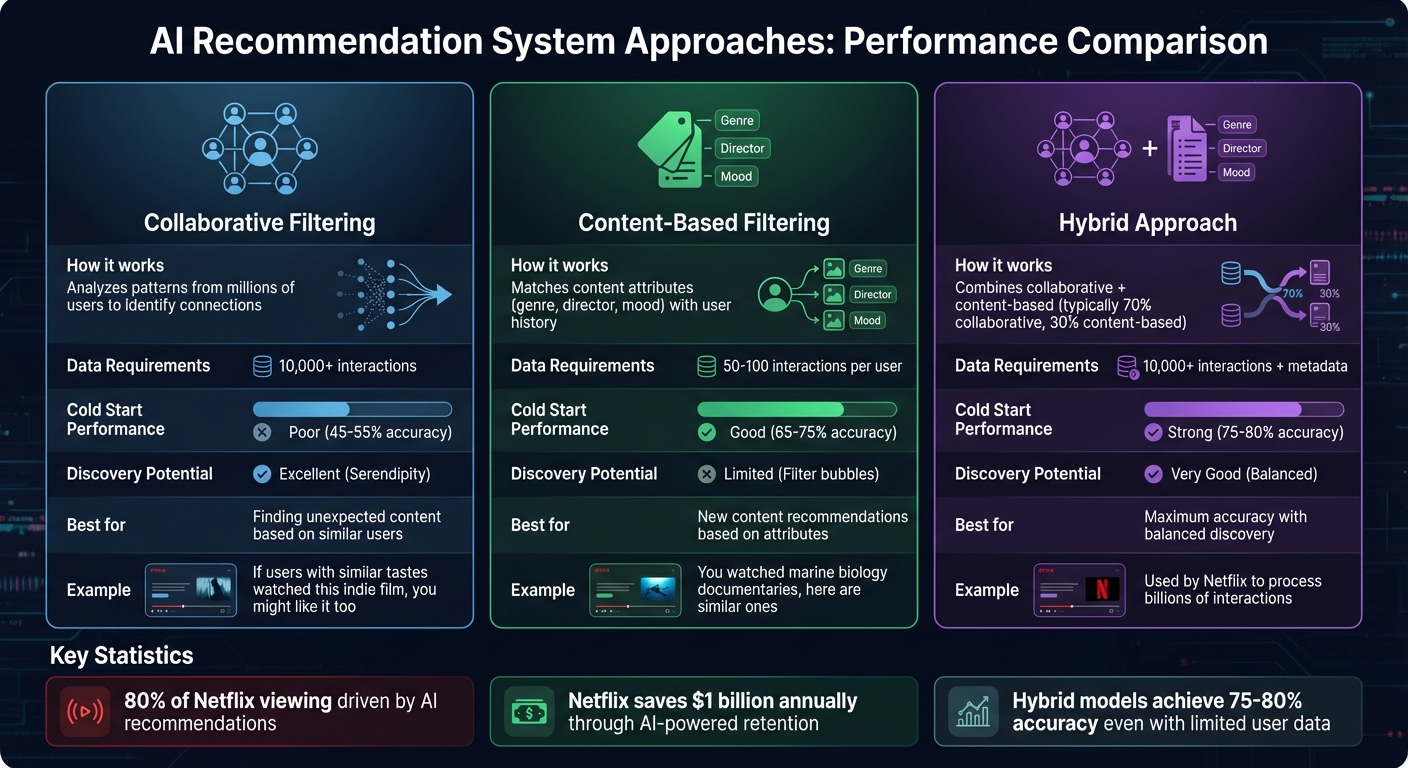
AI Recommendation System Approaches: Collaborative vs Content-Based vs Hybrid Models
AI has made it possible to connect niche content - like obscure documentaries, indie films, or underground music - to audiences who are most likely to enjoy them. Streaming platforms achieve this by combining several AI techniques, including collaborative filtering, content-based filtering, and hybrid models. These methods work together to ensure even the most hidden gems find their way to the right viewers.
Collaborative Filtering for Niche Discovery
Collaborative filtering operates on a straightforward idea: if two users share similar viewing habits, they’ll likely enjoy the same content in the future. By analyzing patterns from millions of users, the system identifies connections. For instance, if someone with tastes like yours watches a lesser-known film, the algorithm might suggest it to you.
This method comes in two forms: user-based filtering, which identifies users with similar preferences, and item-based filtering, which looks at content often consumed together. Behind the scenes, advanced tools like matrix factorization break down the massive web of user-item interactions into factors that uncover niche interests.
"The assumption is that people with similar viewing histories will continue to share similar tastes." - Nadcab
By shifting away from popularity-driven recommendations, collaborative filtering helps tailor content to individual preferences, turning even the most niche titles into potential discoveries.
Content-Based Filtering for Specific Interests
Content-based filtering focuses on the attributes that make each piece of content distinct. It matches these characteristics - such as genre, director, cast, mood, or even pacing - with a user’s viewing history. For example, if you’ve enjoyed several marine biology documentaries, the system might recommend others with similar metadata.
This process involves analyzing the features of each item, building a profile of your preferences, and matching new content to that profile. Techniques like TF-IDF identify important keywords in descriptions, while cosine similarity measures how closely new content aligns with your interests. This method is particularly helpful for solving the "cold start" problem, allowing new content to be recommended based on its attributes alone.
Platforms like Spotify take this a step further by analyzing audio signals - factors like danceability, energy, and mood - to recommend music that matches how you feel. Similarly, Disney+ uses franchise-driven clustering to recommend Marvel documentaries to superhero fans.
Hybrid Models for Better Accuracy
Hybrid models combine the strengths of collaborative and content-based filtering, addressing the weaknesses of each. By blending these approaches, platforms achieve greater accuracy and a more balanced recommendation system. Hybrid systems use various strategies, such as weighted combinations, cascading methods that rank and re-rank recommendations, or switching logic that adapts based on available user data.
"The magic happens when you combine multiple approaches, each compensating for others' weaknesses." - Emmanuel Nwanguma, Data Scientist
For instance, a hybrid system might weigh collaborative signals at 70% and content-based features at 30%. This balance typically achieves 75–80% accuracy, even for users with limited interaction data. In contrast, pure collaborative filtering might drop to 45–55% accuracy when data is sparse. Netflix’s recommendation engine is a prime example, processing billions of interactions while dynamically adjusting between metadata for new titles and collaborative insights for established ones.
| Approach | Data Requirements | Cold Start Performance | Discovery Potential |
|---|---|---|---|
| Collaborative Filtering | 10,000+ interactions | Poor (45–55% accuracy) | Excellent (Serendipity) |
| Content-Based Filtering | 50–100 interactions/user | Good (65–75% accuracy) | Limited (Filter bubbles) |
| Hybrid Approach | 10,000+ interactions + metadata | Strong (75–80% accuracy) | Very Good (Balanced) |
These models form the backbone of niche content recommendations. In the next section, we’ll explore how real-time personalization takes this process to the next level.
Real-Time Personalization in Streaming
Streaming platforms have mastered the art of tailoring content by analyzing your every move - whether it’s skipping an intro, pausing mid-episode, or simply hovering over a thumbnail. These systems focus on your behavior rather than relying on explicit ratings, like star reviews, because actions often reveal preferences better. Real-time personalization doesn’t just boost engagement; it also helps uncover niche content that aligns with your unique tastes.
Event-Driven Architecture for Instant Updates
To make these lightning-fast updates possible, streaming platforms rely on event-driven architecture, which processes user actions as they occur. For instance, back in November 2025, Netflix employed a real-time data pipeline powered by Apache Kafka for event streaming and Apache Flink for analytics. This setup ensured that user profiles updated within milliseconds of an action, like skipping an intro or hovering over a title, instantly reshaping homepage rows and "Continue Watching" lists.
"Profiles update within milliseconds, meaning recommendations adjust immediately." - Pavankumar Ponnaganti
Here’s how it works: Apache Kafka collects real-time user actions (like clicks or pauses), while tools such as Apache Flink or Spark analyze these streams on the fly. Meanwhile, NoSQL databases like Apache Cassandra store vast amounts of preference data with minimal lag. Microservices then coordinate through API gateways, ensuring the system stays functional even if one piece falters. This architecture has proven effective, with real-time tracking driving a 20% increase in completion rates for recommended titles.
Feedback Loops in Recommendation Systems
Feedback loops are what transform streaming platforms from static libraries into adaptive systems that evolve with each user interaction. Instead of relying on slower batch updates, these systems use reinforcement learning and bandit algorithms to test content and refine recommendations based on user engagement.
In December 2025, researchers Qiang Chen, Venkatesh Ganapati Hegde, and Hongfei Li from Tubi introduced an "Inference Time Feature Injection" method. By replacing outdated user data with recent watch history during recommendation inference, they managed to shrink the personalization feedback loop from daily updates to multiple updates within a single day. This change led to a measurable 0.47% improvement in user engagement metrics on Tubi’s ad-supported platform.
"Our approach selectively overrides stale user features at inference time using the recent watch history, allowing the system to adapt instantly to evolving preferences." - Qiang Chen, Tubi
These feedback loops also achieve a balance between exploration and exploitation - showing you familiar favorites while occasionally introducing unexpected content that might pique your interest. The system even adjusts recommendations based on contextual factors like your device, time of day, or session length. This means what you see on your phone during a quick lunch break could differ from what’s suggested on your TV later in the evening, even if you're using the same account.
Next, we’ll dive into how computer vision and natural language processing contribute to these dynamic recommendation systems.
Computer Vision and NLP in Content Recommendations
Streaming platforms don’t just rely on basic genre tags to make recommendations. They analyze every frame and word from their content catalog using computer vision and natural language processing (NLP). This combination allows them to understand visual and textual elements in-depth, tailoring recommendations for even the most niche audiences.
Using Computer Vision for Visual Content Analysis
Computer vision dives into video frames to uncover details like tone, style, and visual quality. For example, a single hour-long episode can generate tens of thousands of frames for analysis. Deep learning models then evaluate these frames for elements such as brightness, contrast, color palettes, shot angles, and even emotional expressions.
Netflix's Aesthetic Visual Analysis (AVA) is a standout example. This system analyzes every frame to pinpoint engaging visuals that influence both recommendations and thumbnail selection. Frames are tagged with metadata - like brightness, contrast, and skin tone - while composition is graded using principles like the "rule of thirds", symmetry, and depth of field. It also identifies faces and shot angles to assess the emotional tone of scenes.
"Netflix's most persuasive weapon for influencing a viewer's choice is thumbnail artwork." – Recosense Labs
This focus on visuals isn’t just for show; it directly impacts user behavior. Did you know that 82% of browsing time on streaming platforms is spent looking at thumbnail artwork? And users typically decide whether to click in just 1.8 seconds. Interestingly, thumbnails with more than three characters tend to perform worse in terms of engagement. Computer vision also helps platforms identify visual patterns, like unique cinematographic styles, that resonate with specific audience groups. By combining these insights, platforms can deliver recommendations that are not only visually appealing but also contextually aligned with users' preferences.
Natural Language Processing for Metadata Analysis
While computer vision handles visuals, NLP takes care of text-based data like titles, synopses, dialogue transcripts, and user reviews, often processed by top AI tools for writing and blogging. By analyzing this information, NLP can uncover microgenres that reflect specific tones, pacing, and themes. This allows platforms to make recommendations that feel more personal and precise.
NLP also processes user reviews and social signals to gauge audience sentiment. This makes it possible for users to discover content through natural language queries, such as “something intense but not too violent”.
Together, computer vision and NLP address challenges like the "cold start problem", where platforms need to categorize and recommend new content without prior viewing data. The effectiveness of these technologies is clear: over 80% of the content watched on Netflix is discovered through its AI-driven recommendations. These systems also have a financial impact, saving Netflix over $1 billion each year in customer retention.
Conclusion
AI is reshaping how streaming platforms connect audiences with the content they care about most. Modern algorithms now analyze factors like aesthetics, mood, and pacing to deliver tailored recommendations - even for niche genres. In fact, over 80% of Netflix viewing comes from AI-driven suggestions, with its recommendation engine saving the company more than $1 billion annually in customer retention.
This shift isn't just about boosting viewership numbers - it’s about capturing emotional and aesthetic resonance. AI-powered systems can now surface niche genres, such as experimental anime or indie dramas, up to five times faster than traditional recommendation methods. The result? Less time searching and more time enjoying content that feels deeply personal.
The potential for personalization is only growing. The global recommendation engine market is expected to skyrocket from $5.39 billion in 2024 to $119.43 billion by 2034. Emerging advancements include conversational search interfaces capable of handling complex queries, AI-generated trailers that align with individual tastes, and even biometric tools that adjust recommendations based on a viewer's emotions in real time.
"AI isn't just supporting the streaming experience - in some ways it's becoming the experience." - Applause
However, the path forward comes with challenges. Platforms must not only embrace AI but also address concerns like filter bubbles, algorithmic bias, and data privacy. As Adrian Garcia from Applause emphasizes:
"Successful streaming platforms won't necessarily be the ones that adopt AI soonest. They'll be the ones that deploy it thoughtfully, with a clear focus on quality, accessibility and trust."
For niche creators and audiences, this AI-driven evolution means better discovery, deeper engagement, and a streaming experience that feels genuinely personal. By deploying AI thoughtfully, platforms can continue to refine how they connect viewers with the stories that matter most.
FAQs
How do streaming apps know what I’ll like?
Streaming apps rely on AI-powered recommendation systems to guess what you’re likely to enjoy next. These systems dig into your viewing habits, search history, watch times, the devices you use, and even how you interact with content. All this data helps build a detailed profile of your preferences. Using machine learning algorithms, the app compares your profile to its library of content, constantly tweaking and improving its suggestions.
Take Netflix, for example. Its AI system influences over 80% of user views by delivering highly personalized recommendations. This approach not only keeps viewers engaged but also helps the platform retain its audience by offering content that feels tailor-made.
How do AI recommendations find niche titles?
AI systems suggest niche titles by diving deep into user behavior, preferences, and content metadata to pinpoint specific interests. Using advanced algorithms - like neural hybrid models - they analyze viewing habits, search patterns, and subtle behavioral cues to build detailed user profiles. These profiles allow platforms to recommend lesser-known content that aligns with individual tastes, making it easier for niche audiences to discover and engage with content that resonates with them.
Can I reduce tracking without losing personalization?
Yes, it’s possible to reduce tracking while still delivering personalized experiences. By leveraging implicit behavioral data - like clicks, time spent on pages, or general interaction patterns - and combining it with advanced AI models, you can create accurate recommendations. This approach minimizes the need for intrusive tracking while keeping user engagement high.