Machine learning transforms how businesses analyze customer journeys by automating data collection, predicting behaviors, and identifying pain points. Unlike manual methods, it processes vast amounts of data in real-time, offering actionable insights that improve conversions, retention, and customer satisfaction.
Key benefits include:
- Predictive Path Modeling: Forecasts customer actions and highlights effective conversion paths.
- Behavioral Segmentation: Groups customers by behavior instead of demographics for better targeting.
- Churn Prediction: Detects at-risk customers using engagement data and sentiment analysis.
With tools like Adobe Customer Journey Analytics and Fullstory, businesses can streamline processes, reduce churn, and boost revenue. Start by unifying data sources, setting up machine learning pipelines, and focusing on high-impact areas like purchase funnels or onboarding processes.
A Deeper Dive Into AI-Powered Journey Mapping
This video explores how visual mapping identifies friction points, a process that can be further enhanced by applying AI content optimization techniques to ensure every touchpoint resonates with the user's intent.
sbb-itb-a759a2a
How Machine Learning Improves Customer Journey Analytics
Machine learning brings a new level of precision to customer journey analytics by leveraging three main capabilities: predictive path modeling, behavioral segmentation, and churn prediction with anomaly detection.
Predictive Path Modeling
Machine learning algorithms can analyze both historical and real-time data to predict customer behaviors, uncovering non-linear paths where users skip stages or take unexpected routes. Through techniques like sequence mining, these algorithms identify "golden paths" - the most effective series of touchpoints that lead to conversions.
For example, as customers navigate your site, ML tools process session data such as search queries, browsing habits, and cart activity to predict their next steps and conversion likelihood. This insight allows businesses to take immediate action, like addressing cart abandonment or optimizing funnel drop-off points. Companies leveraging AI for customer experience have reported revenue increases of up to 25%.
In addition to forecasting paths, machine learning reveals deeper patterns in customer behavior.
Behavioral Segmentation
Using unsupervised learning algorithms, machine learning groups customers based on behavior - like purchase habits, session lengths, or click-through rates - rather than relying on traditional demographic data. Methods such as k-Means or DBSCAN automatically form these clusters without requiring predefined categories.
A popular framework for this segmentation is RFM analysis:
- Recency: How recently did the customer make a purchase?
- Frequency: How often do they buy?
- Monetary: How much do they spend?
Machine learning simplifies complex datasets, sometimes reducing 12 behavioral predictors into just three main components while still explaining 80% of the variance using Principal Component Analysis (PCA). These segments are updated regularly - monthly or quarterly - and can be directly integrated into tools like Google Marketing Platform for instant use in campaigns.
Once the behavioral segments are clear, machine learning plays a crucial role in predicting churn and identifying anomalies.
Churn Prediction and Anomaly Detection
Supervised machine learning models analyze data like purchase history, support interactions, and engagement metrics to predict churn. Natural Language Processing (NLP) complements this by identifying sentiment changes in customer reviews or chats, which often indicate dissatisfaction. This approach enables "anticipatory customer service", addressing issues before they escalate.
Anomaly detection adds another layer of protection by spotting irregular patterns, such as sudden drops in engagement, unexpected spikes in cart abandonment, or disruptions in service. These insights are driving growth in the customer journey analytics market, which is expected to expand at a 20.8% CAGR from 2023 to 2028. Moreover, 71% of businesses plan to invest in AI-powered customer journey analytics within the next two years.
How to Implement Machine Learning in Customer Journey Analytics
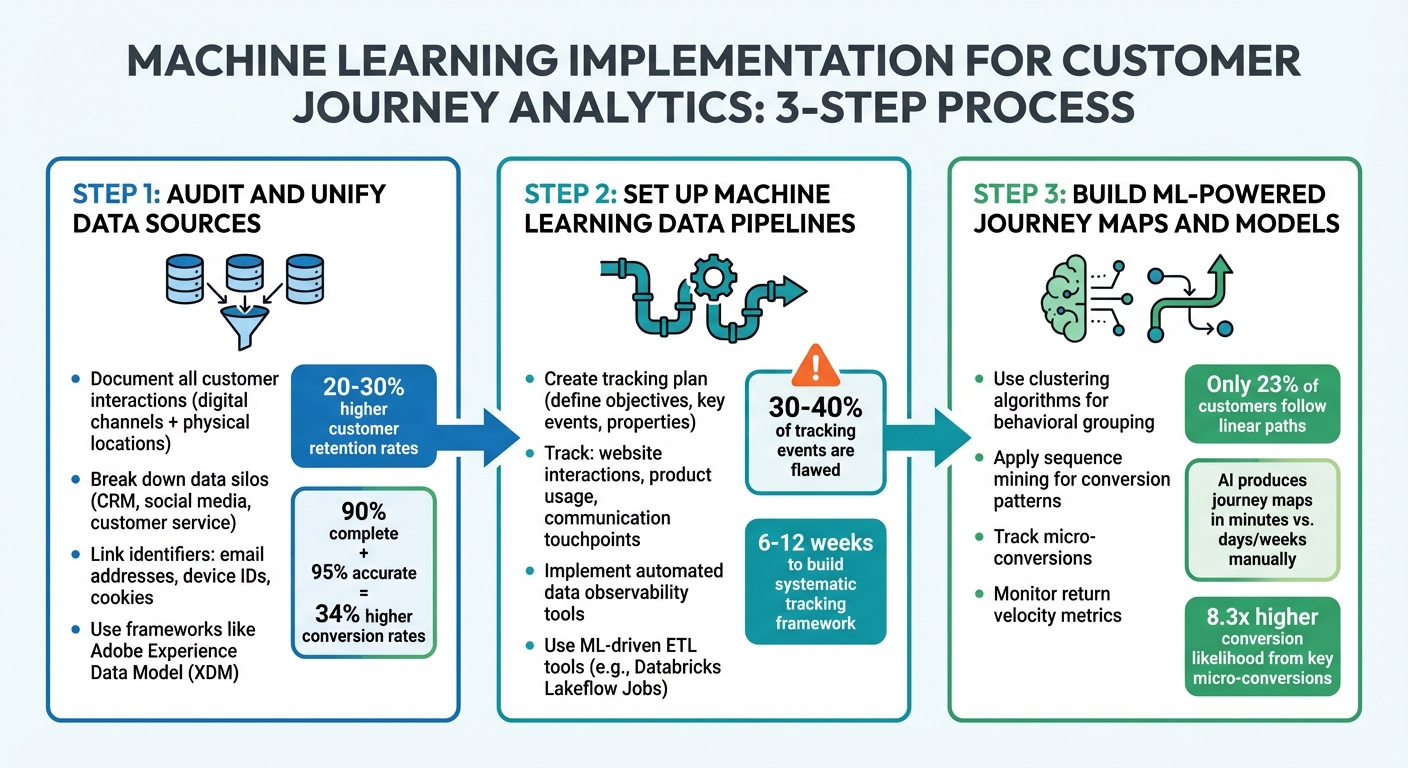
3-Step Process to Implement Machine Learning in Customer Journey Analytics
Using machine learning (ML) in customer journey analytics can turn raw data into insights that drive better conversions and stronger customer retention. To make this work, starting with high-quality data and reliable infrastructure is critical. Research shows that companies with data that's 90% complete and 95% accurate can achieve 34% higher conversion rates and analyze data 60% faster. Below is a practical guide for marketers and content creators looking to integrate ML-powered analytics into their strategies.
Step 1: Audit and Unify Data Sources
The first step is to document every customer interaction. This includes both digital channels like websites and mobile apps, as well as physical locations such as in-store sensors and point-of-sale systems. A common challenge here is data trapped in silos - CRM tools, social media platforms, and customer service logs often operate independently without sharing information.
"Integration occurs through customer data platforms (CDPs) or data warehouses that unify these disparate sources, resolving identity mismatches across silos to create what industry practitioners call a 'single source of truth.'" - CleverX
The goal is to link identifiers like email addresses, device IDs, and cookies to create unified customer profiles. Using frameworks like the Adobe Experience Data Model (XDM) helps maintain consistent data structures across all sources. Additionally, implementing a robust data governance framework ensures all data meets quality and validation standards before it's used for ML analysis. Companies that excel in journey analytics often see 20% to 30% higher customer retention rates.
Once data sources are unified, the next step is setting up efficient data pipelines for machine learning.
Step 2: Set Up Machine Learning Data Pipelines
A tracking plan is essential to define your business objectives, key events (e.g., Trial Started), and event properties while maintaining consistent naming conventions. This plan keeps your data collection focused and reduces "noise" that can lower the accuracy of ML models. Tracking should cover website interactions, product usage (e.g., feature adoption), and communication touchpoints like email opens and support tickets.
However, tracking accuracy can be an issue. Studies show that 30% to 40% of tracking events are often flawed due to broken pixels, tagging errors, or schema mismatches. To address this, use automated data observability tools that monitor pipelines around the clock. These tools can send alerts through platforms like Slack or Microsoft Teams when crucial events fail to track properly. ML-driven ETL (Extract, Transform, Load) tools, such as Databricks Lakeflow Jobs, can automate the cleaning, normalization, and preparation of cross-channel data.
Building a systematic tracking framework - including identity architecture and data integration - usually takes 6 to 12 weeks. Once this is in place, you can move on to creating machine learning-powered journey maps.
Step 3: Build ML-Powered Journey Maps and Models
Instead of relying on demographic assumptions, use clustering algorithms to group customers based on their actual behaviors - like viewing pricing pages, downloading resources, or connecting integrations. Sequence mining can highlight the most common patterns and non-linear paths customers take toward conversion. Pay attention to micro-conversions, such as connecting a software integration shortly after signup, which can signal a conversion likelihood that's 8.3 times higher than average.
"The best customer journey map is the one that helps you understand your customers better and market to them more effectively. Everything else is just pretty pictures on conference room walls." - Snowgraphs
Manual journey mapping can take days or even weeks, but AI can analyze data and produce journey maps in just minutes. Often, this analysis reveals that only 23% of customers follow the "ideal" linear path that marketing teams expect. Another key metric to track is "return velocity", which measures the time between a customer's first and second interaction. This can strongly predict long-term retention. Start by focusing on a high-impact stage of the journey, such as evaluation-to-purchase, to test and refine your framework before scaling it across the entire customer lifecycle.
Machine Learning Tools for Customer Journey Analytics
When selecting a machine learning tool for customer journey analytics, it's essential to consider your team's expertise, budget, and the complexity of your data. Larger teams often require omnichannel platforms, while smaller teams can benefit from tools with features like autocapture for easier setup and use. Below are some standout tools and their capabilities that can simplify analytics while boosting efficiency.
Natural language interfaces are a game-changer. These allow marketers to ask straightforward questions like, "Why did cart abandonment spike last week?" and get AI-driven answers. Tools like Adobe's AI Assistant and Improvado's AI Agent offer this feature, making complex data easier to understand for non-technical users. A 2023 Forrester survey found that 59% of data and analytics leaders using AI technologies reported notable cost savings in their operations.
Automated anomaly detection is another critical feature. It identifies significant changes, such as sudden drops in conversion rates or unexpected spikes in page views, without requiring manual monitoring. Adobe Customer Journey Analytics includes a "Contribution Analysis" feature, which not only detects anomalies but also uncovers their causes - like a specific browser or region contributing to the issue. Similarly, Fullstory's StoryAI highlights "frustration signals", such as rage clicks, and provides summaries of multi-session struggles. In 2024, JetBlue's Manager of IT Digital Operations shared that StoryAI's summaries eliminated hours of manual session reviews, allowing the team to resolve friction points more efficiently.
For teams with tighter budgets, affordable options are available. PostHog offers a free tier with up to $50,000 in credits for eligible startups, Plausible starts at $9 per month, and Umami provides free cloud hosting for up to three sites and 100,000 events. As of October 2024, Google Analytics remains the most widely used tool, with 489,524 deployments among the top 1 million websites, far outpacing competitors like Matomo (20,816 deployments) and PostHog (5,330 deployments).
Tool Comparison Table
Here’s a quick comparison of some leading tools and their key AI capabilities:
| Feature | Adobe Customer Journey Analytics | Fullstory | Improvado | PostHog |
|---|---|---|---|---|
| Primary ML Focus | Generative AI insights, attribution, forecasting | Behavioral sentiment analysis, session summaries | Data unification, automated pipelines | Autocapture, A/B testing, trend analysis |
| Key AI Tool | AI Assistant / Adobe Sensei | StoryAI | AI Agent | Analysis Suggestions / Autocapture |
| Data Integration | High (omnichannel: POS, call center, web, app) | High (full digital interaction capture) | 500+ marketing and sales platforms | Managed ETL to data warehouses |
| Best For | Enterprise marketers and analysts | Product and IT operations teams | Agencies and global brands | Engineers and product teams |
| Pricing | Enterprise (custom pricing) | Enterprise (custom pricing) | Enterprise (custom pricing) | Free tier available; $50K startup credits |
Conclusion and Next Steps
Machine learning (ML) has the power to transform static analytics into actionable, dynamic insights. Instead of relying on theoretical models, ML systems analyze real-world data from every interaction - predicting customer churn, improving conversion paths, and enabling real-time personalization.
Here's the reality: companies with faster growth generate 40% more revenue from personalization efforts, and 80% of consumers are drawn to brands that deliver tailored experiences. With the customer journey analytics market expected to hit $48.40 billion by 2030, businesses that embrace ML today position themselves for a distinct advantage.
Key Takeaways
Switching from traditional methods to AI-powered analytics produces tangible results. For example, ML-powered journey maps can cut first-day churn by 25%, while multi-touch attribution models drive a 15% increase in qualified leads without additional ad spending. As Ameya Deshmukh of Everworker.ai explains, AI transforms static data into dynamic, actionable insights by unifying information across systems.
These results not only highlight the potential of ML but also underscore the urgency of taking action now.
Getting Started
Start small but aim for impact. Begin by auditing your existing data sources to create a unified dataset. Identify a specific pain point, such as improving trial-to-paid conversion rates or reducing onboarding drop-offs, and aim to show measurable results within 30–60 days. To train your ML models effectively, gather at least 60–90 days of behavioral data.
For help translating complex insights into clear, actionable reports, tools like those listed in the AI Blog Generator Directory (https://aibloggenerators.com) can simplify the process with features like SEO optimization and automated content creation.
Lastly, don't skip human oversight. While AI generates valuable insights, it can sometimes produce overly complex or generic outputs. Combine machine-driven data with feedback from teams on the ground and actual customer input. The real challenge isn’t adopting ML - it’s how quickly you can make it a functional part of your operations.
FAQs
What data do I need before using ML for journey analytics?
To effectively apply machine learning to journey analytics, it's crucial to gather comprehensive data on customer interactions across all channels. This means collecting logs from multiple touchpoints, such as social media activity, advertisement interactions, website visits, and app usage. Additionally, understanding behavioral patterns and the context behind these interactions is key.
The goal is to map out the entire customer journey - from the first point of contact all the way to conversion. By doing this, you ensure that your models are built on real customer behavior, avoiding reliance on assumptions and leading to more accurate and actionable insights.
How do I pick the first journey stage to model with ML?
Begin by defining your objectives - what exactly do you want to achieve? Once that's clear, map out the customer journey to identify the moments that matter most. This means digging into your data to find the stages where customers tend to lose interest or drop out entirely.
Why focus here? These points of disengagement often offer the best opportunities for applying machine learning. By targeting these critical moments, you can make meaningful improvements to the customer experience and guide them more smoothly through their journey.
How can I trust ML insights without over-automating decisions?
To make the most of machine learning (ML) insights without relying too heavily on automation, it's essential to strike the right balance. Combine the strengths of ML outputs with human judgment. Start by setting clear objectives for what you want to achieve, and regularly monitor how your models are performing. Human oversight plays a key role in validating the insights produced by ML systems.
It's also important to acknowledge the limitations of ML, such as potential biases in data or algorithms. Incorporating feedback loops can help refine decisions, ensuring they remain ethical and sensitive to context. This measured approach allows you to harness ML's capabilities while keeping critical decisions grounded in human oversight and control.