Are your AI tools for writing worth the investment? To find out, you need to measure its ROI (Return on Investment). Here's a quick breakdown:
- ROI Formula:
(Incremental Profit + Cost Savings − AI Program Cost) ÷ AI Program Cost. - AI Benefits: Saves time, boosts productivity, improves content quality, and enhances SEO with AI optimization. For example, AI can cut blog writing time from 6 hours to 1.5 hours.
- Costs to Track: Monthly subscriptions, usage fees, setup expenses, and ongoing human oversight.
- Gains to Measure: Time saved, increased content output, better SEO rankings, and revenue growth.
Companies using AI have seen measurable results, like a 15% EBIT contribution or a 650% ROI in content marketing. By tracking costs, benefits, and performance over time, you can determine if AI tools are delivering real value to your workflow.
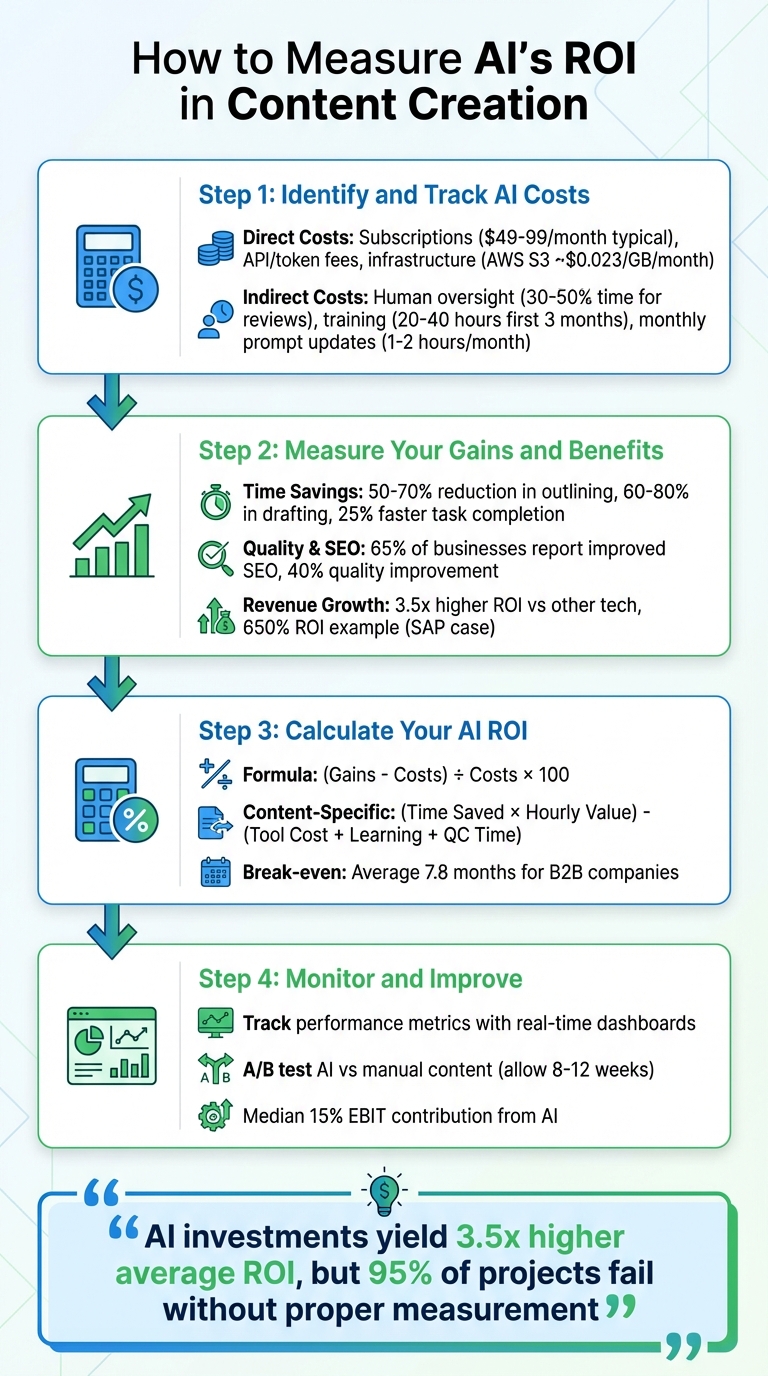
4-Step Process to Calculate AI Content Creation ROI
Step 1: Identify and Track AI Costs
Direct Costs of AI Tools
The most obvious expenses are subscription fees and licensing costs. These are the charges that show up on your credit card every month. For instance, Jasper starts at $49 per month for up to 50,000 words, while PilotPress costs between $49 and $99 per month depending on the plan. Microsoft 365 Copilot is priced at $30 per user per month.
However, subscriptions are only part of the picture. Many AI tools use usage-based pricing, which means you're charged per "token" (a unit of processed text). This can cause your monthly costs to vary based on how much you use the tool. Additionally, there are infrastructure costs to consider, such as cloud storage (e.g., AWS S3 at around $0.023 per GB per month) and specialized databases if you're running a custom AI setup.
Don’t forget about one-time implementation costs. These include setting up automated workflows, integrating AI tools with your CMS, and creating custom prompts. While these costs may not recur, they can be significant upfront investments.
Indirect Costs of AI Integration
AI isn't entirely hands-free - there are hidden costs that can add up quickly. Even though AI speeds up processes, human oversight remains critical for tasks like fact-checking, aligning tone, and conducting legal reviews. Employees may need 20–40 hours during the first three months to get comfortable with crafting effective prompts. For high-stakes content, expect a 30%–50% time commitment for thorough reviews.
You’ll also likely experience a temporary drop in productivity during the initial adjustment phase. On top of that, plan for ongoing costs like monthly prompt updates to keep up with evolving brand standards. This can take 1–2 hours per month per employee.
How to Organize Your Costs
To keep everything in check, it’s crucial to organize your expenses. A simple spreadsheet can do the trick. Use separate tabs for baseline assumptions, costs, and benefits. Named ranges like labor_rate_fully_loaded or seat_price_month can make auditing much easier.
| Cost Category | What to Track | Where to Find It |
|---|---|---|
| Software/SaaS | Monthly subscriptions, seat licenses, add-ons | Credit card statements, vendor invoices |
| Usage/API | Token fees, per-use charges, credit purchases | Vendor dashboards, usage reports |
| Infrastructure | Cloud hosting, storage, vector databases | AWS/Azure/Google Cloud bills |
| Implementation | Integration work, prompt setup, workflow automation | Project time logs, consultant invoices |
| Labor | Human editing, QA time, training hours | Time tracking software, workflow audits |
Before implementing AI, track your "pre-AI" baseline costs for at least a week. Measure how much time research, drafting, and formatting take for each type of content using online content writing tools. This will give you a clear comparison point to evaluate AI's impact. Also, since AI pricing can change frequently, review vendor pricing monthly to keep your cost assumptions up to date. A well-structured tracking system is key to understanding AI’s ROI and its effect on your workflow.
sbb-itb-a759a2a
How to measure the ROI of AI using Asana’s 4-step framework
Step 2: Measure Your Gains and Benefits
After tracking costs, the next logical step is to measure the benefits AI brings in terms of time, quality, and revenue.
Time Savings and Efficiency Gains
AI can dramatically reduce the time spent on tasks like outlining and drafting. For instance, outlining time can drop by 50–70%, while drafting time may decrease by 60–80%. A study conducted by MIT and BCG in 2023 revealed that AI tools helped knowledge workers complete tasks 25% faster while improving the quality of their work by over 40%.
Take the example of Sarah, a marketing consultant. By incorporating AI into her workflow in January 2026, she cut her document creation time from 62 hours to 34 hours per month. Even after dedicating 8 hours to quality control, she achieved a 32% time saving, translating to $1,570 in monthly value.
This efficiency boost doesn’t just save time - it allows teams to produce significantly more content. With AI, organizations can double their output and create up to 10 times more variations for testing and personalization. This means you can experiment with different angles, test multiple headlines, and tailor content for various audience segments - all without stretching your team too thin.
These time and efficiency gains pave the way for better content quality and improved search performance.
Better Content Quality and SEO Results
AI tools can elevate content quality by incorporating features like keyword research, readability analysis, and SEO integration directly into the workflow. Around 65% of businesses report improved SEO results when using AI tools. To make the most of these tools, focus on key metrics like keyword rankings, organic traffic growth, and the speed at which new content gets indexed.
For example, a baby products brand partnered with SEO consultant Ankit Prajapati from May to December 2025. Using AI-driven research, they targeted non-branded search queries, leading to a 79.7% year-over-year revenue increase from organic traffic. Similarly, a global CPG brand adopted an AI-powered workflow for SEO articles in late 2024. The results? Content production became three times faster, costs per asset dropped by 25%, and AI-optimized landing pages saw an 18% conversion rate improvement.
It’s also important to monitor the "Edit Rate" - the percentage of AI-generated content that requires significant human revisions. A high edit rate might signal the need for better prompts or a different strategy. Additionally, as search algorithms evolve, keep track of how AI-generated content performs in terms of brand citations and mentions, which are becoming increasingly important alongside traditional click-through rates.
Improved content quality and SEO don’t just enhance visibility - they also contribute directly to revenue growth.
Revenue Growth from AI-Optimized Content
At the end of the day, the ultimate measure of AI’s impact is its effect on your bottom line. Studies show that AI initiatives can deliver noticeable EBIT gains, and investments in AI and machine learning yield 3.5 times higher average ROI compared to other technology categories.
Consider SAP SE. Under Michael Brenner’s leadership as VP of Content Marketing, the company used AI-driven research to tackle "big-picture" questions. In just one year, they spent $100,000 on content marketing, generating 1,000 leads and $750,000 in revenue - a 650% ROI. Another example is Capgemini, which launched a storytelling website that attracted 100,000 LinkedIn followers and generated $1 million in sales in its first year. By the second year, revenue climbed to $5 million, eventually reaching $20 million annually.
To track these kinds of outcomes, tag all AI-assisted content in your CMS so you can compare its performance against human-generated content. Use attribution models that account for AI-generated content’s role in the customer journey, even if it wasn’t the final touchpoint before conversion. For instance, a mid-market fintech platform implemented an AI-first content pipeline where large language models (LLMs) drafted 80% of their long-form content. This approach led to a 30% reduction in annual content costs, a 40% increase in publication speed, and a 22% year-over-year growth in organic sessions. On average, B2B companies achieve ROI break-even within about 7.8 months of starting their AI initiatives.
Step 3: Calculate Your AI ROI
Once you've tracked your costs and measured your benefits, it's time to put it all together and calculate your ROI.
The ROI Formula for Content Creation
The basic ROI formula is: (Gains - Costs) ÷ Costs × 100. This calculation gives you a percentage that reflects how much return you're getting for every dollar spent. For example, if you spend $1,000 and gain $4,000 in value, your ROI comes out to 300%.
For content-specific workflows, you can tweak the formula to include factors like time savings and quality control:
Net ROI = (Time Saved × Hourly Value) - (Tool Cost + Learning Investment + Quality Control Time).
This version helps account for hidden costs, such as the hours spent training on AI tools or reviewing AI-generated content. If your focus is marketing content that generates revenue, you might use this formula:
(Traffic × Conversion Rate × Average Order Value) - Production Cost.
"ROI is simple: (Return − Cost) ÷ Cost. The complexity comes from separating baseline performance from AI-driven lift and accounting for all inputs with audit-ready rigor."
– Single Grain
To get meaningful results, start with a clear baseline of your pre-AI performance. This could be metrics like time spent per asset, cost per lead, or organic traffic. Once you have that, you can apply these formulas using the data you've gathered.
How to Apply the Formula
Use your baseline metrics from Step 1 to make accurate comparisons. To calculate your hourly value, divide your annual salary by your total working hours for the year. For example, if you earn $75,000 annually and work 2,080 hours, your hourly value is about $36.
Now, add up all AI-related costs. This includes subscriptions (tools like Microsoft Copilot often cost around $30 per month), training time (estimate 20–40 hours in the first three months), and quality control efforts. On the benefits side, multiply your time savings by your hourly value and include any revenue gains from better-performing content. Keep in mind that not all saved time is fully productive - apply a productivity coefficient of 60–80% to reflect this.
To calculate your break-even point, use this formula: (Learning Investment + First Month Tool Cost) ÷ Monthly Net Benefit. Research shows that B2B companies typically reach break-even on AI investments in about 7.8 months.
Using the AI Blog Generator Directory for ROI Tracking
Automated analytics can make ROI tracking much easier. The AI Blog Generator Directory lists advanced AI tools for blog content creation that include built-in analytics and CMS integration. These features allow you to track metrics like organic traffic, keyword rankings, and engagement rates in real time. With a comprehensive dashboard view, you can monitor your ROI without manually pulling data from multiple sources. This lets you identify which tools deliver the best results, helping you refine your strategy and optimize your AI-driven workflows.
Step 4: Monitor and Improve Your AI ROI
Once you've analyzed costs and benefits, the next step is keeping a close eye on your AI's performance. AI is not a "set it and forget it" tool. Its effectiveness changes over time as the tools improve, your business needs shift, and market dynamics evolve. To get the best return on investment (ROI), you need to monitor and adjust regularly.
Track Performance Metrics Over Time
Set up real-time dashboards to monitor how your AI-generated content performs. By linking your content creation tools to analytics platforms, you can quickly identify trends and make informed decisions. For example, tagging AI-created content separately in your CMS allows you to compare its performance directly with manually created content, giving you a clear picture of what's working and what isn't.
Schedule monthly reviews to track long-term performance and share updates with stakeholders. Use dashboards with automated alerts to flag top-performing content or underperforming pieces that need attention. When you notice patterns - like specific headlines driving more clicks or certain formats leading to better conversions - apply those insights to future prompts and templates.
Here's a telling statistic: marketing and sales leaders report that AI contributes a median 15% of their EBIT. However, as of April 2025, only 1% of companies using generative AI had achieved measurable ROI. The difference? Companies that consistently monitor and refine their approach.
Next, compare AI-generated content with manually created pieces to uncover the strategies that deliver the biggest impact.
A/B Test AI-Generated Content
A/B testing is a powerful way to evaluate the effectiveness of AI-generated content. Create two versions of similar topics - one with AI and one manually written - and compare their performance. Focus on high-impact areas like headlines, email subject lines, and social media copy to see which approach drives better engagement.
To get accurate results, control as many variables as possible. For example, publish AI and non-AI content under similar conditions, or test in batches - first without AI, then with AI - while keeping everything else constant.
Patience is key. Allow 8–12 weeks for SEO indexing and the compounding effects of evergreen content to show significant results. Be mindful of "post-novelty dips", where initial performance spikes may fade. A 90-day evaluation period can help confirm whether gains are sustainable or just short-term excitement over a new tool.
Use these findings to fine-tune your AI strategy.
Keep Improving Your AI Workflow
Pay attention to usage data to identify what’s working and what needs improvement. Study the teams achieving the best results with AI and share their methods with others who may be struggling. This is crucial - 31% of employees admitted to deliberately hindering AI efforts in a recent survey, showing that effective change management is essential.
Track model quality metrics like accuracy, tone consistency, and the frequency of errors to ensure your AI aligns with your brand. Implement staged approvals based on the level of risk. For example, social media posts might auto-publish after a quick review, while whitepapers might require sign-off from legal and executive teams. Tools listed in the AI Blog Generator Directory can help automate these processes with built-in quality controls and CMS integrations.
Consider this real-world example: In May 2024, TechVenture automated its content production, cutting blog creation time from 12 days to just 18 hours. This reduced costs by over 70%, boosted organic traffic by 340%, and generated $2.1 million in additional pipeline revenue.
"The ROI calculation that convinced our CFO wasn't the cost savings - it was showing that we could produce 3x more content without hiring. That turned content from a cost center into a growth driver."
– CMO, TechVenture
The time saved through automation can be redirected to high-value tasks like brainstorming new ideas, building relationships, and planning strategic campaigns. Schedule monthly reviews with your finance team to evaluate your progress and adjust your goals as needed. By consistently monitoring and refining your approach, you can turn AI from a one-time investment into a long-term advantage.
Conclusion
What to Remember
Tracking the ROI of AI in content creation boils down to carefully analyzing both costs and benefits to uncover the true value of your investment. Start by listing all expenses - like tool subscriptions, API fees, training, and quality control. Then, evaluate your gains by looking at time saved, improved content performance, SEO rankings, and revenue growth. Using the ROI formula will give you a clear percentage to determine if your AI investment is working as intended. This straightforward approach aligns with the steps outlined earlier.
Here's what the data shows: AI investments often yield 3.5x higher average ROI. However, 95% of AI projects fail to meet expectations because many companies rely on outdated methods to measure success. The key to achieving success lies in thorough tracking that goes beyond just time savings, factoring in flexibility, creativity, and customer engagement.
Keep monitoring your results consistently and allow at least 8–12 weeks to fully capture the impact of AI on content ROI. This time frame accounts for compounding effects like improved SEO rankings and the lasting value of evergreen content. Conduct A/B tests to compare AI-generated content with manually created pieces, and use the findings to refine your prompts, templates, and workflows. According to one report, marketing and sales leaders now attribute a median 15% of their EBIT directly to AI adoption.
With these strategies in mind, choosing the right tools becomes a critical step.
How the AI Blog Generator Directory Can Help
To maximize the benefits of AI in content creation, a focused resource can simplify the process. The AI Blog Generator Directory is designed to help you efficiently select and optimize AI tools for your workflow. By offering curated comparisons of tools with high-ROI features - such as SEO optimization tools, CMS integration, automated keyword research, and quality controls - it minimizes the trial-and-error process. This approach helps you avoid "tool sprawl" and unnecessary subscription costs that can eat into your returns.
The directory also saves you the 20–40 hours typically required to learn new AI tools, enabling faster profitability. Tools with built-in human-in-the-loop governance and brand voice alignment ensure you maintain quality while reducing revision cycles. For context, AI-generated content costs around $131 per blog post, compared to $611 for traditional production methods. Whether you need fully automated writing tools, SEO analytics, or multi-language support, the directory helps you identify features that align with your business goals and ROI tracking.
FAQs
How do I set a pre-AI baseline for content ROI?
To establish a baseline for content ROI before introducing AI tools, start by pinpointing key performance indicators (KPIs). These might include metrics like time spent per deliverable, content quality, engagement levels, or conversion rates. Collect this data beforehand so you have a clear reference point for comparison once AI is implemented. Without these pre-AI metrics, it becomes challenging to evaluate ROI effectively. The goal is to gather measurable and reliable data that can clearly highlight improvements and showcase how AI impacts your content creation process.
What hidden AI costs should I include in ROI?
When figuring out AI ROI, don't overlook the hidden costs that can quickly inflate your budget. These often include infrastructure upgrades, managing billing complexities, and additional charges that go beyond standard subscription fees. In some cases, these expenses can reach 200–300% of your initial estimate. Careful planning is key to keeping these surprises in check.
How can I prove AI content drives revenue, not just time savings?
To understand how AI-driven content affects revenue, focus on tracking metrics such as leads generated, sales conversions, and long-term profitability tied to AI-assisted efforts. Then, compare these outcomes against the expenses involved in adopting and using AI tools. This approach helps reveal whether AI is driving tangible financial growth, not just offering time-saving benefits.