Voice dictation has transformed how writers work, thanks to advancements in Natural Language Processing (NLP). Modern systems now deliver 97–99% accuracy, far exceeding the 70–80% rates of earlier tools. With the ability to transcribe speech at speeds of over 200 words per minute, NLP-powered dictation tools are helping writers create content up to 4x faster than typing. These tools also handle punctuation, filter filler words, and distinguish homophones through context.
Here’s how NLP makes this possible:
- Automatic Speech Recognition (ASR): Converts speech into text with high precision, even in noisy environments.
- Context-Aware Language Modeling: Ensures transcriptions are accurate by analyzing grammar and sentence structure.
- Transformer Models: Enable multilingual support and advanced features like automatic punctuation.
Top AI tools for writing like Dragon Professional, Willow, and Notta cater to different needs, from specialized vocabularies to real-time transcription and multilingual support. Writers also benefit from features like tone adjustment, custom dictionaries, and faster workflows that reduce mental strain. With NLP, dictation has become a reliable and efficient method for producing polished, accurate content.
The Most Accurate Speech-to-text APIs in 2025
sbb-itb-a759a2a
Core NLP Techniques in Voice Dictation
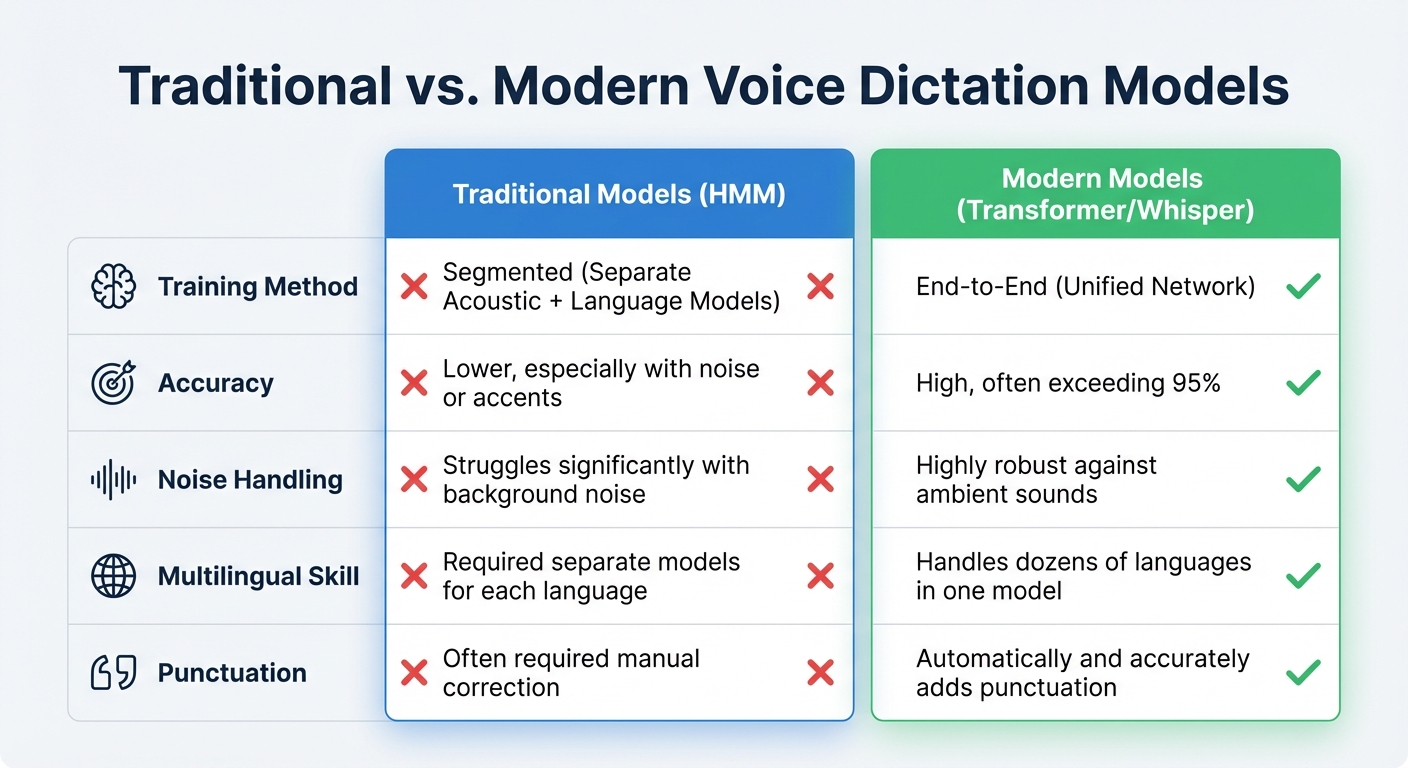
Traditional vs Modern NLP Voice Dictation Models Comparison
Modern voice dictation systems rely on unified neural networks to transform spoken words into polished text. These techniques are the backbone of tools that not only transcribe speech but also understand its meaning, enabling writers to work more efficiently with the best online content writing tools.
Automatic Speech Recognition (ASR)
At the heart of voice dictation lies Automatic Speech Recognition (ASR), the technology that converts spoken language into text. The process begins with cleaning the audio to remove background noise. Then, the system translates sound waves into log-mel spectrograms, which mimic how humans perceive sound. These spectrograms allow the AI to "visualize" audio patterns in a way similar to how image models process pictures.
ASR technology has evolved significantly. Older "Traditional Hybrid" models required separate components for lexicon, acoustic, and language processing. Today, End-to-End AI models use a single neural network to map audio features directly to words. This streamlined approach has eliminated the need for manual alignment by phoneticians, leading to significant accuracy improvements. For example, OpenAI's Whisper large-v2 model achieves a Word Error Rate (WER) of about 3.0% on the LibriSpeech test-clean benchmark, while NVIDIA's Canary model has reduced it to just 1.6% as of February 2026.
"Aside from being applied in language models, NLP is also used to augment generated transcripts with punctuation and capitalization at the end of the ASR pipeline." - Sirisha Rella, Technical Product Marketing Manager, NVIDIA
One tip: use "Prompting" to help the model handle niche terms or acronyms. Providing context or a list of technical words can improve recognition accuracy for specialized content.
Context-Aware Language Modeling
After ASR converts speech into text, context-aware language modeling steps in to refine it. Recognizing phonemes alone isn't enough - context is what turns a string of sounds into coherent sentences. These models analyze grammar, syntax, and the surrounding text to resolve ambiguities, such as distinguishing between "buy", "by", and "bye".
These systems operate on multiple levels. Discourse integration helps clarify pronoun references, while pragmatic analysis interprets subtleties like metaphors, sarcasm, and implied meaning. For instance, advanced tools like StepWrite use large language models (LLMs) to maintain context over time, breaking down complex tasks into manageable steps. This allows users to dictate emails or reports while receiving structured guidance.
With these refinements, writers can focus more on creativity and less on correcting errors, utilizing top AI writing tools for professional results.
Transformer Models and Neural Networks
Transformers have revolutionized dictation technology. Unlike older systems that processed speech in segments, Transformers analyze language as a whole, considering pronunciation, vocabulary, and cultural nuances simultaneously. Using an encoder-decoder architecture, they convert spectrograms into feature vectors and then generate text tokens.
These models also handle tasks like language identification and punctuation with ease, thanks to special tokens. OpenAI's Whisper model, trained on 680,000 hours of multilingual data, supports dozens of languages without needing separate models for each. This unified approach has pushed accuracy levels above 95% under ideal conditions.
| Feature | Traditional Models (HMM) | Modern Models (Transformer/Whisper) |
|---|---|---|
| Training Method | Segmented (Separate Acoustic + Language Models) | End-to-End (Unified Network) |
| Accuracy | Lower, especially with noise or accents | High, often exceeding 95% |
| Noise Handling | Struggles significantly with background noise | Highly robust against ambient sounds |
| Multilingual Skill | Required separate models for each language | Handles dozens of languages in one model |
| Punctuation | Often required manual correction | Automatically and accurately adds punctuation |
These advancements have practical applications. In 2024, CallRail integrated AI-powered ASR into its platform, enabling "Conversation Intelligence" features. By building generative AI tools on top of transcription data, they doubled their customer base for this service line. For those prioritizing privacy, solutions like OpenWhispr use the whisper.cpp implementation to run Transformer models locally, avoiding cloud uploads while maintaining high accuracy in over 99 languages.
"NLP is what ensures the final output isn't just a string of correct words, but a grammatically sound, properly punctuated, and readable document." - Whisperit.ai
NLP Features That Improve Writing Productivity
NLP tools take productivity up a notch by refining how we write. By building on foundational NLP techniques, these features streamline the writing process even further. Advanced AI tools for blog content creation, such as ASR (Automatic Speech Recognition) and transformers, make it possible to optimize both speed and tone, turning voice dictation into a powerful productivity tool tailored to individual needs.
Custom Vocabularies
Standard speech recognition systems often struggle with specialized terms, treating them as unrecognizable words. Custom vocabularies address this issue by improving the recognition of industry-specific jargon, brand names, and technical acronyms that generic systems frequently misinterpret. For example, writers can set "display forms" so terms like "AWS" or specific product names always appear with the correct capitalization.
"Custom dictionaries make sure phrases unique to your individual company (think internal acronyms and product names) are transcribed correctly. Off the shelf ASR's can't compare." - Katie Kuzin, Product Lead for Scribe, Kensho
The benefits are measurable. Features like keyword boosting and phrase lists can improve transcription accuracy by 5–15 points. In specialized fields, such as healthcare, custom vocabularies can reduce Word Error Rate (WER) significantly - sometimes by as much as 2–30 points. To put this into perspective, generic models often produce conversational WERs above 50%, while specialized models using custom dictionaries can achieve rates closer to 8.7%. Regularly updating these dictionaries with evolving industry terms ensures they stay effective and relevant.
Real-Time Transcription
When ideas are flowing, speed is everything. Real-time transcription provides feedback in under 200–500 milliseconds, allowing writers to stay in the zone without pausing for text to catch up. This instant feedback makes it easy to correct mistakes on the spot, rather than waiting until a full recording is processed.
The productivity boost is undeniable. Speaking naturally allows for 150–200 words per minute, compared to the average typing speed of 40–90 WPM. A Stanford University study found that speech input is three times faster than typing and results in 20% fewer errors. Modern AI dictation systems can achieve up to 98% accuracy. By eliminating the physical effort of typing, writers can focus their mental energy on crafting ideas, reducing cognitive load by about 40%.
For the best results, speak in full sentences. Fiction writers, in particular, benefit from this, as spoken prose often leads to more natural dialogue and smoother narrative flow. These real-time transcription features work hand-in-hand with adaptive tone and style tools, creating an even more efficient writing experience.
Tone and Style Adaptation
Beyond improving vocabulary and speed, NLP tools can adjust tone and style to fit the context. Using a combination of voice input and AI refinement, systems powered by models like GPT-4.1 or Claude 3.5 can turn unstructured speech into polished, coherent text. With tone presets, writers can quickly switch between "professional", "casual", "academic", or "sales-focused" styles to suit their audience. Some systems even adapt automatically, using context clues to determine whether a casual tone is needed for Slack messages or a formal tone for client emails.
"Writers now 'talk through ideas while AI refines the text.'" - Fleur van der Laan, COO, ParrotKey
Traditional dictation cleanup can take 10–20 minutes, but AI-driven workflows cut that down to 10–20 seconds. These systems automatically remove filler words like "um", "ah", and "like", correct grammar, and preserve the writer's intent. Writers can also save frequently used rewrite instructions as templates for recurring tasks, such as summarizing a meeting into concise bullet points or action items. This combination of speed and precision makes tone and style adaptation a game-changer for productivity.
Top NLP-Powered Dictation Tools for Writers
These tools highlight how NLP technology is reshaping voice dictation, offering writers enhanced accuracy, vocabulary management, and tone adjustment.
Dragon Professional and Dragon Anywhere

Dragon has been a trusted choice for professionals in fields like law and medicine for years. Its standout feature is the ability to customize vocabulary for specialized terms that generic tools often overlook . With an accuracy rate of up to 99%, Dragon Professional learns your speaking patterns and allows custom voice commands like "bold that" for seamless formatting . It even supports transcription of pre-recorded audio, making it ideal for tasks like converting field interviews into text. However, this tool comes with a hefty price tag - around $500 for a one-time purchase or $65 per month for the subscription model . The setup process can also be complex, making it more suitable for professionals with niche vocabulary needs rather than casual writers.
Willow for Contextual Dictation
Willow stands out for its compatibility and context-aware transcription. It works across a variety of platforms - including Mac, Windows, and iOS - integrating seamlessly with apps like Gmail, Slack, and Notion . Using a simple hotkey (the Function key), you can activate dictation directly in any text field, avoiding the hassle of switching between apps. Willow also reads your document to ensure accurate transcription of technical terms and names. Its accuracy is 50% higher than built-in tools like Apple Dictation, with a latency of under 200 milliseconds. Additionally, its smart formatting adjusts tone based on the application - formal for emails and casual for chat apps like Slack .
"the best AI product I've used since ChatGPT" - Rahul Vohra, CEO of Superhuman
Willow offers a free trial of 2,000 words, with paid plans available for individuals and teams .
Notta for Multi-Language Support
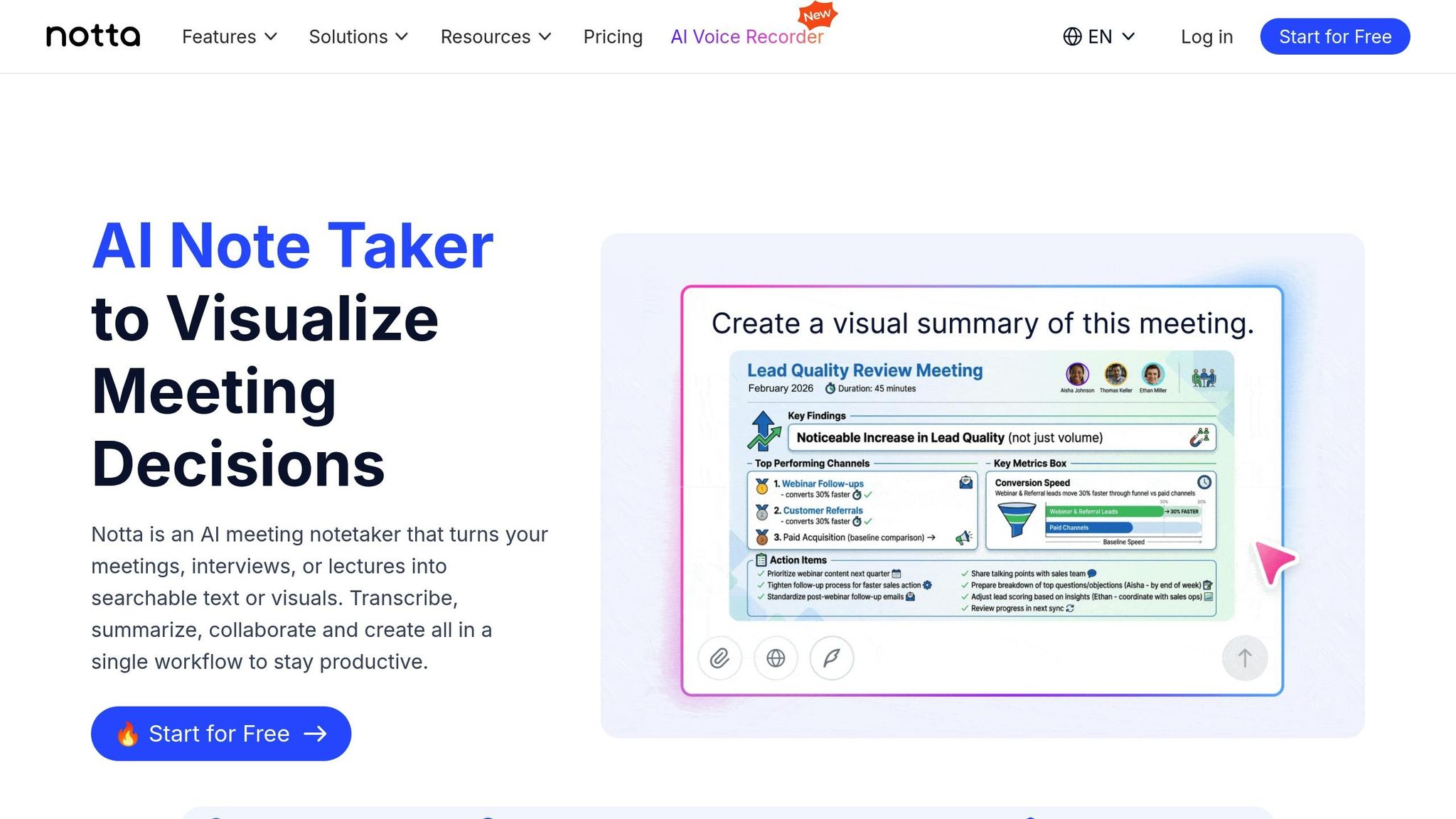
Notta is a strong choice for writers who need multilingual capabilities. Supporting over 58 languages, it delivers 98.86% transcription accuracy across web and mobile platforms. The tool includes an integrated editor for quick adjustments, marking key points, and sharing transcripts. Pricing is flexible, with a free Basic plan, a Pro plan at $8.17 per month (billed annually), and a Business plan at $16.67 per seat per month. These features make Notta particularly useful for writers handling international projects or working across language barriers.
| Feature | Willow | Dragon Professional | Notta |
|---|---|---|---|
| Primary Strength | Context-aware & Universal | Industry Vocab & Training | Multi-language Support |
| Accuracy | 50% higher than built-in | Up to 99% | 98.86% |
| Languages | 100+ | Limited/Common Latin | 58+ |
| Platform | Mac, Windows, iOS | Windows (Desktop) | Web, Android, iOS |
| Starting Price | Free trial (2,000 words) | $500 one-time or $65/month | Free Basic plan |
These tools demonstrate how NLP can simplify and speed up the writing process, offering writers powerful options for creating accurate and polished content.
How AI Blog Generator Directory Helps Content Creators
Curated Selection of Tools
The AI Blog Generator Directory simplifies the process of finding the right tools for your writing needs. It organizes NLP-powered voice dictation tools by specific workflows, whether you're working on long-form manuscripts (like Dragon), creating on mobile devices (such as Willow), or focusing on developer-friendly prompting (like Oravo). By highlighting features like custom vocabularies, real-time auto-edits, and tone adjustments, the directory takes the guesswork out of choosing the right software.
For those with unique requirements, such as accessibility features for dyslexia (Speechify) or multilingual support for global audiences (Notta, Monologue), the directory points to these specialized solutions. It also differentiates between tools that integrate system-wide (like Oravo and Wispr Flow) and browser-based options (such as Google Docs Voice Typing), helping users pick tools that suit their devices and workflows.
Beyond dictation, the directory includes resources for tasks like SEO optimization and keyword research tools, CMS integration, and text editing. This comprehensive approach ensures that every step of the content creation process is more efficient, saving time and effort.
Saving Time in the Writing Process
Voice dictation can be 3–4 times faster than typing, making it a game-changer for productivity. The directory features tools with accuracy rates of 98% or higher, enabling writers to accomplish tasks significantly faster than with traditional typing methods.
"The average professional types 60-90 words per minute but speaks at 200+ words per minute. This 3-4x speed difference creates a productivity bottleneck."
- Dipesh Bhatt, Oravo AI
The directory also promotes a "dictate first, edit later" approach, which reduces cognitive strain by about 40%. This method not only speeds up editing but also supports long-term health for writers. For the over 3 million U.S. workers who experience repetitive strain injuries each year - a number that has risen by 30% since 2020 - adopting voice-first workflows can be a sustainable solution for maintaining productivity and well-being.
Conclusion: The Future of NLP in Writing
Natural Language Processing (NLP) has taken voice dictation far beyond simple transcription, evolving into intelligent writing tools capable of understanding context, intent, and tone. Modern systems now achieve 98% accuracy and process speech with latency under 100 milliseconds, making text appear almost instantly. They've also moved from requiring manual punctuation commands to automatically interpreting natural speech patterns, cutting composition time by 54%. These advancements pave the way for even more sophisticated innovations.
Looking ahead, new systems are aiming to go beyond transcription by focusing on content management and adaptive structuring. For example, in August 2025, Hamza El Alaoui and his team introduced StepWrite, a system powered by large language models (LLMs) that helps users craft long-form content with context-aware audio prompts. Tests with 25 participants showed it significantly reduced mental effort compared to tools like Microsoft Word. Similarly, Susan Lin’s team unveiled Rambler in January 2024, a tool that lets writers refine dictated text using keywords and summaries as anchors. This approach outperformed traditional speech-to-text systems combined with ChatGPT.
Future systems are expected to integrate multiple input methods - voice, gaze tracking, gestures, and screen context - while incorporating emotional intelligence to adjust tone based on vocal cues. Dr. Sophia Chen, an AI Research Scientist, highlights the significance of these developments:
"The integration of advanced AI with voice input represents one of the most significant leaps forward in human-computer interaction since the graphical user interface. We're moving from computers that simply record what we say to systems that truly understand us."
The market growth underscores this progress. The global speech-to-text API market is projected to grow from $5 billion to $21 billion by 2034, with an annual growth rate of 15.2%. Meanwhile, the Voice AI Agents market is set to expand from $2.4 billion to $47.5 billion over the same period. For writers, these breakthroughs promise tools that not only transcribe but also adapt to your creative process, capturing your unique voice and intent - showcasing the exciting future of AI blog and text generators.
FAQs
How can I improve dictation accuracy with my accent or background noise?
To improve dictation accuracy, especially with distinct accents or in noisy settings, consider using advanced speech recognition tools designed with diverse datasets. Features like model adaptation allow these systems to better understand specific words or phrases you frequently use. Additionally, using a high-quality microphone and minimizing background noise can make a big difference. These adjustments can greatly enhance transcription reliability, even in challenging conditions.
What’s the best way to dictate long-form writing without losing structure?
To create long-form content while keeping its structure intact, consider using voice dictation tools that offer offline capabilities and automatic correction. Start by recording offline to safeguard your privacy and maintain a natural flow. Once recorded, transcribe your audio into text. Leverage AI-driven features to help organize and refine your draft, ensuring the final version is clear and well-structured. Tools with built-in grammar and punctuation correction can make the process even smoother, cutting down on manual edits and preserving the integrity of your work.
Can I use voice dictation privately without uploading audio to the cloud?
Modern AI tools, like Whisper, let you use voice dictation directly on your device. Since everything runs locally, your audio never leaves your machine. This setup provides an extra layer of privacy and security, keeping your data safe from external servers or cloud transmission.