Predictive analytics is reshaping content distribution. Instead of relying on outdated, fixed schedules, this method uses machine learning to analyze user behavior, predict trends, and deliver tailored content at the right time. The results? Publishers report a 40%-60% boost in engagement, 202% higher conversion rates, and an average ROI of $6.66 for every dollar invested.
Key takeaways:
- Engagement: AI-driven scheduling improves engagement by analyzing real-time signals.
- Personalization: Delivers one-to-one experiences by tracking user behavior and preferences.
- Trend Forecasting: Predicts micro-trends faster, achieving first-page rankings 43% quicker.
- ROI: Outperforms traditional methods by optimizing costs and targeting high-value prospects.
While traditional methods rely on broad audience segments and historical data, predictive content analytics offers precise, data-driven strategies. Although initial setup costs and data requirements can be high, the long-term gains in engagement and efficiency make it a game changer. Ready to upgrade? Start with a pilot program and clean, quality data.
1. Predictive Analytics for Personalized Content Distribution
Predictive analytics takes content distribution to the next level by using machine learning and behavioral data to tailor delivery based on individual user actions. Instead of relying on generic schedules, this method predicts future outcomes - like traffic, engagement, and conversions - before content even launches. Essentially, it provides a data-driven roadmap for reaching the right audience at the right time.
Engagement Rates
AI-powered scheduling can significantly improve engagement, with publishers reporting increases of 40% to 60% compared to traditional fixed schedules. By analyzing real-time behavioral signals, predictive systems identify the perfect moment to deliver content to each user.
Personalized calls-to-action (CTAs) also perform far better than generic ones, converting 202% more effectively. Beyond boosting engagement, these systems tackle issues like content fatigue by adjusting delivery frequency. This helps reduce email unsubscribe rates by up to 50%.
The ability to fine-tune content delivery in real time is a game changer, providing a deeper level of personalization for users.
Personalization Level
Predictive analytics doesn’t just enhance engagement - it enables true one-to-one personalization. By integrating Customer Data Platforms with Vector Databases, these systems analyze why users interact with specific content. Even for new visitors with no browsing history, contextual signals - like device type, referral source, and page content - allow platforms to create tailored experiences from the very first interaction.
Multi-channel coordination is another key advantage. Predictive systems ensure content reaches users on their favorite platforms at the ideal time, boosting brand awareness by up to 90%.
Trend Forecasting Accuracy
Predictive models excel at spotting micro-trends by analyzing metrics like search rankings, social shares, time on page, and conversions. AI-optimized content achieves first-page search rankings 43% faster than content optimized through traditional methods. This level of forecasting replaces outdated quarterly planning with dynamic, data-driven strategies. Teams using AI-powered workflows also complete projects 37% faster and report 47% higher job satisfaction.
Accurate trend predictions not only improve strategy but also lead to tangible financial benefits.
Return on Investment (ROI)
The financial impact of predictive analytics is undeniable. Companies leveraging marketing automation and predictive strategies see an average return of $6.66 for every dollar invested. Additionally, 89% of marketers report positive ROI from their personalization efforts.
sbb-itb-a759a2a
2. Generic Content Distribution Methods
Traditional content distribution relies on fixed schedules and general audience groupings instead of focusing on individual behaviors. These approaches often depend on historical data to guide decisions, rather than forecasting future trends. The result? A one-size-fits-all strategy that views audiences as broad categories instead of unique individuals. Let’s break down how these methods underperform in key areas compared to predictive analytics.
Engagement Rates
Generic methods struggle to capture attention because they fail to consider individual preferences or the best times to deliver content. Fixed publishing schedules ignore behavioral cues, which can lead to content fatigue when audiences are bombarded with irrelevant information at the wrong times. Predictive systems, on the other hand, have shown engagement improvements of 40%-60% by dynamically adjusting to user behavior.
"A generic email sent to thousands (or millions) of prospects isn't as effective as it used to be. The customer experience has evolved and buyers expect companies to communicate as if they know them." - Persado
Personalization Level
Traditional approaches rely on broad categories like age, location, or previous purchases to segment audiences. While they may use basic rules (e.g., showing different content to new vs. returning visitors), these systems can’t adapt to real-time behavioral changes. This results in treating customers more like statistics than individuals.
Trend Forecasting Accuracy
Human teams are limited when it comes to processing the massive amounts of data required for accurate forecasting. AI, however, can analyze millions of data points to uncover micro-trends, while traditional methods rely on a mix of limited data and gut instincts. This reactive approach often misses emerging opportunities, whereas AI-optimized content achieves first-page search rankings 43% faster than content optimized through conventional methods. These shortcomings ultimately lead to higher costs and reduced efficiency.
Return on Investment (ROI)
When it comes to financial outcomes, generic methods can’t match the ROI potential of predictive analytics. Traditional distribution relies more on opinion than on data-driven probabilities. This lack of precision inflates customer acquisition costs and wastes valuable resources. Additionally, traditional targeting methods struggle to pinpoint high-value prospects, further increasing costs. Considering that acquiring a new customer can cost six to seven times more than retaining an existing one, these inefficiencies can quickly add up.
Pros and Cons
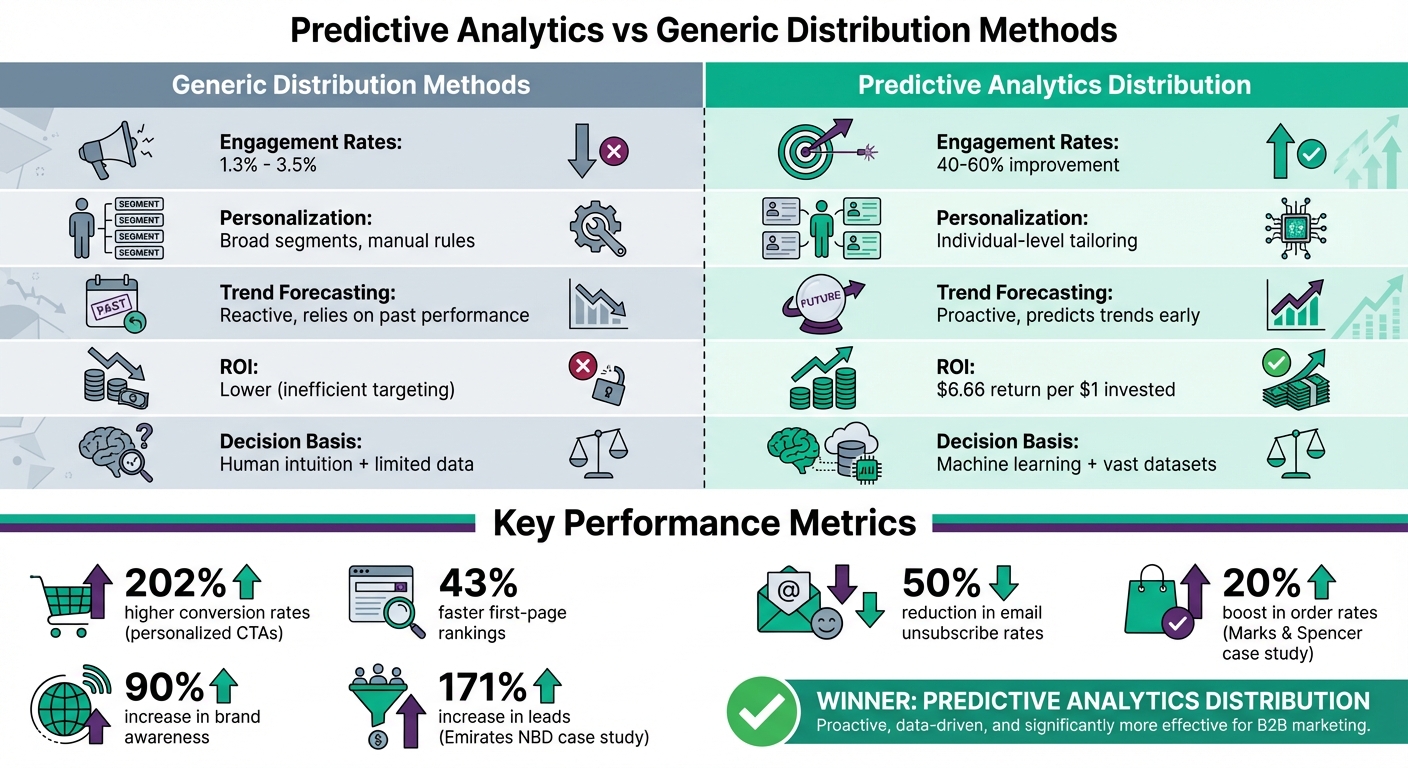
Predictive Analytics vs Generic Content Distribution: Performance Comparison
When deciding between predictive analytics and generic distribution methods, it’s essential to weigh their trade-offs. The table below highlights how these two approaches measure up across key performance areas:
| Feature | Generic Distribution Methods | Predictive Analytics Distribution |
|---|---|---|
| Engagement Rates | Industry averages range from 1.3% to 3.5% | Can boost engagement by 30% or more |
| Personalization Level | Broad segments based on manual rules | Tailors experiences at an individual level |
| Trend Forecasting | Reactive; relies on past performance | Proactive; predicts trends before they peak |
| ROI | Lower due to irrelevant content and excess "noise" | Higher; improves CAC and resource efficiency |
| Decision Basis | Relies on human intuition and limited data | Leverages machine learning with vast datasets |
These differences aren't just theoretical - they translate into tangible results. For instance, Emirates NBD, a leading Middle Eastern bank, utilized the Persado Motivation AI Platform to craft predictive content for their campaigns. This approach led to a 171% increase in leads and significantly reduced campaign launch times from weeks to days. Similarly, Marks & Spencer, a British retailer, achieved a 20% boost in order rates by applying predictive personalization to email and website copy, encouraging loyalty program sign-ups.
That said, predictive analytics isn't without its hurdles. Implementing this approach demands accurate historical data, advanced infrastructure, and skilled personnel or enterprise-grade tools. The upfront investment can be hefty, and compliance with privacy regulations like GDPR and CCPA adds another layer of complexity. Additionally, AI models aren’t foolproof - they can produce errors or "hallucinations", necessitating human oversight to ensure brand consistency.
Ultimately, the right choice depends on your resources and objectives. While generic methods might suit tighter budgets in the short term, the growing demand for personalized experiences makes the long-term benefits of predictive analytics hard to ignore.
Conclusion
From the comparisons above, it's clear that predictive analytics has a distinct edge over generic distribution when it comes to delivering personalized content. This approach shifts content strategies from simply reacting to trends to actively forecasting audience needs before they even emerge. While traditional methods depend on broad segments and historical data, predictive models tap into intricate, real-time patterns to deliver better results.
The benefits are hard to ignore. Predictive personalization can lead to 43% faster first-page rankings and boost revenue by up to 40%.
"Marketers who once reacted to consumer behavior can now predict it and create personalized campaigns".
- Harvard researchers
This proactive approach is why 71% of marketers using AI report working more efficiently, and 82% see measurable results.
To get started, consider launching a pilot program. Use AI-driven tools alongside strategic human input, focusing on one high-traffic channel to prove its value before scaling up. Before diving in, perform a detailed audit of your data to ensure it's clean and complete - predictive models are only as good as the data they work with. Choose platforms that integrate smoothly with your CRM and analytics tools, and keep human oversight at the forefront to maintain your brand’s authenticity.
Striking the right balance between AI insights and human creativity is key.
"AI excels in offering data-driven insights and efficiency, but the human element - creativity, intuition, and emotional intelligence - remains irreplaceable".
- Jeremy Collier, ActiveCampaign
With 71% of customers expecting personalization and 76% becoming frustrated when they don’t receive it, the real question isn’t whether to adopt predictive analytics - it’s how quickly you can make it work for your strategy. For more tools and insights, visit AI Blog Generator Directory and take your content strategy to the next level.
FAQs
What data is needed to begin predictive content distribution?
To kick off predictive content distribution, you’ll need to gather historical data on your audience. This includes their behavior, preferences, and how past content has performed. From there, AI and machine learning models come into play. These technologies analyze the data and predict trends, enabling you to create content that resonates deeply with your audience and delivers the best possible results.
How can I run a low-risk pilot for predictive personalization?
Start by experimenting with predictive analytics tools on a small, controlled audience segment or a specific content area. Use content analytics to pinpoint high-performing pieces and track metrics such as views and engagement. Incorporate AI-powered tools to process and analyze the data, but keep the initial scope narrow to minimize potential risks. Compare the results to your objectives and make adjustments as necessary. This step-by-step method helps limit exposure while giving you the confidence to expand gradually.
How do I stay GDPR/CCPA-compliant with predictive analytics?
To ensure compliance with GDPR and CCPA while using predictive analytics, prioritize privacy-focused data practices. Start by obtaining explicit user consent and clearly explaining how their data will be used. Always provide users with the option to opt out if they choose.
Make sure your data handling aligns with regulations by applying safeguards like data minimization - only collecting what’s necessary - and ensuring secure storage of sensitive information. Regularly audit your processes and stay informed about updates to privacy laws to keep your practices compliant.