Want to sell globally without breaking the bank? AI translation makes it possible to translate thousands of product descriptions into multiple languages quickly, accurately, and affordably. Here's how it works:
- Cost savings: AI slashes translation expenses - 9,000 SKUs in 27 languages cost just $8,000 versus $1.1 million with traditional methods.
- Speed: AI translates in seconds, not weeks. A single description takes about 30 seconds compared to 15–20 minutes manually.
- Consistency: Centralized glossaries and Translation Memory ensure accurate, uniform translations for technical terms.
- Better ROI: Brands report up to a 5:1 return on investment, with some achieving 345% ROI using AI tools.
AI translation also integrates directly with Product Information Management (PIM) systems, automates updates, and adapts content for local markets. By combining AI with selective human review, businesses achieve over 90% of human translation quality at a fraction of the cost and time.
Key takeaway: AI translation is the future of global e-commerce, helping businesses scale their catalogs faster, cheaper, and with better results.
RAJA: Translate content of 1,2 M products with AI in 18 languages, by Jill Schreurs
sbb-itb-a759a2a
How AI Translation Changes Content Scaling
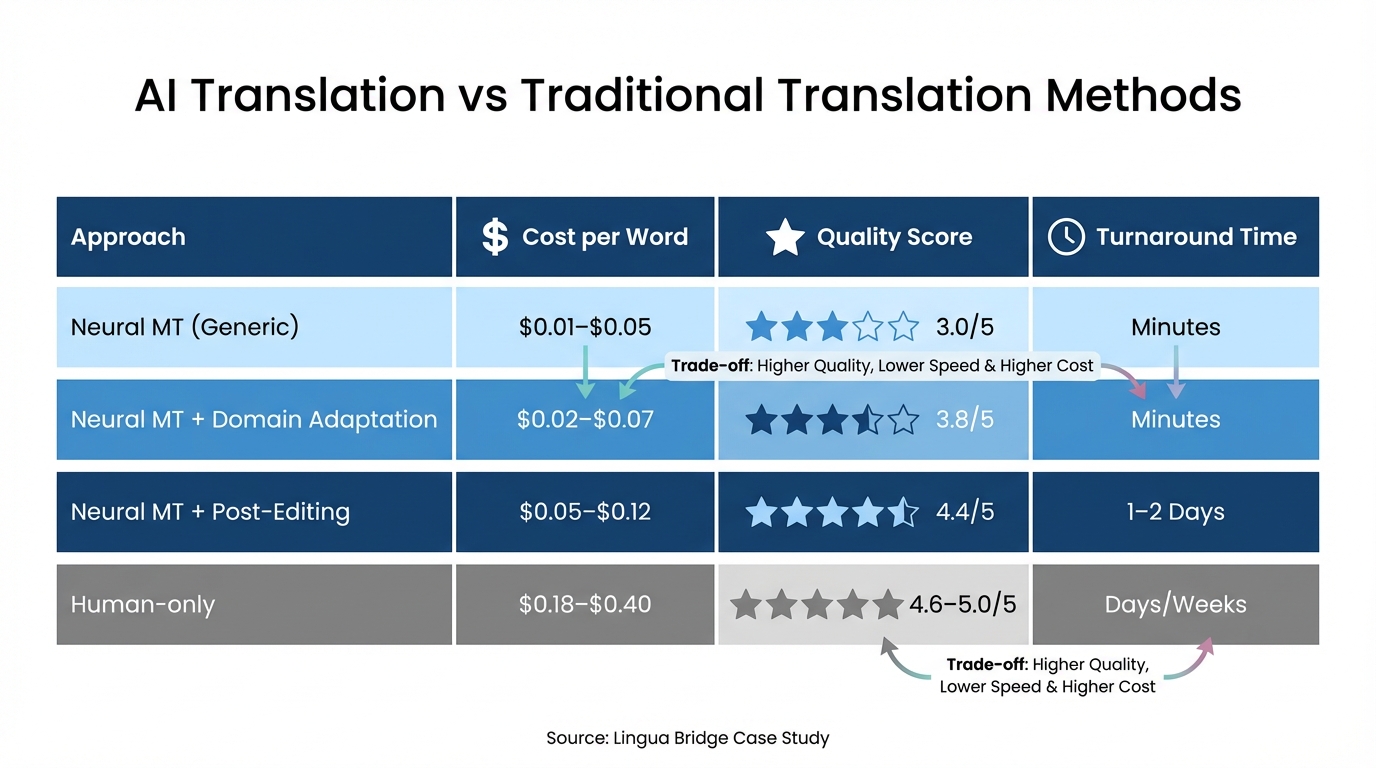
AI Translation vs Traditional Translation: Cost, Speed, and Quality Comparison
AI translation is transforming global e-commerce by seamlessly integrating into workflows through APIs and Translation Management Systems (TMS). This automation eliminates the manual, time-consuming tasks of copy-pasting text, resolving version inconsistencies, and managing delays. For example, when a new SKU is added to your Product Information Management (PIM) platform, translations occur automatically, streamlining the entire process.
One standout feature is the use of Translation Memory (TM) paired with enforced glossaries. TM stores approved translations for terms like "stainless steel" or "450-watt motor", ensuring consistent terminology across thousands of products. This consistency is vital for maintaining brand integrity and clarity throughout your catalog. Next, let’s dive into how neural machine translation compares to traditional methods in delivering these efficiencies.
AI vs. Traditional Translation: Main Differences
Neural Machine Translation (NMT) leverages deep learning to grasp context, making it significantly more accurate than older statistical methods. But its real strength lies in scalability. Traditional translation methods scale linearly, meaning more languages require more translators and longer timelines.
AI, on the other hand, upends this model. Whether you need to translate 100 products or 10,000, the cost and time per item remain largely unchanged. By using domain adaptation and glossary locking, AI systems can reduce terminology errors by about 75% compared to generic AI translations. These systems learn your brand's tone and technical vocabulary, applying them consistently across markets. This scalability directly translates into lower costs and faster international launches.
| Approach | Cost per Word | Quality Score | Turnaround |
|---|---|---|---|
| Neural MT (Generic) | $0.01–$0.05 | 3.0/5 | Minutes |
| Neural MT + Domain Adaptation | $0.02–$0.07 | 3.8/5 | Minutes |
| Neural MT + Post-Editing | $0.05–$0.12 | 4.4/5 | 1–2 Days |
| Human-only | $0.18–$0.40 | 4.6–5.0/5 | Days/Weeks |
Source: Lingua Bridge Case Study
Measured Benefits of AI Translation
The technical efficiencies of AI translation translate into clear business advantages. Take Deliveroo as an example. In February 2025, they implemented the Phrase Localization Platform to support over 170,000 delivery partners. Cristina Marín, Senior Localization Manager, noted that this system reduced project timelines by three to four days and cut localization managers’ workload by 35–40%.
"By using the Phrase Localization Platform, localization managers are saving at least 35–40% of the time typically spent on project management" - Cristina Marín, Senior Localization Manager, Deliveroo
The cost savings are just as impressive. Neural MT is 5 to 20 times cheaper per word compared to human translation. But perhaps the most game-changing benefit is speed. AI can reduce time-to-market from weeks to mere days - or even hours. For instance, DeepL achieved 92% accuracy on English-to-German technical documentation without requiring human post-editing. This shows that AI is not only fast but also capable of handling complex, technical content at scale.
Preserving Context and Culture with AI Translation
Fast and affordable translation is great, but it’s not enough if the results feel robotic or miss the mark culturally. Think about this: 86% of native speakers have encountered mistranslations, and 62.4% have noticed local idioms being ignored. That’s a big deal because three out of four consumers are willing to switch to brands that show a better understanding of their culture.
To tackle this, modern platforms now use multiple AI engines in tandem. Take Ovesio, for example - it combines tools like Google Translate, DeepL, Microsoft, and OpenAI, then applies its own "AI Inspector" to analyze and choose the most natural, contextually accurate translation for each market. This isn’t just about getting the grammar right; it’s about ensuring the tone and sentiment align with local expectations.
Context Analysis for Local Markets
AI-driven sentiment analysis helps tailor content to fit the communication style of a specific culture. It’s about understanding high-context (indirect) versus low-context (direct) communication styles. For instance, in the United States, a straightforward call-to-action like "Buy now" works well. But in Japan, where communication tends to be more nuanced, something like "Discover more" resonates better. AI can even adapt product descriptions based on regional needs - highlighting UV protection for skincare in sunny climates while focusing on moisturizing benefits in drier areas. This level of localization can have a big impact, with conversion rates increasing by up to 70% for properly localized product pages.
advanced AI tools now have dedicated modules that refine content by focusing on sentiment, terminology, and cultural tone. These systems work together to create content that feels authentic, not just accurate. But as Laia Gimeno, Language Quality Manager at Centific, points out:
"AI alone cannot reliably sense when an idiom carries unintended meaning, or when a slogan might come across as disrespectful or bland. This is where human expertise makes the difference".
This combination of AI precision and human insight ensures content resonates with local audiences. Many brands use an AI blog generator directory to find tools that balance these capabilities.
Case Studies on Regional Adaptation
The results speak for themselves. In July 2025, a large retailer used Ovesio to translate 9,000 products into 27 languages. By leveraging Ovesio’s multi-engine AI system and "AI Inspector", the company slashed costs from an estimated $1.17 million to just $8,000. Even with such savings, the translations maintained cultural relevance and accuracy.
Another example comes from January 2026, when Suitsupply, a menswear brand based in Amsterdam, switched to a fully AI-powered localization process. Using Crowdin AI and OpenAI’s GPT-4 models, the company integrated its design and content systems with AI-driven reviews. This cut their publishing time from 2–3 days to just a few hours - a 95% improvement - across eight target languages, with no customer complaints about AI errors. Human oversight played a key role here, catching subtle nuances like the difference between “Busca ofertas” (searching for sales) and “Encuentra ofertas” (finding/discovering sales) in Spanish.
These examples show how AI translation can deliver speed and cost savings while keeping content culturally relevant. It’s about more than just words - it’s about understanding the audience.
Practical Applications: Scaling Product Descriptions Globally
Enterprise Case Studies
From June to December 2023, a major Polish construction materials reseller partnered with SUNZINET to streamline a catalog of 10,000 products using AI. By leveraging Python and Large Language Models, the company slashed the time needed to create product descriptions from 15 minutes to under 2 minutes per item. The results? Half of the AI-generated descriptions were instantly approved, while minor edits were needed for 45% of the content.
In October 2025, Elena Rossi, an e-commerce entrepreneur specializing in home goods, revamped her 2,000-SKU catalog with the help of Claude and GPT-4. She structured her approach by creating an attribute spreadsheet and a "banned words" list to eliminate generic AI-generated phrases. The project wrapped up in just 12 days, costing her only $20 for the AI tool subscription. Within three months, her sales grew by 23%, and the conversion rate for her top-selling bamboo drawer organizer increased from 8.2% to 11.3%.
Sweden’s top office supply retailer, Kontor AB, turned to Cension AI to enhance 5,700 products in just 24 hours. The system generated 63,000 unique keywords and produced structured JSON technical specifications for the entire catalog. This automation saved the company 2,850 hours of manual labor and improved search functionality by enabling better filtering options.
These examples highlight how AI not only eases operational challenges but also accelerates global market expansion through fast and consistent translation.
Performance Metrics and Scalability Data
The numbers speak for themselves: AI-driven workflows deliver measurable efficiency gains and cost savings. For instance, AI translation can cut localization costs by as much as 90%. Translating a 9,000-product catalog with AI costs just $8,000, compared to an estimated $1.17 million using traditional human translation methods.
The speed benefits are equally impressive. A 2,000-SKU catalog rewrite that would take a professional human copywriter 6–8 months was completed in only 12 days using AI. Similarly, a 5,700-product catalog that would typically require months of manual effort was processed in just 24 hours with professional AI writing tools. This powerful combination of cost efficiency and rapid execution enables businesses to expand their global reach without the usual time and resource constraints.
SEO Localization with AI Translation
Keyword Optimization for Local Search
AI translation does more than just convert text; it tailors keywords to fit the way people search in specific regions. For instance, while a shopper in the U.S. might look for "sneakers", someone in the U.K. is more likely to type "trainers." It even accounts for spelling differences, like "color" in the U.S. versus "colour" in the U.K..
Top AI tools for writing use tiered glossaries to handle terms differently based on context. These glossaries classify terms as non-translatable (like brand names or SKUs), conditionally translatable depending on local usage, or fully translatable generic terms designed to match local search habits. Advanced systems can even analyze search engine results in real time to adjust translations according to current ranking trends.
When paired with effective metadata management, these keyword strategies ensure that your content not only connects with local audiences but also ranks well in search engines across different markets.
Automated Metadata Management
AI writer tools take keyword optimization a step further by automating the creation and localization of meta titles, meta descriptions, and image alt text. These tools also ensure that market-specific character limits are respected, preventing truncation issues. This matters because 75% of online shoppers prefer websites in their native language, and 42% avoid sites in unfamiliar languages altogether.
Automation also safeguards essential technical elements during translation. Features like tag locking help maintain the integrity of HTML entities, inline tags, and placeholders. This ensures that localized product feeds - whether in CSV, XML, or JSON formats - remain valid for search engines. By preventing issues like broken code or malformed tags, AI tools go beyond basic translation to deliver a seamless and technically sound localization process.
Hybrid Models: Combining AI with Human Review
AI-Assisted Workflows for Quality Control
Hybrid models take the scalability of AI translation to the next level by pairing it with selective human review to ensure content quality. Businesses often prioritize full human review for their most critical content - like best-sellers, checkout pages, and marketing materials - while relying on fully automated AI blog generators combined with Translation Memory for less critical content, such as bulk descriptions, FAQs, and technical specs.
This approach, known as Machine Translation Post-Editing (MTPE), comes in two forms. Light post-editing focuses on correcting errors and ensuring clarity, making it suitable for support content and internal documents. On the other hand, full post-editing enhances style, tone, and cultural nuances, making it essential for marketing materials and UI strings where brand identity plays a key role. By refining AI-generated content, human editors maintain speed while keeping costs in check.
A compelling example comes from July 2024, when MakesYouLocal, an e-commerce localization expert, adopted EasyTranslate's HumanAI technology. This integration slashed translation times from 20 hours to just 2 hours - a tenfold productivity increase. They achieved an accuracy rate of one mistake per 1,000 words, far surpassing the traditional benchmark of one per 150 words, and cut costs by 90%. Max Riis Christensen, CEO of MakesYouLocal, remarked:
"EasyTranslate's HumanAI innovation has provided us with a competitive edge, offering our customers translations that combine AI's efficiency with human quality".
This fusion of AI precision and human expertise not only raises quality but also sets the stage for significant efficiency improvements.
Efficiency Improvements from Hybrid Approaches
Beyond quality, hybrid models deliver remarkable gains in efficiency and cost savings. These systems can achieve over 90% of human translation quality at just 30–40% of the cost and 10× the speed. While traditional human translation averages 250–400 words per hour, post-editing allows editors to handle 800–1,500 words per hour, with daily outputs reaching up to 5,000 words.
Cost comparisons highlight the value of hybrid models. Pure AI translation costs about $0.01–$0.05 per word, hybrid approaches range from $0.08–$0.12 per word, and pure human translation costs $0.20–$0.35 per word. Businesses adopting hybrid workflows often report 40–60% reductions in localization costs, a 30% faster time-to-market, and a 25% boost in international conversion rates. Modern hybrid systems also achieve professional-grade BLEU scores, ranging from 68 to 74.
The real magic lies in continuous improvement. Human edits feed back into the system, training the AI to perform better over time. This evolving process, often referred to as a "Global Context Engine", ensures that the system becomes increasingly effective with each iteration.
Conclusion
AI translation is transforming global e-commerce by making it easier than ever to scale product descriptions across languages. The numbers speak for themselves: 75% of shoppers prefer buying in their native language, and 42% won’t purchase if the content isn’t in a language they understand. For brands aiming to expand internationally, AI translation isn’t just about cutting costs—it’s the backbone of global growth, supported by the best online content writing tools available today.
The efficiency gains are hard to ignore. Businesses can now translate thousands of product listings into multiple languages in mere hours, slashing costs compared to traditional methods. And these time and cost savings lead to measurable business outcomes: companies using AI translation report 47% more website traffic, double the conversion rates, and a 5:1 return on investment for every dollar spent.
The best strategy blends AI’s speed with human expertise. 92% of enterprises now use hybrid workflows, where AI handles the bulk of the work and human reviewers fine-tune critical content to ensure it aligns with local nuances. This approach delivers high-quality translations while maintaining consistency across thousands of SKUs, enabling a deeper level of localization.
AI goes beyond translation to enable true localization - adjusting currency formats, measurement units, regional keywords, and even product positioning to match local market expectations. Modern systems also ensure content is optimized for AI shopping assistants, keeping products visible as search behaviors shift.
These advancements allow brands to break through traditional language barriers. In a global e-commerce market valued at $28.53 trillion, AI translation levels the playing field, enabling businesses of all sizes to compete internationally. Whether managing 100 or 100,000 products, today’s technology empowers brands to connect with customers in their native language - efficiently, accurately, and affordably.
FAQs
How do I connect AI translation to my PIM so new SKUs auto-translate?
Linking your Product Information Management (PIM) system to an AI translation tool or Translation Management System (TMS) can make handling new SKUs much easier. This integration ensures that whenever new product details are added or updated, translations happen automatically. The result? Less manual effort, faster scaling, and consistent, reliable translations throughout your product catalog.
When should I add human post-editing instead of using AI-only translation?
Human post-editing plays a key role when precise, culturally sensitive, and brand-aligned translations are required. This becomes crucial for content that is complex, delicate, or deeply localized, as AI translations often miss these finer details. By blending AI capabilities with human insight, you can achieve both accuracy and cultural appropriateness.
How does AI localization enhance SEO keywords for target countries?
AI localization fine-tunes SEO keywords by translating and adapting them to match local search habits while maintaining both relevance and brand identity. This process ensures that keywords reflect regional language nuances, idiomatic expressions, and local search trends, making them more effective for specific audiences.
By optimizing elements like metadata and product descriptions, AI helps businesses attract more organic traffic, improve visibility, and increase conversion rates in global markets. It bridges the gap between language and cultural preferences, ensuring businesses resonate with international audiences.