Sentiment analysis helps businesses understand customer emotions in real time by analyzing text data like social media posts, reviews, and support tickets. It’s a powerful way to measure brand health, address issues quickly, and improve customer satisfaction. Companies using these tools have seen:
- 25% increase in customer satisfaction
- 30% boost in brand loyalty
- Ability to detect crises 3 days earlier
This article covers five companies that used sentiment analysis to solve specific challenges:
- Delta Airlines: Reduced negative sentiment by 37% during a crisis by providing timely updates.
- Shopify: Cut response times from 4.2 hours to 27 minutes, increasing customer satisfaction by 41%.
- TechSmith: Improved product upgrades by 18% through targeted feature updates based on customer feedback.
- Goldman Sachs: Outperformed traditional portfolios by 3.2% annually using AI-powered sentiment tracking.
- Cleveland Clinic: Reduced patient readmissions by 27% by addressing communication gaps in feedback.
Each case highlights how sentiment analysis transforms customer insights into actionable strategies, driving measurable improvements in service, product development, and decision-making.
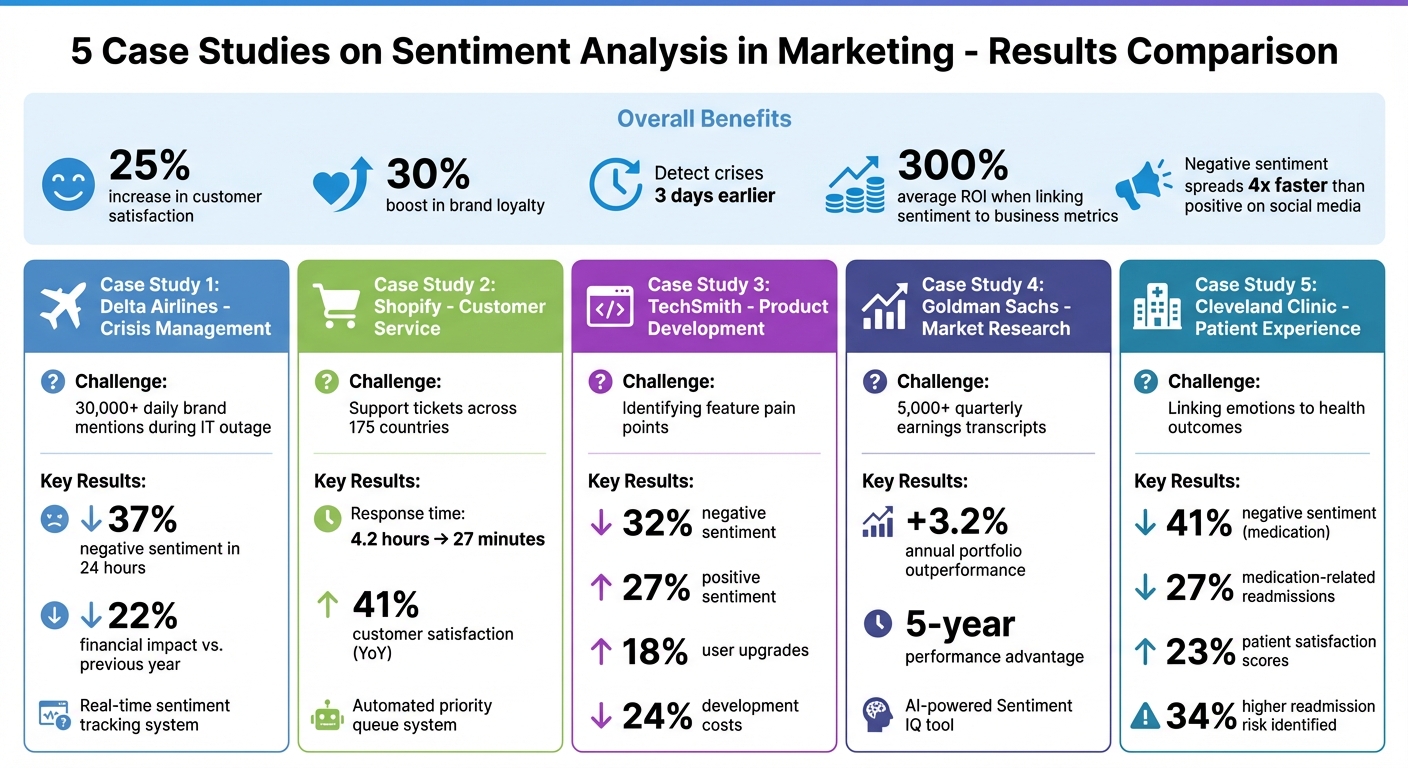
5 Sentiment Analysis Case Studies: Results and Key Metrics Comparison
Case Study 1: Crisis Management at a Major Airline
Challenge: Handling Negative Customer Reactions
Delta Airlines faced a tough situation during a service disruption, dealing with a wave of negative feedback. Imagine managing over 30,000 brand mentions daily across social media and news outlets - this was their reality. The tipping point came during a 2024 IT outage that disrupted passenger check-ins. Interestingly, the biggest source of customer frustration wasn’t the outage itself but the lack of timely updates. People felt left in the dark, which only fueled their dissatisfaction.
Solution: Real-Time Sentiment Tracking
Delta tackled this issue head-on by introducing an advanced sentiment analysis system. This tool didn’t just scan messages - it understood them in context. For example, it could distinguish between a passenger upset about a delay and one praising the airline’s transparency. The system also used a tiered response approach, flagging critical problems and triggering specific departmental actions, whether it was baggage handling or in-flight services. These tailored responses made a noticeable difference.
Results: Better Crisis Communication
The results were clear after the 2024 IT outage. Delta learned that customers valued frequent, transparent updates far more than generic responses. By providing regular progress reports, the airline managed to cut negative sentiment by 37% within just 24 hours. Even better, this approach reduced the financial impact of disruptions by 22% compared to the previous year.
sbb-itb-a759a2a
Case Study 2: Customer Service at a Global E-Commerce Platform
Challenge: Managing High Support Volumes
Shopify faced a daunting challenge: handling thousands of daily support tickets across 175 countries. These inquiries ranged from simple tracking updates to urgent issues like payment failures. The real struggle wasn’t just the sheer volume - it was figuring out how to prioritize. Without a smarter system in place, customers with critical problems often found themselves stuck behind routine questions. This was a major concern, especially since 60% of customers report they’d abandon a brand after just one or two bad experiences. Shopify needed a way to address this issue head-on.
Solution: Prioritizing Tickets Based on Sentiment
In July 2025, Shopify introduced a real-time sentiment analysis system to tackle the problem. The system scanned incoming messages, assigned sentiment scores, and categorized issues. It was designed to recognize urgency by combining negative sentiment with critical keywords like "payment failure" or "store down." When flagged, these tickets were automatically moved to the front of the queue. Additionally, it tracked escalation patterns, identifying cases where a customer’s frustration increased over multiple interactions. These cases were immediately flagged for supervisor intervention.
Results: Increased Customer Satisfaction
The results were clear and impactful. Shopify slashed average response times for critical issues from 4.2 hours to just 27 minutes. Customer satisfaction scores for resolving issues saw a 41% year-over-year increase. Beyond just speeding up responses, the system uncovered recurring problems that traditional surveys missed - like specific checkout features causing repeated frustration. This allowed Shopify to address underlying issues effectively. The combination of sentiment analysis and automation demonstrated how technology and top AI tools for writing can significantly improve both efficiency and customer experience.
Case Study 3: Product Development at a Software Company
Challenge: Identifying Customer Pain Points
TechSmith, the company behind Snagit and Camtasia, faced a tough challenge: how to prioritize features when bombarded with feedback from countless user channels. Traditional metrics weren’t cutting it - they couldn’t capture the subtle frustrations users experienced. Was the problem the interface? Performance? Something else entirely? Without a clear picture, the team risked wasting time and resources on updates that didn’t address real issues. To solve this, TechSmith turned to sentiment analysis for answers.
Solution: Analyzing Sentiment Across Multiple Channels
TechSmith implemented a sentiment analysis system powered by advanced AI tools like natural language processing (NLP) to sift through user reviews, support tickets, and even social media mentions. By using aspect-based sentiment analysis, they could pinpoint how users felt about specific features. For instance, the system flagged "timeline manipulation" in Camtasia as a consistent source of negative feedback, while other features fared better.
But they didn’t stop there. TechSmith paired this sentiment data with tools like heatmaps and session replays to dig deeper into the root causes of user frustration. This layered approach uncovered something unexpected: users weren’t as upset with the interface as they were with confusing documentation and workflow hurdles - issues that standard surveys had completely overlooked.
Results: Better Feature Prioritization
Armed with these insights, TechSmith made targeted improvements. They redesigned the timeline manipulation feature and overhauled their help documentation, adding focused video tutorials. The results? A 32% drop in negative sentiment, a 27% rise in positive sentiment, an 18% increase in user upgrades, and a 24% reduction in development costs. This shift showed how sentiment analysis could turn product development into a precise, data-driven process that not only satisfied customers but also strengthened the company’s bottom line.
Case Study 4: Market Research at a Financial Institution
Challenge: Processing Large Volumes of Market Data
Every quarter, Goldman Sachs analysts sift through over 5,000 earnings call transcripts, along with thousands of news articles and social media posts. The sheer volume of data, coupled with the need to detect subtle linguistic changes that could signal major market shifts, made traditional methods inadequate. Analysts needed a solution that could handle this complexity with precision.
Solution: AI-Powered Sentiment Analysis
To tackle this, Goldman Sachs introduced Sentiment IQ, an AI-driven sentiment analysis tool. Unlike basic keyword scanning, Sentiment IQ dives deeper, analyzing executive statements and Q&A sessions to pick up tonal shifts. It prioritizes data sources based on their historical accuracy in forecasting market trends and monitors sentiment changes over time. For instance, in 2024, during tech earnings calls, Sentiment IQ flagged rising uncertainty in discussions about supply chain issues. This insight allowed analysts to update their forecasts well before these challenges became widely recognized.
"Real-time data is everything. Our sentiment analysis doesn't just tell us what people are saying, it helps us understand what they're actually thinking about market conditions before those thoughts are fully reflected in prices."
- Head of Quantitative Research, Goldman Sachs
Results: Better Investment Decisions
Over five years, portfolios incorporating insights from Sentiment IQ delivered an average annual outperformance of 3.2% compared to traditional approaches. By processing thousands of transcripts and uncovering nuanced linguistic patterns, Goldman Sachs leveraged sentiment analysis to gain a competitive edge, ultimately boosting client returns. This case highlights how advanced sentiment analysis can reshape decision-making and drive success in the financial sector.
Case Study 5: Patient Experience at a Healthcare Organization
Challenge: Responding to Patient Feedback
In 2024, Cleveland Clinic faced a tough hurdle: they couldn’t effectively link patient emotions to health outcomes. While traditional surveys were in place, they often missed critical issues like confusion over medications and unclear discharge instructions. This made it difficult to pinpoint areas where physicians needed better communication skills or to understand how feedback directly influenced patient recovery.
Solution: Analyzing Patient Sentiment
To tackle this, Cleveland Clinic turned to sentiment analysis across multiple platforms, including post-visit surveys, social media, and transcribed phone calls. Using AI content generator tools and NLP platforms like Alteryx and R, they standardized and analyzed thousands of data points. The system employed aspect-based sentiment analysis, which allowed them to break down feedback into specific care areas - such as medication schedules and communication clarity. They also identified key frustration triggers, such as words like "exhausted", "rejected", and "prior authorization", signaling patient dissatisfaction.
"Technology is helping us to improve patient support programs by systematically understanding and responding to patient emotions."
- Katie Wilson, Managing Director, U.S. Patient Support Services, IQVIA
This approach allowed Cleveland Clinic to implement targeted solutions where they were needed most.
Results: Higher Patient Satisfaction
With these insights, Cleveland Clinic uncovered a key trend: patients who gave negative feedback about their discharge were 34% more likely to be readmitted within 30 days. In response, they introduced a medication reminder app and launched communication training for physicians. This led to a 41% drop in negative sentiment around medication management, a 27% reduction in medication-related readmissions, and a 23% boost in patient satisfaction scores for trained physicians. Additionally, the clinic shifted its focus from quick call handling to resolving issues in a single call, prioritizing thorough responses over speed, which patients appreciated.
What Are Some Real-World Examples Of Sentiment Analysis? - Next LVL Programming
Key Lessons from These Case Studies
The case studies underline the importance of real-time monitoring and multi-channel tracking. Companies like Delta Airlines, Shopify, TechSmith, Goldman Sachs, and Cleveland Clinic implemented systems to analyze sentiment across multiple platforms - social media, support tickets, reviews, and more - all at once. This approach allowed them to identify potential issues up to 48 hours before they escalated. These examples emphasize how a proactive strategy can make all the difference.
A closer look reveals that going beyond basic sentiment scores is critical. Instead of sticking to general positive or negative feedback, these companies leveraged aspect-based sentiment analysis. For instance, TechSmith discovered that user frustration wasn’t tied to their software’s interface but rather to its documentation. Addressing this led to a 32% drop in negative mentions. Similarly, Cleveland Clinic pinpointed discharge instructions as a key issue, which was linked to a 34% higher readmission rate. By focusing on specific pain points, these organizations made targeted improvements that delivered measurable results.
Another key takeaway is the value of connecting sentiment data to business metrics. Linking insights to outcomes like customer lifetime value or revenue showed an average ROI of 300%. Shopify's integration of sentiment analysis with their support system reduced critical issue response times from 4.2 hours to just 27 minutes, which boosted customer satisfaction scores by 41% year-over-year. This demonstrates how tying insights to actionable metrics can directly influence performance and strategy.
To get started, marketers should establish baseline sentiment metrics for their brand. Tracking Net Sentiment Score and sentiment volume over time helps distinguish normal fluctuations from crises. A tiered response system can then be implemented, where minor issues trigger automated replies, while severe negative spikes activate a crisis team.
The benefits of AI tools for content analysis and sentiment tracking are clear. Companies using these tools report a 25% increase in customer satisfaction, a 30% improvement in brand loyalty, and the ability to respond to crises 30% faster than those relying on manual methods. Considering that negative sentiment spreads up to 4 times faster than positive sentiment on social media, quick detection and response can be the difference between a small hiccup and a major PR disaster.
FAQs
What data sources should I analyze first for sentiment?
Social listening data and social media mentions are like windows into your audience's thoughts. They provide real-time insights into customer sentiment and how people perceive your brand. By analyzing these sources, you can get a sense of what your audience loves, what bothers them, and where you might need to step up your game.
For example, tracking mentions of your brand across platforms can help you spot trends, gauge reactions to a recent campaign, or even uncover recurring issues with your product or service. This kind of immediate feedback is invaluable for understanding your audience and identifying areas where you can improve.
In short, social listening isn’t just about monitoring - it’s about learning and adapting based on what your customers are saying.
How do I connect sentiment changes to ROI?
To understand the connection between sentiment changes and ROI, focus on how shifts in customer sentiment - detected through AI-driven sentiment analysis - correlate with tangible outcomes like sales, conversions, or brand trust. For instance, some businesses have reported noticeable improvements in sales or ROI by responding to social sentiment and using AI tools for brand management.
What’s the best way to act on sentiment in real time?
The most effective way to respond to sentiment in real time is by leveraging AI-powered sentiment analysis tools. These tools keep a constant watch on online conversations, social media activity, and customer feedback, analyzing the emotional tone almost instantly. This allows brands to react quickly to trends, address feedback, or manage potential crises as they arise. By integrating these insights into automated systems, businesses can fine-tune their messaging, interact with customers more effectively, and adjust strategies to boost satisfaction while reducing risks.