Sentiment analysis helps you understand how customers feel about your competitors, offering insights beyond star ratings or raw data. By analyzing emotional tones in reviews, social media posts, and forums, you can identify competitor strengths, weaknesses, and trends that impact customer decisions. Advanced AI tools, like those using Transformer-based models (e.g., BERT, GPT), detect subtle emotions such as sarcasm or disappointment, making it easier to pinpoint actionable insights.
Key Takeaways:
- Beyond Ratings: Understand why customers feel positively or negatively about competitors.
- Competitor Weaknesses: Spot issues like poor customer support or unclear pricing.
- Trends Over Time: Track sentiment over months to connect shifts with events like product launches.
- Actionable Insights: Use findings to refine marketing, improve products, or capitalize on competitor missteps.
For example, a December 2025 study showed PayPal lagging behind Wise and Stripe in customer sentiment, revealing opportunities to address transparency and fees. AI tools streamline this process, cutting analysis time from 18–25 hours to just 2–3 hours while maintaining high accuracy. By leveraging sentiment data, you can make smarter decisions to outpace competitors.
Benefits of Sentiment Analysis in Competitor Benchmarking
Finding Competitor Strengths and Weaknesses
Sentiment analysis digs deeper than star ratings, uncovering exactly where competitors shine or fall short. Instead of just knowing a competitor averages 3.5 stars, you can identify whether customers are upset about high prices, clunky usability, or poor customer support. Using aspect-based analysis, feedback gets broken down into specific attributes - like pricing, design, or features - making it easier to spot precise pain points.
Sentiment heatmaps take this a step further by visually mapping competitor performance across various themes. For instance, you might quickly see which company dominates in areas like service speed or product durability. Analyzing 200–300 recent reviews per competitor can reveal that one brand excels in ease of use, while another struggles with ongoing negative feedback about customer support. With this knowledge, you can adjust your marketing to highlight competitor weaknesses - if your rival’s support is consistently criticized, you can emphasize your own strengths in that area.
For even more raw and unfiltered insights, mix structured reviews with feedback from platforms like Reddit and X. Using a social media content generator can help you quickly draft responses or posts based on these findings.
Understanding these strengths and weaknesses helps you track how shifting customer sentiments impact competitor positioning over time.
Tracking Market Perception Over Time
Monitoring sentiment over 6–12 months allows you to see whether the perception gap between you and your competitors is growing or shrinking. This kind of trend analysis becomes even more powerful when you connect sentiment shifts to specific events - like product launches, marketing pushes, or pricing changes - helping you pinpoint what’s driving the changes.
A sudden spike in review volume - known as review velocity - can signal major events that warrant immediate attention. Weekly KPI updates and monthly deep-dive sentiment reports help you stay on top of these shifts. The time savings are huge: Advanced AI tools can cut manual analysis time from 18–25 hours down to just 2–3 hours, all while maintaining about 90% accuracy and 95% report completeness.
To make this process even smoother, establish a "normal" sentiment range for each competitor. This way, you can quickly spot meaningful deviations, like a 20% spike in negative sentiment, and respond in real time.
Getting Practical Insights
Sentiment analysis doesn’t just provide data - it delivers actionable insights. These insights can refine your competitive benchmarks and guide strategic decisions in marketing and product development. For example, if sentiment data shows customers love your "service speed" more than your competitors’, you can weave that into your brand messaging. This isn’t guesswork - it’s aligning your strategy with what customers actually value.
"Averi doesn't just give us insights, it helps us act on them. That's the gap every other platform misses. We're finally turning data into real campaigns." - David, Thorn
If your analysis reveals industry-wide frustrations - like slow delivery times - you can address these issues in your operations to stand out and win market share. Sentiment data also informs product planning. By identifying unmet needs in competitor products, you can prioritize adding those features to your own roadmap. AI tools excel here, identifying gaps with an 85% success rate and mapping opportunities with 80% accuracy, leading to a 25% boost in marketing performance by turning insights into action.
You can even segment sentiment data by geography to spot regional weaknesses in your competitors and tailor your strategy accordingly.
sbb-itb-a759a2a
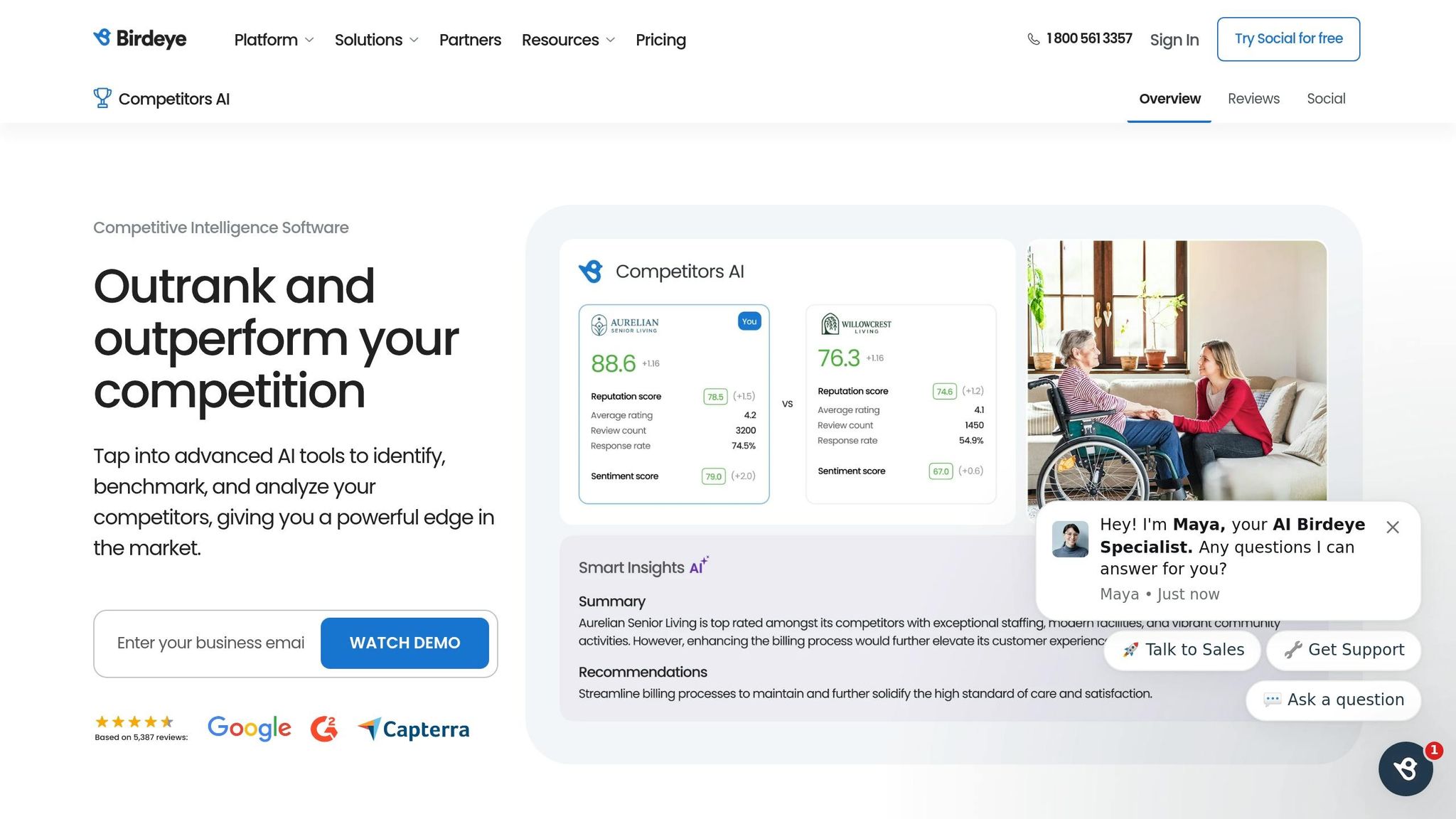
Birdeye Competitors AI | AI-Powered Competitive Intelligence Software
How to Use Sentiment Analysis for Competitor Benchmarking
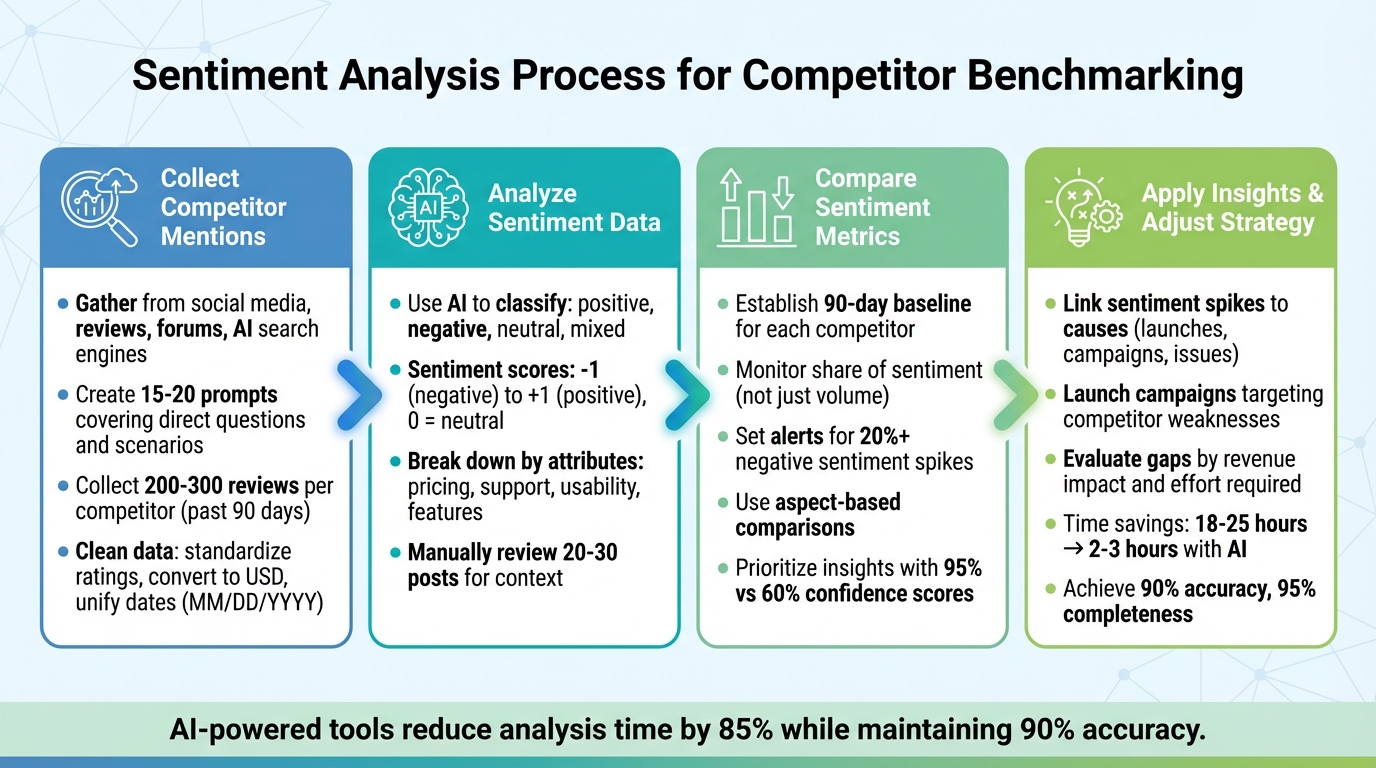
4-Step Sentiment Analysis Process for Competitor Benchmarking
Step 1: Collect Competitor Mentions Across Channels
Start by gathering mentions of your competitors from various digital platforms. This includes social media, review sites, AI search engines, and community forums where customers share feedback. To ensure you don’t miss key mentions, account for variations in competitor names, including abbreviations, product names, executive names, and even common misspellings.
Develop a set of 15–20 prompts that cover direct questions, scenario-based queries, and specific weaknesses (e.g., "What do people usually complain about when it comes to [Competitor]?"). Use Boolean queries to filter out irrelevant data and focus on meaningful insights.
For a solid dataset, aim to collect at least 200–300 reviews per competitor from the past 90 days. Before automating, manually test your prompts across major AI platforms to identify patterns - like which competitors frequently appear in the "first mention" position. Clean the data by standardizing ratings, converting currencies to USD, and unifying date formats (MM/DD/YYYY) to avoid skewed results.
Once your dataset is ready, you can dive into sentiment analysis.
Step 2: Analyze Sentiment Data
With your data in hand, use AI tools to classify competitor mentions into categories such as positive, negative, neutral, or mixed sentiment. Advanced AI models can detect subtle cues like sarcasm, industry-specific language, and nuanced emotions. Instead of relying on a single overall score, break down sentiment by specific attributes like pricing, customer support, usability, or product features using targeted prompts.
Sentiment scores typically range from –1 (completely negative) to 1 (completely positive), with 0 indicating neutral sentiment. To ensure accuracy, manually review 20–30 posts to understand the context, especially in cases where sarcasm or irony might skew the results. You can also segment your analysis by platform, region, or customer group to uncover localized trends or issues.
Step 3: Compare Sentiment Metrics
Establish a 90-day baseline for positive, negative, and neutral sentiment scores for each competitor. This baseline helps you spot major shifts, such as a sharp 20% increase in negative sentiment. Instead of focusing solely on the volume of mentions, prioritize the "share of sentiment" to understand the emotional tone of conversations.
Use aspect-based sentiment comparisons to identify where competitors outperform or underperform relative to your brand. Set up smart alerts to notify you if a competitor’s negative sentiment rises by more than 20% above the baseline within 24 hours. Tools with confidence scores (e.g., 95% certainty versus 60%) can help you prioritize actionable insights.
Once you’ve compared these metrics, use them to inform your strategy in the next step.
Step 4: Apply Insights and Adjust Your Strategy
Turn your findings into actionable strategies by linking sentiment spikes to underlying causes like product launches, marketing campaigns, or service issues. For example, if a competitor faces a wave of negative sentiment due to a product failure, you could launch campaigns highlighting your product’s reliability, supported by customer testimonials. Similarly, if competitors consistently score poorly on something like delivery speed, focus on improving that aspect to gain an edge.
Evaluate each performance gap by considering its potential revenue impact, the effort required to address it, and how quickly it could deliver results. Leveraging AI tools for benchmarking can cut manual work from 18–25 hours to just 2–3 hours, while still achieving around 90% accuracy and 95% report completeness.
Tools and Resources for Sentiment Analysis
After collecting and analyzing sentiment data, the right tools can help you turn those insights into actionable strategies for competitor benchmarking.
AI Blog Generator Directory

The AI Blog Generator Directory is a curated resource designed to simplify sentiment analysis and competitor benchmarking. As sentiment analysis has advanced beyond basic positive/negative labels, this directory helps you find tools capable of nuanced tasks - like detecting sarcasm with over 90% accuracy. Whether your focus is on in-depth research or large-scale social listening for monitoring brand reputation, this directory connects you with solutions tailored to your needs.
The directory also highlights tools that integrate seamlessly with workflows for AI content optimization, SEO, and CRM. This can speed up processes like creating content briefs in response to a competitor’s service issues. It also points to tools offering precise "apples-to-apples" comparisons for Share of Voice, ensuring queries for both your brand and competitors are consistent - covering official product names, active hashtags, and more.
In addition to directories, individual AI platforms offer specialized sentiment analysis capabilities.
Other AI-Based Sentiment Analysis Tools
Several AI platforms excel in delivering advanced features for competitor benchmarking:
- iWeaver: This platform provides "Reasoning-based Sentiment", which explains the underlying causes of customer emotions by linking related data points. For example, it might connect customer frustration to a recent UI update mentioned in support logs.
- Similarweb's AI Brand Visibility: Offers a sentiment heatmap with scores ranging from –1 to 1 for topics like "E-commerce" or "Financial Services." For instance, recent benchmarks show PayPal lagging behind competitors in key areas due to user dissatisfaction with fees.
- Averi AI: Analyzes competitor reviews on platforms like G2 and TrustRadius to uncover feature gaps and customer pain points. Users report a 40% increase in efficiency and a 25% performance boost by consolidating multiple tools into Averi’s workspace.
"We replaced five disconnected tools with Averi and got 40% faster execution with 25% performance improvement" - Indy, Lucid AI
- Brandwatch: A leader in social intelligence, Brandwatch uses "Iris AI" to monitor emerging crises and analyze full Twitter (X) and Reddit data streams.
- Writesonic: Features a "Sentiment: Competitors" dashboard that identifies the strongest and weakest competitors based on keyword sentiment trends.
When choosing tools, look for features like real-time alerts for spikes in negative sentiment, access to historical data (at least 90 days for establishing benchmarks), and aspect-based analysis that breaks sentiment into categories like pricing, support, and usability.
Pricing varies widely: Google Cloud NLP offers a pay-as-you-go model with 5,000 free units monthly; MonkeyLearn starts at $299/month; and Qualaroo ranges from $50 to over $500/month.
Conclusion
Sentiment analysis transforms competitor benchmarking from speculation into a clear, actionable strategy. By following the outlined approach, it uncovers the emotional drivers behind customer decisions - whether it's frustration over a competitor's pricing or enthusiasm for a newly launched feature. Breaking down sentiment by categories like customer support, usability, and pricing helps you identify where competitors miss the mark and where your brand can shine.
The leap from manual processes to AI-powered tools is game-changing. Tasks that once took 18–25 hours can now be completed in just 2–3 hours, with 90% accuracy and 95% completeness. This efficiency frees your team to focus on strategy and execution rather than drowning in spreadsheets. Plus, real-time monitoring lets you act quickly when a competitor’s negative sentiment spikes by 20% or more, turning their setbacks into your opportunities.
For those looking to streamline their efforts, the AI Blog Generator Directory is a great place to start. It connects you with tools that not only detect nuanced sentiment but also integrate seamlessly into your workflows, linking insights directly to actions like SEO content creation. Considering that nearly 95% of shoppers read online reviews before making a purchase, deciphering what those reviews say about your competitors is crucial to staying ahead. These tools simplify data collection and ensure your strategy remains agile and responsive.
The insights gained can shape everything from product improvements to advertising campaigns, enabling precise strategic decisions. Setting 90-day sentiment baselines and configuring alerts for major shifts, as suggested, helps you turn these insights into impactful actions.
FAQs
How do I choose which channels to track for competitor sentiment?
To understand what customers are saying about your competitors, focus on platforms where these conversations are already happening. Key places to monitor include:
- Review sites: Platforms like G2 and TrustRadius are goldmines for detailed customer feedback. These sites often feature in-depth reviews that highlight both strengths and weaknesses of competing products or services.
- Social media: Channels such as Twitter and Reddit are buzzing with real-time discussions. Customers often share candid opinions or ask for recommendations here, making it a great space to observe trends and sentiment.
- AI-powered search tools: These tools can help you uncover insights by analyzing customer queries and conversations relevant to your industry.
Using social listening tools can further enhance your ability to track these conversations. They allow you to monitor trends, measure sentiment, and stay updated on how competitors are perceived. Focus your efforts on the platforms where your target audience is most active and where competitor-related feedback is most frequent.
How can I tell if a sentiment spike is real or just noise?
To figure out whether a sentiment spike is real or just random noise, leverage advanced tools like AI and natural language processing. These tools can dig into customer feedback, analyzing emotional tone and context to pinpoint genuine shifts in sentiment. By tracking trends over time and connecting sentiment changes to specific events or campaigns, you can better determine whether the spike represents an actual shift or just a momentary blip.
What’s the fastest way to turn sentiment findings into actions?
The fastest way to put sentiment findings into action is by leveraging AI tools designed to automate the analysis process. These tools can pinpoint performance gaps, highlight strengths and weaknesses, and link real-time signals like traffic and keywords directly to your KPIs. This not only simplifies the process but also cuts down on manual work, allowing you to make quicker decisions and take strategic actions in a matter of hours rather than days.