AI-generated art raises important questions about ethics, especially when it comes to using cultural elements. The key issue is distinguishing between appropriation - taking symbols, styles, or traditions without understanding or permission - and appreciation, which involves respect, collaboration, and acknowledgment. Misuse can harm communities by erasing meaning, reinforcing stereotypes, or undercutting artists' livelihoods. However, ethical AI practices, like consulting experts and ensuring proper attribution, can help preserve and respect cultural heritage.
Key Points:
- Appropriation: Using cultural elements without consent, often for profit, stripping them of their meaning.
- Appreciation: Engaging respectfully, working with communities, and ensuring fair credit.
- Real-world examples show how misuse, like AI-generated Indigenous art, can harm creators.
- Ethical practices include transparent datasets, collaboration, and revenue-sharing mechanisms.
AI art’s future depends on balancing creativity with ethics by respecting the origins and significance of the cultural elements it draws from.
Cultural Appropriation in AI Art
What is Cultural Appropriation in AI Art?
Cultural appropriation in AI art happens when AI writing tools and algorithms replicate traditional motifs, styles, or sacred symbols without the consent, understanding, or involvement of the originating communities. Researchers often refer to this as "algorithmic appropriation", as these systems extract and reproduce cultural patterns at a scale previously unseen.
This practice can lead to what some call cultural flattening, where distinct traditions are blended into oversimplified, generic representations. For example, in Australia, which is home to over 250 Indigenous languages, AI often merges diverse cultural identities into a single, homogenized "pan-Indigenous" aesthetic. Adding to the problem, many traditional designs remain unprotected by copyright laws, which generally safeguard works for only 70 years after the creator's death. This legal gap leaves many Indigenous creations vulnerable to exploitation, a situation some advocates describe as "technological colonialism".
Let’s explore some real-world examples that showcase these ethical concerns in AI art.
Examples of Appropriation in AI Art
In March 2025, the National Indigenous Times reported an incident involving Adobe Stock, where AI-generated images labeled "Indigenous Australians" featured body markings stripped of their sacred cultural context. A search for "Aboriginal artworks" on the platform revealed 384,000 results, many AI-generated. Aboriginal artist Kylie Hill expressed her frustration, stating:
"People should be paying the real artists, not the Adobe fakes".
Adobe responded by defending the images, claiming they "should not be interpreted as factual" and declined to remove them, citing compliance with their generative AI policies.
Another instance of appropriation came from the Nizhoni fashion brand in March 2024. The luxury brand, based in Spain and owned by Kitty van Coesant, used the Navajo word for "beautiful" as its name. The brand's website also featured an image of a Native American woman, which AI-detection tools identified as nearly 100% AI-generated. In response to backlash from Indigenous leaders, the brand issued an apology on March 25, 2024, and pledged to change its name. Commenting on the case, Cody Anthony said:
"This is really a fascinating first case of artificial intelligence taking Indigenous culture at this scale".
The financial implications of such appropriation are severe. Adobe Stock sold extended licenses for AI-generated Indigenous-style vector art for approximately $88, while offshore platforms offered similar works for as little as $4. This pricing disparity undercuts the revenue of authentic cultural creators, directly harming the economic and cultural foundations of the communities whose heritage is being exploited.
sbb-itb-a759a2a
Cultural Appreciation in AI Art
What is Cultural Appreciation?
Cultural appreciation in AI art means engaging with cultural elements thoughtfully and respectfully, emphasizing clear communication and understanding. The goal is to foster relationships with the communities whose traditions inspire the work, rather than simply adopting elements without permission, which is often labeled as appropriation.
Christine Rivera from the Arts Management and Technology Lab explains this distinction:
"It's important here to draw the line between cultural 'appreciation,' which carries a quality of respectful curiosity and open communication with a culture that you don't belong to, versus 'appropriation,' which implies taking aspects of another culture without due respect, honor or acknowledgement."
True appreciation in AI art goes beyond surface-level imitation. It involves understanding the historical and social significance of cultural symbols. This requires collaboration with cultural representatives during the design and training of AI models to ensure what researchers call "visual narrative sovereignty". By doing so, communities retain control over how their heritage is represented digitally, avoiding the oversimplification that often happens when AI systems blend diverse traditions into generic styles. These foundational principles guide ethical practices in AI art.
Examples of Appreciation in AI Art
Unlike appropriation, which often extracts cultural elements without context, ethical AI art practices emphasize mutual respect and collaboration. Participatory design is a key component, allowing communities to influence how their cultural knowledge is represented in AI systems. This approach also incorporates data sovereignty protocols, giving groups control over their cultural heritage.
Developers are adopting technical solutions to prioritize appreciation. For example, some AI systems now include metadata that preserves cultural context and attribution, ensuring that generated content remains tied to its origins rather than being reduced to disconnected aesthetic elements. Additionally, dataset curation is shifting to include more nuanced and validated sources, reflecting the diversity and depth of cultural traditions.
Indigenous communities are also leveraging AI tools to document and revive traditional languages, music, and art forms. These efforts often include revenue-sharing mechanisms, ensuring that the benefits of these projects flow back to the communities involved. This approach reflects a commitment to relational ethics, where respect and reciprocity replace extraction, fostering meaningful engagement and empowerment.
Fighting cultural appropriation in the age of AI | Angelo Baca | TEDxRISD
Appropriation vs. Appreciation: Main Differences
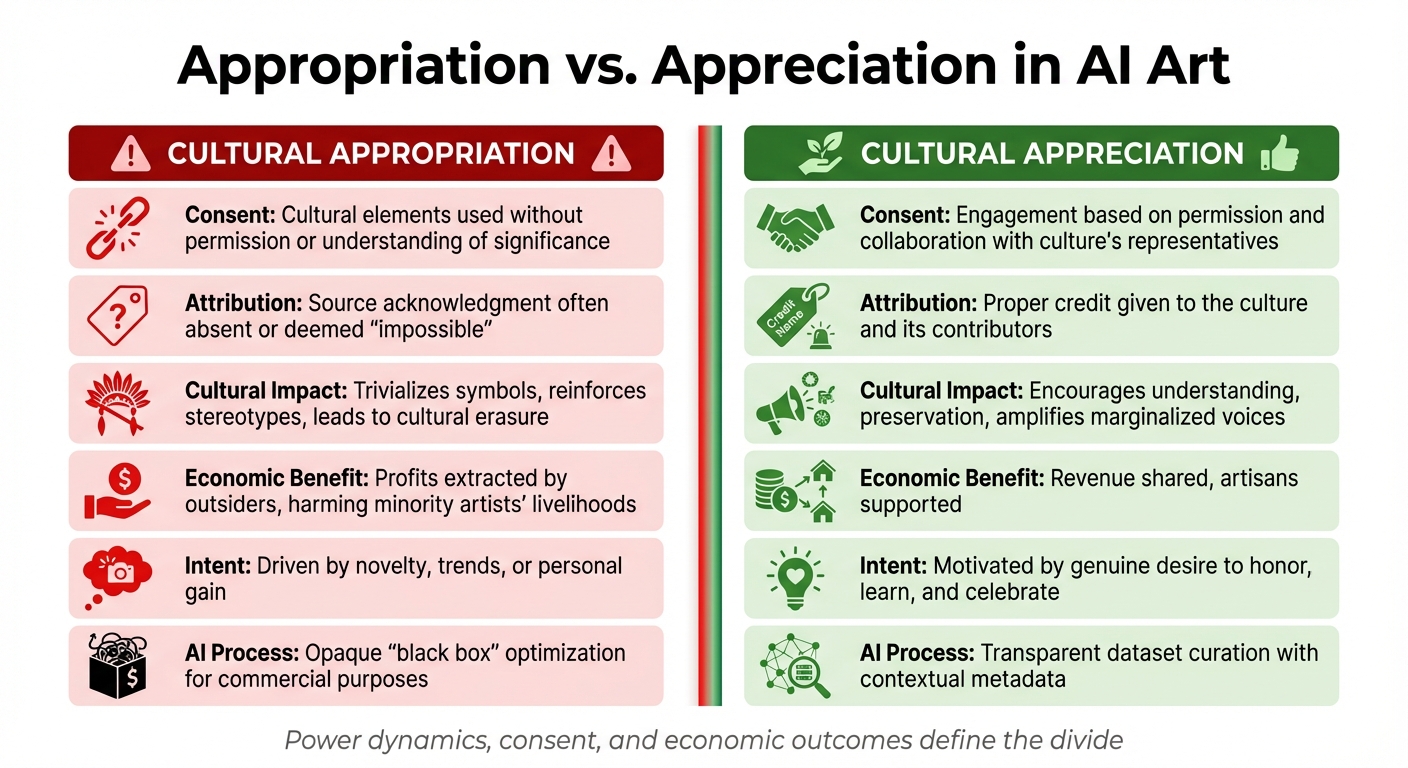
Cultural Appropriation vs Appreciation in AI Art: Key Differences
When discussing AI art, the divide between appropriation and appreciation becomes clear through power dynamics, consent, and economic outcomes. Appropriation occurs when AI systems take cultural elements without permission, stripping them of their meaning and using them for profit. Appreciation, on the other hand, involves working closely with cultural stewards, ensuring traditions are respected and processes are transparent.
The economic effects of appropriation are significant, threatening the livelihoods of artists and creative professionals. In the U.S., the creative economy accounts for nearly 10% of GDP and supports around 30 million jobs globally. When AI systems exploit cultural elements, they often leave originating communities uncompensated. Predictions suggest that by 2026, AI could affect over 200,000 creative jobs in the filmmaking industry alone.
A striking example of appropriation occurred in August 2022 when Capitol Records signed FN Meka, a virtual rap artist developed by Factory New. After backlash from Industry Blackout, the contract was canceled within days. The controversy highlighted how the project profited from Black culture while failing to compensate the Black artist who provided the vocals.
The table below highlights the critical differences between cultural appropriation and appreciation:
Comparison Table: Appropriation vs. Appreciation
| Factor | Cultural Appropriation | Cultural Appreciation |
|---|---|---|
| Consent | Cultural elements are used without permission or understanding of their significance | Engagement is based on permission and collaboration with the culture's representatives |
| Attribution | Source acknowledgment is often absent or deemed "impossible" | Proper credit is given to the culture and its contributors |
| Cultural Impact | Trivializes symbols, reinforces stereotypes, and leads to cultural erasure | Encourages understanding, preservation, and amplifies marginalized voices |
| Economic Benefit | Profits are extracted by outsiders, harming minority artists' livelihoods | Revenue is shared, and artisans are supported |
| Intent | Driven by novelty, trends, or personal gain | Motivated by a genuine desire to honor, learn, and celebrate |
| AI Process | Relies on opaque "black box" optimization for commercial purposes | Uses transparent dataset curation with contextual metadata |
This comparison underscores the importance of ethical practices in AI art, ensuring that creativity uplifts rather than exploits.
Ethical Guidelines for AI Art Creation
As AI-generated art becomes more prevalent, establishing clear ethical guidelines is crucial to navigating the fine line between cultural appreciation and appropriation.
Best Practices for Ethical AI Art
Creating ethical AI art involves thoughtful, intentional steps throughout the process. Developers should focus on building datasets that are diverse and contextually accurate. This means collaborating with experts like anthropologists, cultural specialists, and community leaders to ensure traditions and symbols are represented authentically and respectfully. By doing so, the risk of unintentionally misusing or misrepresenting cultural elements can be minimized.
Regular audits are another key practice. Using bias detection algorithms, developers can identify and address cultural biases within AI systems. For example, in December 2022, a collective effort by 5,000 individuals and several online art platforms led to the removal of over 80 million images from the LAION dataset used by Stable Diffusion. This action highlighted the growing demand for consent-based practices in AI art creation. Platforms like ArtStation and Shutterstock have since introduced tools that allow creators to exclude their work from AI training datasets.
Transparency is equally important. Artists should document their creative process, including prompts, iterations, and decisions, to support claims of authorship and demonstrate ethical practices. Marketers and organizations working with AI-generated art should request detailed data usage statements from AI providers. Notably, the European Court of Justice has ruled that originality in a work hinges on independent creative decisions.
To ensure responsible AI deployment, organizations can adopt ethical frameworks from bodies like UNESCO or the IEEE. These guidelines provide a foundation for aligning AI systems with cultural expectations and include mechanisms for ongoing monitoring and feedback. By following these practices, creators can produce AI art that respects cultural boundaries and promotes ethical engagement.
Tools for Ethical AI Content Creation
A range of tools is available to help creators uphold ethical standards in AI-generated content. For instance, Intel's FakeCatcher is designed to verify the authenticity of digital content, while Microsoft's Emissions Impact Dashboard tracks the carbon footprint of AI usage. This is particularly relevant given that training OpenAI's GPT-3 model produced 502 metric tons of carbon emissions - the equivalent of emissions from 100 average passenger cars over a year.
To address bias, the UC Santa Cruz Bias Evaluator employs the Implicit Association Test to measure gender and racial biases in AI models. For creators looking for comprehensive resources, the AI Blog Generator Directory (https://aibloggenerators.com) offers a curated list of AI tools. This directory includes text-to-image generation software as well as resources for tasks like SEO optimization, automated keyword research, and CMS integration. Many of these tools feature transparency options and documentation capabilities to ensure proper attribution and cultural sensitivity in AI-generated content.
Conclusion: Balancing Creativity and Ethics in AI Art
The boundary between cultural appropriation and cultural appreciation in AI art hinges on factors like intent, context, and process. Appropriation often misuses cultural elements for profit or novelty, ignoring their deeper significance. On the other hand, cultural appreciation involves genuine interest, collaboration with cultural experts, and an awareness of power dynamics - focusing on preserving cultures rather than diminishing them.
AI technology adds another layer to these challenges by accelerating appropriation. Without proper oversight, algorithms can scrape sensitive materials, strip them of their context, and reduce sacred symbols to generic presets. The impact isn't hypothetical: surveys show that 74% of artists believe AI-generated artwork currently lacks ethics, and 55% are concerned about its potential to harm their income. A telling example is the FN Meka controversy in August 2022, where public backlash over cultural insensitivity led Capitol Records to cancel the project within days.
To address these issues, ethical guidelines are essential. Developers should focus on curating diverse and respectful datasets, conducting regular bias checks, and involving cultural communities during design stages. Transparency is equally important - documenting data sources and creative processes helps ensure respect for cultural boundaries. Striking this balance is vital as AI continues to reshape the creative landscape in the U.S. and beyond.
Resources like the AI Blog Generator Directory (https://aibloggenerators.com) can support these ethical practices by offering tools for text-to-image generation, transparency, and documentation. Combined with initiatives like the European Union's AI Act, these tools give creators a framework to balance innovation with cultural awareness. The question isn't whether AI will change art - it already has - but how we define authorship, authenticity, and cultural care in this new era.
FAQs
How can I tell if an AI artwork is appropriation or appreciation?
To determine if AI-generated artwork shows appropriation or appreciation, it's important to evaluate the intent, context, and representation of the cultural elements involved. Appropriation typically happens when cultural symbols are used without respect, understanding, or connection to their origins. On the other hand, appreciation involves careful consideration, acknowledgment, and often collaboration with the communities tied to those cultural symbols.
Steps like curating datasets ethically, consulting experts, and being transparent about the sources used can help ensure that the artwork respects cultural boundaries and avoids crossing into harmful territory.
What steps should I take before using sacred or Indigenous styles in AI art?
Before using sacred or Indigenous styles in AI art, it’s important to research their meaning and significance thoroughly. These designs often carry sacred or historical importance, so understanding their context is key. Additionally, consulting cultural experts or representatives ensures that your work respects the traditions and values tied to these styles.
Pay close attention to the AI training datasets you use. Avoid including culturally sensitive designs if proper consent hasn’t been given. Ethical practices are essential - this includes obtaining permissions, giving credit where it’s due, and steering clear of stereotypes. These steps help ensure that these cultural styles are represented with respect and integrity.
How can communities be credited and paid when AI uses their cultural elements?
Communities can be recognized and fairly compensated for AI's use of their cultural elements by implementing legal protections for Indigenous Knowledge Systems and traditional cultural expressions. These frameworks help ensure proper acknowledgment and equitable payment for their contributions.
Equally important is working directly with cultural experts and community representatives. This involves consulting them during dataset creation, establishing ethical guidelines, and maintaining oversight to protect cultural integrity and prevent misuse or misrepresentation.