Quick answer
An AI blog generator is useful when you want help across more than one content step, not only drafting. In 2026, the better tools support a broader workflow: they help shape the angle, organize the outline, generate usable sections, and make human review faster instead of heavier.
That is the real distinction. A generic blog generator can describe almost any tool that produces article text, but an AI blog generator should be judged by how well it handles the full path from prompt to review-ready draft. If the tool only gives you fast paragraphs, it is probably closer to a narrow draft generator. If it helps your team move from idea to publishable article with clearer structure, less friction, and better editorial control, it is a stronger fit.
This guide explains how to compare AI blog generator options, which examples are worth studying, how the category overlaps with nearby searches, and how to implement an AI-assisted workflow safely.
sbb-itb-a759a2a
Why this category matters in 2026
The category matters more now because teams are no longer impressed by AI output alone. They care about whether the system helps them publish better blog content with less waste.
That shift has made evaluation more practical. Content teams now feel the cost of weak AI tooling in several places:
- article ideas that sound plausible but are too generic to publish
- outlines that look organized but create weak section flow
- first drafts that read fluently while still missing the real user question
- repetitive body sections that add editing time instead of saving it
- workflows that break down once multiple writers or editors touch the same tool
That is why AI blog generator is not just a synonym for blog writer or blog post generator. It usually points to a broader system-level expectation. The buyer wants AI-assisted blog creation, not only AI text output.
What a good AI blog generator should actually do
A strong AI blog generator should support the full blog workflow better than a narrow article generator.
| Job | What strong tools do | What weak tools do |
|---|---|---|
| Topic shaping | Help narrow the angle, audience, and article goal | Produce generic ideas with weak differentiation |
| Outline planning | Turn the brief into a useful article structure | Create heading lists that look tidy but lack logic |
| Draft generation | Build sections that are directionally usable | Produce long filler that still needs rebuilding |
| Revision support | Help improve clarity, transitions, and focus | Only paraphrase without improving usefulness |
| Workflow support | Fit repeated editorial use with stable prompts and review steps | Look good in demos but collapse in real production |
That is the key lens for this page. A searcher looking for an AI blog generator usually needs help evaluating the broader AI-assisted blog process, not only one drafting feature.
Practical framework: how to evaluate an AI blog generator
The best way to compare tools is to score the full workflow instead of the first draft alone.
| Criterion | What to check | Why it matters |
|---|---|---|
| Workflow coverage | Does the tool help with angle, structure, draft, and revision? | Broader coverage makes the category fit stronger |
| Prompt control | Can you guide audience, structure, tone, and constraints clearly? | AI only helps when it follows the system |
| Draft usefulness | Is the generated article close to editable, or does it need a rebuild? | Good output reduces total content cost |
| Fact and example risk | How much human verification is still required? | Polished AI output can still be shallow or wrong |
| Editorial fit | Can the team use it repeatedly without creating chaos? | Long-term value depends on process compatibility |
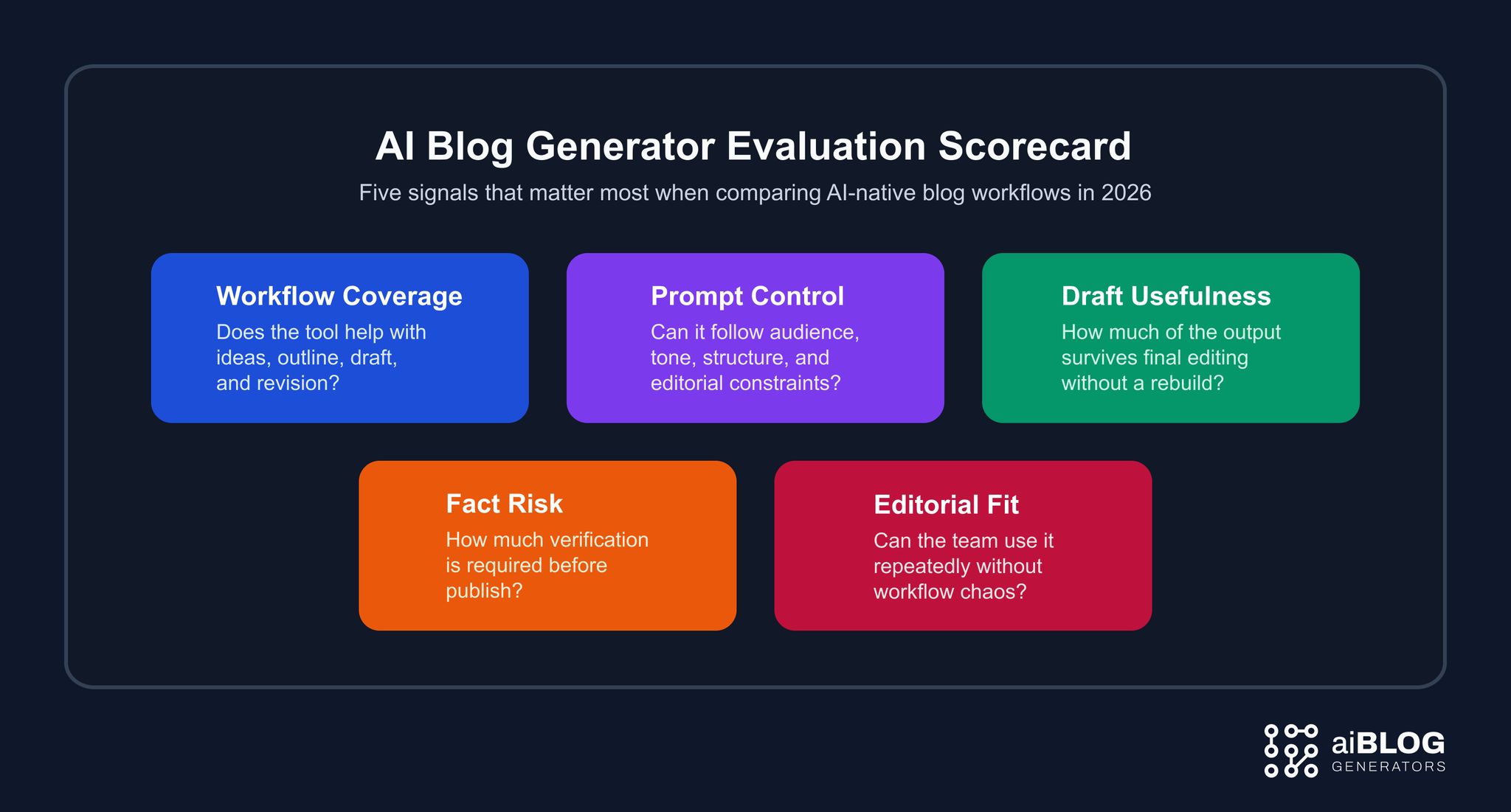
AI Blog Generator Evaluation Scorecard
A simple rule helps here: do not judge the tool by how much text it generates. Judge it by how much of your real blog workflow it improves without increasing risk.
External examples and tools worth studying
A good shortlist should include different kinds of AI-assisted blog workflows, not only one type of product.
| Example | Type | Why it belongs in this guide | URL |
|---|---|---|---|
| QuillBot AI Blog Post Generator | AI drafting tool | Useful benchmark for direct AI-generated article positioning and simple workflow framing | https://quillbot.com/ai-writing-tools/ai-blog-post-generator |
| RyRob Free AI Article Writer | Creator-focused AI writer | Strong reference for quick-answer structure, practical framing, and lightweight creation workflows | https://www.ryrob.com/ai-article-writer/ |
| AIOSEO Best AI Blog Post Generators | Comparison article | Helpful for shortlist formatting, buyer language, and pros-versus-cons structure | https://aioseo.com/best-ai-blog-post-generators/ |
| Jasper AI Blog Post Writer | Premium AI writing workflow | Useful for understanding team-level use cases, structure support, and editorial control messaging | https://www.jasper.ai/tools/ai-blog-post-writer |
| Writesonic AI Article Writer | SEO-oriented AI workflow | Helpful for buyers who care about search-shaped blog creation and guided article building | https://writesonic.com/ai-article-writer |
| Copy.ai Blog Post Wizard | Guided AI workflow | Strong example of step-based blog creation rather than raw one-shot generation | https://www.copy.ai/tools/blog-post-wizard |
These examples matter because they show the difference between broad AI blog creation, guided post generation, and narrower AI writing workflows.
Where this query differs from nearby pages
This keyword sits close to several sibling topics, but the job is broader.
Blog generator
This broader phrase can include older generator categories that are not always explicitly AI-first.
Blog post generator
This is narrower and usually centers on first-draft post creation after the topic is already known.
Blog ideas generator
This is earlier in the workflow and mostly about ideation rather than full blog creation.
Blog content generator
This often leans toward section writing, expansion, and rewriting.
Blog writer
This usually focuses more tightly on writing quality and editorial output.
AI blog generator free
This usually emphasizes pricing, limits, and free-plan tradeoffs.
That is why this page should stay centered on the broader AI-native blog workflow. It sits above the post-only, ideas-only, and free-only variants.
What AI-specific signals buyers should compare
AI blog generation introduces some category-specific buying questions that older content tools did not expose as clearly.
1. Workflow breadth
Can the tool help at more than one stage, or does it only generate draft text?
2. Prompt obedience
Can you shape the article around the audience, search goal, and structure you actually need?
3. Consistency across the article
Does the intro, middle, and FAQ feel like one article, or like fragments stitched together?
4. Hallucination and vagueness risk
Does the tool generate confident statements that still require heavy correction?
5. Repeatable editorial value
Can the same workflow support multiple posts without quality collapsing?
These are the questions that separate a novelty AI content tool from a real AI blog generator workflow.
Prompt tests buyers should run before choosing
A useful comparison should test how the tool behaves across several parts of the blog workflow.
Prompt test 1: angle plus outline
Example: “Create a practical blog outline for startup founders comparing AI website builders. Include one decision framework, a section on common mistakes, and a short FAQ.”
What to look for:
- whether the angle is specific enough to publish
- whether the outline order feels logical
- whether the tool understands the reader goal
Prompt test 2: draft one section deeply
Example: “Expand the section on common mistakes into one useful H2 with one example, one warning, and one practical next step.”
What to look for:
- whether the tool adds useful depth
- whether the example supports the section properly
- whether the writing stays aligned with the article goal
Prompt test 3: rewrite weak copy
Example: “Rewrite this paragraph to reduce repetition, improve clarity, and make it more useful for a SaaS content marketer.”
What to look for:
- whether the rewrite is better, not just different
- whether the tool improves usefulness instead of smoothing over weak logic
Prompt test 4: maintain consistency across parts
Example: “Using the same brief, generate the intro, one body section, and four FAQ entries. Keep the tone direct and avoid repeated phrasing.”
What to look for:
- whether quality stays stable across sections
- whether the tool repeats itself
- whether the article still feels coherent
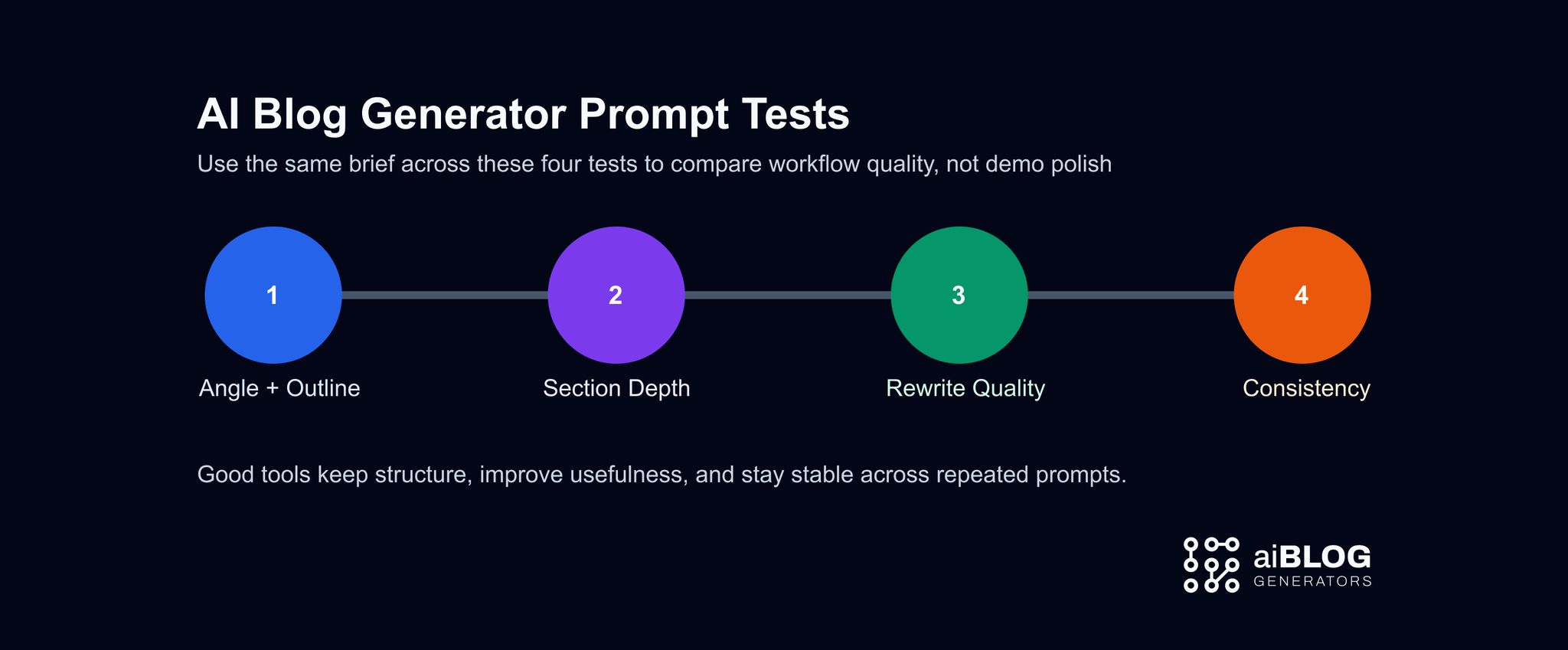
AI Blog Generator Prompt Tests
What free AI blog generators are actually good for
A free AI blog generator can still be useful, but mostly within narrower limits.
Free options are often good for:
- testing different prompt shapes
- building article outlines quickly
- generating intros or FAQ blocks
- comparing tone directions before writing manually
- running small content experiments before investing in a larger workflow
Free options are usually weaker when you need:
- stable long-form article quality
- dependable repeated use across many posts
- stronger workflow governance
- lower rewrite burden for editors
- team-level collaboration and consistency
That does not make free tools bad. It just means their best role is often experimentation and lightweight support, not full editorial operations.
How to use an AI blog generator safely in a real workflow
The main risk is treating AI output as the whole system instead of one layer of the system.
A safer workflow usually looks like this:
1. Start with a clear brief
Define:
- target reader
- article goal
- search or content intent
- required sections
- tone rules
- claims that need verification
2. Review the structure before expanding it
A safer order is:
- generate the angle
- generate the outline
- approve the section flow
- expand the approved sections
- polish tone and transitions
That order prevents teams from polishing the wrong article structure.
3. Separate factual review from style cleanup
AI-generated copy can sound strong while still being vague, outdated, or unsafe.
Review:
- examples
- comparisons
- product facts
- process steps
- any claim specific enough to mislead if wrong
4. Standardize the final edit
The final pass should always check:
- first-screen clarity
- section order
- usefulness of examples
- factual precision
- internal linking
- CTA fit
That is where many teams discover whether the AI blog generator is truly saving time or only moving the work downstream.
Step-by-step implementation plan for a real content team
If you want to test the category seriously, use a short structured evaluation cycle rather than one casual experiment.
Step 1: choose one repeatable article type
Pick one article pattern first, such as:
- comparison post
- how-to guide
- shortlist article
- FAQ explainer
That keeps the test fair across tools.
Step 2: build one reusable prompt scaffold
Your scaffold should define:
- reader
- article goal
- main keyword or topic
- mandatory sections
- tone rules
- examples rules
- factual review warning
- CTA policy
This makes it easier to judge the tool rather than the randomness of the prompt.
Step 3: test more than one stage
Do not only test first-draft generation. Also test:
- topic shaping
- outline creation
- section expansion
- rewrite quality
- FAQ generation
This is especially important for the AI blog generator category, because its value claim is broader than one paragraph of output.
Step 4: score edit burden and workflow value
Track:
- how many structural changes were needed
- how many factual checks were required
- how many sections survived the final edit mostly intact
- how much manual rewriting was still required
Step 5: keep a narrow shortlist
After a one-week evaluation, keep only the tools that:
- follow instructions consistently
- reduce editorial drag
- fit your publishing cadence
- stay useful across repeated prompts
That is a better buying rule than choosing the tool with the best single demo output.
Common mistakes and risk controls
Mistake 1: treating the generator as a full autonomous writer
Many tools can create text quickly but still fail at real editorial usefulness.
Risk control: judge the workflow outcome, not the draft speed.
Mistake 2: mixing all sibling jobs into one page or one test
If your team uses the same test for topic generation, drafting, and rewriting, the results become muddy.
Risk control: separate idea, draft, and revision tests clearly.
Mistake 3: trusting fluent copy too early
AI blog generators can produce confident-sounding material that still requires factual review.
Risk control: make verification a required stage, not an optional pass.
Mistake 4: overvaluing one good output
A single strong draft does not prove the workflow is stable enough for production use.
Risk control: test repeated-use consistency before choosing a tool.
Mistake 5: choosing the broadest tool without process fit
A tool can cover several workflow stages and still be a poor fit for your team.
Risk control: compare tools against your real content process, not only against feature pages.
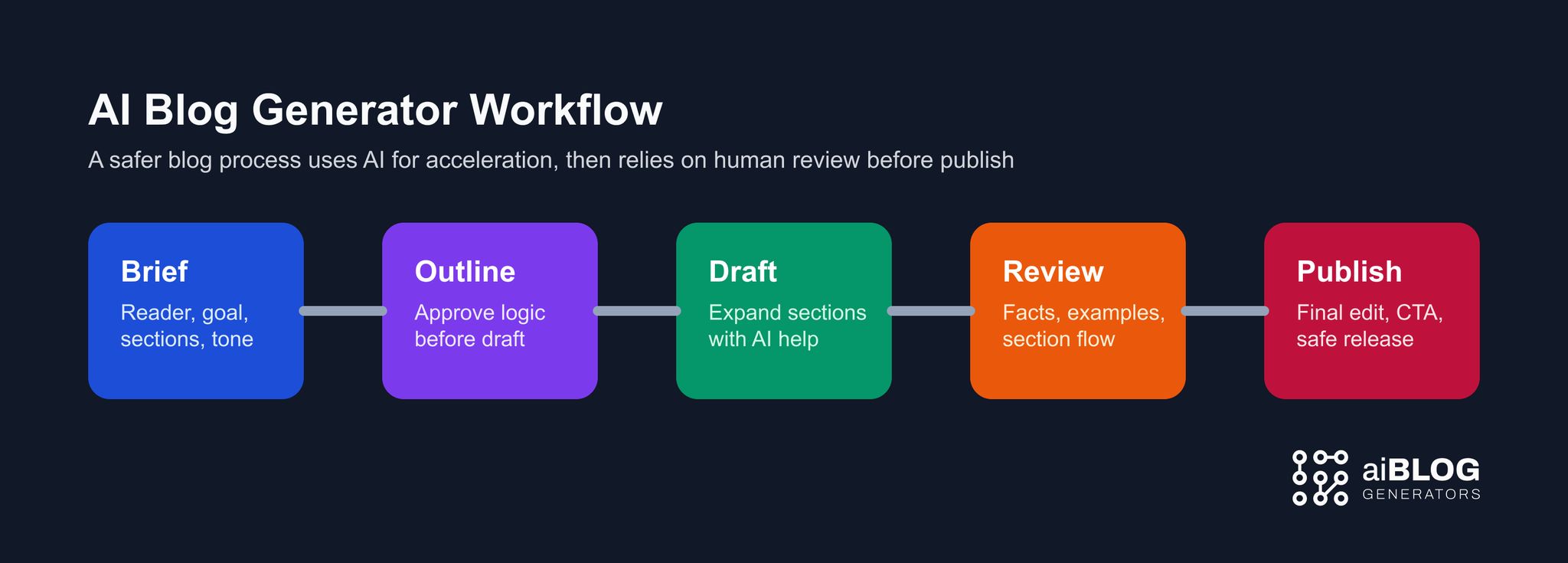
AI Blog Generator Workflow
Quality control and human review are the real advantage
The best AI blog generator workflows still win because of human judgment.
A strong review layer checks:
- whether the article answers the right question early enough
- whether the section order supports the intent
- whether examples are useful and believable
- whether claims are precise enough to publish
- whether the final CTA fits the article stage
That is why teams that succeed with AI-generated blogging usually talk more about process discipline than about model hype. The tool matters, but the review system matters more.
Where AIBlogGenerators fits in this workflow
AIBlogGenerators is most useful when you are comparing blog-creation workflows and trying to understand which tool pattern fits your publishing process.
Use AI Blog when you want a broader AI-assisted blog creation path. Use AI Writer when the job is narrower and you primarily need support with draft generation and writing output.
That distinction matters because many teams do not need the same tool for every content step. Some need a stronger generation system. Others need a broader workflow view before committing to one tool stack.
If you are choosing between broad AI blog workflows, it also helps to compare Blog Generator for the wider category page that is not always explicitly AI-first, Blog Generator Tool when the selection criteria matter more than category definition, and Free AI Blog Generator when pricing limits become the deciding factor.
FAQ
What is an AI blog generator?
An AI blog generator is a tool or workflow that helps create blog content using AI across one or more stages, such as ideation, outlining, drafting, rewriting, or FAQ generation. The stronger options support a broader editorial process rather than only fast text output.
How is an AI blog generator different from a blog generator?
The overlap is strong, but AI blog generator usually emphasizes AI-assisted workflow behavior more directly. It often implies broader AI support across the blog process rather than only the general idea of generated content.
How is an AI blog generator different from an AI blog post generator?
An AI blog post generator usually leans more tightly toward first-draft post creation. An AI blog generator often points to a broader content workflow that can include ideas, structure, drafting, and refinement.
Are free AI blog generators good enough?
They can be good enough for testing, lightweight publishing, and early-stage workflows. They are usually weaker when teams need stable output quality, stronger controls, and lower rewrite effort at scale.
What should I test before choosing one?
Test angle creation, outline quality, section expansion, rewrite usefulness, repeated-use stability, and how much human review is still required before publishing.