Quick answer
A blog generator is useful when it shortens the path from idea to publishable draft without creating extra cleanup work for your team. In 2026, the best options do three things well: they help you shape the angle, produce a structured first draft, and make it easier to review facts, tone, and SEO coverage before you hit publish.
If you only need ideas, a blog ideas generator or blog topic tool may be enough. If you need a full first draft, a blog post generator or blog writer workflow is closer to the right fit. If you want a repeatable content system, the better choice is usually a blog generator tool that fits your editorial process rather than the tool that promises the fastest output.
This guide explains how to evaluate the category, what examples are worth studying, and how to turn AI output into a safe, repeatable publishing workflow.
sbb-itb-a759a2a
Why this matters in 2026
The category is more crowded than the label suggests. Some tools marketed as a blog generator only produce topics. Others create full drafts but offer weak control over structure, citations, or factual quality. A few are useful for real publishing workflows, but many are still best treated as draft accelerators rather than autonomous writing systems.
That matters for three reasons.
First, the editorial bar is higher. Search visibility depends more on clarity, topical depth, and quality control than on sheer output volume. A fast generator that creates generic posts can still slow your team down if every article needs a heavy rewrite.
Second, the category language is messy. Buyers search for blog generator, blog content generator, blog post generator, blog writer, and ai blog generator free as if they all mean the same thing. In practice, each phrase often points to a slightly different job in the workflow.
Third, teams no longer need just a novelty tool. They need a system that can support briefs, drafts, editing, and review without creating process chaos.
That is why the best way to evaluate a blog generator in 2026 is not by hype, but by workflow fit.
What a blog generator actually needs to do
A useful blog generator usually covers one or more of these jobs:
| Job | What it should help with | Where teams get confused |
|---|---|---|
| Topic discovery | Angles, title ideas, audience pain points | This is often closer to a blog ideas generator than a full writer |
| Outline creation | Headings, section flow, FAQ blocks | Many tools can outline well but produce weak body copy |
| Draft generation | Intro, sections, transitions, examples | This is where a blog post generator or blog writer workflow matters most |
| Revision support | Tone cleanup, tightening, repurposing | Good for polishing, not enough for full factual review on its own |
| Workflow support | Prompt reuse, collaboration, approvals | This is what separates a toy from a production-safe tool |
That distinction helps avoid overlap with sibling topics on the site. A page targeting blog generator should explain the category and the workflow. A page targeting blog topic generator should focus more tightly on ideation. A page targeting blog post generator should lean harder into full-draft production.
Practical framework: how to evaluate a blog generator
Before you compare tools, decide what a successful outcome looks like. For most teams, a strong blog generator should reduce drafting time without reducing trust, accuracy, or editorial control.
Use this five-part scorecard.
| Criterion | What to check | Why it matters |
|---|---|---|
| Angle quality | Does the tool understand the article goal, audience, and search intent? | Weak angle selection creates generic posts even when the writing sounds fluent |
| Structure control | Can you shape headings, FAQ blocks, sections, and tone? | Good structure lowers revision time and improves publish consistency |
| Draft usefulness | Is the first version actually editable, or does it require a restart? | Teams save time only when the first draft is directionally correct |
| Fact safety | Does the workflow support review, verification, and cleanup? | AI speed is not worth much if factual correction takes longer than writing manually |
| Workflow fit | Can the tool fit your process for briefs, reviews, and publishing? | A tool that fights your workflow will not scale, even if output quality looks good in a demo |
A simple decision rule helps. If a tool scores well on angle quality and structure control but poorly on fact safety, it may still be worth testing as a first-draft assistant. If it scores poorly on draft usefulness and workflow fit, it is probably not the right system for regular publishing.
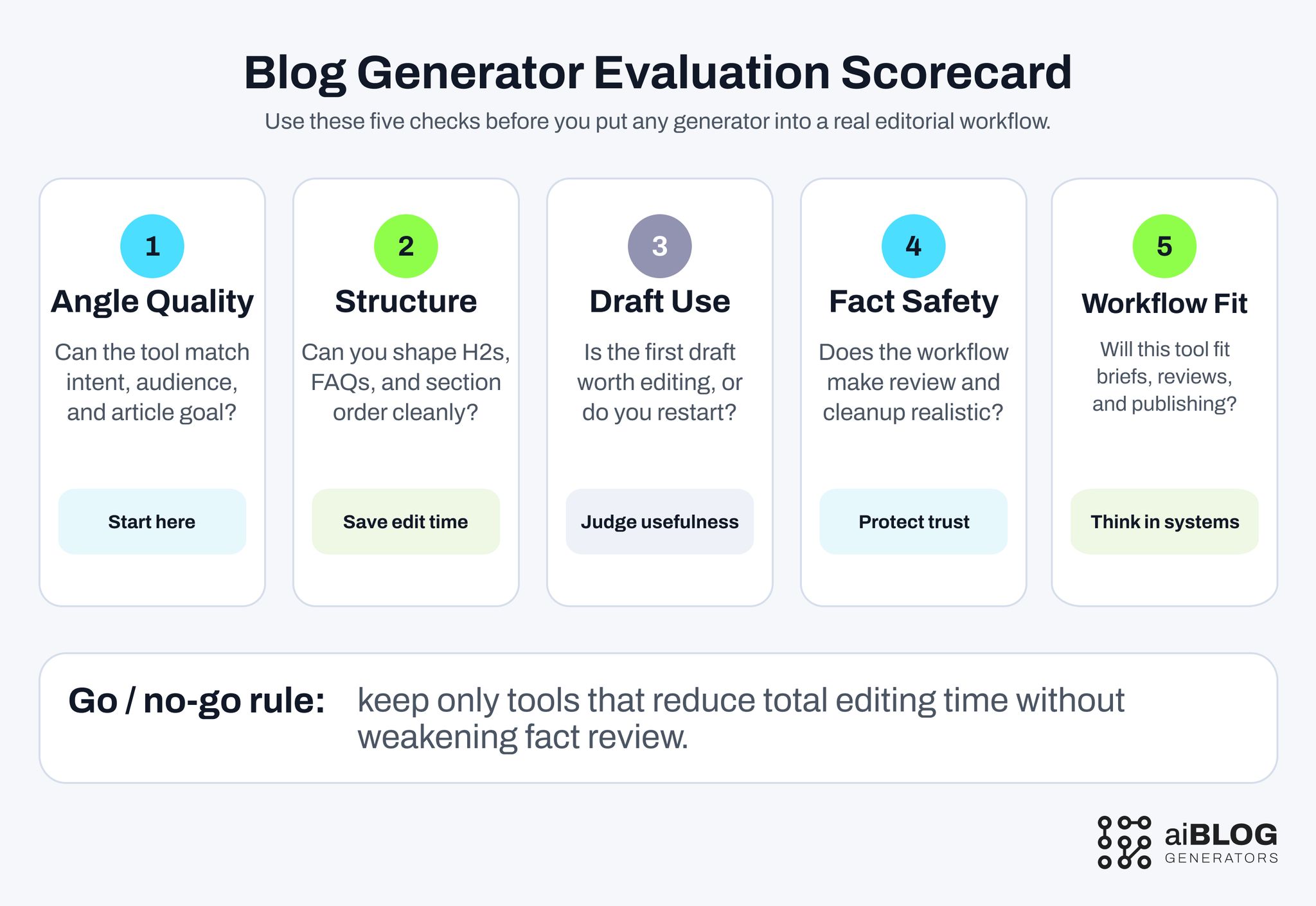
Blog Generator Evaluation Scorecard
External examples worth studying before you choose
You do not need to study dozens of tools to understand the category. You do need a balanced set of examples that show the difference between idea generation, full drafting, and comparison-style evaluation.
| Example | Type | Why it fits this guide | Who should study it | URL |
|---|---|---|---|---|
| QuillBot AI Blog Post Generator | Tool page | Useful for understanding prompt-to-draft positioning and how tool pages frame output speed | Buyers comparing direct draft generators | https://quillbot.com/ai-writing-tools/ai-blog-post-generator |
| RyRob AI Article Writer | Tool/workflow page | Good reference for creator-focused quick answers and practical first-draft language | Solo creators and lean content teams | https://www.ryrob.com/ai-article-writer/ |
| Blaze AI Blog Post Generator | Tool page | Helpful benchmark for workflow-oriented positioning around SEO-friendly blog production | Marketing teams that want a structured writing workflow | https://www.blaze.ai/ai-writer/ai-blog-post-generator |
| RyRob Blog Idea Generator | Idea-generation page | Useful for understanding where topic generation stops and full writing begins | Teams that need ideas before drafting | https://www.ryrob.com/blog-idea-generator/ |
| AIOSEO Best AI Blog Post Generators | Comparison article | Strong shortlist format for buyer language, comparison logic, and pros/cons framing | Editors building a shortlist before testing tools | https://aioseo.com/best-ai-blog-post-generators/ |
The point of this section is not to copy any one page. It is to study how the market frames the category so you can make a better tool decision.
What a practical blog generator workflow looks like
A reliable blog generator workflow usually follows five stages.
1. Start with a tight brief
The tool should know the audience, the search intent, the stage of awareness, and the outcome the article should create. When teams skip this step, even a strong blog content generator will default to generic copy.
At minimum, your brief should include:
- who the article is for
- what question it must answer
- what angle makes the article distinct
- what sections must appear
- what tone and reading level you want
- what claims need verification before publish
2. Separate idea generation from draft generation
This is where many teams waste time. A blog ideas generator can be excellent for headlines, angles, and subtopics while still being weak at producing a full article. Treat ideation and drafting as related but separate tasks.
A good rule is:
- use a topic generator for angle discovery and headline options
- use a blog post generator for full structure and first-draft creation
- use a human editor to combine the two into a publishable workflow
3. Ask for structure before asking for polish
When using a generator, the safest order is:
- generate a section outline
- review the structure manually
- expand the approved sections
- cut repetition before polishing tone
That order prevents the common mistake of polishing weak structure.
4. Review factual claims before style cleanup
A polished sentence can still be wrong. If your tool makes product comparisons, claims results, or names processes, the review pass should check truthfulness before word choice.
5. Standardize the final edit
The final pass should always cover:
- search intent alignment
- clarity of the first screen
- section progression
- examples relevance
- factual accuracy
- internal linking
- call-to-action fit
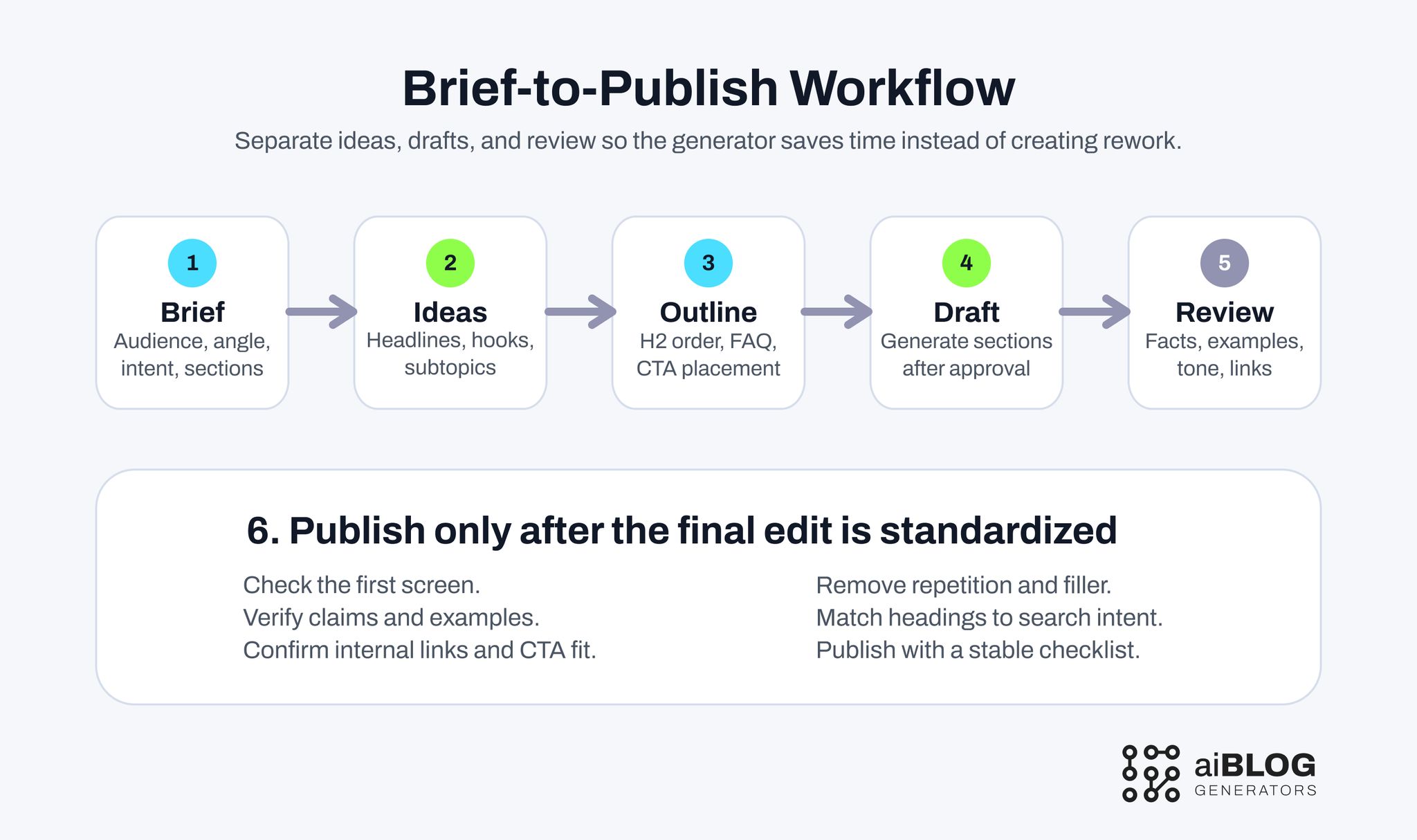
Brief-to-Publish Workflow
Step-by-step implementation plan for a real content team
If you are evaluating this category for production, use a short testing cycle instead of a one-day impression test.
Step 1: define one article type to test
Pick one article archetype first. For example:
- product comparison
- how-to guide
- list of tools
- FAQ explainer
A broad test across too many formats makes results hard to compare.
Step 2: create one reusable prompt scaffold
Your prompt scaffold should include:
- main keyword and user intent
- H2 structure rules
- sections to include and sections to avoid
- tone rules
- factual caution rules
- CTA rules
This makes testing fair across multiple tools.
Step 3: test three outputs, not one
Run at least three prompts per candidate tool:
- a quick-answer explainer
- a comparison-style article
- a deeper implementation guide
Some tools look strong on short explainers and weak on long-form structure. Others do the opposite.
Step 4: measure edit time, not just first impression
A blog generator that looks impressive in the first minute may still create more work than it saves. Track:
- minutes spent rewriting the intro
- number of structural changes needed
- number of claims that need checking
- how many examples you had to replace
Step 5: keep a narrow shortlist
After one week, cut the list down to the tools that:
- follow instructions most reliably
- reduce structural editing
- support your actual publishing cadence
This is where category clarity helps. If a tool is really an idea engine, keep it in that lane instead of forcing it to become your full blog writer.
Common mistakes and risk controls
Mistake 1: treating every generator as a full writing platform
Some products are better at prompts and ideas than complete articles. If you expect a lightweight generator to replace your entire workflow, you will judge it unfairly and still end up with thin content.
Risk control: define the exact job each tool must do before you test it.
Mistake 2: optimizing for speed instead of publish readiness
A generator can produce copy in seconds and still be a poor business decision if the draft needs heavy rewriting.
Risk control: score edit time and publish readiness, not just draft speed.
Mistake 3: skipping factual review because the output sounds polished
Fluent text can hide weak reasoning, outdated claims, or vague examples.
Risk control: add a dedicated fact-check pass before tone cleanup.
Mistake 4: letting one keyword pull the article off-topic
Because the category overlaps with blog content generator, blog writer, and ai blog generator free, some drafts drift into adjacent keyword territory and lose focus.
Risk control: center the article on the main job of a blog generator and use sibling terms as supporting context only.
Mistake 5: testing too many tools at once
When every writer uses a different tool, quality becomes hard to compare and harder to govern.
Risk control: keep one primary generator, one fallback, and one idea tool at most in the first testing round.
Quality control and human review are the real advantage
A blog generator becomes useful when it is paired with a clear review system. The faster the draft arrives, the more important your safeguards become.
A strong review system usually checks five things:
- does the article answer the promised question in the first screen?
- are the sections in the right order for the intent?
- do examples actually support the argument?
- are the claims precise enough to publish?
- does the CTA match the article stage and reader goal?
This is why teams that win with AI-generated content usually talk more about process than about models. They know a blog generator is only one layer of the system.
Where AIBlogGenerators fits in this workflow
AIBlogGenerators is most useful as a discovery and comparison layer when you are still deciding which category or tool set fits your workflow.
Relevant internal paths to use:
- browse writing-focused options at AI Writer
- compare publishing-oriented tools at AI Blog
- review category coverage from the main Blog
That makes the site useful before you commit to one tool stack. You can start with category discovery, shortlist what looks relevant, and then decide whether you need an idea engine, a full blog post generator, or a broader workflow tool.
If you are narrowing the category, it also helps to compare Blog Generator Tool when the main question is tool selection and evaluation criteria, AI Blog Generator if you want the broader AI-first version of this workflow, and Free Blog Generator when free-plan tradeoffs matter more than broad category coverage.
A 30-day rollout plan that keeps quality stable
The fastest way to waste a good blog generator is to adopt it too broadly before you understand where it helps and where it creates risk.
Use this rollout model instead.
Week 1: define the job
Choose the article type, prompt scaffold, and editorial checklist. Do not compare tools until the workflow is clear.
Week 2: run controlled tests
Generate multiple drafts from the same brief across a small shortlist. Focus on structure quality and edit time.
Week 3: connect it to publishing
Add internal links, CTA rules, examples checks, and final formatting standards. This is where the tool becomes part of an actual system.
Week 4: keep only what proves useful
Drop the tools that create unstable quality or unclear ownership. Keep the ones that improve production without increasing risk.
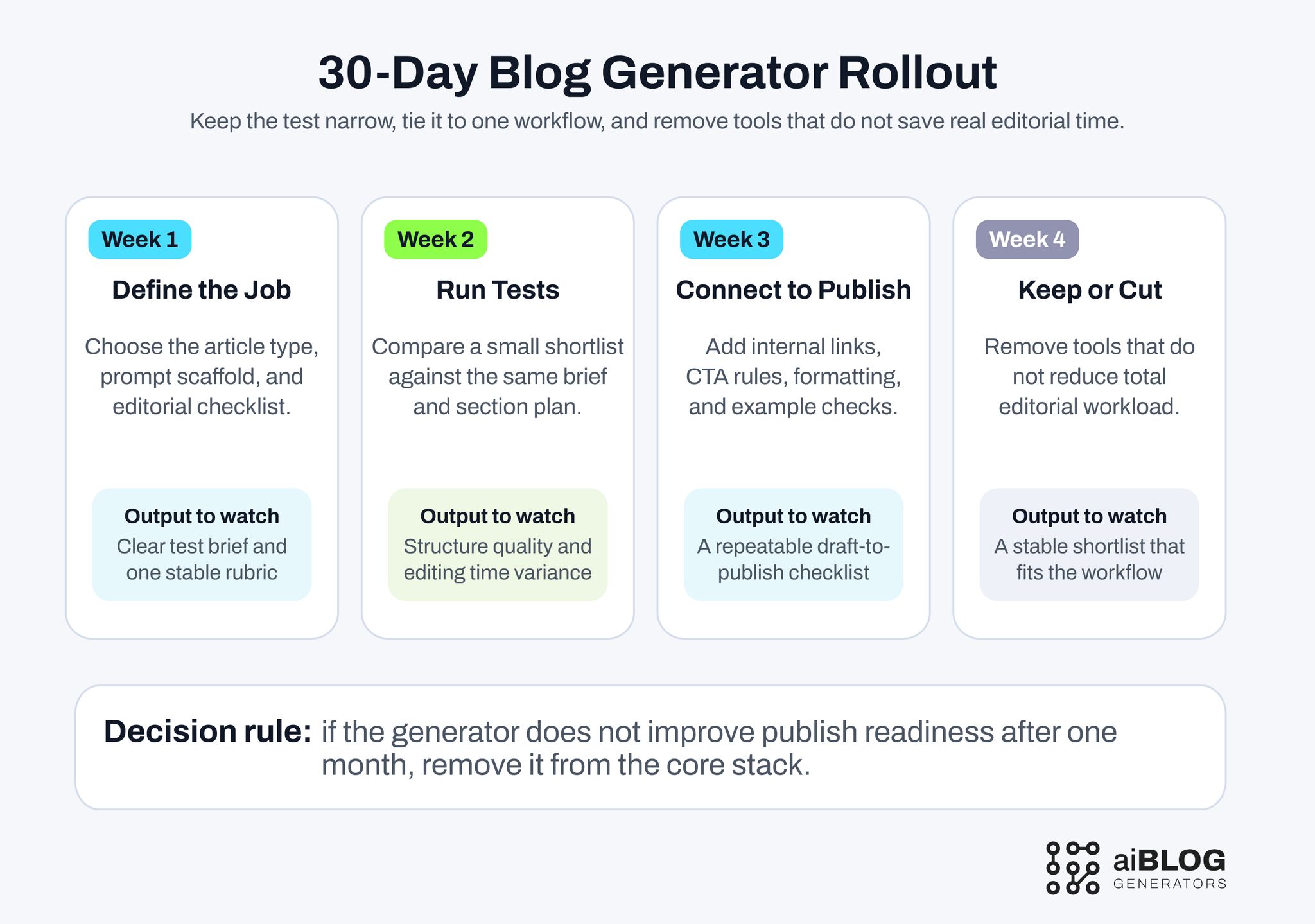
30-Day Blog Generator Rollout
A simple decision rule works well here: if a generator does not reduce total editorial time after a month of controlled use, it is not helping enough to keep.
FAQ
What is a blog generator?
A blog generator is a tool or workflow that helps create blog content faster. Depending on the product, that may mean generating ideas, outlines, full drafts, or revision suggestions.
How is a blog generator different from a blog post generator?
A blog post generator usually focuses more directly on producing a full article draft. A broader blog generator may cover more of the workflow, including ideas, structure, and revision support.
When should I use a blog ideas generator instead of a full writer?
Use a blog ideas generator when your biggest bottleneck is angle discovery or title creation. Use a full writer when you already know the angle and need help building a structured draft.
Can an ai blog generator free plan be enough for real publishing?
A free plan can be enough for validation and light testing, but teams often outgrow free limits once publishing cadence increases. It is best to test free access for quality and workflow fit before relying on it.
What should I measure during a trial?
Track first-draft usefulness, structural editing time, factual corrections, and whether the tool keeps your content aligned with the search intent.
Is a blog writer better than a generator?
Not automatically. The better choice depends on the job. Some blog writer tools are stronger at tone and longer drafts, while some generators are better at speed, prompts, or idea formation.