Quick answer
A blog post generator is useful when you already know the topic and need help turning that topic into a structured first draft. In 2026, the best options do more than write fast. They help you shape the outline, keep the article aligned with the query, and reduce the amount of cleanup required before publication.
That is the key difference between a generic blog generator and a true blog post generator. A broader generator may help with ideation, repurposing, or summaries. A blog post generator should be judged more directly on draft quality, structure control, and editorial safety.
If the output saves an hour of drafting but adds two hours of correction, it is not a strong tool. If it creates a directionally solid draft that your editor can verify and refine, it can become part of a real publishing workflow.
This guide explains how to evaluate the category, which examples are worth studying, what free options can and cannot do, and how to use the output safely.
sbb-itb-a759a2a
Why the category matters in 2026
The query blog post generator sounds simple, but the market behind it is messy. Some products produce a loose article stub. Some create a surprisingly usable first draft. Others are really just prompt wrappers around a model with very little structure control.
That matters because teams now expect more from AI-assisted writing. They do not only want speed. They want workflow stability. That includes better outlines, stronger first-screen answers, clearer heading logic, and fewer factual errors in the final draft.
There is also more keyword overlap now than there was a year ago. People search for blog post generator, ai blog post generator, blog post generator ai, free ai post generator, and free blog post generator almost interchangeably. But the user need is not always the same.
Some searchers want a free drafting tool for quick experiments. Some want a dependable writing layer inside a real content operation. Some are not even looking for a finished article. They only want the fastest route from a brief to a rough structure.
So the smart way to evaluate this category is not to ask whether AI can write. The better question is whether a blog post generator creates drafts that are worth editing.
What a blog post generator should actually do
A useful blog post generator should support the drafting stage first, then reduce the effort required in review and publishing.
| Job | What a strong tool should help with | What weak tools usually miss |
|---|---|---|
| Draft setup | Turn a topic or keyword into a sensible outline | They jump into body copy before the structure is sound |
| Article building | Create intros, section transitions, FAQs, and summaries | They produce repetitive filler instead of useful section development |
| Format control | Let you steer tone, length, audience, and section order | They make every article sound the same |
| Rewrite support | Make it easier to tighten, clarify, and re-angle a draft | They treat one-shot generation as the whole workflow |
| Editorial handoff | Reduce the time needed for review, fact checks, and publish prep | They create a lot of rewrite debt for editors |
That is why a page about blog post generator should stay focused on full-draft production. If the reader only wants topic ideas, they are closer to a topic generator workflow. If they want a broader category overview, they are closer to a blog generator article. Here, the main question is whether the tool can produce a draft that earns a second step.
Practical framework: how to evaluate a blog post generator
Use this scorecard before you compare tools.
| Criterion | What to check | Why it matters |
|---|---|---|
| Draft quality | Does the first version feel coherent, complete, and editable? | Good draft quality lowers rewrite time immediately |
| Structure control | Can you shape headings, section depth, and FAQ blocks? | Strong structure matters more than polished filler |
| Search-intent fit | Does the draft answer the likely query fast enough? | A post that misses intent will struggle even if the prose sounds smooth |
| Fact risk | How much verification work is required before publish? | Fluent output can still be wrong, vague, or misleading |
| Workflow fit | Can the tool support repeated use without confusing the team? | A tool that fights your process will not scale |
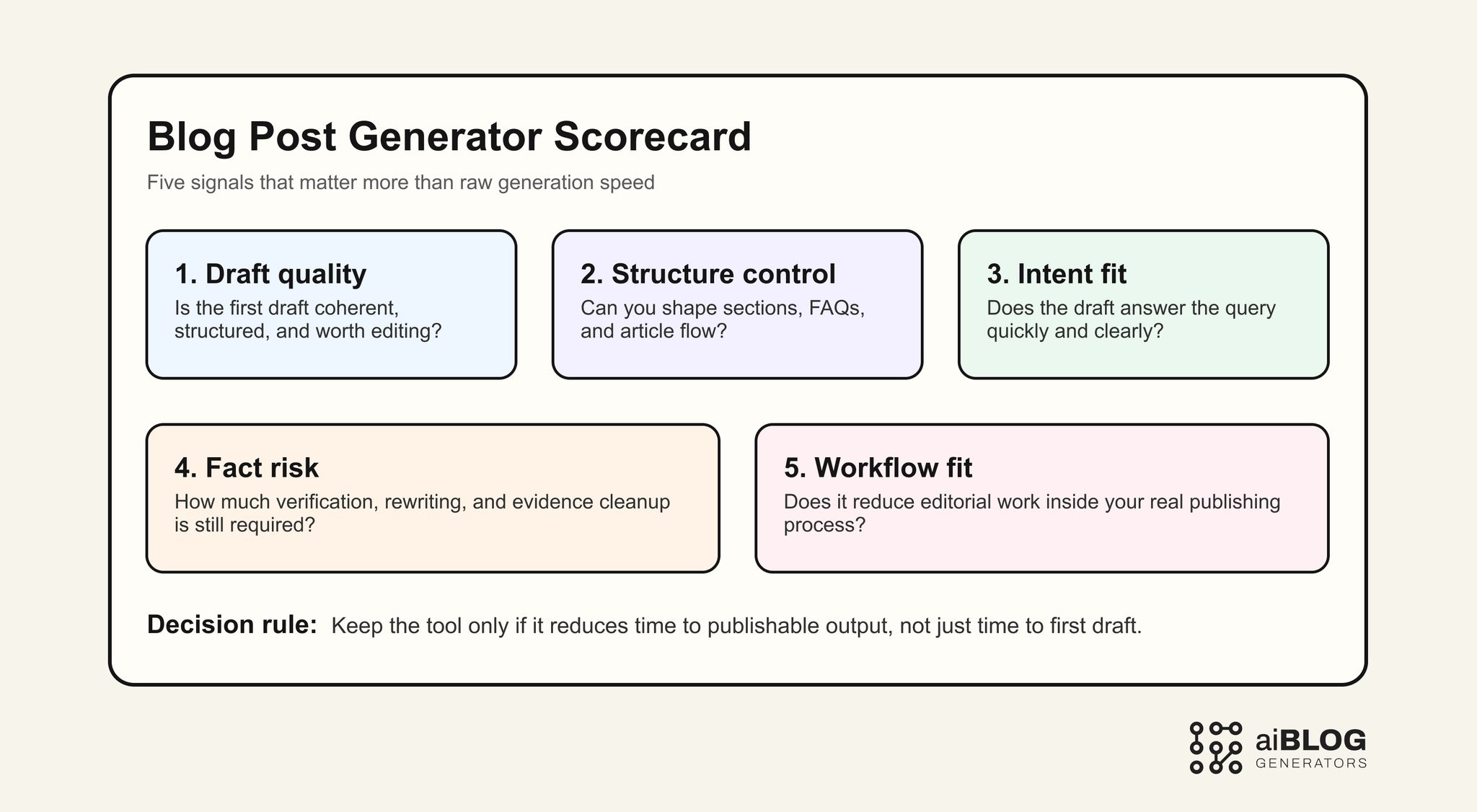
Blog Post Generator Scorecard
A good rule is to score the category based on publish readiness, not novelty. A tool can feel impressive in a demo and still be weak in real editorial use if the first draft requires major restructuring.
External examples and tools worth studying
You do not need to test every tool in the market. You do need a strong shortlist that shows the difference between full-draft tools, free experiments, and comparison-style buyer resources.
| Example | Type | Why it belongs in this evaluation | URL |
|---|---|---|---|
| QuillBot AI Blog Post Generator | Tool page | Useful benchmark for direct prompt-to-draft positioning and simple user flow | https://quillbot.com/ai-writing-tools/ai-blog-post-generator |
| Jasper AI Blog Post Writer | Product workflow | Good for understanding how premium tools frame long-form drafting and brand voice control | https://www.jasper.ai/tools/ai-blog-post-writer |
| Writesonic AI Article Writer | Product workflow | Helpful reference for SEO-focused article generation and multi-step prompting | https://writesonic.com/ai-article-writer |
| Copy.ai Blog Post Wizard | Product workflow | Useful for studying guided draft creation and workflow-led positioning | https://www.copy.ai/tools/blog-post-wizard |
| RyRob Free AI Article Writer | Creator workflow | Strong reference for quick-answer framing and creator-first usability language | https://www.ryrob.com/ai-article-writer/ |
| AIOSEO Best AI Blog Post Generators | Comparison article | Good benchmark for shortlist logic, buyer criteria, and tool pros/cons framing | https://aioseo.com/best-ai-blog-post-generators/ |
A practical test set can include one premium writing platform, one free-first tool, one guided wizard product, one comparison page, and one creator-oriented reference. That gives you a better view of the category than comparing only product homepages.
How to get useful output from a blog post generator
A blog post generator performs best when it is fed a clear brief instead of a vague keyword.
The safest input usually includes:
- the main query or topic
- the intended reader
- the outcome the article should produce
- required sections
- tone guidance
- what claims need verification
- whether the piece should be short, medium, or long form
This matters because many weak drafts are caused by weak prompts, not only weak tools. If you ask for “write a blog post about X,” you often get a generic introduction, recycled talking points, and no real logic in the section flow.
A stronger pattern is:
- ask for a draft outline first
- review the outline manually
- approve or edit the section structure
- generate section-by-section expansion
- tighten the final article after fact checking
That approach turns the tool into a drafting assistant instead of an uncontrolled ghostwriter.
What free ai blog post generators are actually good for
Free tools can be useful, but usually in narrower roles.
A free ai blog post generator or ai post generator free workflow is often strong enough for:
- outline experiments
- first-screen intros
- FAQ ideas
- short section stubs
- variation testing for angle and tone
A free option is often weak for:
- stable long-form structure
- original examples
- nuanced comparisons
- factual reliability
- consistent house style
That does not mean a free blog post generator is useless. It means the team should be honest about the job. If you need a fast ideation and draft-starting layer, free can be enough. If you need publish-ready article packets every week, free plans usually become bottlenecks.
A practical implementation plan for real publishing workflows
The fastest way to waste time with AI drafting is to treat generation as the finish line. The better model is to use the tool as one layer inside a controlled production process.
Step 1: choose one post type first
Do not test the tool on every content format at once. Pick one article archetype such as:
- comparison post
- how-to tutorial
- tools list
- FAQ explainer
That makes results easier to compare.
Step 2: lock the outline before the full draft
This is one of the clearest lessons from strong benchmark pages. The faster tools get better results when they build from structure first.
Ask for:
- title options
- intro angle
- H2 list
- FAQ ideas
- proof/example slots
Only then move to the full article draft.
Step 3: measure edit time, not generation time
A tool that drafts in 30 seconds is not automatically better than a tool that drafts in 3 minutes. The real KPI is how much work your editor still has to do.
Track:
- structural rewrites needed
- duplicate phrasing removed
- factual corrections added
- examples swapped out
- time to publishable draft
Step 4: review every claim before polish
A blog post generator can write confidently about products, trends, and workflows it does not fully understand. Treat fluency as a formatting advantage, not as proof of accuracy.
Step 5: standardize the final pass
Your final editorial pass should always check:
- first-screen answer quality
- intent alignment
- section order
- evidence and examples
- internal linking
- CTA fit
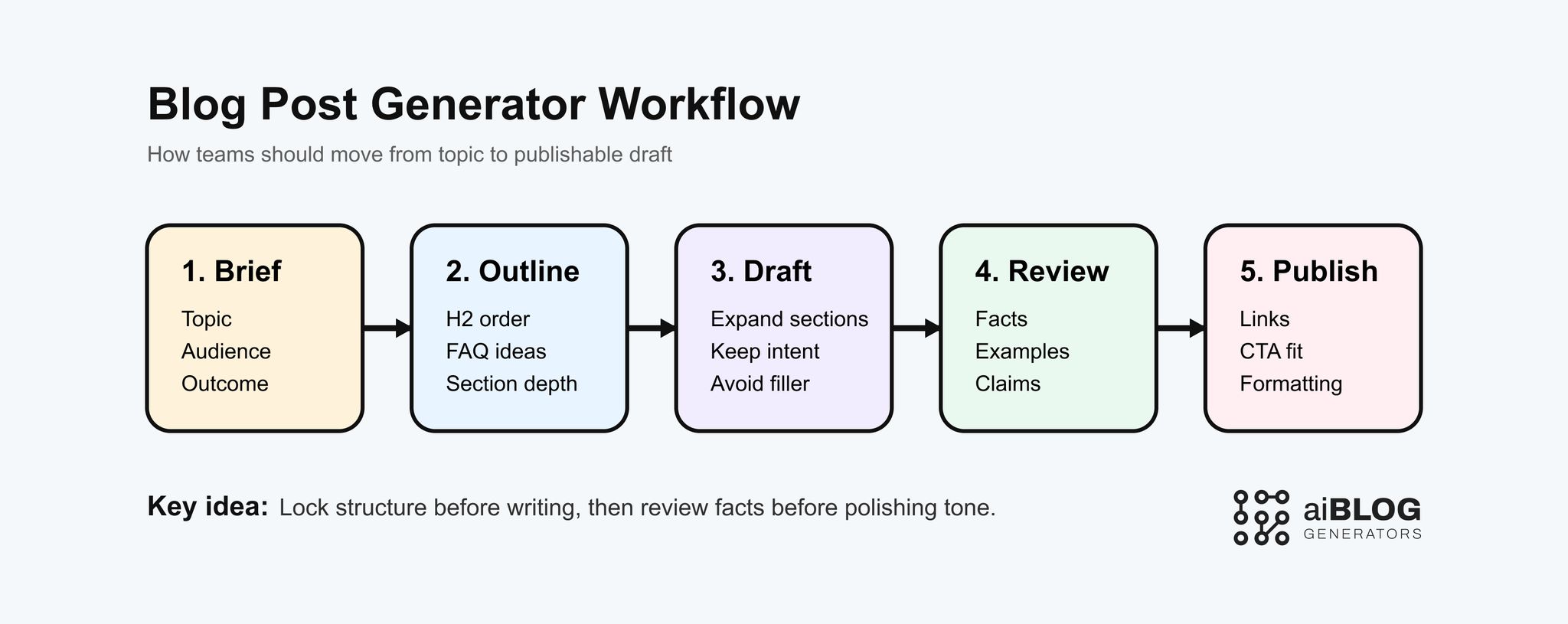
Blog Post Generator Workflow
Common mistakes teams make with blog post generators
Mistake 1: expecting one-shot publishable drafts
That expectation creates disappointment and weak governance. Even strong tools still work best with human review.
Better approach: treat the first output as a draft asset, not as a finished article.
Mistake 2: comparing tools without a shared prompt scaffold
If one tool gets a detailed brief and another gets a one-line prompt, the test is not useful.
Better approach: keep the prompt scaffold consistent when comparing products.
Mistake 3: letting category overlap blur the article target
A draft for blog post generator can drift into blog generator, blog content generator, or ai blog generator free territory. That makes the page less focused and weaker as an owner page.
Better approach: keep the center of gravity on full-draft creation and publishing workflow.
Mistake 4: overvaluing fluent tone
Some drafts read smoothly but still answer the wrong question, bury the actual angle, or make vague claims.
Better approach: score usefulness, structure, and factual reliability before style.
Mistake 5: ignoring rewrite debt
A tool can look cheap until you calculate how much time your editor spends cleaning its output.
Better approach: measure the full cost of the workflow, not only subscription price.
Quality control is what makes the category viable
The strongest teams do not win because they found a magical ai blog post generator. They win because they built a process around review, proof, and reuse.
A dependable review layer usually checks:
- is the article actually answering the target query?
- are the examples relevant and current?
- are the headings logically ordered?
- are any claims too broad or unsupported?
- does the CTA match the reader's stage?
This is also the main difference between trying a free ai post generator and operationalizing a real editorial workflow. One is about experimentation. The other is about consistency.
Where AIBlogGenerators fits in this workflow
AIBlogGenerators is most useful when you are comparing the category, testing what type of drafting help you actually need, and deciding whether your workflow needs a dedicated writer tool, a broader AI blog stack, or just a better shortlist.
Useful internal paths:
- compare drafting-oriented options at AI Writer
- explore publishing-focused tools at AI Blog
- browse the full content hub in Blog
That positioning matters because many teams do not need one universal tool. They need clarity about whether their bottleneck is ideas, outlines, or full-draft creation.
If you are narrowing the post-generation workflow, it also helps to compare AI Blog Post Generator when you want the AI-first version of this drafting category, Blog Post Generator AI when you are comparing the same drafting intent through a different phrasing pattern, and Free AI Blog Post Generator when free-plan limits are part of the buying decision.
A 30-day rollout plan for testing a blog post generator
Week 1: define the draft standard
Create one reusable article brief format and one editorial checklist.
Week 2: test a small shortlist
Compare a few tools using the same brief and track draft usefulness instead of speed alone.
Week 3: connect the best tool to your editing workflow
Add review rules, internal links, CTA standards, and formatting requirements.
Week 4: keep only what truly reduces workload
If the tool does not reduce total time to publishable output, replace it or narrow its role.
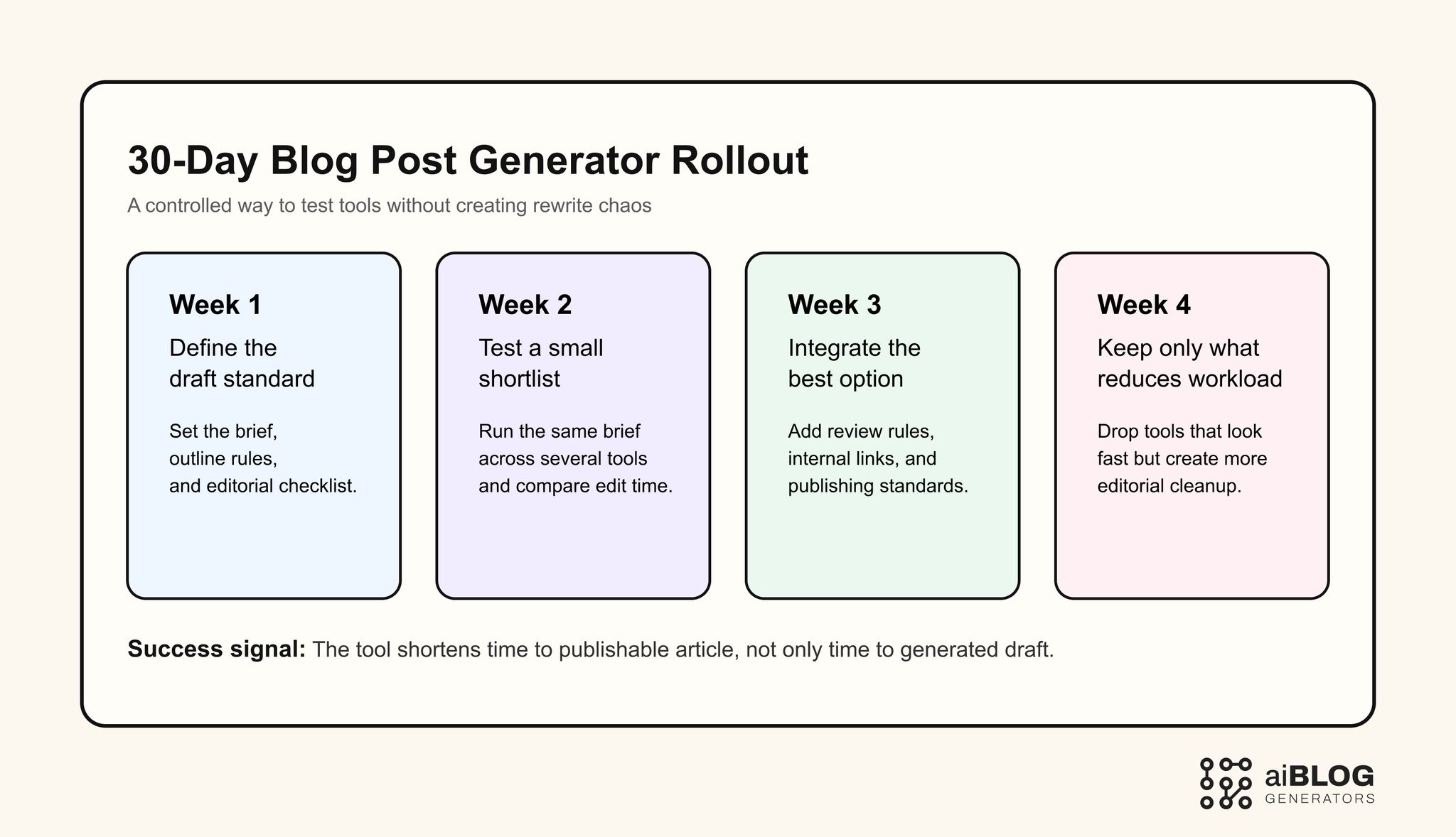
30-Day Blog Post Generator Rollout
This last point matters more than it sounds. A useful blog post generator does not only create copy. It creates enough structure and direction that human editors can move faster with confidence.
FAQ
What is a blog post generator?
A blog post generator is a tool or workflow that helps create a structured first draft of a blog article from a topic, keyword, or prompt.
How is a blog post generator different from a blog generator?
A blog post generator is more tightly focused on full-draft production. A broader blog generator may cover ideation, summarization, repurposing, or lighter writing tasks.
Is a free ai blog post generator enough for professional publishing?
It can be enough for testing, drafts, and lighter workflows, but most professional teams still need human review, fact checking, and stronger structure control than free tools usually provide.
What should I measure when testing a blog post generator?
Track edit time, structure quality, factual corrections, duplicate phrasing, and whether the final article stays aligned with the target query.
Can a blog post generator replace a writer?
Not fully in most real publishing workflows. It can reduce drafting time, but human review is still needed for judgment, verification, examples, and quality control.
What is the difference between blog post generator ai and ai blog post generator?
In practice, they usually point to the same category. The better question is whether the tool helps you produce a useful draft and reduce editorial cleanup.