AI content curation platforms simplify the process of finding, filtering, and organizing information. These tools use machine learning and natural language processing (NLP) and AI writing assistants to scan vast amounts of content, delivering tailored, high-quality results. Here's what makes them essential:
- Automated Content Discovery: Platforms like Feedly AI and BuzzSumo analyze millions of sources daily, using advanced models to surface relevant, timely content.
- Customization & Filters: Tools such as Curata and ContentStudio allow users to refine searches by keywords, tone, industry, or even funnel stages.
- Multi-Channel Publishing: Many platforms, like Scoop.it and Quuu, integrate with CMS and social media tools to streamline distribution.
- Analytics & Performance Tracking: Platforms like UpContent and Curata link curated content to measurable outcomes, such as engagement, ROI, and sales impact.
Quick Comparison:
| Platform | Key Feature | Best For |
|---|---|---|
| Feedly AI | 30,000 ML models for precision filtering | Industry-specific insights |
| Curata | Feedback loop for smarter recommendations | Scaling content efforts |
| BuzzSumo | Trending and evergreen content analysis | Viral and long-term content strategies |
| ContentStudio | Multi-dimensional filtering and scheduling | Social media and blog management |
| Scoop.it | Human curation with AI suggestions | Knowledge sharing and newsletters |
These tools save time, reduce workloads, and enhance blog content creation by focusing on quality and relevance. By combining curated content with original insights, you can maintain a strong brand presence while meeting audience needs.
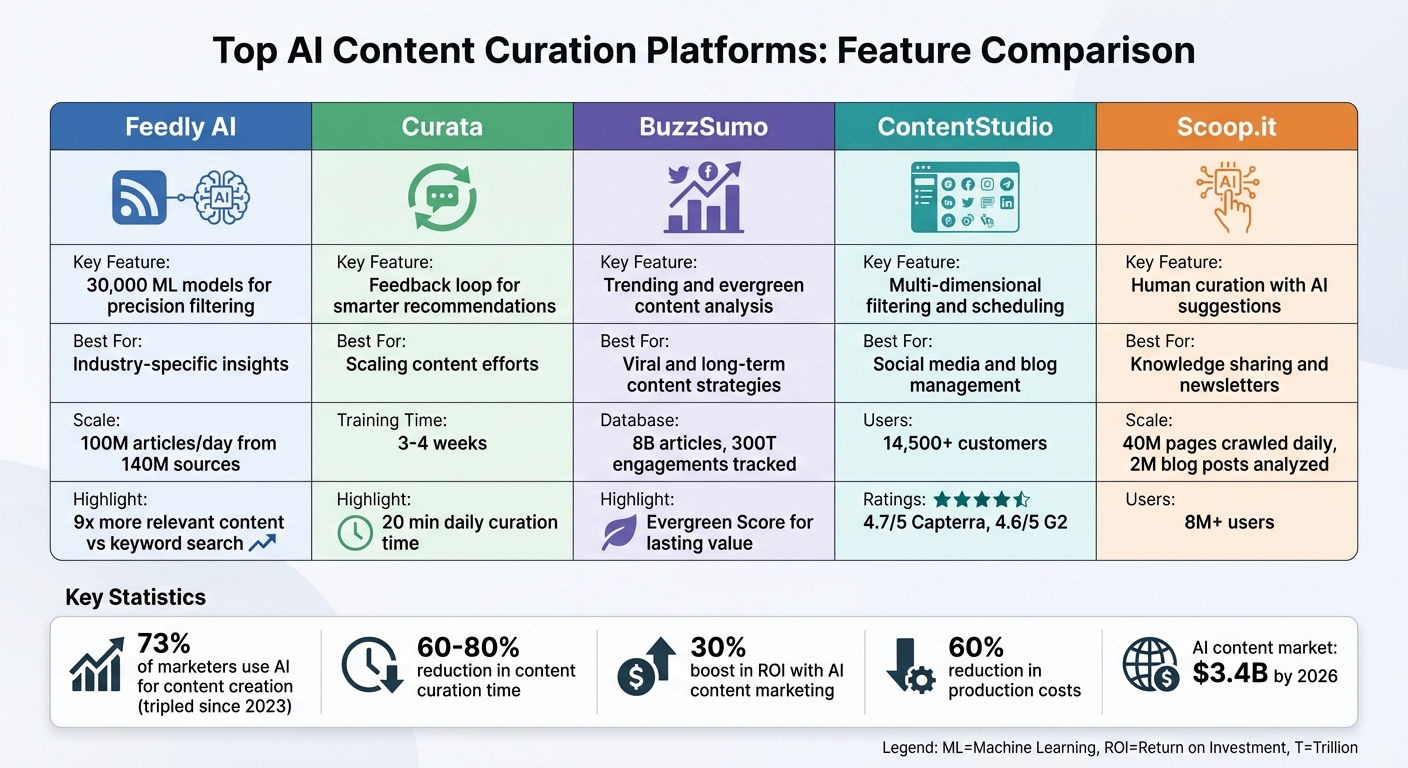
AI Content Curation Platforms Comparison: Features and Best Use Cases
1. AI Blog Generator Directory
AI-powered content discovery
The AI Blog Generator Directory is a go-to resource for content creators, bringing together more than 100 top AI tools for writing and blogging in one place. It includes everything from autonomous SEO agents to niche-specific content generators. Among these is Perplexity AI, an AI-powered search engine that not only delivers sourced answers but also integrates content generation features.
What makes this directory stand out is its use of Active Retrieval tools. These tools go beyond traditional RSS feeds by scanning unstructured web sources like niche blogs, news platforms, and industry-specific publications. For example, SEObot acts as a self-sufficient SEO agent, assisting with keyword optimization and content discovery. Other tools, such as Upword and FounderBrief, provide personalized research and condensed insights, helping creators find the most relevant information while maintaining their brand's unique style.
Customization and filtering options
The directory also features tools that adapt to your brand's voice by learning from your existing content, URLs, and style guides. This makes it easier to maintain consistency in tone and vocabulary. Additionally, niche-specific filters cater to industries like real estate, legal (via Cimphony), and healthcare (via Healify), ensuring creators find the best AI content generator tools for your business.
Advanced filtering options include mute filters to eliminate repetitive press releases and prioritization engines that highlight high-value content. As nbot.ai explains:
The primary challenge for professionals is no longer information access - it is signal-to-noise ratio optimization.
These tools also allow tagging content by funnel stages - such as awareness, consideration, or decision - ensuring that the content aligns with the buyer's journey. This tagging system improves not only content selection but also the accuracy of analytics. These filters work seamlessly with analytics tools to streamline the entire process.
Analytics and performance tracking
After discovering and customizing content, integrated analytics tools provide measurable insights. For instance, BlogPilot Pro includes marketing analytics and reporting features to track blog performance and content ROI across platforms like social media, email, and ads. Tools like BuzzSumo use Evergreen Scores and viral metrics to identify content that delivers long-term value.
Statistics show that companies using AI for content marketing have seen a 30% boost in ROI and a 60% reduction in production costs. The AI content creation market is expected to grow to $3.4 billion by 2026, with AI potentially automating up to 80% of content creation tasks. Additionally, tools like Writesonic and Junia AI integrate directly with CMS platforms such as WordPress and Medium, making it easier to move from content discovery to publication.
sbb-itb-a759a2a
2. Feedly AI
AI-powered content discovery
Feedly AI employs an impressive array of 30,000 machine learning models to sift through 100 million articles every day from 140 million sources. Instead of just relying on keyword matches, it identifies over 1,000 intelligence concepts - like "Strategic Moves" or "Threat Actors" - to surface content that truly matters. This approach results in up to 9 times more relevant content compared to basic keyword searches.
The platform's AI Feeds work like personal assistants, scanning vast amounts of content and prioritizing it based on user-defined AI Models and Boolean logic (AND, OR, NOT). For instance, the AI can tag articles with specific intelligence concepts, such as flagging a phishing method as a "TTP" (Tactics, Techniques, and Procedures). Dennis Underwood, VP of Molecular & Info Systems at Agenus, shares:
I find Feedly AI incredibly valuable to keep up with all the scientific news out there. It helps me move through my feeds much faster.
This powerful discovery system is further enhanced by tools that let users fine-tune searches to their exact needs.
Customization and filtering options
Feedly AI doesn’t stop at finding content—it works alongside essential AI content writing tools to help you refine it into actionable insights. Users can combine AI Models with Boolean operators to create highly specific queries. The Natural Language Filters feature allows you to narrow down searches using plain language, making it easy to zero in on niche topics, numerical data (like percentages or dollar figures), or even relationships such as "exported from the U.S. to Mexico". Additionally, you can limit your feeds to curated "Source Bundles", such as the Market Intel Bundle, which includes 26,000 sources.
To ensure quality, features like "Top Sources Only" and "Top Stories Only" highlight credible and frequently cited articles. The "Downvote" option lets you remove irrelevant content, helping the AI learn your preferences over time. For optimal results, aim to maintain about 10-20 articles per week per feed to keep the signal-to-noise ratio high.
Multi-channel publishing and scheduling
While Feedly doesn’t include built-in social media scheduling, it offers Automated Newsletters and integrates seamlessly with tools like Slack, Microsoft Teams, and Zapier, enabling you to share insights across platforms. The Ask AI feature takes things further by summarizing up to 25 articles, extracting actionable data into tables, and even generating multilingual summaries. Tino Klaehne, Director of Strategic Innovation & Intelligence at Lufthansa Innovation Hub, highlights its efficiency:
Ask AI enables us to create ready-to-use insights and datasets within Feedly, saving us hours of work every week.
Additionally, insights can be shared through the Feedly API, making it easy to integrate with custom workflows and other content management systems. Feedly reports that its tools allow teams to collect, analyze, and share insights 7 times faster than traditional manual methods.
3. Curata

AI-powered content discovery
Curata's NLP engine plays a key role in modern content strategies using advanced AI text generation tools. It scans hundreds of thousands of sources to pinpoint relevant content, analyzing context and themes while assigning relevancy scores. This ensures outdated material, duplicates, or non-target languages are filtered out [26,28].
The platform gets smarter over time through a feedback loop. As users approve or reject content, the AI fine-tunes its discovery process to align better with preferences [26,28]. Typically, it takes about three to four weeks of consistent use to train the system for reliable recommendations. Once trained, users can sift through hundreds of articles, videos, and images in just 20 minutes daily. Matt Carter from IBM Big Data & Analytics highlights its importance:
Curata software is the principal way we infuse content that is balanced for visitors to educate themselves.
Customization and filtering options
Curata allows users to create custom taxonomies for automatic content categorization. You can refine content flows by defining specific keywords, trusted sources, and preferred authors. The platform also supports audience segmentation, letting users build multiple content streams tailored to different topics or personas. These streams can feed into microsites or existing blogs.
For larger teams, role-based permissions and approval workflows ensure all content aligns with brand standards [28,29]. Ed Youngblood from Alcatel-Lucent shares:
Curata has enabled us to scale our content curation efforts using fewer marketing resources in a more connected manner.
The platform also simplifies production by pre-populating curated posts with summaries, royalty-free images, and metadata. This feature significantly reduces the time spent on manual editing. Combined with its seamless multi-channel publishing capabilities, Curata ensures your content reaches the right audience efficiently.
Multi-channel publishing and scheduling
Curata integrates with popular CMS platforms like WordPress, Joomla, and Drupal, as well as marketing tools such as HubSpot, Marketo, Eloqua, and MailChimp. With one-click publishing and social media distribution via tools like Buffer or Hootsuite, it streamlines the entire process. An on-the-fly browser plugin also allows for instant content curation [26,28].
One success story comes from Triumvirate Environmental, which used Curata to launch four monthly newsletters. This effort grew their subscriber base to over 10,000, doubled their web traffic, and tripled the number of qualified leads.
Analytics and performance tracking
Curata doesn’t stop at content discovery and customization; it also provides detailed analytics to measure performance. The analytics dashboard links content to tangible outcomes like social shares, lead generation, and sales pipeline impact. By integrating with tools like Salesforce, marketing automation systems, and web analytics, Curata offers a unified view of content performance [31,32]. Users can generate tailored reports based on content type, persona, writer, or buyer stage, helping support ROI-focused decisions.
For example, RingLead used Curata to combine insights from Google Analytics, Marketo, and Salesforce. This integration allowed them to track content performance throughout the sales funnel. One eBook alone contributed $180,000 to their sales pipeline. Amanda Nelson from RingLead explains:
Curata CMP helps us analyze our content like never before, down to the pipeline generated by each blog post.
4. ContentStudio
AI-powered content discovery
ContentStudio takes content discovery to the next level by leveraging Natural Language Processing (NLP) and semantic analysis to understand context beyond basic keyword matching. The platform scans thousands of websites, blogs, social platforms, and news outlets, assigning relevance and quality scores to pinpoint high-value content. Its Trending Content Hub makes spotting viral content easy, pulling from sources like the web, YouTube, and Twitter. Users can search trending topics or explore curated and custom topics to stay ahead of the curve.
The platform’s AI Studio adds a conversational element, enabling users to browse the web, summarize links, and analyze online sources without leaving the interface. This feature provides real-time updates, helping users keep up with industry trends. With over 14,500 customers across diverse industries, ContentStudio has become a trusted tool for many.
Customization and filtering options
ContentStudio allows users to create tailored feeds by filtering content based on keywords, domains, locations, and languages. Its Brand Knowledge feature lets users define a unique brand identity - covering tone, style, and vocabulary - which the AI applies to all curated and generated content. This ensures a consistent voice across all platforms.
The platform uses multi-dimensional filtering to evaluate relevance, quality, freshness, and credibility, while also eliminating duplicates and low-quality content. Users can set exclusion rules to automatically filter out unwanted topics, sources, or content types. Marketing expert Neal Schaffer highlights the platform’s value:
ContentStudio.io is a powerful content curation tool that ensures you can become part of, influence, and even generate thought leadership around a topic that is of interest to you or your business.
These advanced filtering and customization options make it easier to deliver content that resonates with your audience.
Multi-channel publishing and scheduling
ContentStudio simplifies content management across platforms like Facebook, Instagram, Twitter (X), TikTok, LinkedIn, Pinterest, and Google My Business - all from a single dashboard. Its AI-powered smart scheduling feature identifies the best times to post based on past performance, helping users maximize engagement. You can upload assets, auto-generate captions, and review everything in a table format before scheduling posts in bulk.
Dennis Lewis from Image Protect shares his experience:
ContentStudio is better than the big boys. I love the way all of the social/content marketing modules are tightly integrated.
The drag-and-drop visual content calendar makes planning straightforward, allowing teams to spot gaps, balance post types, and align their strategy. Beyond social media, ContentStudio integrates with WordPress and other CMS platforms, facilitating the integration of AI content generation APIs enabling users to publish or schedule blog posts directly. This all-in-one approach reflects the growing demand for streamlined, AI-driven content workflows.
Analytics and performance tracking
ContentStudio doesn’t just help you distribute content - it also helps you measure its impact. The platform’s centralized analytics dashboard provides detailed metrics across all connected social platforms. These insights help users identify what’s working and where adjustments are needed. Competitor analysis tools allow brands to benchmark their performance against industry leaders, highlighting areas of opportunity.
With features like campaign and label analytics, users can measure the effectiveness of specific content types and marketing efforts. The platform also delivers AI-driven insights and automated reports to fine-tune strategies. It’s no surprise that ContentStudio scores high with users, earning ratings of 4.7/5 on Capterra, 4.6/5 on G2, and 4.7/5 on GetApp. These ratings reflect its seamless integration of social and content marketing tools, making it a favorite among marketers.
5. Scoop.it
AI-powered content discovery
Scoop.it uses an automated engine to monitor a vast range of global sources, from major media outlets to niche publications, delivering relevant third-party content based on the keywords you provide. With over 40 million web pages crawled daily and more than 2 million blog posts analyzed, it ensures up-to-date suggestions without the need for manual searches.
The platform operates on a three-step process: Discover, Select & Editorialize, and Distribute. AI takes care of the discovery phase, while the human touch comes into play during curation. As Kelly Moser, Co-founder and Editor at Home & Jet, puts it:
Curation is the human touch. It requires a human to sift through the collected pile of data and create a hand-picked selection of the best pieces for a particular purpose.
With over 8 million users, including curators, marketers, and business intelligence professionals, Scoop.it has established itself as a go-to tool for scalable content discovery.
Customization and filtering options
Scoop.it’s strength lies in its advanced filtering capabilities, which allow users to refine content suggestions. By using keywords and Boolean logic, you can tailor search parameters - multiple keywords function as "OR" by default, while grouping them creates an "AND" relationship. The Exact Match feature, which places terms in quotes, is particularly useful for pinpointing specific brands, acronyms, or proper nouns.
Additional filtering options include:
- Excluding specific content types, like videos.
- Sorting results by Freshness or Relevance.
- Searching within titles or URLs for niche topics.
Premium users benefit from even more control, including domain blacklists and filters to keep suggestions relevant and clutter-free. The platform also supports multilingual discovery while maintaining an English interface, making it adaptable for diverse content needs.
Multi-channel publishing and scheduling
Beyond content discovery, Scoop.it streamlines distribution by enabling you to publish curated content across social media, WordPress blogs, and email newsletters. It offers automatic social media feeds, ensuring consistent posting without extra effort. With the Direct Link feature, you can send followers directly to the original content source, saving time when commentary isn’t necessary.
Before publishing, users can customize titles, images, excerpts, and add insights to enhance engagement. Pro and Business plans include scheduling tools to optimize posts for peak activity times. Scoop.it also integrates with platforms like Mailchimp to create templated newsletters from curated content. For teams, private hubs provide a secure way to share curated knowledge internally.
6. Zest.is
AI-Powered Content Discovery
Zest.is uses AI to help brands find and shortlist the right creators across various platforms - all from a single prompt. With training based on thousands of successful campaigns, it analyzes critical factors like a creator's style, tone, and performance metrics to align with brand objectives. This process, called Agentic Discovery, digs deeper than basic keyword searches by evaluating the quality of content and creator performance. By focusing on these nuanced details, Zest.is ensures brands can identify creators who consistently produce high-quality content with AI writing tools, paving the way for smarter, more strategic decisions.
Automated Planning
Once creators are identified, Zest.is takes it a step further by generating detailed go-to-market (GTM) plans. These plans include strategic advice, the ideal mix of platforms, and format recommendations, offering brands a clear path to effectively use the curated content.
7. BuzzSumo
AI-Powered Content Discovery
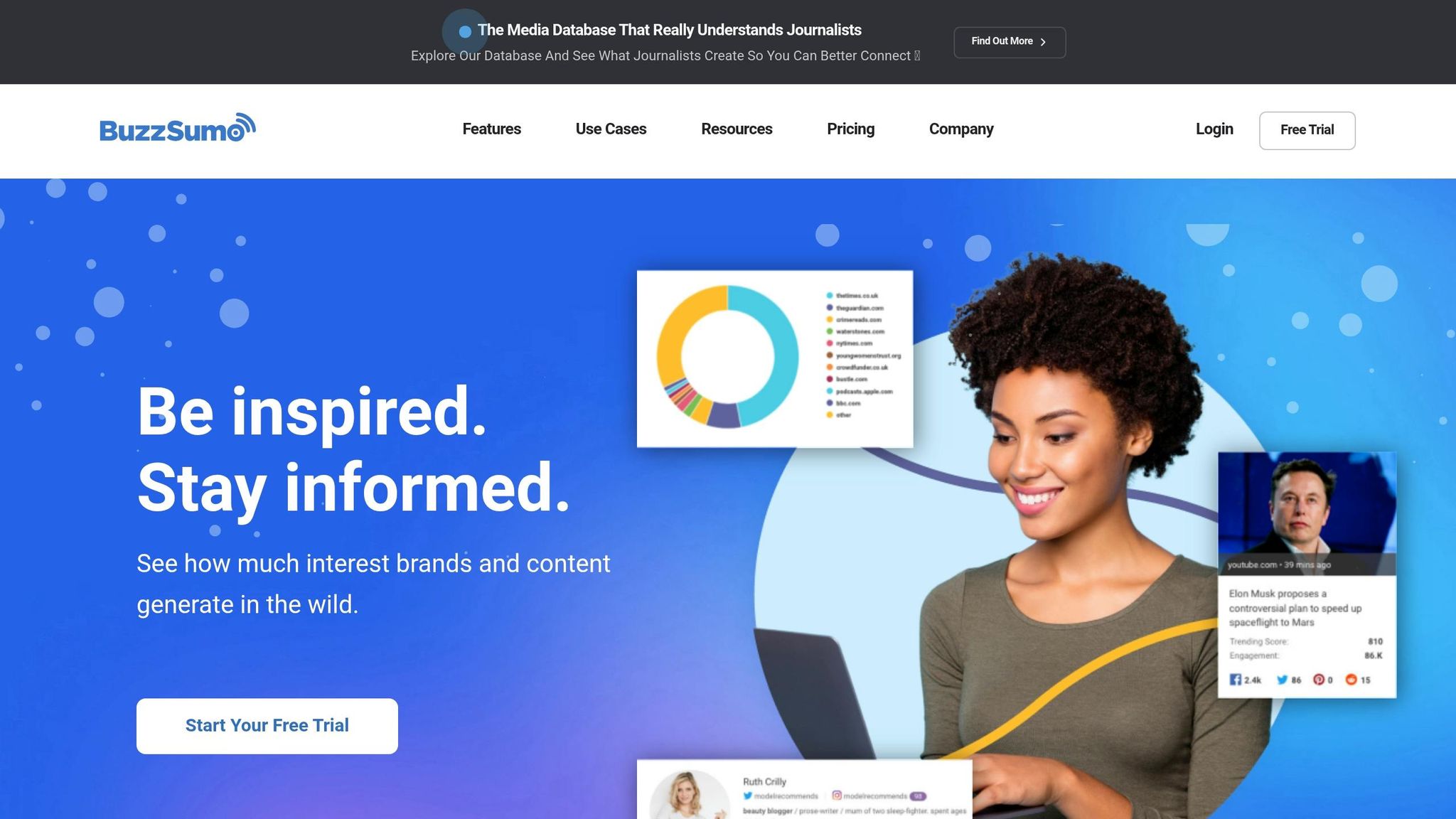
BuzzSumo uses a massive database and smart algorithms to help users uncover content that resonates with their audience. With access to 8 billion articles and 3 million new ones added daily, the platform tracks 300 trillion engagements across Facebook, Twitter, Reddit, and Pinterest. This allows it to pinpoint what’s trending and performing well in specific niches [55,58,59]. Its Trending Score evaluates the speed of social shares over 24 hours to highlight emerging viral content.
Another standout feature is the Evergreen Score, which measures the long-term value of content by tracking ongoing engagement and backlinks. This helps users focus on topics that remain relevant over time [58,60]. The Content Ideas Generator pulls data from sources like Reddit, Quora, and Amazon, analyzing headlines, keywords, and forum queries to uncover trending topics [56,60]. Additionally, headline optimization metrics guide users toward content that’s likely to perform well. Together, these tools make it easier to identify timely and engaging content. For those looking to streamline production further, using an AI blog generator can help turn these insights into optimized drafts.
Customization and Filtering Options
BuzzSumo offers powerful search filters to refine results. For instance, you can use operators like author:[Name] to find a specific writer’s best-performing work or shared:@[TwitterHandle] to see what influencers are sharing. Other filters include "B2B Publishers Only" for professional industries, content type sorting (e.g., infographics, videos, giveaways), and geographic or language-based tailoring using Top-Level Domain (TLD) filters. Impressively, the platform supports over 170 languages across 195 countries.
"I can search for terms/phrases and quickly identify content that's performing well in a niche or with an audience." – Rand Fishkin, Founder & CEO, SparkToro
These advanced filters, combined with BuzzSumo’s performance insights, make it one of the best online content writing tools for content discovery.
Analytics and Performance Tracking
The Content Analysis Report provides a detailed breakdown of social engagement for specific topics or domains. Users can view charts that highlight the best-performing content types, ideal lengths, and optimal publishing days. Plus, the platform offers up to five years of historical data to uncover long-term trends and seasonal patterns. The competitor benchmarking feature allows side-by-side comparison of up to eight domains, helping users spot content gaps, analyze performance, and evaluate potential marketing partners.
A great example of its effectiveness comes from Backlinko. In 2023, they used BuzzSumo to search for "SEO" and found that mobile SEO was a hot topic, with four of the top 20 engaging articles focusing on it. This insight led to the creation of the "Ultimate Guide to Mobile SEO", which earned 3,000 social shares, 398 comments, and backlinks from 460 domains. Similarly, Venngage used BuzzSumo’s historical data to analyze five years of "design trends", resulting in improved rankings for 97 key keywords and gains across 962 additional ones.
8. Pocket with AI Integration
AI-Powered Content Discovery
Pocket has embraced AI to make content discovery more intuitive and personalized. After Mozilla ended its standalone apps and extensions on July 8, 2025, Pocket shifted gears by embedding its content discovery tools directly into the Firefox browser. This approach blends machine learning with human oversight to highlight reliable, high-quality content.
Additionally, Open Vision Engineering has introduced a new AI-powered Pocket solution. This wearable device and app combination uses advanced models like GPT-5, Claude, and Gemini to capture and organize personal thoughts and conversations. One standout feature is "Ask Pocket," which lets users query their saved information in plain language, helping them find specific insights without tedious manual searches. The platform also uses AI to automatically detect patterns and group related ideas. According to user data, 94% of users reported they stopped losing key ideas within two weeks, and 96% felt more focused during conversations within a month.
Pocket’s focus on reliable content discovery is complemented by its extensive customization options.
Customization and Filtering Options
Pocket offers a range of customization features to suit individual preferences. The base version includes five clean summary styles, while the Pro version unlocks over 100 options for synthesizing information. Pro users can also choose from a variety of advanced AI models for content processing, thanks to the platform's model-agnostic design. Pocket supports transcription and content discovery in more than 120 languages and dialects, making it accessible to a global audience.
"Pocket's aesthetics are spot on, from the website to the product design, everything looks innovative. I'm already a fan of this AI device!" – Abhinav Kukreja, Startup Founder
The platform has received glowing reviews, earning a 4.8/5 rating on the Apple App Store from 930 users and a 4.92/5 rating from 232 reviews on its official product website. Users praise its accurate call summaries and the ability to stay engaged in meetings without taking manual notes. However, some have pointed out issues like syncing bugs and the absence of a custom dictionary to prevent errors with company names or technical terms.
9. Quuu
AI-Powered Content Discovery
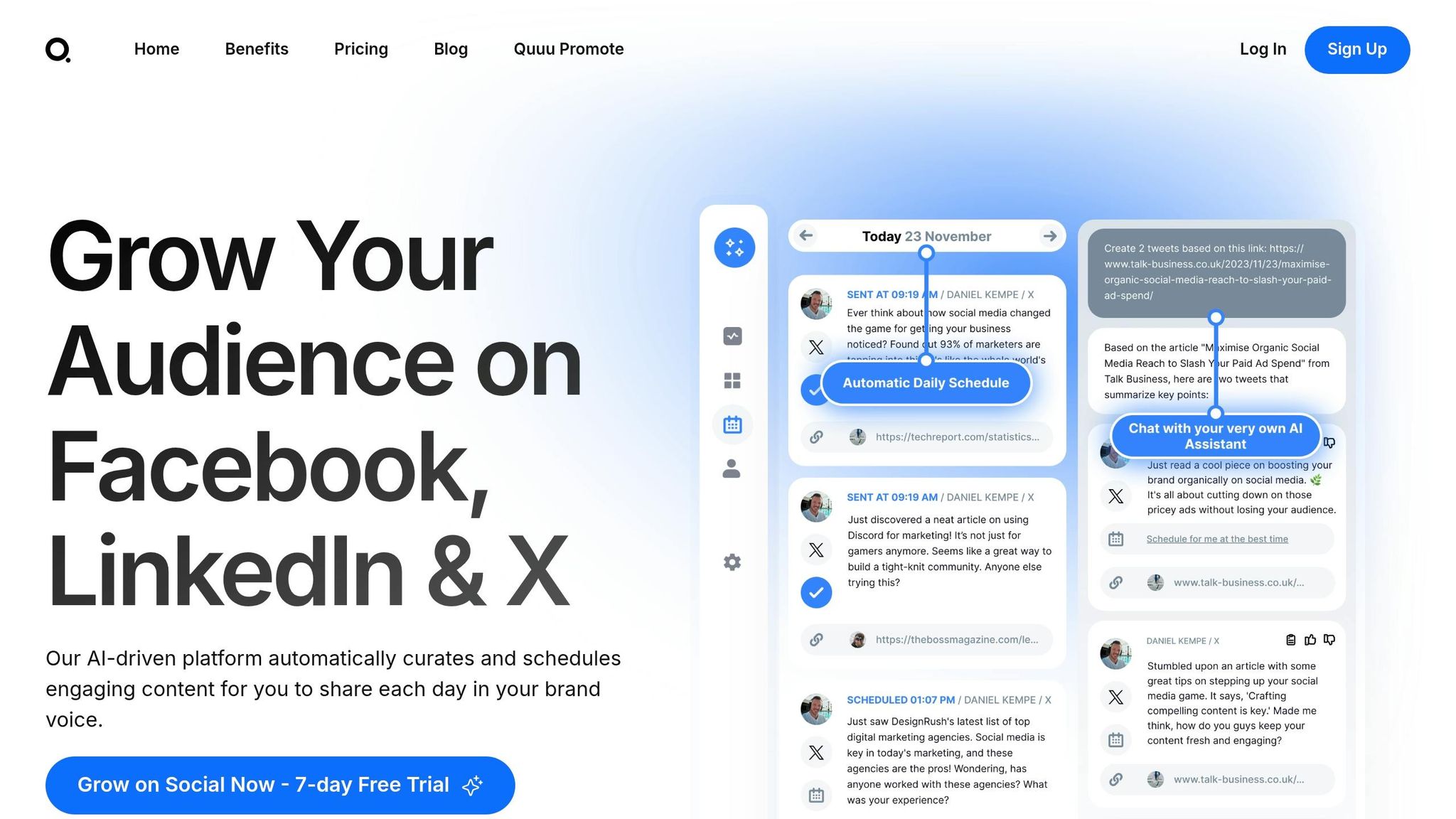
Quuu uses AI to analyze your brand's social media presence, studying tone, language, and messaging to ensure curated content aligns with your voice. Its machine learning adapts based on your feedback, becoming smarter with each approval or rejection. The AI is also designed to handle industry-specific terms and meet strict standards - for example, ensuring medical accuracy for healthcare brands or maintaining professionalism for financial services. It tailors content depth to your audience, offering in-depth material for B2B clients and simpler posts for consumer-facing brands. By 2026, Quuu's discovery engine sources content from industry publications, research databases, and niche blogs, going beyond mainstream sources. The platform serves over 50,000 marketers and agencies, boasting an impressive 4.9/5 rating on Product Hunt from 69 reviews.
"The AI learns from which suggested content you approve or reject, refining future recommendations based on your preferences and audience response." – Daniel Kempe, CEO/Founder of Quuu
Customization and Filtering Options
Quuu takes customization seriously, offering over 500 interest categories and allowing integration with custom RSS feeds. This lets you track niche industry publications while benefiting from Quuu's curated content library. You can choose from various content formats and even toggle options like emojis and hashtags to match your brand's aesthetic. The platform's audience calibration feature adjusts content depth based on engagement trends, and manual approval workflows let you fine-tune suggestions during a two-week training period. These tools ensure your content aligns with your brand while being optimized for your audience. As of 2026, 76% of organizations are using fully automated AI blog generators and generative AI to boost their content creation strategies.
Multi-Channel Publishing and Scheduling
Once content is selected, Quuu simplifies its distribution. It integrates with popular social media schedulers like SocialBee, Buffer, and Hootsuite, making it easy to post across platforms such as Facebook, LinkedIn, Instagram, and Twitter/X. The platform optimizes content for each channel - for instance, creating professional posts for LinkedIn or visually engaging infographics for Instagram. It also analyzes audience behavior to recommend the best times to post, offering both automated and manual approval options. Companies using these AI-driven tools have reported a 75% increase in engagement. By late 2026, Quuu plans to expand its integrations with additional social media and marketing automation tools.
"It produces seemingly endless relevant articles to choose from for the social media profiles that we manage for our clients. These complement nicely with the other content that we post daily." – WebXD
10. UpContent
AI-Powered Content Discovery
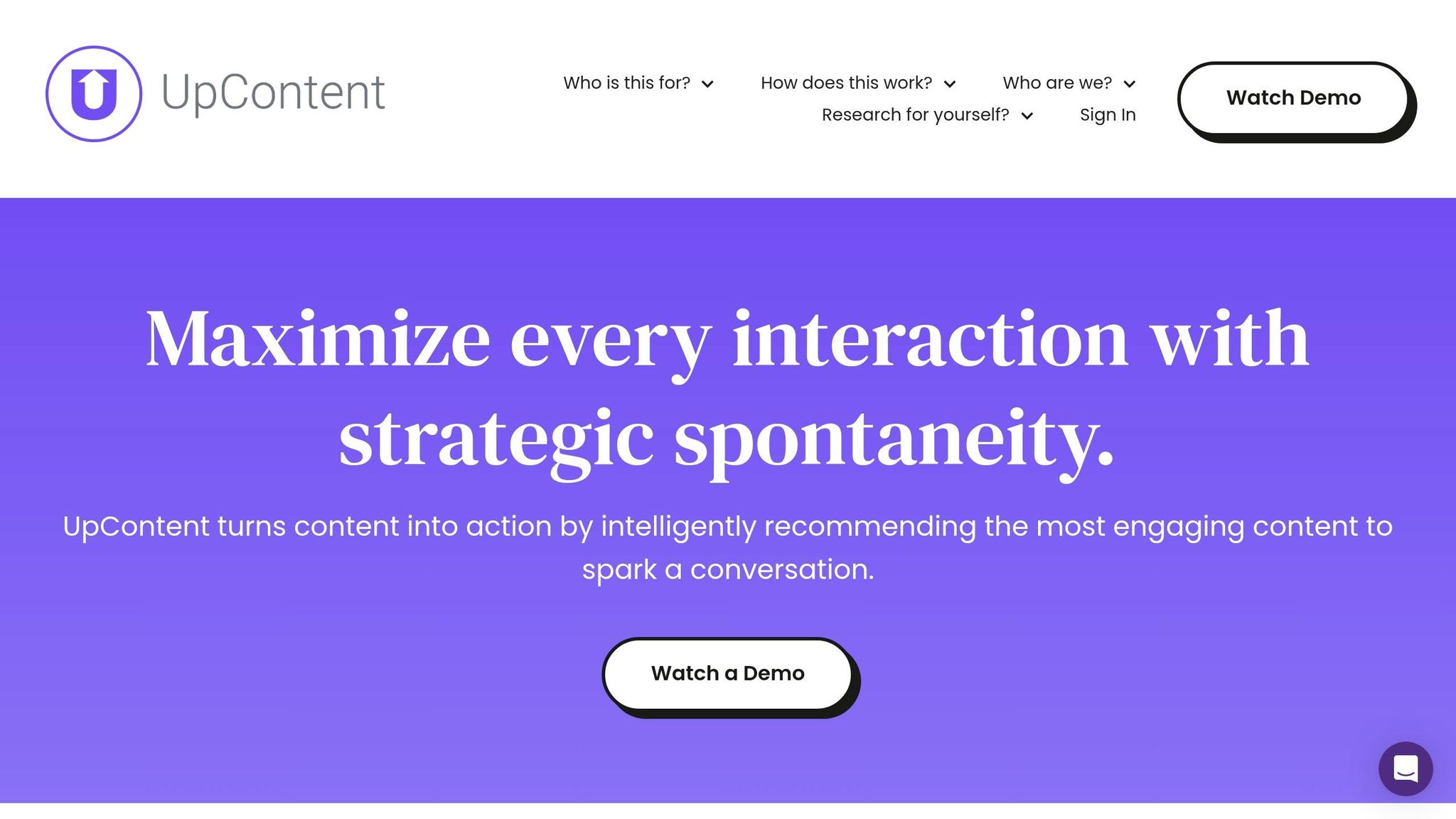
UpContent takes content curation to the next level by using its proprietary AI crawler to perform full-text analysis. Unlike tools that rely on titles or meta descriptions, UpContent dives deep into the entire article to identify pieces that align with your industry and audience. This approach ensures you're sharing content that sparks conversations and boosts engagement.
The platform also integrates with LLMs to simplify tasks like generating social media captions and email blurbs using free AI writing tools. For example, Nathan Lenyszyn, Vice President of Marketing at HealthLink Dimensions, shared that his team sources about 150 articles monthly using UpContent. With the help of its AI Post Text Generation feature, they create two-sentence captions tailored to their brand voice for each article. In just one to two hours per week, they manage and schedule curated content across multiple social platforms. The results? Users have reported an 80% increase in program adoption, double the engagement rates, and three times the website traffic.
"Using UpContent's AI Post Text Generation saves me a ton of time, and it helps us have a consistent brand voice in the marketplace." - Nathan Lenyszyn, Vice President of Marketing, HealthLink Dimensions
Customization and Filtering Options
UpContent offers a range of customization tools to ensure the content you share aligns perfectly with your needs. Its ArtClass machine learning system categorizes content as either "News" or "Blogs", making it easy to filter by type. You can also exclude paywalled, short, or image-less articles. To refine your search even further, the platform provides three sorting metrics:
- Shareability: Evaluates content based on elements like power words and images that drive clicks.
- Influence: Measures an article’s authority using link networks.
- Smart Sorting: Predicts how well an article will perform compared to others in your collection.
For added precision, you can create "agents" that ensure AI-generated captions reflect your brand tone. Control over sources is another key feature - you can include or block specific publishers and filter content by date ranges, from the past 30 days to a full year. Pricing is flexible, starting with a $0/month Free Forever plan (1 topic, 1 user) and going up to $265/month for the Orchestrator plan (100 topics, 9 collections).
These tools make it easier than ever to fine-tune your content strategy.
Multi-Channel Publishing and Scheduling
UpContent integrates seamlessly with popular social media management tools like Hootsuite, Buffer, CoSchedule, Oktopost, and Lately to simplify publishing and scheduling. The platform supports auto-publishing to social platforms and even inserts curated posts directly into email newsletters. Users have noted that it can cut content management time by 30%.
Collaboration features are another standout, allowing team members to leave notes on content and streamline planning and review processes. MariAnne Vanella, CEO of The Vanella Group, Inc., highlighted the time savings:
"I love UpContent…it makes loading up all our content on the site and on social accounts so easy. It cut my time at least 30% from how I did it before".
With a 4.34/5 rating on Cuspera based on 846 user insights, UpContent has earned praise for its user-friendly design and ability to fine-tune content searches.
Using Agentic AI for Trustworthy Content Curation
Conclusion
AI content curation platforms have reshaped how marketers and content creators approach their work. Tasks like discovery, filtering, and scheduling, which once took hours, are now completed in minutes - reducing content curation time by 60–80%. This efficiency not only saves time but also allows for more focus on strategy and crafting original content.
Beyond just saving time, these platforms help strengthen your brand by improving the quality of the content you share. Combining curated content with your own insights builds trust and credibility within your industry. A balanced approach, such as a 60/40 mix of original and curated content, ensures consistent publishing while lightening the workload. Today's AI tools make this process even more effective by using machine learning to filter out irrelevant material and prioritize high-quality, authoritative content, ensuring your audience gets meaningful information rather than clutter.
Consider this: 73% of marketers now rely on AI for content creation - a number that has tripled since 2023. The platforms highlighted in this article cater to a variety of needs, from advanced RSS monitoring to viral content analysis and automated social media management. Choosing the right tool comes down to your specific goals, whether you're focused on detailed research, broad industry insights, or streamlined social publishing.
As emphasized throughout, the true advantage of these tools isn't just in their features but in how effectively you define and monitor the topics that matter most to your audience.
"The competitive advantage lies not in the software itself, but in how precisely you define the topics you monitor." – nbot.ai
Take the time to explore the platforms mentioned here to find the one that aligns with your workflow, budget, and overall content strategy. Whether you're running a personal blog or managing content for a large organization, investing in the right AI curation tool can lead to significant time savings, better engagement, and a more impactful brand presence.
FAQs
How do I choose the right AI curation platform for my goals?
To choose the best AI content curation platform, begin by pinpointing what you need most - whether that’s content discovery, automation, or distribution. Next, assess the platform’s AI features, its ability to integrate with your current tools, and how well it handles your preferred content formats. Lastly, take a close look at pricing and scalability to make sure it fits within your budget and supports your future growth. Following these steps will help you find a platform that aligns with your objectives.
How can I keep curated content aligned with my brand voice?
To keep your brand voice consistent, it's essential to train AI with your brand guidelines, real examples, and clear guardrails. This helps the AI understand your tone, style, and messaging preferences. For content that is sensitive or carries higher risks, incorporating a human review process is crucial. This extra step ensures the final output aligns with your standards for quality and consistency.
What metrics should I track to prove curated content ROI?
To gauge the return on investment (ROI) of curated content, focus on tracking key metrics like engagement (including likes, shares, and comments), content reach (views and impressions), and conversion rates. These metrics reveal how your audience interacts with the content and help you understand its overall impact on your business goals.


