AI-powered writing assistants are transforming how businesses manage multilingual content. They ensure quality, reduce errors, and maintain brand consistency, all while saving time and costs. Here's what they bring to the table:
- Grammar & Syntax Tools: Detect and fix grammar, punctuation, and sentence structure issues. They operate quickly and support regional variations like US vs. UK English.
- Terminology Tools: Ensure consistent use of terms like product names or technical jargon across languages. Glossaries help maintain precision but may require human input for nuanced phrases.
- Fluency Tools: Assess tone and natural language flow, tailoring content for local audiences. They adapt to formal or informal preferences and catch awkward phrasing.
Quick Comparison
| Tool Type | Focus | Key Benefit | Limitation |
|---|---|---|---|
| Grammar & Syntax Tools | Technical accuracy | Fast error detection | May flag false positives |
| Terminology Tools | Brand and term consistency | Real-time glossary checks | Struggle with idiomatic phrases |
| Fluency Tools | Tone and flow | Adapts to audience preferences | Setup can be complex |
These tools integrate with CMS, CAT, and TMS platforms, enabling seamless workflows. Whether you're managing marketing pages or technical documents, combining automation with human oversight ensures top-tier content quality.
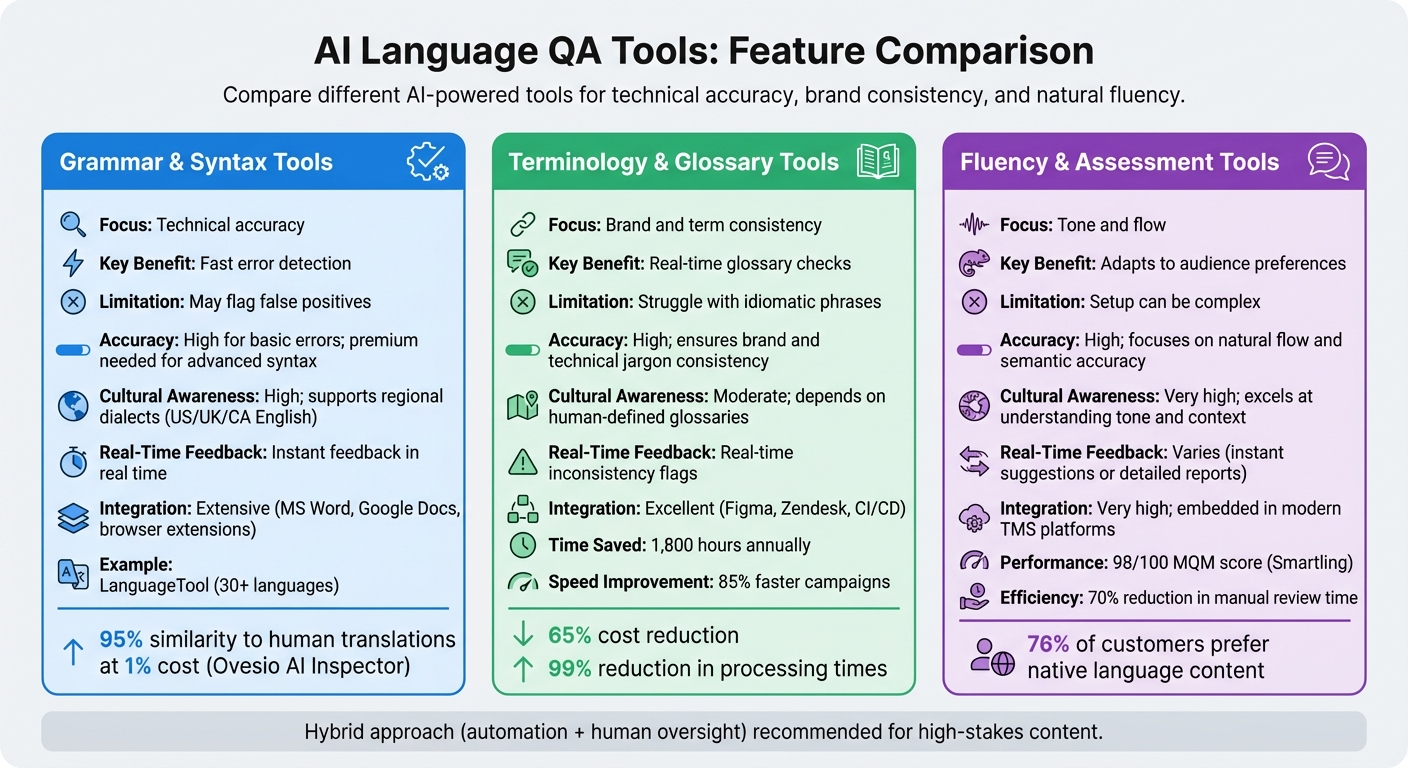
AI Language Quality Assurance Tools Comparison: Grammar, Terminology, and Fluency Features
AI-Powered Translation Scoring: Scaling Quality with MQM Framework
sbb-itb-a759a2a
1. Automated Grammar and Syntax Validation Tools
These tools play a key role in maintaining the quality of multilingual content. They don’t just check for spelling mistakes - they also validate grammar, syntax, sentence structure, and punctuation across different languages . Additionally, they can catch issues like improper capitalization, repeated words, and restricted terms .
Accuracy
Modern validation tools rely on advanced multi-engine systems, such as Google Translate, DeepL, and OpenAI, to ensure grammatical accuracy and fluency. For instance, Ovesio's AI Inspector boasts a 95% similarity to human translations while operating at just 1% of the cost.
To further enhance precision, the MQM framework categorizes errors by type and severity . This systematic approach helps teams maintain consistent messaging across different regions. According to Phrase, AI-driven quality assessments can slash processing times by up to 99% and reduce costs by as much as 65%.
Beyond technical accuracy, these tools also adapt content to align with local preferences and expectations.
Cultural Awareness
AI validation tools now evaluate content for cultural alignment, not just linguistic precision. For example, German readers often favor formal and structured writing, while American audiences lean toward a casual, conversational tone. These tools can adjust content automatically to reflect these stylistic differences.
They also ensure adherence to regional conventions, such as date formats (MM/DD/YYYY for the U.S. vs. DD/MM/YYYY in other regions), currency styles ($1,000.00 vs. €1,000.00), and number formatting . By incorporating local idioms and optimizing for region-specific SEO keywords, these systems help make content more relatable and effective for the target audience.
This level of cultural fine-tuning ensures that content resonates with its intended audience while maintaining high quality.
Real-Time Feedback
When managing large volumes of multilingual content, speed is crucial. Tools like LanguageWire's Smart Editor offer immediate, in-context feedback, using color-coded underlining - red for spelling mistakes and blue for stylistic issues - directly within the editing interface .
This instant feedback significantly reduces review times by up to 70%, allowing teams to maintain consistent brand messaging and handle larger workloads without needing additional resources.
Integration Capabilities
In addition to accuracy and cultural adaptability, these tools fit seamlessly into existing workflows. They support standard file formats like .XLIFF and integrate with widely used CAT tools. For example, MarsQA offers over 100 pre-configured language profiles, enabling immediate quality checks without manual setup.
These tools also connect with CMS platforms, productivity software, and communication tools . Browser extensions for Chrome, Firefox, and Edge allow for real-time validation in any web-based environment . Developers can even use APIs from providers like DeepL and WProofreader to embed automated quality checks into custom software .
A standout example is LanguageTool, which supports over 30 languages and six variations of English (including U.S., UK, and Canadian English) . Trusted by organizations like BMW Group, the European Union, and Spiegel Magazine, it has earned over 10,000 reviews on the Chrome Store.
2. Terminology and Glossary Consistency Tools
These tools are designed to ensure that specific terms - like product names, technical jargon, and SEO keywords - are translated consistently across multiple languages. Unlike translation memory, which recalls previously used phrases, glossaries are more rigid. They define exactly how each term should appear, helping maintain brand consistency across all content.
Accuracy
Advanced AI models excel at analyzing context to choose the correct meaning of ambiguous words. For example, the word "account" might refer to a financial record in one instance or a user profile in another. These systems evaluate the specific context to apply the right translation for the domain. Glossary terms are prioritized over generic translations, and human linguists see these approved terms highlighted in real time within their editing tools. Automated checks also flag issues like prohibited terms, missing parameters, or punctuation errors. Organizations using these systems have reported saving 1,800 hours annually, with multilingual campaigns being delivered 85% faster thanks to automated validation and terminology checks.
This level of precision also supports the need for localized adaptations in multilingual projects.
Cultural Awareness
Terminology tools can adapt to regional language variants, ensuring terms resonate with specific audiences. For instance, Spanish used in Spain (es-ES) differs from Spanish used in Mexico (es-MX), and these tools adjust accordingly. However, even top AI tools for writing and blogging often fall short when it comes to cultural nuances and stylistic preferences. A 2026 survey revealed that 82% of respondents felt standard machine translation often misinterprets industry-specific jargon. Collaborating with native speakers to build glossaries can help ensure translations are culturally appropriate.
Real-Time Feedback
Consistency isn’t just about accuracy - it’s also about speed. Tools like XTM Language Guard provide immediate feedback by comparing translations to approved glossaries and flagging inconsistencies on the spot. AI-powered quality checks on individual text segments can process in under 5 seconds, cutting down the need for lengthy manual reviews. Vincent Rigal, CAT Tools Products Owner at Acolad, highlighted the impact of these tools:
"XTM forms a big global ecosystem of seamlessly connected accounts to which thousands of users connect daily. Overall, the result is better quality with fewer resources."
The industry is moving away from batch-style quality reports toward real-time "translation scoring" directly integrated into editing tools. This shift not only speeds up workflows but also reduces server strain.
Integration Capabilities
Integration across platforms plays a key role in maintaining consistent global content. These tools work directly with major CMS platforms, CAT tools, and Translation Management Systems, allowing teams to launch projects and monitor quality from a single platform. Glossaries stored in the TermBase eXchange (TBX) format - a global ISO standard - can be easily migrated between different systems. Modern systems can even automate quality checks when a document is uploaded or reaches a specific stage, reducing manual effort. Dominic Pemberton, VP of Content at RS Group, shared:
"With XTM Cloud, we can now offer all customers across the world the same level of support and access to every new product we launch more quickly while reducing costs and errors, and ensuring consistency across all content."
3. Fluency and Natural Language Assessment Tools
Fluency tools take things a step further by ensuring content feels natural to native speakers. Using Large Language Models (LLMs) and Natural Language Processing (NLP), these tools evaluate whether the tone and meaning align with the intended audience. They also adapt tone - formal or informal - based on local preferences, ensuring the content feels authentic in every target language.
Accuracy
Modern AI tools rely on frameworks like the Multidimensional Quality Metrics (MQM) to evaluate linguistic quality at scale. These frameworks classify errors by severity and calculate error rates, providing a structured way to measure fluency. For instance, Lilt's AI-powered QA evaluates translation segments in under five seconds, catching awkward phrasing before it becomes a problem. Smartling boasts an impressive average MQM score of 98 out of 100, outperforming the industry average of 95 by three points. Furthermore, these tools can cut manual review time by as much as 70%, streamlining the entire process. This level of precision sets the foundation for assessing how naturally content flows.
Cultural Awareness
Fluency tools go beyond grammar and structure by ensuring translations resonate with native audiences. Instead of relying on basic keyword matching, these tools evaluate phrasing within its full context. They adjust writing styles to suit local norms, such as deciding when to use formal versus informal language. This includes incorporating regional idioms and tonal nuances that make content feel more relatable.
"A true multilingual AI blog writer does more than just swap words. It considers regional SEO keywords, local idioms, and culturally appropriate formatting".
- Kenneth Pangan, writer and marketer
This attention to detail is critical, especially when you consider that 76% of customers are more likely to make a purchase when product information is available in their native language.
Real-Time Feedback
Tools like Lilt and Tomedes offer instant fluency scores during translation, allowing translators to make improvements on the spot. This "shift-left" approach focuses on catching issues early in the process, reducing the likelihood of errors slipping through to the final stages. Automated feedback loops enhance efficiency, but human oversight remains essential for high-stakes content. These tools provide real-time insights at the segment level, enabling smarter workflows while maintaining high-quality output.
Integration Capabilities
Fluency tools integrate smoothly with content management systems (CMS), translation management systems (TMS), and computer-assisted translation (CAT) tools, ensuring quality throughout the entire workflow. They also connect with platforms like Zendesk and Salesforce Service Cloud, enabling teams to manage quality from one central hub. For example, MarsQA offers live commenting features, allowing linguists and managers to collaborate directly within project files. Companies like Babbel have saved up to 31 hours per month on translation projects by combining automated fluency checks with expert reviews, demonstrating how these tools can optimize workflows.
Pros and Cons
Let’s dive into the strengths and weaknesses of top AI tools for content writing categories, building on the features discussed earlier. These insights show how each type of tool tackles the challenges of ensuring quality across languages.
Grammar and Syntax Validators, like LanguageTool and QuillBot, are great at identifying technical errors quickly. They support over 30 languages and provide real-time feedback. However, the free versions of these tools often fall short when it comes to more advanced grammar issues. For instance, LanguageTool’s free tier only checks up to 2,000 characters and skips advanced style checks. Another limitation is their focus on surface-level mechanics, which can sometimes lead to false positives. Balancing efficiency with deeper language understanding remains a challenge for these tools.
Terminology and Glossary Tools shine when it comes to maintaining consistency in brand and technical jargon across different markets. They work seamlessly with platforms like Figma, Zendesk, and CI/CD pipelines, ensuring that specific terms are used correctly. But these tools struggle with idiomatic expressions or phrases that don’t translate well. For example, a phrase like "boil the ocean" might be translated literally if not reviewed by a human. This limitation underscores the need for human oversight to handle nuanced language.
Fluency and Natural Language Assessment Tools excel in understanding cultural context. Tools like XTM Language Guard analyze meaning across over 90 languages to catch biased or inappropriate language. Meanwhile, Smartcat’s Quality Assurance Agent can cut manual review time by up to 70%, and MarsQA offers over 100 pre-configured language profiles for detailed checks. The downside? These tools often require more technical setup and still rely on human reviewers for final approval of brand voice. Again, there’s a trade-off between automation and the need for human input to ensure quality.
Here’s a quick comparison of how these tools perform across key criteria:
| Tool Category | Accuracy | Cultural Awareness | Real-Time Feedback | Integration Capabilities |
|---|---|---|---|---|
| Grammar & Syntax Tools | High for basic errors; premium needed for advanced syntax | High; supports regional dialects (e.g., US/UK/CA English) | Instant feedback in real time | Extensive; works with MS Word, Google Docs, browser extensions |
| Terminology & Glossary Tools | High; ensures brand and technical jargon consistency | Moderate; depends on human-defined glossaries | Real-time inconsistency flags | Excellent; integrates with Figma, Zendesk, and CI/CD |
| Fluency & Assessment Tools | High; focuses on natural flow and semantic accuracy | Very high; excels at understanding tone and context | Varies; some offer instant suggestions, others provide detailed reports | Very high; embedded in modern TMS platforms |
Conclusion
Choosing the right tool for your language quality assurance depends on your specific priorities, workflow, and the unique needs of your projects. With options ranging from instant corrections to advanced tone analysis, there’s no one-size-fits-all solution.
WProofreader stands out for its ability to flag and correct issues instantly within the editor, allowing linguists to address problems as they arise. Meanwhile, XTM Language Guard provides real-time detection of harmful or biased language by analyzing tone and intent rather than just relying on keywords.
If maintaining approved terminology is a top priority, Smartcat's Quality Assurance Agent ensures consistency by directly connecting to existing translation memories and glossaries. Similarly, LanguageWire's Smart Editor helps maintain uniformity by applying the correct terms across all communication channels.
For efficiency-focused teams, Ovesio's AI Inspector offers multi-engine routing that achieves 95% similarity to human translation at just 1% of the usual cost. Users have reported saving over 1,000 hours on localization projects, reducing timelines from months to mere days. One Smartcat case study highlighted:
"Quality has markedly increased. The number of corrections is now much lower and the editing process is faster and less labor-intensive as a result".
Different content types require different approaches. High-risk materials like marketing pages or legal documents often benefit from a hybrid method - automated checks combined with human post-editing, often supported by essential AI content writing tools. On the other hand, lower-risk content, such as support articles, can lean more on automation. For non-linguist project managers, tools like InText AI Review offer a way to perform initial quality checks without fluency in the target language.
Ultimately, no single tool can meet every need. For example, WProofreader offers on-premises deployment for businesses prioritizing security, while MarsQA provides specialized checks for specific use cases. The key lies in selecting tools that strike the right balance of speed, nuance, brand consistency, and multilingual accuracy, tailored to your content and workflows.
FAQs
Which AI QA tool type should I use first?
Start by using an AI-powered QA tool designed to automate content reviews for accuracy, formatting, and compliance. Take Smartcat's Quality Assurance Agent as an example - it can cut review times by as much as 70%, all while ensuring consistent quality across multilingual projects. This kind of tool not only simplifies your workflow but also helps you maintain top-notch standards without the usual hassle.
How do I measure translation quality with MQM scores?
To assess translation quality using MQM scores, start by evaluating a sample of the translated material with the MQM framework. This involves identifying errors, categorizing them by type (like grammar, meaning, or style), and assigning a severity level to each. Once errors are logged, apply a scoring model to calculate a numerical quality score. A higher score indicates fewer errors and better overall quality. This structured method provides a clear and measurable way to gauge translation accuracy and consistency.
When do I still need a human reviewer?
A human reviewer plays a key role in maintaining nuance, accuracy, and cultural sensitivity in content that is complex or carries high stakes. They can spot mistakes or AI-generated inaccuracies that automated tools might overlook. While AI can streamline processes, it isn't capable of fully handling these critical elements by itself.