Real-time personalization tools have become essential for businesses aiming to deliver tailored experiences instantly. These platforms use AI, machine learning, and live data to adjust content and recommendations based on user behavior in milliseconds. With 71% of customers expecting personalization and 76% feeling frustrated when it’s missing, these tools directly impact engagement, conversions, and revenue.
Here are 2026’s top tools for real-time personalization:
- Dynamic Yield: Combines AI-driven recommendations, testing, and omnichannel personalization. Used by brands like McDonald’s and e.l.f. Cosmetics. Pricing is custom.
- Optimizely: Known for experimentation and edge delivery for fast, flicker-free personalization. Ideal for e-commerce and B2B. Pricing is custom.
- Bloomreach: Focused on e-commerce with AI-powered search and merchandising. Pricing starts at $1,000/month.
- Personyze: Affordable, multi-channel personalization using 70+ visitor attributes. Starts at $250/month.
- Insider: Omnichannel platform with AI-driven segmentation and messaging across web, mobile, and email. Pricing is custom.
- Mutiny: Tailored for B2B account-based marketing with a no-code editor. Free tier available; enterprise starts at $30,000/year.
- Braze: Cross-channel engagement for large-scale operations. Pricing is custom, starting around $60,000/year.
Quick Comparison:
| Tool | Focus Area | Starting Price | G2 Rating |
|---|---|---|---|
| Dynamic Yield | Omnichannel eCommerce | Custom | 4.5/5 |
| Optimizely | Experimentation | Custom | 4.2/5 |
| Bloomreach | E-commerce AI Tools | $1,000/month | 4.6/5 |
| Personyze | Multi-channel | $250/month | 4.8/5 |
| Insider | Omnichannel Engagement | Custom | 4.8/5 |
| Mutiny | B2B ABM | Free/$30,000+ | 4.7/5 |
| Braze | Cross-channel Messaging | Custom (~$60k) | 4.5/5 |
Each tool caters to specific needs - enterprise e-commerce, B2B marketing, or omnichannel engagement. Choose based on your business size, use case, and budget.
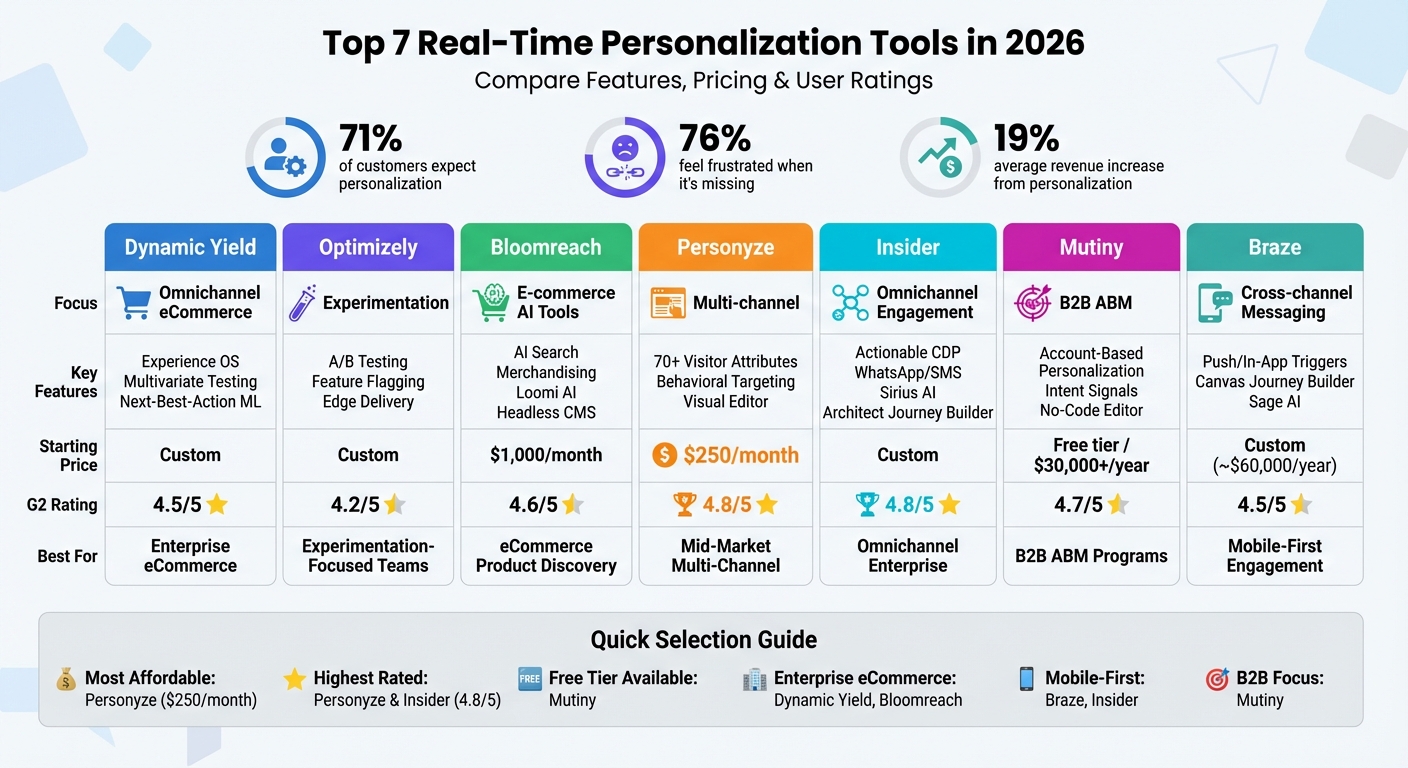
Top 7 Real-Time Personalization Tools 2026: Features, Pricing & Ratings Comparison
From Content Bottleneck to Personalization at Scale | Optimove Connect 2026
sbb-itb-a759a2a
1. Dynamic Yield
Dynamic Yield is an Experience OS that combines personalization, testing, and recommendations across various digital platforms. It delivers enterprise-level features and exclusive consumer spending insights, empowering brands to scale their personalization efforts effectively.
Real-time personalization capabilities
Dynamic Yield uses AI-driven tools like recommendations and predictive targeting to adapt instantly to user behavior. These features enhance product pages, shopping carts, and even post-purchase experiences. Its affinity allocation feature ensures traffic is routed based on changing user preferences. Additionally, the platform integrates Mastercard Spend Insights, utilizing real consumer spending data to refine strategies further. Marketers can also take advantage of a visual WYSIWYG editor to design campaigns without needing technical assistance, supporting both server-side and client-side experimentation.
Key use cases (e.g., e-commerce, B2B, omnichannel)
Dynamic Yield shines in omnichannel personalization, extending its capabilities beyond websites to mobile apps, emails, kiosks, and even physical displays. For instance, McDonald's customizes drive-thru menus in real time, considering factors like weather and time of day. E-commerce brands have also achieved impressive results:
- e.l.f. Cosmetics improved its conversion rate by 17.6% by personalizing its site menu based on past shopping behaviors.
- Sky saw a 140% increase in engagement from lapsed subscribers through targeted, time-sensitive offers.
- Electrolux boosted its direct-to-consumer revenue by 16% by implementing personalized experiences across 21 markets and 16 languages.
"Dynamic Yield's templating engine has empowered our team to build new experiences and get them up and running immediately. We're able to deliver a truly customized shopping experience and personalize at lightning speeds."
- Wilbert Vivas, eCommerce Manager, Cabela's Canada
The platform serves a diverse range of industries, including retail, travel, telecommunications, beauty, and financial services. It’s built to handle complex enterprise needs across multiple regions, making it a go-to solution for global, multi-market programs.
Starting pricing (USD)
Dynamic Yield’s pricing reflects its focus on enterprise clients. The platform operates on a custom pricing model, tailored to variables like traffic volume, number of channels, and the scope of personalization. There’s no free tier or self-serve option, and contracts typically require annual commitments following a personalized sales demo. While no specific starting price is publicly available, organizations report a 300%+ ROI and a 15–25% increase in conversion rates.
Integration and scalability
Dynamic Yield’s Experience OS is designed for seamless integration, offering robust APIs and SDKs that connect with tools like CRMs, CDPs (e.g., Segment, Tealium), and analytics platforms such as Google Analytics 4. It supports both client-side and server-side setups, allowing for extensive testing. While onboarding usually takes several weeks and requires technical resources, the platform is built to scale globally. Dynamic Yield has earned recognition as a Leader in the Gartner Magic Quadrant for Personalization Engines for eight consecutive years (as of 2026) and holds strong ratings, including 4.3/5 on AI:PRODUCTIVITY and 4.5/5 on G2.
2. Optimizely
Optimizely is a Digital Experience Platform that blends AI-driven personalization with powerful experimentation tools. It helps businesses create tailored experiences across web, mobile, and email channels. With over 10,000 brands relying on it, Optimizely has maintained its position as a Leader in Gartner's 2026 Magic Quadrant for Personalization Engines for the second year in a row.
Real-time personalization capabilities
Optimizely employs Contextual Bandits, a machine learning technique that delivers the most effective, individualized experience to each visitor based on their unique attributes. Its Edge Delivery feature, supported by Akamai, processes personalization at the CDN level. This setup eliminates page flicker and ensures fast load times by applying changes before the page reaches the user.
The platform's Opal AI Agents suite streamlines technical processes. For instance, its Variation Development Agent can turn natural language prompts into custom CSS or JavaScript. Want to add a countdown timer to your checkout page? Simply type the request, and the AI generates the necessary code. Additionally, Conditional Activation allows for personalized experiences triggered by real-time visitor behaviors, such as scrolling, hovering, or exhibiting exit intent.
Optimizely has proven its reliability, processing 31.3 billion impressions during Black Friday week without any downtime. Businesses using the platform have reported a 37% increase in engagement and a 35% improvement in test impact.
Key use cases
In e-commerce, Optimizely drives personalized experiences like AI-powered product recommendations, tailored search results, and dynamic pricing based on customer behavior. For example, Gerrie Electric successfully leveraged the platform in 2026 to transform its B2B digital operations by optimizing customer journeys with commerce-specific AI tools.
For B2B companies, Optimizely shines in content orchestration and lead targeting. It segments users based on their interest level, offering whitepapers and blogs to early-stage visitors, product demos and technical guides to those in the middle stages, and pricing or feature comparisons to late-stage leads. Valtech, a global agency, uses Optimizely to improve customer experiences and boost conversions.
The platform's omnichannel features unify customer data through the Optimizely Data Platform (ODP), enabling consistent 1:1 experiences across multiple channels. Companies that adopt AI-driven personalization with Optimizely report an average ROI of 300% within a year, with Forrester validating a 446% ROI for the platform.
"Every personalization campaign we run through Optimizely has resulted in significant improvements in conversion rate. And we have much higher levels of engagement, because we have an experience that's relevant to what you're doing and the stage you're at, as a customer." - Darren Chait, Head of Growth Marketing, Calendly
These examples highlight how Optimizely delivers impactful personalization, making it a strong choice for businesses looking to refine their customer experiences.
Starting pricing (USD)
Optimizely offers custom pricing tailored to your specific needs. Pricing depends on factors like traffic volume, technical requirements, and the modules you choose, such as Web Experimentation, Personalization, Data Platform, or CMS. While no starting price is publicly available, a personalized demo and quote are required. The platform holds a 4.2/5 rating on G2 and an 8.6/10 on TrustRadius, with over 830 verified reviews.
Integration and scalability
Optimizely is built for seamless integration and scalability. Its warehouse-native design connects effortlessly with existing CDPs and data stacks, enabling real-time segment updates. The platform supports Feature Experimentation with SDKs in 10 programming languages and ensures compliance with EU data residency options. A native connector also allows for direct asset retrieval from its Digital Asset Management system during experience creation.
For modern web applications, Optimizely includes Single Page Application (SPA) support, ensuring changes persist during navigation and injected elements remain intact. Users report a 78% improvement in testing speed with experimentation agents, and the platform processes hundreds of billions of events annually.
3. Bloomreach
Bloomreach is a commerce-focused platform designed to deliver personalized experiences in e-commerce using scalable AI. Its Loomi AI engine evaluates customer behavior in real time, predicting actions like purchase likelihood, churn risk, and the best times for engagement. The platform's in-memory framework processes data lightning-fast, delivering personalized content within just 0.1 seconds of a user's action.
Real-time personalization capabilities
At the heart of Bloomreach's personalization is its Single Customer View (SCV), which consolidates data streams into a constantly updated customer profile. Using this, the platform can deliver contextual content tailored to the user's current behavior. This feature is supported by a patented flicker-free system, ensuring smooth and seamless content delivery. Additionally, Bloomreach supports omnichannel orchestration, allowing marketers to trigger personalized web banners, pop-ups, and notifications across channels like email or SMS in real time.
The platform has produced impressive results for its clients:
- Oliver Bonas, a UK retailer, achieved a 161% increase in conversion rates after adopting Bloomreach's tools in 2026.
- The Vitamin Shoppe boosted add-to-cart rates by 11% using real-time product recommendations to optimize category pages.
- baby-walz saw a 53.8% rise in email open rates by tailoring dynamic email content to pregnancy stages and baby gender.
"Bloomreach have enabled us to truly stitch together online and offline behaviour via their CDP. Now that we have access to their Single Customer View, we're able to use Bloomreach's orchestration platform to execute personalized campaigns across all channels." - Nicola Cottrell, Head of CRM, Sofology
These use cases highlight how Bloomreach's personalization features translate into measurable outcomes for businesses.
Key use cases
In e-commerce, Bloomreach stands out for its AI-powered site search and merchandising tools. Its conversational shopping assistant, Bloomreach Clarity, enhances customer experiences by interpreting intent and driving conversions. For example, Panera Bread leveraged Bloomreach during a 2024 menu revamp to create over 4,000 personalized offers. This effort led to a 5% increase in retention among at-risk customers, a twofold jump in purchase conversions, and saved more than 50 hours of manual work.
For omnichannel marketing, Bloomreach simplifies managing customer journeys across platforms like email, SMS, WhatsApp, mobile apps, and ads - all from a single visual interface. Real-time triggers adjust campaigns on the fly, enabling features like price drop alerts, back-in-stock notifications, and abandoned cart recovery. BrewDog, for instance, achieved a 13.8% revenue boost through personalized email campaigns.
The platform's Autonomous Marketing module further streamlines efforts, delivering a 251% ROI over three years with a payback period of less than six months. Businesses engaging customers across multiple channels see revenue increases of 5–14x, while adding a second messaging channel can boost purchases per user by 4.5x.
"It enables us to deliver personalized experiences at scale." - Tom Reding, Group Digital Director, BrewDog
Starting pricing (USD)
Bloomreach uses a customized pricing model based on factors like the number of customers, catalog size, and event volume (e.g., emails or SMS sent). Pricing includes a module fee - so businesses only pay for what they use, such as Search or Marketing Automation - and a usage fee. Notably, Loomi AI is included in all packages at no additional cost.
While quotes are tailored, entry-level personalization solutions typically start at $1,000 per month, with enterprise options ranging from $10,000 to over $100,000 monthly. The platform has earned a 4.6/5 rating from over 570 reviews.
Integration and scalability
Bloomreach also excels in integration and scalability, making it adaptable for businesses of all sizes.
The platform offers over 160 native connectors with two-way integrations for tools like Snapchat, Facebook, Shopify, BigCommerce, Magento, Snowflake, and Segment. These integrations enable data streaming in under 10 minutes without requiring extensive IT resources. Its Customer Data Engine serves as a central hub, making data accessible across the suite after a single integration.
Thanks to its modular design, businesses can start small - such as with SMS - and expand to other modules as needed, avoiding unnecessary complexity upfront. Most customers are actively using Bloomreach Engagement within three months of onboarding. For example, Luxury Escapes connected their data warehouse via Cloud Data Ingestion to display personalized membership benefits. This led to achieving 142% of their membership signup goal in just one month and a 10% increase in email click-through rates.
4. Personyze
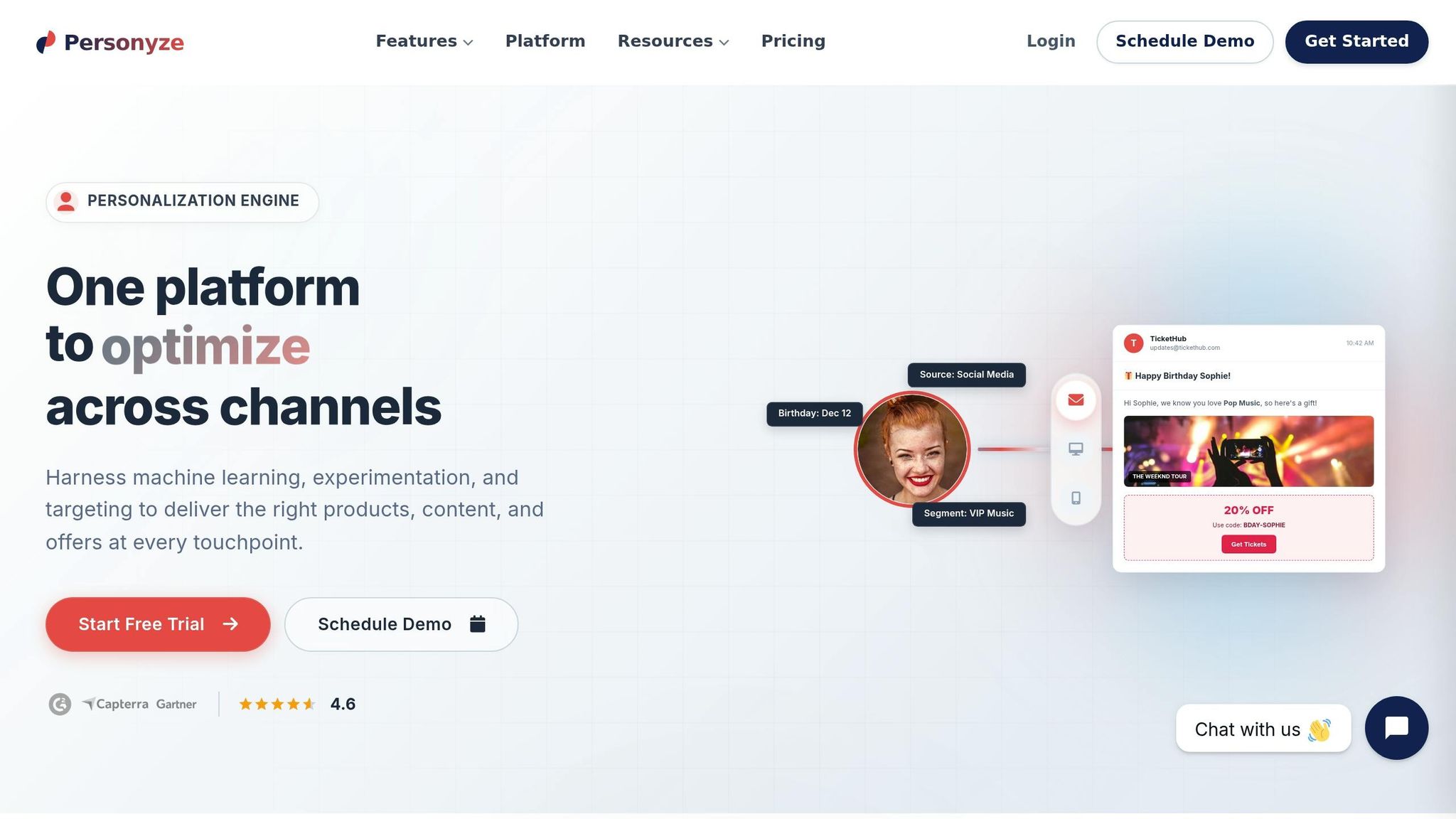
Personyze is an AI-powered personalization platform designed to help businesses create tailored experiences across websites, mobile apps, and email campaigns. What makes it stand out is its ability to use 70+ visitor attributes - like geo-location, local weather, referral source, and real-time site behavior - to trigger highly specific content variations. By leveraging AI, Personyze delivers dynamic product recommendations, adjusts landing page layouts, and ensures consistent messaging across multiple channels. Its combination of real-time insights and multi-channel capabilities makes it a strong contender in the personalization space.
Real-time personalization capabilities
Personyze specializes in dynamic content customization, seamlessly adjusting website elements such as headlines, images, and page layouts based on individual user profiles. Its live email personalization feature takes things further by updating email content in real time to ensure relevance at the moment of engagement. The platform also uses social proof and urgency tactics, like showing real-time stock availability, purchase notifications, and countdown timers, to encourage immediate action.
For B2B businesses, Personyze offers Account-Based Marketing (ABM) tools, tailoring content for key accounts using firmographic data and industry-specific behavior insights. Its intuitive visual editor and guided wizards allow marketing teams to deploy targeted campaigns quickly. As Trey Ogier from HomeAway.com shared:
"With Personyze, our teams around the globe can deliver new targeted promotions and messages within hours instead of weeks".
Key use cases
In e-commerce, companies like PalmBeach Jewelry use Personyze's AI-driven product recommendations to boost email conversion rates by analyzing browsing behavior and purchase history. Jackie Heller noted:
"We use Personyze for Product Recommendation emails and get really good conversion rates. Users love seeing recently viewed items".
The platform’s ability to display real-time stock levels and purchase notifications adds urgency, helping to drive sales.
For omnichannel marketing, Personyze ensures consistent messaging across websites, mobile apps, and emails - all managed from a single interface. This approach aligns with businesses focused on delivering a unified customer experience. Kate Kotzea from Click Rain explained:
"We deliver personalized content and CTAs aligned to interest and location. Managed service helped on complex use cases".
With online personalization increasing revenue by an average of 19%, these omnichannel capabilities are a valuable asset for companies looking to enhance customer engagement.
Starting pricing (USD)
Personyze uses a tiered pricing model based on monthly pageview volume:
- Lite Plan: $250 per month for up to 100,000 pageviews, with standard support.
- Power Plan: $450 per month for up to 1 million pageviews, including enhanced support.
- Enterprise Plan: $1,450 per month for up to 10 million pageviews, with premium support.
This scalable, pay-as-you-go structure ensures businesses only pay for what they use. With a 4.8/5 rating on G2, customers frequently praise the platform's customer support and its ability to handle complex use cases effectively.
Integration and scalability
Personyze integrates seamlessly with major platforms like Salesforce, HubSpot, Shopify, WordPress, Segment, and Google Analytics 4. It unifies data from CRMs and marketing tools to create comprehensive user profiles, enabling precise personalization. Designed to accommodate businesses of all sizes, the platform supports everything from small-scale testing with 100,000 pageviews to enterprise-level operations exceeding 10 million pageviews. This flexibility makes it a practical choice for mid-sized to large organizations looking to scale their personalization efforts.
5. Insider
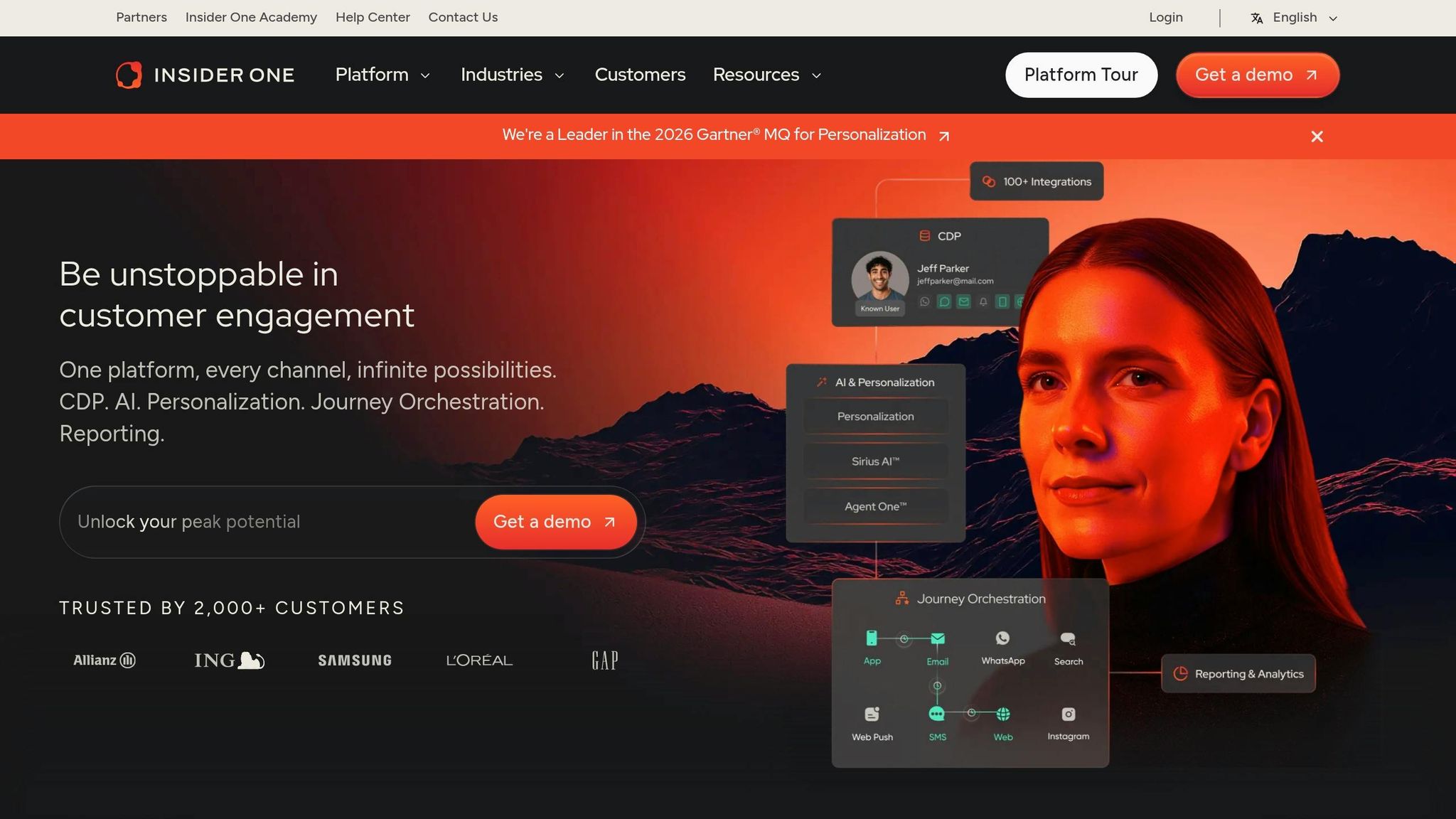
Insider is an AI-driven personalization platform built around its Actionable CDP. This tool gathers data from CRMs, point-of-sale systems, APIs, and other sources - both online and offline - to create real-time, 360° customer profiles [4, 37]. The platform's Sirius AI™ suite automates audience segmentation and content creation [4, 38]. It enables personalization across multiple channels, including web, mobile apps, email, SMS, WhatsApp, and push notifications, ensuring a seamless experience for users. Insider boasts a 4.8/5 rating on G2 from over 1,200 reviewers and has been recognized as a 2026 Gartner® Magic Quadrant™ Leader for Personalization Engines [38, 39].
Real-time personalization capabilities
Insider's real-time personalization tools are designed to engage users at the right moment.
The Architect tool allows businesses to create automated cross-channel customer journeys with a simple drag-and-drop interface. It can trigger actions based on live events like cart abandonment or price changes [4, 36]. Send-Time Optimization (STO) uses AI to send messages when users are most likely to interact, while Predictive Segmentation identifies customers based on purchase likelihood, churn risk, or their preference for discounts [4, 37]. On-site, the InStory feature delivers Instagram-style mobile stories, and EUREKA provides AI-powered site search that adjusts results based on browsing history and predicted intent [36, 40]. The Smart Recommender offers over 20 AI-driven strategies for personalized product suggestions, while Conversational Commerce enables users to shop directly within WhatsApp, including browsing catalogs and completing purchases [36, 39].
For example, during the Galaxy Note launch, Samsung used Insider's Architect to target users interested in competitor devices. Personalized web push notifications sent to users who abandoned their carts led to a 24% increase in conversion rates [4, 40]. Muharrem, Co-Founder & Chief Product Officer of Insider One, emphasized:
"Real-time personalization enables brands to meet this expectation. It delivers dynamic, relevant content at the exact moment a user engages whether via email, web, SMS automation, or app".
These capabilities demonstrate how Insider supports businesses in delivering timely and relevant content.
Key use cases
Insider's tools have delivered measurable results across various industries:
-
E-commerce:
- Philips used Insider's website personalization to tailor content and recommendations, achieving a 40.11% boost in conversion rates and a 35% increase in average order value (AOV).
- Avon implemented the AI-driven Smart Recommender for real-time product suggestions, resulting in an 11% rise in AOV and a 13% improvement in click-through rates [37, 40].
- Carrefour targeted cart abandoners with personalized web push notifications, which led to a 350% increase in conversion rates and generated $11,000 in extra revenue in the first month.
-
Omnichannel marketing:
- Slazenger implemented cross-channel personalization across web, email, and SMS, reporting a 700% increase in customer acquisition and a 49x return on investment (ROI) within eight weeks.
- Adidas used advanced segmentation to deliver tailored offers, achieving a 258.99% rise in AOV for new users and a 35.31% uplift in conversion rates for returning customers [37, 40].
A Digital Marketing Manager from a global department store noted:
"What I like best about Insider One is the fact that it allows us to provide an individualized onsite experience for our customers according to their interests".
These examples highlight Insider's ability to drive impactful results for businesses.
Starting pricing (USD)
Insider operates as an enterprise-level solution and does not publicly disclose pricing. Instead, it offers custom quotes following a demo. The platform has no setup fees and includes guided onboarding, where Insider manages the full implementation and migration of existing automation flows [4, 37]. Users have consistently praised its ease of setup (92%) and quality of support (97%). On G2, Insider earned a perfect 100/100 satisfaction score in the Personalization Software and E-commerce Personalization categories.
Integration and scalability
Insider's ability to integrate and scale makes it a standout option for personalization.
The platform connects seamlessly with CRMs, CMSs, APIs, and POS devices via its Actionable CDP, eliminating data silos without complex configurations [4, 37]. Designed for large-scale operations, Insider supports over 1,200 global brands in 26 countries, handling high traffic and large customer databases. It delivers results 3X faster time-to-value (TTV) than traditional platforms [37, 38]. With 120+ rules and attributes for audience segmentation and 100+ pre-built templates, businesses can launch campaigns quickly and efficiently [4, 39].
A Marketing Manager shared their experience:
"Insider One had the right set of tools. Their personalized product recommendations helped us generate 18.8% more revenue per user, and increase profitability from returning users by 42%".
This combination of integration, speed, and scalability ensures Insider meets the needs of businesses at all levels.
6. Mutiny
Mutiny brings real-time personalization to the B2B world, focusing specifically on account-based marketing (ABM) strategies.
This platform leverages firmographic data and real-time intent signals to deliver customized experiences for target accounts. With a 4.7/5 rating on G2, it’s a trusted tool among B2B SaaS and enterprise teams.
Real-time Personalization Features
Mutiny’s AI-powered tools simplify the creation of personalized landing pages and microsites, significantly reducing manual work. Its no-code editor lets marketing teams adjust headlines, calls-to-action, logos, and case studies dynamically - no developer needed. By pulling data from CRMs, intent signals, and firmographics, teams can create tailored experiences that reflect visitor needs. Template prompts also ensure that branding stays consistent across all AI-generated content.
The platform’s smart workflows direct small-to-medium businesses (SMBs) to self-serve trials, while enterprise accounts are routed to sales demos. Mutiny integrates seamlessly with popular B2B tools like Salesforce, HubSpot, Clearbit, 6sense, and Demandbase, enabling precise audience segmentation.
In June 2024, Growth Strategists used Mutiny to automate their quarterly business review (QBR) microsites. This reduced the time spent per account from four hours to just 15 minutes - a 93% time savings - and resulted in a 50% conversion rate for follow-up meetings. As June Castro explained:
"The ability to deliver personalized experiences at scale has been a game-changer for our customer engagement efforts. We're now able to provide tailored attention to a larger number of accounts while maintaining a high level of efficiency and effectiveness."
Practical Applications
Mutiny has proven effective for B2B teams implementing account-based strategies. For example, Livestorm, a webinar platform, used Mutiny alongside Clearbit Reveal in 2023/2024 to personalize their homepage for different visitors. For companies with over 10,000 employees, they hid pricing, promoted demo offers instead of free trials, and featured enterprise logos prominently. This strategy led to a 30% increase in homepage conversions. Thibaut Davoult, Livestorm’s Head of Growth, noted:
"This is a really common issue for product-led companies. You have a self-serve plan that is competing with the sales-enabled plan. We wanted to prevent that."
Other success stories include Personio, which achieved a 45% boost in conversions with tailored homepage experiences based on account characteristics. Even beyond traditional B2B scenarios, Ruggable used Mutiny to update landing pages dynamically based on ad sources, resulting in a 7× increase in click-through rates and a 25% lift in conversions.
Pricing Overview (USD)
Mutiny’s pricing is tiered to suit teams of different sizes and traffic levels:
- Free Tier: $0/month for small teams (up to 5 members) with 5 daily AI credits per user.
- Business Tier: $50/month per seat, ideal for growing teams, with integrations for tools like Outreach and Salesloft.
- Enterprise Tier: Starts at $30,000/year for larger organizations handling over 200,000 monthly unique visitors. This tier includes Salesforce/HubSpot integrations, single sign-on (SSO), and a dedicated Customer Success Manager.
Additional AI credits are available at $100 per 100 credits, and onboarding fees range from $5,000 to $25,000, depending on the complexity of implementation.
Scalability and Integration
Mutiny integrates with leading ABM tools like 6sense, Demandbase, Salesforce, HubSpot, Outreach, Salesloft, and Clearbit. It supports over 200,000 monthly unique visitors and offers enterprise-grade security features such as SOC 2 compliance and SSO. For high-value campaigns, the platform can create personalized, 1:1 microsites and landing pages tailored to specific accounts.
Next, we’ll explore Braze, another standout in real-time, cross-channel personalization.
7. Braze
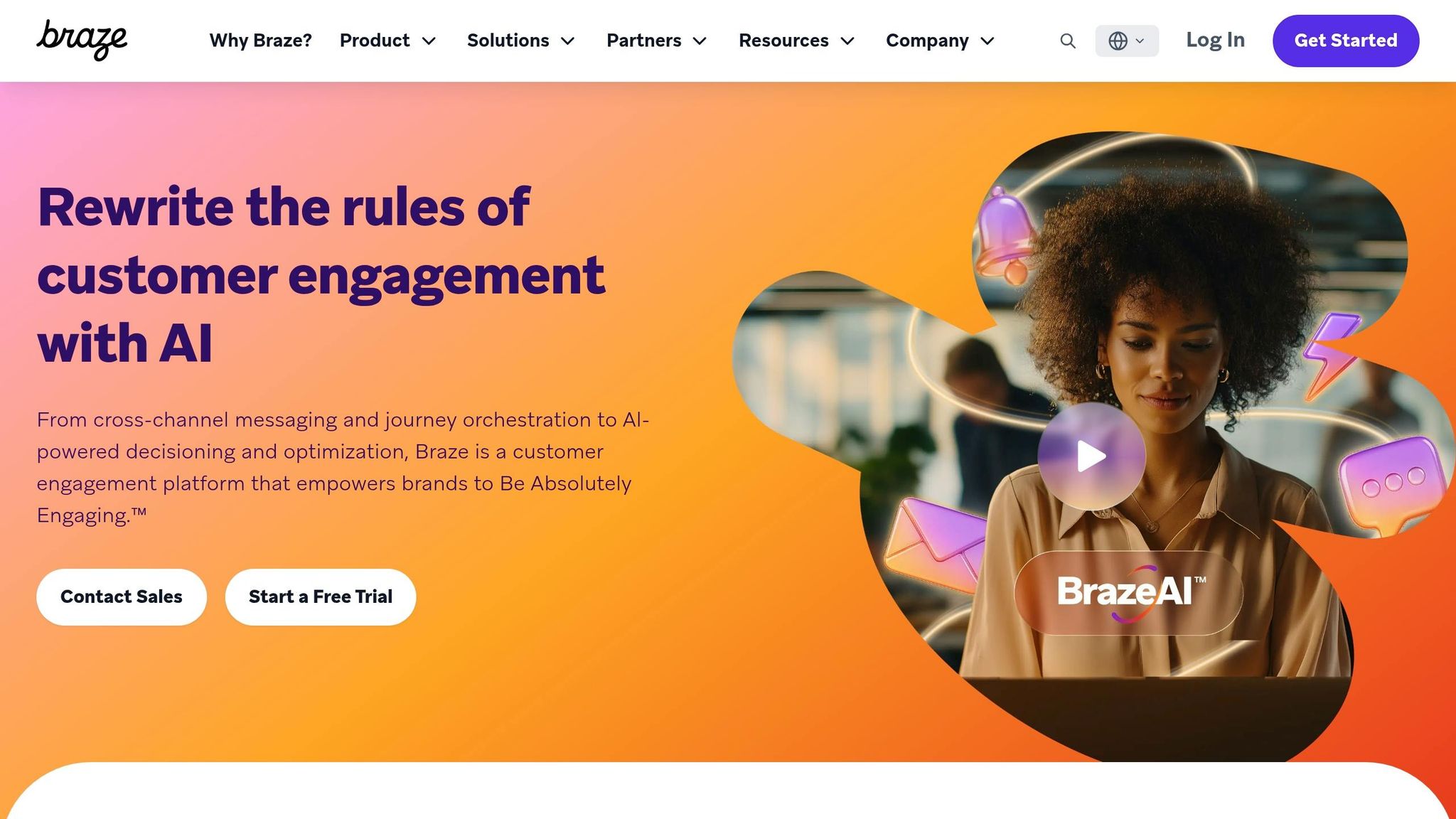
Braze wraps up the list with a solution tailored for large-scale, cross-channel personalization. It's a top choice for businesses focused on delivering instant, multi-channel customer engagement. By 2024, Braze had processed an impressive 3.9 trillion messages and 8.6 trillion API calls. Fast forward to September 2025, and the platform supported 7.8 billion monthly active users across various channels, including email, SMS, push notifications, in-app messaging, and web.
What sets Braze apart is its real-time data streaming, which updates customer profiles instantly. Its BrazeAI Decisioning Studio™ leverages reinforcement learning to fine-tune message timing and channel selection.
Real-Time Personalization Capabilities
Braze excels at using live data to personalize messaging. It can trigger communications in response to user actions like cart abandonment or location changes. With its Connected Content feature, Braze pulls live data from external APIs - such as weather updates, sports scores, or inventory details - right at the time of sending. This has been shown to increase conversions by 1.3×.
The platform also offers tools like Canvas Journey Orchestration for mapping multi-step customer journeys, Liquid Personalization for swapping content based on user profiles, and a Predictive Suite to identify users likely to convert or churn.
One standout example is Canva, which scaled its weekly email volume from 30 million to 50 million with Braze while maintaining 99% deliverability. By using Connected Content for localized recommendations in over 20 languages, Canva saw a 33% rise in open rates and a 2.5% increase in engagement.
Key Use Cases
E-commerce brands reap significant benefits with Braze. Adding a second messaging channel through the platform can lead to a 4.5× increase in purchases per user. Grubhub, for instance, personalized its year-in-review emails using 32 custom API attributes, which doubled social media mentions and boosted referrals.
In the B2B and omnichannel space, Kayo Sports in Australia expanded its communication variations from 300 to 1.2 million in fiscal year 2024 using Braze's Customer Cortex engine. This resulted in a 14% rise in subscriptions, an 8% growth in average annual occupancy, and a 105% jump in cross-sells.
Panera Bread also saw success with Braze during its April 2024 menu update. The campaign delivered over 4,000 unique personalized offers, leading to a 5% improvement in retention among at-risk customers, a twofold increase in purchase conversions, and saving over 50 hours of manual work.
Starting Pricing (USD)
Braze operates on a custom pricing model, factoring in data usage, monthly active users, and the selected feature set. Pricing details aren't publicly available, so interested businesses need to contact the sales team for a tailored quote. The platform is primarily aimed at mid-market and enterprise clients managing vast user profiles and global operations.
Integration and Scalability
Braze integrates seamlessly with over 140 technologies, including Snowflake and Twilio Segment. It also offers enterprise-grade governance features like multi-business unit architecture and SOC 2 compliance. For example, Dutch Bros consolidated its messaging channels using Braze Canvas and Catalogs, achieving a 230% ROI increase from CRM campaigns and reducing costs by 31% through platform consolidation.
Comparison Table
The table below provides a quick overview of key features, pricing, and user satisfaction for the tools discussed earlier. This makes it easier to compare and decide which one aligns with your needs.
| Tool | Primary Use Case | Key Features | Starting Price | G2 Rating |
|---|---|---|---|---|
| Dynamic Yield | Enterprise eCommerce | Experience OS, multivariate testing, next-best-action ML | Custom | 4.5/5 |
| Optimizely | Experimentation-focused teams | A/B testing, feature flagging, content recommendations | Custom | 4.2/5 |
| Bloomreach | eCommerce Product Discovery | AI search, merchandising, Loomi AI, headless CMS | $1,000/month | 4.6/5 |
| Personyze | Mid-market multi-channel | Behavioral targeting, email personalization, visual editor | $250/month | 4.8/5 |
| Insider | Omnichannel Enterprise | Actionable CDP, WhatsApp/SMS, Sirius AI, Architect journey builder | Custom | 4.8/5 |
| Mutiny | B2B ABM Programs | Account-based personalization, intent signal integration, no-code editor | $0/month (Free tier) | 4.7/5 |
| Braze | Mobile-first Engagement | Push/In-app triggers, Canvas journey builder, Sage AI | Custom (starting at around $60,000) | 4.5/5 |
If you're looking for affordability, Personyze stands out with a starting price of $250/month, making it a great choice for mid-market personalization experiments. For modular pricing, Bloomreach begins at $1,000/month, while Mutiny offers a free tier, perfect for smaller teams or those just getting started. On the other hand, enterprise solutions like Dynamic Yield, Optimizely, Insider, and Braze offer custom pricing based on traffic and feature needs.
When it comes to user satisfaction, Personyze and Insider take the lead with 4.8/5 ratings, followed closely by Mutiny at 4.7/5.
With this comparison, you're better equipped to decide which tool aligns with your real-time personalization goals.
Conclusion
After examining the features, pricing, and applications of leading real-time personalization tools, it’s evident that each platform caters to different needs and priorities. Real-time personalization isn't just a luxury anymore - it's an expectation. Companies that excel in this area can experience a 19% boost in total revenue, while the fastest-growing organizations see 40% more revenue generated from personalization efforts compared to their slower competitors.
Each tool brings something distinct to the table. Dynamic Yield and Bloomreach are favorites for enterprise eCommerce, offering advanced product recommendation engines. Optimizely shines for teams that require robust A/B testing alongside personalization. Mutiny is tailored for B2B teams focused on account-based marketing, while Insider and Braze lead in mobile-first, omnichannel engagement. For mid-market companies, Personyze delivers enterprise-level features at a more approachable price point.
"Real-time personalization needs to happen in milliseconds, or at least so fast that any delay in delivery is imperceptible by the customer." - Esat Artug, Senior Product Marketing Manager, Contentful
This guide was designed to help you evaluate which tool aligns best with your specific needs - whether you’re looking for enterprise-grade scalability or cost-effective options for mid-sized operations. For B2B SaaS teams, Mutiny’s firmographic targeting is a game-changer. Retailers managing large product catalogs should look to Dynamic Yield or Bloomreach. Teams with limited developer resources will appreciate the no-code editors offered by Mutiny and Personyze, while mobile-centric brands can leverage the powerful push and SMS capabilities of Braze and Insider.
The key is to select a tool that not only fits your business model but also integrates smoothly with your CRM or analytics platform. This ensures your personalized content is backed by reliable first-party data. Use the comparison table above to narrow down your options, then schedule demos to see how each platform performs with your unique use cases.
FAQs
How do I choose the right real-time personalization tool for my business?
To pick the right tool, start by pinpointing your specific goals - whether it's website personalization or omnichannel marketing. Make sure the tool integrates smoothly with your current systems, like your CRM or e-commerce platform. Prioritize tools with AI-driven features that enhance engagement, simplify usage, and provide actionable insights through analytics or A/B testing. Lastly, check pricing and trial options to confirm the tool fits both your budget and objectives.
What data is needed to enable real-time personalization safely and accurately?
To deliver real-time personalization effectively, you need live customer data - things like behaviors, preferences, and attributes. This information should be gathered using tools such as Customer Data Platforms (CDPs) or APIs and processed within milliseconds. Why? Because speed is key to ensuring the experiences you deliver are timely and relevant.
To make this work, integrated systems are essential. They help maintain the balance between speed and accuracy, ensuring your personalization efforts hit the mark every time.
How long does it usually take to implement and see ROI from personalization?
You can often begin noticing a return on investment (ROI) from personalization within just a few months. In fact, some reports highlight measurable gains - like increased conversion rates and revenue - as early as the first month or two. However, the exact timeline can differ based on the specific tools and strategies you implement.