Want to cut content creation time by 80% while saving thousands of dollars? AI content pipelines make this possible by automating repetitive tasks like keyword research, drafting, and publishing. Here's what you need to know:
- Time Savings: Reduce weekly content creation from 15–20 hours to just 2 hours.
- Cost Efficiency: Slash costs per article from $611 to $131 using AI tools.
- Higher Output: Companies using AI publish more consistently, driving 3.5x more inbound traffic.
- Automation Benefits: Tasks like CMS uploads drop from 30 minutes to just 2 minutes per post.
This guide outlines how to plan, create, and distribute content faster without sacrificing quality. From strategic goal-setting to AI-driven performance analysis, you'll learn how to build a system that works for you.
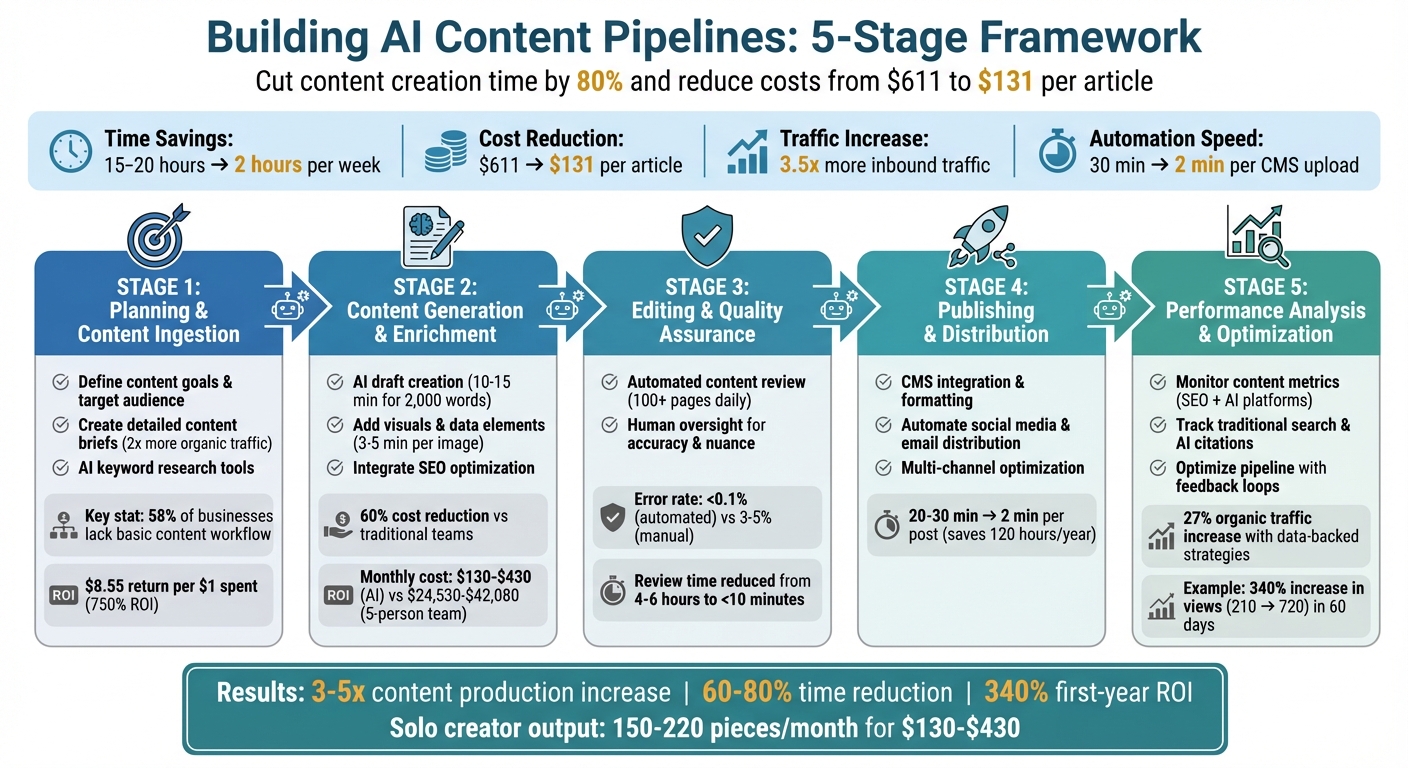
5-Stage AI Content Pipeline Workflow: From Planning to Performance Analysis
I Built an AI Content Agent With N8N and Claude (Step-by-Step)

sbb-itb-a759a2a
Stage 1: Planning and Content Ingestion
Stage 1 lays the groundwork for effective AI-driven content creation and optimization. Every successful content pipeline begins with a clear, strategic plan. Before diving into content creation, it’s critical to define your objectives. Are you aiming to boost website traffic, generate leads, or convert prospects into paying customers? And how does each piece of content contribute to these goals? In 2026, 58% of businesses still lack a basic content workflow, which explains why many struggle to maintain consistency. However, organizations that adopt structured content systems see returns of $8.55 for every dollar spent - a 750% ROI. This phase is all about establishing audience-specific strategies and creating targeted content briefs.
Define Content Goals and Target Audience
The first step is aligning your content with specific business outcomes. Instead of chasing generic traffic, focus on creating content tailored to segments of your ideal customer profile. For example, if you sell networking equipment, you might need distinct content streams for technical installers versus network administrators. Use metadata tags to categorize content by user segment, enabling AI tools to deliver more personalized recommendations.
In 2026, content must perform well across two discovery paths: traditional search engines (SEO) and AI model recommendations (GEO - Generative Engine Optimization). Metrics like "citation frequency" in AI systems such as ChatGPT and Claude are becoming key performance indicators. For instance, Palo Alto Networks implemented metadata-driven AI workflows to improve the searchability of their technical documentation, resulting in increased web traffic through better SEO. This evolution means your planning phase must address how both humans and AI systems will interact with your content.
"Structured content is the foundation for AI success because it provides a clear, standardized format that AI can understand and work with." - Saibal Bhattacharjee, Director of Product Marketing, Adobe
With well-defined goals and audience insights, you’re ready to create content briefs that guide production effectively.
Create Detailed Content Briefs
A detailed brief can be the difference between polished, high-performing content and generic, forgettable material. Your briefs should include target keywords, search intent classification (e.g., informational, commercial, or transactional), audience context (such as roles and knowledge level), required heading structures, specific data points, and tone guidelines. Content created from comprehensive briefs achieves 2x more organic traffic within six months compared to content without them.
For example, if targeting the keyword "AI content automation", your brief might specify which sections should address setup versus maintenance. Include negative constraints to avoid generic phrasing (e.g., banning clichés like "in today’s digital landscape") and limit paragraphs to three sentences for readability. Teams using structured briefs see content production speeds increase by 40%, with fewer revisions needed. Grundfos, a global manufacturing company, reduced translation time for documentation updates from seven weeks to under an hour by leveraging modular content and reusing over 750,000 topics. Detailed briefs not only streamline writing but also enhance AI tools' ability to generate relevant content.
Use AI Tools for Keyword Research
AI tools simplify keyword research, turning it into a systematic process. Platforms like Semrush’s Content Toolkit offer features like Topic Finder, which identifies trending ideas, and an SEO Brief Generator, which suggests keywords, subtopics, and competitive insights. DeepRank AI’s Content Plan Generator, for example, creates 10-day content calendars complete with target keywords and internal linking suggestions for $99/month (or $64/month with the LAUNCH64 promo).
These tools analyze top-ranking search results in minutes, identifying recurring subtopics and determining the depth of content needed to compete. Prioritize semantic matches that address core concepts and user questions. EverWorker, for instance, uses AI to automate multi-step SEO workflows, analyzing competitors, extracting search intent, and generating prioritized topic clusters. For technical content, tools like Llama 4 leverage Retrieval-Augmented Generation (RAG) with vector databases to ensure accuracy by grounding output in verified documentation.
"AI keyword research for content is the use of machine learning and LLMs to discover, prioritize, and cluster search topics based on intent, competition, and business value - then turn those insights into a scalable content plan." - Ameya Deshmukh, Director of Marketing
Stage 2: Content Generation and Enrichment
This stage turns the groundwork laid in Stage 1 into polished, ready-to-use content. It’s where strategic ideas evolve into drafts, enhanced with visuals, data, and SEO elements. By running processes like writing, visual creation, and optimization concurrently, this phase connects planning with tangible results - leveraging tools like AI for efficiency and quality.
Use AI Writing Tools for Draft Creation
With detailed briefs and keyword research in hand, AI writing tools can significantly speed up content creation. For example, these tools can draft a 2,000-word blog post in just 10–15 minutes, followed by 15–25 minutes of human review, totaling about 25–40 minutes of production time. A proven workflow starts with a detailed outline - complete with headings, talking points, and FAQs - before expanding each section individually. To ensure consistency, incorporate brand voice and formatting rules into every system prompt. Include specifics like citation requirements, paragraph length limits (usually three sentences), and guidelines for quotes or product mentions.
The cost advantage is clear: an AI content stack (covering writing, visuals, and automation) typically costs between $130 and $430 per month. Compare that to the $24,530 to $42,080 monthly expense of a traditional five-person content team. That’s a cost reduction of about 60%, without sacrificing quality.
"The quality ceiling is set by the brief, not the model." – The SEO Engine
For more complex projects, like pieces exceeding 5,000 words, break the content into smaller sections. This ensures each part is detailed and focused. Always dedicate time to fact-checking to verify statistics, dates, and claims, as AI tools can sometimes generate inaccurate data. Specialized tools listed in the AI Blog Generator Directory (https://aibloggenerators.com) can support these efforts with features tailored to different content needs, from automated blog generation to CMS integration.
Add Visual and Data Elements with AI Tools
Visuals are just as important as the writing itself, and AI tools make creating them faster and easier. For instance, generating a blog’s featured image takes roughly 3–5 minutes, while a full set of social media graphics can be ready in 5–8 minutes.
To improve readability, use AI to create elements like lists, tables, and FAQ sections. When your content involves statistics or comparisons, consider marking these as "data callouts" for visual representation through charts or tables. Additionally, generate platform-specific visuals - 16:9 for YouTube thumbnails, 9:16 for TikTok or Pinterest, and 1:1 for Instagram.
Maintaining brand identity is crucial. Use your brand’s color codes (e.g., #FF5733), style guidelines, and visual tone in image-generation prompts. Be sure to include clear alt text for SEO and accessibility purposes. Teams using AI for visual and content production can create up to five times more material at 60% lower costs. However, human review remains essential for ensuring accuracy and alignment with the brand.
Integrate SEO Optimization Features
SEO works best when it’s part of the content creation process, not an afterthought. Tools like Semrush AI Search Optimizer analyze keyword coverage, readability, and tone while generating AI-driven metadata for both traditional and AI-focused search engines (like ChatGPT or Perplexity). Another tool, Gixo, provides real-time SEO analysis during content generation, even embedding citations through its "evidence engine" to enhance credibility.
Structured AI workflows - starting with a detailed brief, followed by drafting, human editing, and optimization - can yield impressive results. Content created this way averages 3.2x more organic impressions compared to unedited AI-generated content. On the flip side, unrefined AI output can lose up to 40% of its potential traffic within 90 days due to lack of specificity. For example, in March 2026, a user of the SEVOsmith automation system produced a 4,800-word review in just 36 minutes. This included six images, Rank Math metadata, and formatted pricing tables - all without manual intervention.
To optimize for AI search engines, focus on concise sentences and clear headings, enabling large language models to extract information quickly. Structure claims in a format like "[stat] which means [consequence]" to make them more citable for AI-generated responses. The AI Blog Generator Directory (https://aibloggenerators.com) offers tools with built-in SEO features, from keyword research to analytics integration, helping ensure visibility across both traditional and AI-driven search platforms.
Stage 3: Editing and Quality Assurance
Once content is generated, the next step is ensuring it meets high standards through a mix of automated tools and human review. This stage serves as a quality checkpoint, filtering out errors, maintaining consistency, and confirming accuracy before the content reaches your audience. By combining the speed of AI with the discernment of human reviewers, you can bridge the gap between fast production and polished, reliable content.
Automated Content Review and Optimization
Automated tools take care of repetitive tasks that would otherwise eat up hours of manual effort. These systems evaluate content for factors like relevance, depth, and originality. For example, Syntora shared in March 2026 that their 8-tier automated quality system - integrating Gemini and Brave Search APIs - reviews over 100 pages daily, with less than 5% requiring manual intervention.
Automated quality assurance (QA) drastically reduces review time, trimming it from 4–6 hours for 100 variations to just under 10 minutes. These systems also achieve an error rate of under 0.1%, compared to the 3–5% typical of manual reviews. This means every piece of content gets reviewed, not just a small sample, as is common with purely manual workflows.
Here’s what automated systems excel at:
- Checking spelling, grammar, and formatting
- Spotting banned words or off-brand phrases
- Ensuring keyword density and SEO meta tags are on point
- Running semantic similarity checks to prevent self-plagiarism, using tools like Supabase and pgvector
- Comparing text against verified sources, such as Product Information Management (PIM) systems, to eliminate errors before publishing
"AI is a game-changer in content quality assurance. It's not just about catching typos. AI can detect subtle issues like tone inconsistency, biased language, and readability concerns." – Sanity
To make the most of these tools, develop AI-readable style guides that outline your brand’s tone and voice. Set up checkpoints in your workflow to ensure content is reviewed against these standards before moving forward. Automated tools can also verify link authority and assess readability for your target audience, making the process even more streamlined.
Human Oversight for Accuracy and Nuance
While automation is great for routine tasks, humans are essential for more nuanced evaluations. The best systems combine AI’s efficiency with human expertise to handle tone, factual accuracy, and intent.
"AI is an incredibly helpful drafting tool, but it has its limitations... it can't reliably fact-check its own hallucinations." – Ana Gotter
Here’s where human reviewers shine:
- Fact-checking: Always verify primary sources. Never rely on AI-generated citations without confirming their validity.
- Tone and flow: Ensure the content feels natural and engaging rather than robotic. A simple technique? Read it aloud to catch awkward phrasing or repetition.
- Tailored reviews: Adjust the level of scrutiny based on the content type. Social media posts may need a quick pass, while technical or regulated content (e.g., legal, medical, or financial) often requires specialized expertise.
A great example of this balance is Grundfos, a global pump manufacturer. Their structured content approach, integrated with AI, allowed them to manage over 750,000 reusable topics. This system cut translation times for updates from seven weeks to under an hour.
To refine the process, create a feedback loop between QA findings and AI prompts. If the system repeatedly fails a brand rule, update prompts to address the issue directly. Maintain a shared library of verified sources to speed up future reviews. Use a layered checklist to ensure all aspects - accuracy, brand voice, SEO, style, and compliance - are covered.
| Task Category | Automated AI Check | Human Oversight Required |
|---|---|---|
| Technical | Spelling, grammar, punctuation | Fact-checking against primary sources |
| Brand | Banned word lists, basic tone | Nuance, irony, brand personality |
| SEO | Keyword density, meta-tag presence | Search intent alignment, depth |
| Structure | Word count, header formatting | Logical flow, narrative tension |
| Safety | Offensive language detection | Ethical bias, regulatory compliance |
"Trust isn't the issue - predictability is. QA makes sure every piece that goes out sounds like us and says what we actually mean." – Ana Gotter
Striking the right balance between automation and human input ensures both efficiency and quality. Tools listed in the AI Blog Generator Directory (https://aibloggenerators.com) can support this process, offering features like text editing and analytics integration to streamline both automated and manual review workflows.
Stage 4: Publishing and Distribution
After ensuring your content passes quality checks, the next step is to publish it efficiently across various channels. This stage connects the creation process to audience engagement, streamlining the transition from preparation to delivery. The goal? Automate repetitive tasks so your team can focus on strategy rather than spending hours manually hitting "publish."
Format Content and Integrate with CMS
Automating the transfer of content to your CMS saves time and ensures everything lands in the right spot - titles in title fields, body text in content sections, and meta descriptions where they belong. Maintaining proper formatting, like headers, bold text, bullet points, and internal links, is crucial for a polished final product.
There are three main ways to link your content pipeline to your CMS: direct API integration, middleware platforms, or native publishing tools.
- Manual vs. Automated Publishing: Manually uploading content can take 20–30 minutes per post, while automation reduces this to just 2 minutes of review time. For a team publishing 20 articles a month, automation saves about 10 hours monthly - or 120 hours annually, the equivalent of three full work weeks.
Automated systems can also handle image tasks like alt text, featured images, and SEO optimization. SEO metadata can be pre-configured to pull from your content brief, while URL slugs can be auto-generated using lowercase letters and hyphens for clean, search-friendly links.
Secure your API connections with application-specific passwords or API tokens that limit permissions rather than using your main admin credentials. For WordPress, you can create unique application passwords by navigating to Users > Profile.
Before publishing, test everything on a staging environment to catch issues like broken links or formatting errors. Automated "quality gates" can also check readability, keyword density, and formatting hierarchy to ensure your content is ready for prime time.
To help search engines find your content faster, consider implementing IndexNow protocols. This can reduce discovery times from weeks to just minutes or hours on platforms like Google, Bing, and Yandex.
Automate Social Media and Email Distribution
Publishing content to your blog is just the beginning. To maximize reach, you’ll need to distribute it across social media and email platforms. Tailor your content to fit the style and format of each platform. For example:
- LinkedIn: Longer, professional posts (1,300+ characters)
- Instagram: Visual-first captions with 3–5 hashtags
- X (formerly Twitter): Concise threads with 5–12 posts
- TikTok: Hook your audience in the first 1.5 seconds
"The brands that win on social media in 2026 are not the ones with the biggest teams or budgets. They are the ones that have built repeatable content engines powered by AI." – Digital Applied
Batch your social content creation to save time. For example, create all your posts for the week or month in one session, then use bulk upload features in scheduling tools to streamline the process. This approach can reduce planning time by up to 78%, cutting a 12–16 hour task down to just 3–4 hours.
Automate UTM tagging for every link to track which platforms and posts drive the most traffic and conversions. Integrate tools like Google Drive or Canva directly with your scheduling platform to avoid manual file transfers.
For email campaigns, segment your subscriber list and personalize subject lines based on reader behavior. Schedule emails for times when your audience is most active, considering time zones if you have a global reach.
While automation can handle drafting and formatting, keep a human involved for quality control and to maintain your brand’s voice. This ensures efficiency without compromising the authenticity of your messaging.
"In a high-performance content operation, automation is not about replacing people. It is about removing low-value work so people can focus on quality decisions." – Better Blog AI
Lastly, don’t forget to refresh your API connections every 60–90 days. Social media platforms often expire security tokens, and re-authenticating proactively helps avoid errors that could disrupt your publishing schedule.
For tools to help with CMS integration and multi-channel distribution, check out the AI Blog Generator Directory (https://aibloggenerators.com). These resources can help you set up automated workflows quickly and effectively.
Stage 5: Performance Analysis and Optimization
The final step in your AI content pipeline is measuring how well your content performs. By 2026, tracking results will require monitoring two key areas: traditional search engines like Google and Bing, and AI-driven platforms such as ChatGPT, Claude, and Perplexity. Data-backed strategies can drive organic traffic up by about 27% compared to relying on intuition alone.
Monitor Content Metrics
To understand how your content is performing, keep an eye on essential metrics like organic sessions, click-through rates (CTR), average search position, and engagement levels. Tools like Google Analytics 4 and Google Search Console are invaluable here. With AI overviews cutting website clicks by over 30% in certain industries, it's also crucial to measure how frequently AI models cite your content. Specialized tools can help track your "share of voice" within AI-generated responses, showing how often platforms like ChatGPT, Claude, and Perplexity mention your brand.
Dive deeper by analyzing performance at the cluster level. This means evaluating how well your pillar pages perform in relation to their supporting content and tracking keyword rankings across entire topic groups. Don’t overlook internal link click-through rates, and set up automated alerts for sudden ranking drops or changes in AI visibility.
Set up regular performance check-ins. For example:
- At 2 weeks, confirm your content is indexed and discoverable.
- At 30 days, identify quick wins, such as optimizing underperforming meta descriptions.
- At 90 days, compare your content's performance to your initial goals.
Consider this real-world example: Between February and April 2026, Jackson Lee created a self-improving AI content pipeline that published 18 posts on platforms like Dev.to and Medium. By feeding performance metrics into his GPT-4 generator, he increased average views per post by 340% (from 210 to 720) and doubled engagement rates within 60 days. These insights are invaluable for refining your content strategy.
Optimize the Pipeline with Performance Feedback
Performance data isn’t just for tracking progress - it’s a tool for improving your overall content strategy. A well-designed pipeline has a feedback loop that connects performance metrics back to the planning stage, shaping keyword research and content creation. For instance, if certain topics, headlines, or structures consistently perform well, use that knowledge to refine your AI generator's prompts for future content.
"Content marketing fails when the phases are disconnected... Performance data from Phase 6 feeds directly back into Phase 1, informing the next cycle of keyword research with real-world results." – Mike McKearin, Founder, WE-DO
To strengthen your pipeline, try these adjustments:
- Use cohort analysis to track how content performs over time and identify when older posts need updates.
- Automate checks for readability, semantic coverage (aim for over 85%), and brand voice consistency before publishing.
- A/B test AI-generated elements like headlines, visuals, and calls to action to see which versions resonate most with your audience.
Reassess your topic clusters every quarter based on ranking data. Focus on topics that perform well and deprioritize those that don’t. Feeding these insights back into your planning ensures your pipeline evolves alongside your results. While 78% of marketers already use analytics to guide content topics, the real advantage lies in automating this process rather than manually sifting through spreadsheets.
"Without measurement and learning, automation is just repetition." – Lee Jackson, Founder, Jackson Studio
For tools to help monitor both traditional SEO and AI visibility metrics, check out the AI Blog Generator Directory (https://aibloggenerators.com). Many of these platforms now integrate analytics directly into your content workflow, making it easier to refine and optimize your pipeline continuously.
Conclusion
An AI content pipeline bridges the gap between brainstorming and publishing, streamlining the process without sacrificing creativity. By adopting a unified workflow, creators can increase content production by 3–5×, cut production time by 60–80%, and achieve a first-year ROI of 340%. For example, a solo creator could generate 150–220 pieces of content monthly for just $130–$430. Compare that to a five-person team, which might cost $24,530–$42,080 per month, and the monthly ROI could surpass 1,000%.
"The most successful content teams do not use AI to replace human creativity - they use it to eliminate repetitive tasks so humans can focus on strategy, voice, and ideas that AI cannot replicate." – Digital Applied
To get started, focus on one type of content, refine your workflow, and scale up from there. Incorporate quality checks and automated scoring throughout the process to maintain high standards. At the same time, human oversight ensures your brand's voice and subtle nuances stay intact. For tools to help you research, write, optimize for SEO, and integrate with your CMS, check out the AI Blog Generator Directory (https://aibloggenerators.com). It’s a one-stop shop for building your pipeline.
The teams that embrace AI-driven content workflows now will gain a major edge in both the speed and quality of their output.
FAQs
What tools do I need to build an AI content pipeline?
Creating an AI-driven content pipeline involves combining AI tools with automation platforms to streamline your content production process. Here's how it works:
- AI writing assistants: These tools help draft content quickly and efficiently, saving time on initial writing tasks.
- SEO tools: Essential for optimizing content to ensure it ranks well on search engines and reaches the right audience.
- Automation platforms: These connect various workflows, enabling seamless integration between research, editing, content creation, and distribution.
By using these tools together, you can simplify time-consuming tasks like research, polishing drafts, designing visuals, and distributing content. The result? A smoother, more efficient content creation system.
How do I keep AI-generated content accurate and on-brand?
To keep AI-generated content both accurate and aligned with your brand, start by setting up clear brand guidelines. Train the AI using your style guides and existing content so it understands your tone and messaging. Make it a habit to review its outputs regularly and offer feedback to fine-tune its performance.
Structured content and metadata are also key to maintaining consistency across different platforms. Additionally, put systems in place that enforce your brand's parameters, helping to minimize inconsistencies and ensure that every piece of content reflects your brand's voice and identity.
How do I measure SEO and AI-citation performance together?
To gauge the combined effectiveness of SEO and AI-citation performance, focus on tracking key metrics such as organic traffic, keyword rankings, and mentions of your brand by large language models (LLMs). Over time, analyze trends like traffic growth, improved rankings, and how frequently LLMs cite your content. By reviewing these metrics together, you can better understand how AI-generated content contributes to both SEO success and brand visibility.
