Virtual influencers are AI-crafted digital personalities designed to engage audiences, promote products, and build brands. Using tools like Midjourney (images), ElevenLabs (voice), and HeyGen (video), you can create professional-grade virtual influencers for as little as $50–$200 monthly. These influencers offer brands complete control over their persona, operate 24/7, and boast higher engagement rates (2.84%) than human influencers (1.72%). The virtual influencer market is booming, projected to grow from $6.33 billion in 2024 to $111.78 billion by 2033.
Key Steps to Create a Virtual Influencer:
- Plan Your Strategy: Define your target audience, goals, and platforms (e.g., Instagram, TikTok).
- Design the Influencer: Use detailed prompts for visuals, craft a personality using AI writer tools, and maintain consistency across content.
- Generate Content: Create photos, videos, and voiceovers using AI tools while ensuring quality and uniformity.
- Automate & Scale: Use scheduling tools, performance tracking, and multi-language capabilities to expand reach.
With AI tools, creating and managing virtual influencers is now affordable, efficient, and scalable, offering brands new opportunities in digital marketing.
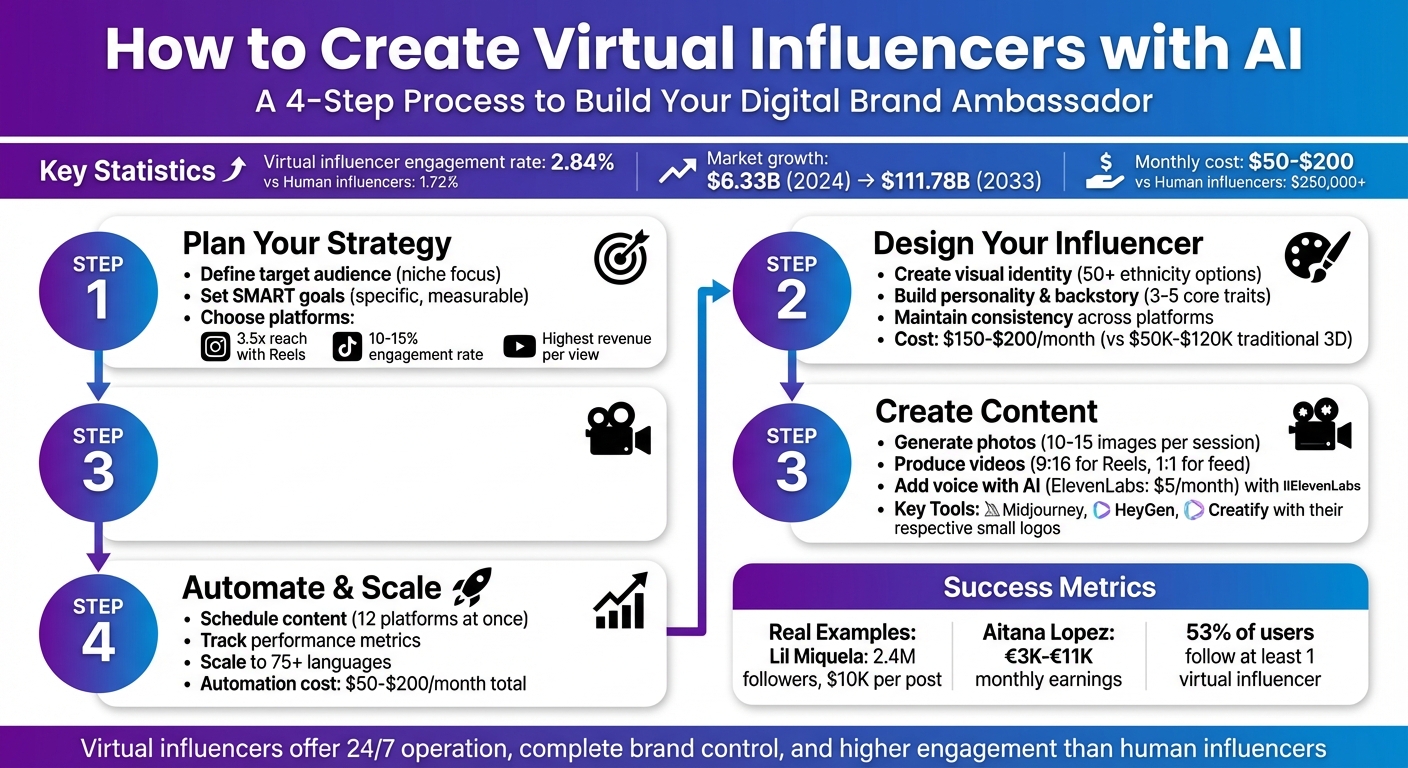
4-Step Process to Create Virtual Influencers with AI Tools
Step 1: Plan Your Virtual Influencer Strategy
Identify Your Target Audience
When it comes to virtual influencers, being specific about your audience is everything. Instead of casting a wide net, focus on niche groups like "sustainable fashion for millennial moms" or "fitness tips for busy professionals". With the virtual influencer market expected to grow from $4.6 billion in 2025 to $15 billion by 2028, standing out in a crowded space means narrowing your focus.
Start by defining key details about your ideal follower - think age, location, spending habits, and challenges. For example, you might target women aged 22–35 who love minimalist fashion but are priced out of luxury brands. Your virtual influencer’s appearance and style should align with this audience’s preferences, creating a sense of connection that feels personal and relatable. Beyond looks, establish a clear "content promise." Whether it’s quick workout routines or daily style inspiration, consistency in what you deliver keeps followers engaged and coming back, often supported by advanced AI tools for blog content creation.
Before diving in, research where brands in your chosen niche are already investing in influencer marketing. This ensures your efforts align with potential monetization opportunities down the line. Once you’ve nailed down your audience, define concrete goals to give your virtual influencer a clear purpose.
Set Clear Brand Goals
Your virtual influencer needs a well-defined role right from the start. Are they a brand-owned character for social media, a persona for ad campaigns, or a spokesperson for product launches? Tie these goals to specific stages of the marketing funnel, like awareness, consideration, conversion, or retention.
Take Ralph & Russo’s 2020–2021 couture collection as an example. They introduced Hauli, a virtual model, who showcased their designs at iconic landmarks like the Taj Mahal and the Great Wall. The campaign racked up 19.4 million views globally and generated $65.1 million in media value. This highlights the importance of aligning clear objectives with measurable outcomes. In fact, brands with defined goals are four times more likely to succeed in influencer marketing.
Use the SMART framework to shape your goals. For instance, instead of saying, "grow followers", aim for something specific like, "increase Instagram profile visits by 25% within three months". Budgeting is another key factor. While a professional AI setup might cost $50–$200 per month, it’s a fraction of the $250,000 or more that top human influencers charge. Once your goals are set, identify the platforms that will best help you achieve them.
Choose the Right Platforms
To make the most impact, match your platform choice to your goals and audience. Instagram is ideal for polished visuals and brand collaborations, with Reels reaching 3.5 times more users by 2026. For rapid growth and viral potential, TikTok is unbeatable, boasting engagement rates of 10–15% compared to Instagram’s 1–4%. Its algorithm prioritizes quality content over follower count, making it a great starting point for new creators.
If your focus is on tutorials, gaming, or storytelling, YouTube is a strong contender. While growth may be slower, it offers the highest revenue per view. For early adopters, Threads provides a chance to repurpose Instagram content and foster community engagement in a growing space.
Success stories abound. Lil Miquela, with 2.4 million Instagram followers, earns $10,000 per sponsored post and has worked with brands like Prada, Calvin Klein, and Samsung. Similarly, Spanish virtual model Aitana Lopez earns between €3,000 and €11,000 monthly through Instagram collaborations. These examples show how crucial platform selection is for monetization.
To keep up with platform algorithms, aim for consistent posting - 1–2 Reels daily on Instagram and 1–3 posts daily on TikTok. And don’t forget transparency: make it clear your influencer is AI by including phrases like "Virtual Influencer" or "AI Creator" in their bio. This builds trust and ensures compliance with platform guidelines.
sbb-itb-a759a2a
Step 2: Design Your Virtual Influencer
Visual Identity and Style
Start by shaping your virtual influencer's appearance with detailed AI prompts. Be specific when describing physical traits - AI generators often provide over 50 ethnicity options, along with a variety of skin tones, hair colors, and body types to choose from. For instance, instead of a generic prompt like "attractive woman", go for something like: "25-year-old Asian woman with shoulder-length black hair, subtle freckles, wearing casual streetwear, shot on Canon EOS R5, 85mm lens, natural lighting." This level of detail helps produce photorealistic and consistent results.
Focus on creating visual anchors - distinctive features like eye shape, nose structure, or signature hairstyles - that make your influencer instantly recognizable. Develop a character sheet with 10–15 reference images that showcase different poses, outfits, and lighting scenarios. Avoid overly perfect features, ultra-smooth skin, or unusual hair colors, as these can compromise the character's realism and consistency. The cost? Around $150–$200 per month - a fraction of the $50,000–$120,000 needed for traditional 3D modeling. Once the visual framework is in place, the next step is to breathe life into your influencer with a compelling personality and backstory.
Personality and Backstory
A striking appearance may grab attention, but a well-crafted personality keeps audiences engaged.
"Pretty faces are everywhere; personality is the currency that keeps audiences hooked." – Civitai
Start by building a detailed character bible that outlines your influencer's name, age, location, occupation, and key values. This ensures their personality aligns with the visual identity you've established. Choose 3–5 defining traits - like adventurous, witty, or self-deprecating - and sprinkle in relatable quirks, such as being terrible at cooking or always losing their keys, to make them feel human and relatable. Write a backstory that explains their motivations and origins, giving your influencer depth and purpose.
Define their voice - whether it's playful, authoritative, or heartfelt - and stick to consistent vocabulary, slang, and even catchphrases across all content. To keep your influencer aligned with your brand's goals, establish 3–5 content pillars, such as fitness tips, meal prep ideas, or personal development advice. With 53% of global social media users already following at least one virtual influencer, creating a character with depth and relatability is key to standing out.
Maintain Consistency Across Platforms
Consistency is crucial when managing a virtual influencer. Even minor changes in their appearance between posts can disrupt the illusion, with noticeable differences potentially leading to revenue losses of 20–30%, and major inconsistencies causing drops of up to 50–70%. Tools like LoRA training and IP-Adapters can help maintain visual uniformity. By training LoRA on 15–50 high-quality images, you can lock in your influencer's unique identity. Pair this with IP-Adapters to handle variations in poses and lighting while preserving core features. Before publishing, always compare new content with reference images to avoid "face drift."
To streamline your workflow, create a base prompt template that includes key identifiers. For video content, tools like ElevenLabs can clone a specific voice, ensuring your influencer sounds consistent across platforms. Consider batch-producing content - script and generate 10–20 pieces at once to maintain a cohesive tone and aesthetic while saving time. By focusing on these details, you can ensure your virtual influencer remains believable and engaging across every channel.
Step 3: Create Content
Generate Photos and Images
Once your virtual influencer's design is finalized, it’s time to start producing images. To maintain consistency, use structured JSON prompts that lock in key "subject" traits while allowing variations in "environment", "pose", and "clothing". This method helps avoid "visual drift", where your influencer's appearance might unintentionally change between posts.
You have several tools at your disposal for creating hyper-realistic images. Platforms like Sozee.ai can generate lifelike images using just three high-quality photos from different angles. For more control, Artificial Studio allows you to train a custom character model with a dataset of 20–40 images, enabling you to create limitless visuals in different settings. Another option is face swapping: generate a pose or outfit you like, then use tools like Rope, Roop, or Midjourney's "Swap ID" to overlay your influencer's face onto the target image.
Batch generation tools, such as Nano Banana Pro, streamline the process by producing multiple variations - expressions, angles, and full-body shots - in one go. Aim to generate 10–15 images per session to build a content library, ensuring you always have assets ready for your posting schedule. For platform-specific needs, use 9:16 vertical images for Instagram Stories and Reels, 1:1 squares for feed posts, and 16:9 horizontal images for website or YouTube thumbnails.
"The secret isn't better prompts. It's structured prompts." – Artem Vysotsky, Co-Founder & CEO, WritingMate
The virtual influencer market is projected to reach $4.6 billion in 2025, with a growth rate of 38.9% annually. Some creators already earn over $5,000 monthly by managing multiple AI influencers. Affordable tools like i10X Platform provide access to 500+ AI models for as little as $8, while AdpexAI offers unlimited face swapping for about $0.01 per 10 minutes of processing. Before publishing, use AI-assisted correction tools to fix common glitches like uneven lighting, cluttered backgrounds, or awkward hand positions.
Once your still images are ready, consider converting them into videos to add depth to your influencer’s presence.
Produce Video Content
Videos take your influencer’s personality to the next level, making them feel more relatable and engaging. The first three seconds are critical - grab attention with a bold visual, strong statement, or text overlay to stop viewers from scrolling. Combine talking head clips with lifestyle footage or B-roll for a dynamic, story-driven approach. Selfie-style videos tend to perform well on platforms like TikTok and Instagram Reels, often driving higher engagement and conversions.
Tailor your videos to the platform’s preferred format: 9:16 vertical for TikTok, Reels, and YouTube Shorts; 1:1 for standard feed posts; and 16:9 horizontal for YouTube pre-roll ads or website embeds. Tools like Creatify allow you to script and batch-produce multiple videos at once. For example, the e-commerce brand Flamingo Shop scaled to over 100 AI avatar videos per month in early 2026 using Creatify’s batch mode, cutting production time by 30%.
Choose AI avatars that reflect your influencer’s age, ethnicity, and personality for a cohesive brand image. High-fidelity models like Creatify's Aurora or HeyGen deliver smooth 24fps rendering, ensuring natural facial movements and eye contact. Before finalizing, use "Inpaint" tools to fix glitches like unnatural hand gestures or facial artifacts. Since over 85% of social video is watched without sound, always include captions to boost engagement.
"Creating a virtual influencer isn't about replacing yourself, it's about simplifying how you tell your story. Artificial intelligence can handle animation and editing, but the message still comes from you." – HeyGen
AI video production is up to 80% cheaper than traditional methods. Creatify offers a free plan with 10 credits, while paid plans start at $19/month for Starter and $49/month for Pro. HeyGen provides a free trial with 3 credits, with paid plans starting at around $30/month. A full toolkit for managing a professional AI influencer typically costs between $50 and $200 per month.
Pair your videos with a distinctive voice to make your influencer even more memorable.
Voice and Messaging
Your virtual influencer’s voice and messaging should feel seamless and consistent across all content. Start with a character guide that outlines 3–5 core personality traits and "Content Pillars" - topics like fitness tips, product reviews, or travel advice - that keep messaging focused and aligned with your brand.
AI voice synthesis platforms like ElevenLabs can help you create a unique, consistent vocal profile through voice cloning or pre-designed models. Match the voice to your influencer’s age, ethnicity, and location for added authenticity. Use "Emotional Tags" (e.g., [excited], [whispering], [laughing]) in scripts to fine-tune delivery and match the tone to the visuals. For the best results, generate custom audio in ElevenLabs and sync it with tools like Enhancer V2 or HeyGen, instead of relying on generic built-in voices.
Build recognizability by giving your influencer signature quirks - catchphrases, rituals, or specific vocabulary - that appear across all platforms. To maintain a cohesive narrative, draft scripts for 10+ videos at a time, ensuring a consistent tone and storyline throughout the series.
"The key difference between a one-off 'AI character' and an influencer is continuity. It is the same identity showing up again and again with a recognizable voice, consistent design, and a clear niche." – Phygital+
ElevenLabs plans start at just $5/month, making voice production accessible. Creatify supports 75+ languages, allowing your influencer to maintain the same persona while speaking to global audiences. Always include clear labeling - like "Virtual Creator" or "AI-generated" in social media bios - to comply with platform rules and foster trust with your audience.
Step 4: Automate and Scale Operations
Content Automation with AI
Once you've established a steady flow of content, automation becomes your best friend for keeping things running smoothly. Tools like PostPlanify and Publer allow you to schedule a week's worth of posts across as many as 12 platforms in one go. This eliminates the need for daily manual posting, giving you more time to focus on strategy and creativity.
AI tools like OwlyWriter and AI Script Writer can craft captions that match your influencer's unique tone. For instance, a single product announcement can be tailored for different platforms - casual and fun for TikTok, polished and professional for LinkedIn, and visually focused for Instagram - without the need to rewrite it manually. Some tools even repurpose long-form videos into platform-specific clips for TikTok, Reels, and YouTube Shorts, complete with captions customized for each platform.
For evergreen content like tips, tutorials, and quotes, SocialBee offers category-based scheduling that automatically rotates posts, keeping your influencer's feed active even when you're not producing new material. This hands-off approach is crucial because 60% of creators say managing multiple platforms drains their energy the most. By automating repetitive tasks, you can maintain a consistent presence across all channels without burning out.
If your influencer has a blog or website, check out the AI Blog Generator Directory (https://aibloggenerators.com). It offers a range of tools that handle tasks like keyword research, SEO, and CMS integration, making it easier to expand beyond social media into search-optimized content.
With automation in place, the next step is to fine-tune your scheduling and track performance.
Scheduling and Performance Tracking
Smart scheduling isn’t just about timing - it’s about using data to improve results. AI dashboards like PostPlanify and Sprout Social consolidate DMs and comments, streamlining how you engage with your community. This is especially important since 52% of full-time creators post on three or more platforms to stay competitive.
Focus on metrics that matter, such as engagement rates, click-through rates (CTR), and revenue per post, rather than superficial stats. Use A/B testing to refine your content and allocate $20–$30 daily to boost static posts for a week, helping them gain traction with platform algorithms.
For teams managing multiple influencers, tools like Loomly offer approval workflows, creating a "draft-review-approve" process to ensure no AI-generated content goes live without human review. This oversight is critical for maintaining quality and consistency. Keep an eye on details like "Face Drift" (subtle changes in facial features) and "Uncanny Valley" effects, as these can erode trust and engagement.
"Managing multiple platforms is the number one time challenge for creators - 60% say it's what drains their energy most." – Hasan Cagli, PostPlanify
When it comes to cost, most tools are budget-friendly. Buffer offers a free plan for three channels, with paid plans starting at $6/month per channel. PostPlanify starts at $19/month for three accounts, while SocialBee offers a $29/month plan for five profiles. A full suite of automation tools typically costs between $50 and $200 per month, depending on your needs.
These scheduling strategies directly tie into broader growth plans, allowing you to scale your influencer's reach with ease.
Scaling for Multi-Language Campaigns
With automation and scheduling handled, scaling to a global audience becomes the next logical step. AI localization tools make this process seamless. For instance, HeyGen supports over 175 languages, while Proom AI can translate and dub content into 30+ languages with natural-sounding voiceovers. This enables your influencer to connect with audiences in cities like Tokyo, São Paulo, and Paris - using the same core content.
Creatify supports 75+ languages, ensuring your influencer maintains their persona while reaching global audiences. Voice cloning tools like ElevenLabs and PlayHT help keep your influencer's voice consistent across translated scripts. To stay on-brand, maintain a "Character Bible" that documents your influencer's voice, style, and quirks. This ensures captions and translations remain aligned with their persona. Be transparent by labeling content as created by a "Virtual Creator" to build trust.
Virtual influencers already outperform human influencers in engagement, with an average rate of 2.84%, compared to 1.72% for their human counterparts. Combining this performance edge with AI-driven automation and localization allows you to scale operations far beyond traditional influencer marketing limits.
Conclusion
Review of Key Steps
This guide has outlined the essential steps to create a virtual influencer. The process starts with careful planning: define your niche and establish clear brand objectives before diving into image creation. Make sure your character feels consistent and relatable by reviewing your character bible. Tools like RenderNet's FaceLock or Leonardo AI's Character Reference can help maintain visual consistency across posts. For content creation, use tools like HeyGen or Creatify for static images and lip-synced videos. To match your influencer's voice with their personality, platforms like ElevenLabs provide voice synthesis options. Finally, automation tools can help you scale your efforts globally.
The numbers speak for themselves. Virtual influencers boast an average engagement rate of 2.84%, far surpassing human influencers at 1.72%. The market for virtual influencers is predicted to skyrocket - from $6.33 billion in 2024 to $111.78 billion by 2033. High performers like Aitana López can earn up to $10,000 per month through brand collaborations. With 46.2% of brands prioritizing AI-driven content creation when choosing marketing tools, this space is brimming with opportunity.
Use AI for Continued Growth
Building a virtual influencer is just the beginning. Sustained success requires constant adaptation. Conduct weekly performance reviews to identify your top-performing posts and refine your AI content optimization techniques. Experiment with different avatars, scripts, and emotional tones through A/B testing to optimize your return on ad spend. Treat your influencer's personality as an evolving asset, adjusting it based on audience feedback and platform trends.
"The ability to create a brand ambassador from scratch means you can build a persona that embodies your company's core values without compromise." – Proom AI
For those wanting to expand beyond social media, tools like the AI Blog Generator Directory offers features for keyword research, SEO optimization, and CMS integration. These tools can help you create blog posts, tutorials, and articles that enhance your influencer's brand and drive organic traffic. With the right AI tools and a commitment to consistency, your virtual influencer can become a global marketing powerhouse, working tirelessly around the clock.
How to create an AI Influencer (Nano Banana, HeyGen, Midjourney)
FAQs
How do I keep my virtual influencer’s face consistent across posts?
To keep your virtual influencer’s face consistent over time, consider using tools like reference image workflows or AI identity-locking features. Start by creating a "Master Portrait" - this involves uploading several reference images to establish and lock in facial features and style. Some advanced AI platforms can even produce hyper-realistic, consistent images from just a handful of photos, ensuring there’s no "facial drift." Regularly maintaining reference data and leveraging image-to-image workflows are essential for ensuring reliability and consistency in your virtual influencer's appearance.
What legal or disclosure rules apply to AI virtual influencers?
The FTC has set clear rules for sponsored content featuring AI virtual influencers. It’s essential that such content does not mislead audiences into thinking it represents genuine experiences or opinions unless explicitly disclosed. Furthermore, any commercial partnerships or paid promotions must be openly declared to stay within FTC guidelines. Transparency is key.
How can a virtual influencer start making money quickly?
To start earning quickly as a virtual influencer, consider monetization methods such as subscriptions, pay-per-view content, and brand partnerships. A strong, consistent character combined with engaging posts on platforms like Instagram and TikTok is key. From the beginning, aim to diversify your income sources while creating content that resonates with both brands and followers. Many creators have reported generating impressive earnings in a short time by sticking to these strategies.