Using AI tools without tracking ROI is like driving blind. By late 2025, 65% of companies were using generative AI, but many still struggled to measure its impact. Effective ROI tracking can clarify whether AI is saving costs or causing hidden expenses.
Here’s what you need to know:
- Challenges in Measuring ROI: AI content ROI is hard to track due to delayed results and complex touchpoints.
- Consumer Trust Issues: 48% of consumers distrust AI-generated content, and poorly executed AI ad copy can reduce purchase consideration by 14%.
- Key Metrics to Watch: Indexing speed, organic traffic, SEO content structure, AI content optimization, and operational costs (like human editing) are critical.
This article evaluates four platforms - AI Blog Generator Directory, Jasper, Copy.ai, and Writesonic - highlighting their ROI tracking features, pricing, and integration capabilities. Whether you're a startup spending $2,000/month or a larger company with a $50,000 content budget, these tools offer solutions tailored to different needs.
Quick Takeaway: AI tools can deliver strong ROI, but only when paired with precise tracking methods. The right platform depends on your team's size, goals, and budget.
1. AI Blog Generator Directory
ROI Tracking Features
The AI Blog Generator Directory provides a straightforward way to compare costs across top AI writing tools using a "Cost Per 10,000 Words" calculation. This combines labor, AI credit, and fees, offering a clear picture of expenses. This is especially helpful since pricing structures vary - some tools charge per word, others per user, and some offer flat-rate "unlimited" plans.
But cost is just one piece of the puzzle. The directory also focuses on performance metrics like organic sessions per article and top-10 keyword coverage. These metrics help measure whether your content is actually resonating with audiences or just filling up your CMS. For example, by dividing total search-driven sessions by the number of live AI-generated articles, you can gauge the real impact of your content. Another important metric is indexing speed, which tracks how quickly search engines like Google or Bing index your content after it’s published. This data not only highlights performance but also sets the stage for understanding overall cost efficiency.
Pricing and Cost Efficiency
Using these ROI metrics, the directory uncovers hidden costs that can distort advertised pricing. While some tools boast low costs for high-volume output, true cost efficiency requires factoring in what experts call the "ops tax." This includes hidden expenses like human post-editing, prompt engineering, and maintaining workflows.
"If you don't add these governance costs into your ROI tracking, your numbers will lie to you." - Akaunting Contributor
This approach helps businesses choose tools that match their actual needs. For instance, usage-based pricing works well for companies with steady, lower-volume demands, whereas unlimited plans may be a better fit for agencies handling high-volume content, as they can make the most of a fixed monthly fee.
Ease of Integration with Workflows
The directory also highlights tools designed to integrate effortlessly with your existing workflows. Features like native SEO integration, CMS connectivity, and automated keyword research are emphasized for their ability to simplify publication and track rankings, ultimately saving both time and money.
For example, tools that can directly publish to WordPress, monitor rankings, and adjust content based on performance data not only reduce manual effort but also speed up the entire content creation process. This kind of automation ensures smoother workflows and better results without the extra hassle.
sbb-itb-a759a2a
2. Jasper
ROI Tracking Features
Jasper organizes ROI tracking by splitting metrics into leading indicators and lagging outcomes. Leading indicators focus on short-term signals like cycle time and output per full-time employee (FTE), while lagging outcomes address long-term results such as revenue growth and cost savings. The platform’s built-in dashboards provide a detailed view of team and individual metrics, including total generations, active users, and hours saved, giving users a clear picture of both immediate and long-term ROI. Joyce Yi, Director of Business Value Services at Jasper, emphasizes:
"A clear value framework... is the only way to prove AI isn't just theater".
One standout feature is Jasper’s conversational performance insights, which allow users to ask natural language questions like, "How are our email campaigns performing this quarter?" to quickly uncover actionable data. Jasper also reviews marketing portfolios to pinpoint leverage points, such as connections between specific content types and higher conversion rates. The platform suggests a structured reporting schedule: weekly dashboards for frontline teams measuring task speed, monthly summaries for managers tracking engagement and accuracy, and quarterly reviews for leadership focusing on financial outcomes. This layered approach provides a comprehensive understanding of performance, setting the stage for discussions on Jasper's pricing and efficiency.
Pricing and Cost Efficiency
Jasper offers two pricing options:
- The Pro Plan, priced at $59 per seat/month when billed annually or $69 when billed monthly, includes 1 seat, 2 Brand Voices, and basic usage analytics.
- The Business Plan features custom pricing, unlimited Brand Voices, API access, and detailed team analytics.
According to a 2025 Forrester study, Jasper customers experience an average ROI of 342%, often within six months. The study also found that a composite organization saved $2.2 million annually in time thanks to Jasper.
Companies such as Webster First Federal Credit Union and Cushman & Wakefield have reported significant time savings and reduced production costs, enabling them to increase content output and organic traffic. Jasper’s "Jasper IQ" feature embeds brand voice and style guidelines directly into AI output, cutting content rework by 50% and helping organizations save up to $1.1 million annually on outsourcing costs.
Performance Metrics and Reporting
Jasper takes its ROI tracking a step further by improving content quality with automated optimization tools. By integrating third-party platforms, the system ensures real-time quality checks. Its "Optimization Agent" fine-tunes elements like headlines, meta descriptions, and internal links using external tools such as SEMrush. This allows teams to move beyond basic usage metrics to assess real business outcomes. By measuring gains in content quality and production speed, Jasper provides metrics that directly tie to ROI.
For example, iHeartMedia reduced the time needed to develop multi-platform campaigns from several weeks to just one day using Jasper. Similarly, VertoDigital slashed their time-to-market for client content by 50%. Dick Podiak, Vice President of Marketing and Communications at Old Dominion Freight Line, shared:
"Since bringing the platform on board, we've been able to quickly and consistently produce high-quality, industry-relevant content that stays true to our brand voice".
Jasper has also helped reduce blog creation times dramatically - from six weeks to just two days in some cases.
Ease of Integration with Workflows
Jasper’s ability to integrate seamlessly into existing workflows adds to its appeal. With 99% uptime and a browser extension, the platform brings AI capabilities directly into tools like Gmail, HubSpot, and Google Docs. For users on the Business Plan, additional features include API access for custom integrations and a dedicated Customer Success Manager for priority support. Jasper has garnered a 4.8/5 star rating from over 10,000 reviews and is trusted by more than 100,000 businesses worldwide, including Wayfair, iHeartMedia, and SentinelOne.
3. Copy.ai
ROI Tracking Features
Copy.ai offers tools designed to directly link content efforts to measurable revenue outcomes. One standout feature is its GTM AI ROI Calculator, which lets organizations input seller count, average selling price (ASP), weekly leads, and funnel conversion rates to calculate revenue growth, lead generation, and potential opportunities. The platform also automates data collection and provides real-time insights into how content influences revenue.
Kyle Coleman, CMO at Copy.ai, emphasizes the importance of this approach:
"Measuring content marketing ROI is critical for identifying successful strategies, gaining insights into customer engagement, guiding future investments, demonstrating value to stakeholders, and enabling continuous improvement".
Additionally, Copy.ai integrates with CRMs like Salesforce and HubSpot to track multi-touch attribution. This means it can assign value to different content types - such as blogs, webinars, and email campaigns - throughout the customer journey. It also uses AI-driven sales forecasting to analyze historical trends and predict future sales, helping teams understand the long-term financial effects of their content strategies. These features make it easier for businesses to align their pricing strategies with financial goals.
Pricing and Cost Efficiency
Copy.ai's pricing is designed to scale with business needs. It starts with a Free plan (2,000 words/month) and a Chat plan at $24/month (billed annually) or $29/month (billed monthly). More advanced tiers include:
- Growth: $1,000/month for 75 seats and 20,000 workflow credits
- Expansion: $2,000/month for 150 seats and 45,000 credits
- Scale: $3,000/month for 200 seats and 75,000 credits
- Enterprise: Custom pricing with API access and priority support
These plans cater to a range of users, from individuals to large enterprises. For example, in 2025, a Fortune 500 cybersecurity firm used Copy.ai to personalize sales enablement across a $650 million partner sales channel, saving $2.6 million in costs. Another organization focused on product reviews automated content creation for over 100,000 catalog sites, cutting operational costs by 80% and increasing content coverage by 300%.
The CMO of the cybersecurity company shared:
"Copy.ai navigated through our rigorous security protocols. They set a new standard for efficient onboarding and instilled confidence in our partnership from day one".
These success stories highlight the cost efficiency and ROI potential of Copy.ai.
Performance Metrics and Reporting
Copy.ai tracks a variety of performance metrics to demonstrate its impact. These include:
- Efficiency metrics: Content volume and cycle time
- Cost metrics: CPA (Cost Per Acquisition) and savings from reducing reliance on agencies
- KPIs: Click-through rate (CTR) improvements, organic traffic growth, and conversion impact
The platform also measures strategic value by analyzing how much time teams spend on strategy versus drafting content. Its Demand Gen Workflows use CRM data to evaluate the performance of multi-channel campaigns, while SEO Workflows perform automated audits using automated AI blog generators to ensure alignment with Google's helpful content guidelines.
Interestingly, businesses that actively measure content marketing ROI are 12 times more likely to achieve higher returns.
Ease of Integration with Workflows
As a GTM AI platform, Copy.ai simplifies content creation with automated workflows that cover the entire process - from ideation to publication. Enterprise-level plans offer over 20 tech integrations and API access for running bulk workflows. Users can also switch between various AI content writing tools, including OpenAI, Anthropic, and Gemini, directly within the Chat interface.
These integrations and flexible options make it easier for teams to streamline their operations and adapt the platform to suit their existing workflows.
4. Writesonic
ROI Tracking Features
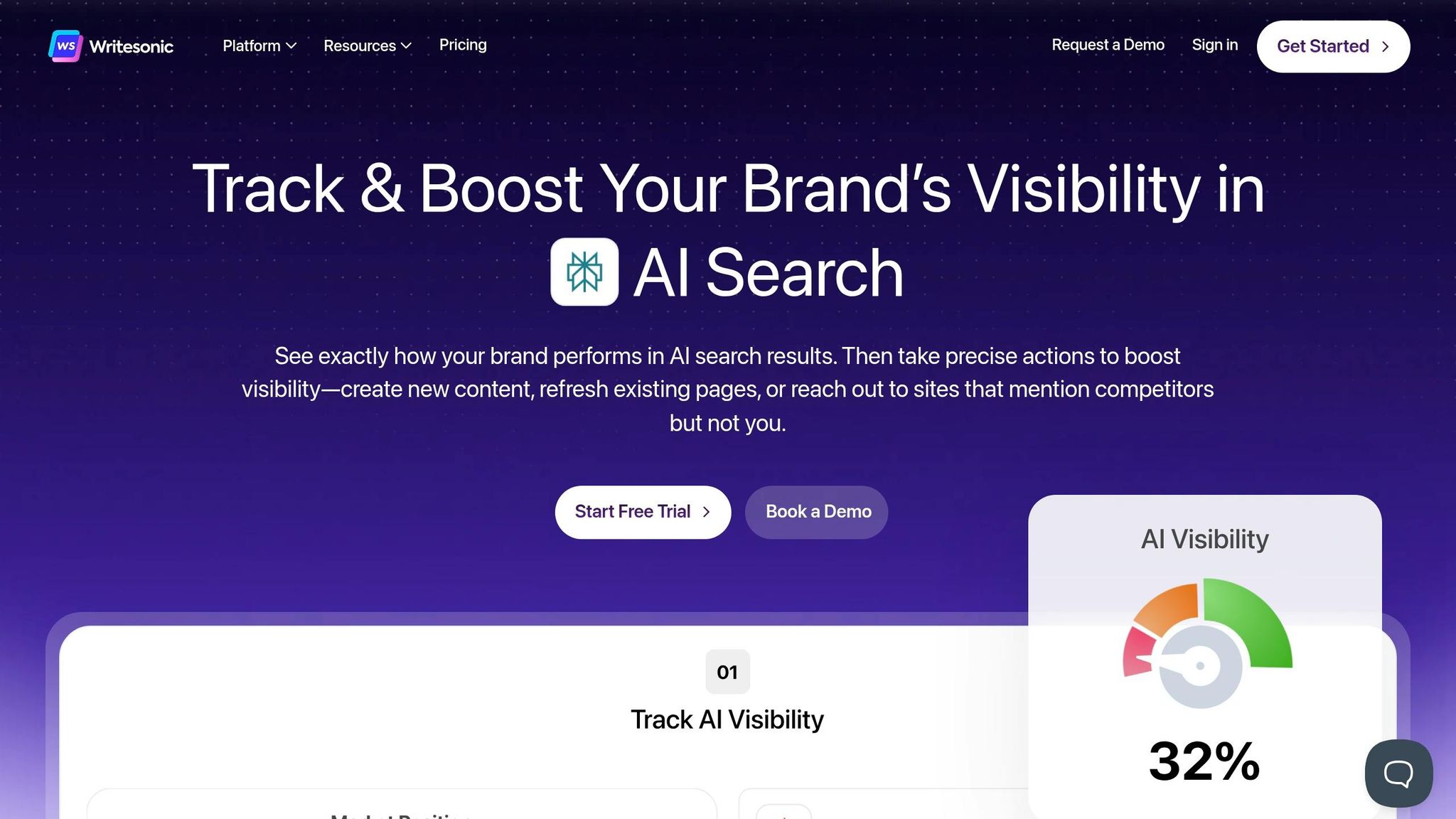
Writesonic takes a distinct approach by emphasizing AI visibility tracking - monitoring your brand's presence across major AI platforms like ChatGPT, Claude, Perplexity, and Google AI Overviews. This is particularly relevant given that ChatGPT alone boasts 800 million weekly active users, which surpasses Bing's numbers by 300 million. Moreover, 89% of B2B buyers now use AI as part of their purchase research.
The platform focuses on several key metrics:
- Share of Voice: The percentage of AI-generated responses that mention your brand compared to competitors.
- Sentiment Analysis: Evaluating the tone and perception of your brand in AI responses.
- Citation Tracking: Identifying specific content pieces referenced by AI engines.
It also highlights "Citation Gaps", where competitors are mentioned instead of your brand. Writesonic’s Action Center transforms these insights into actionable steps, such as updating outdated content or reaching out to websites citing competitors. Like other platforms, Writesonic evaluates both the cost efficiency and effectiveness of content strategies.
Dennis Yu, Co-founder, shared a compelling example of Writesonic’s impact:
"We landed two $100,000 clients who found us through ChatGPT. That's $200,000 in revenue directly from AI visibility".
This data-driven approach supports Writesonic’s competitive pricing model.
Pricing and Cost Efficiency
Writesonic markets itself as an all-in-one replacement for top AI tools for writing and blogging, potentially saving businesses about $960 per month by streamlining their marketing tools. Pricing begins at $39 per month (billed annually) for the Lite tier, which includes 15 AI-generated articles and basic SEO tools. The Standard plan costs $79 per month and offers unlimited AI agent generations, while the Professional tier, priced at $199 per month, tracks up to 300 AI queries and includes sentiment analysis.
Ryan Watts, Founder of Tasty Tours, shared how Writesonic impacted his budget:
"Writesonic eliminated my $100 per blog freelance costs completely".
For companies producing fewer than 10 pieces of content each month, the lower-tier plans deliver strong value. Additionally, the platform reduces content creation time significantly, cutting the time needed to create a 1,500-word blog post from 3 hours to just 1.7 hours - a 43% time savings.
Performance Metrics and Reporting
Beyond SEO metrics, Writesonic tracks AI Search Volume, which shows the popularity of specific AI prompts. It also uses server-side tracking to monitor traffic from AI systems and pinpoints the pages prioritized by large language models (LLMs), offering insights into content authority.
Alan Ranger, a founder using Writesonic, highlighted its impact on search performance:
"I've seen a 500% increase in impressions. Google sees me as an authority because I'm posting fresh content every day with Writesonic".
The Professional and Advanced plans offer daily data updates, enabling teams to adapt quickly to shifts in AI visibility. With predictions that 60% of searches will soon end without a click-through and half of traditional search traffic will migrate to AI by 2028, these insights are becoming increasingly critical.
Ease of Integration with Workflows
Writesonic integrates seamlessly with platforms like WordPress, Google Search Console, and Google Analytics. It also offers API access for enterprise-level integration. The platform uses a Cloudflare worker for server-side tracking, which captures AI crawler activity without requiring additional coding. This is especially important since AI crawlers can account for 5–10% of total server requests, traffic that traditional JavaScript-based analytics tools like Google Analytics often miss.
The Action Center simplifies tasks that previously required developer input, automating processes like outreach for citation gaps and technical SEO updates. Users have reported a 60% reduction in costs and a 75% decrease in time spent on content operations. Additionally, Writesonic ensures data security with SOC 2 Type II, GDPR, and HIPAA compliance, along with bank-level encryption. These integrations ensure that every aspect of content creation delivers measurable results.
The REAL Way to Measure AI ROI (Hint: It's Not Usage) | AI Strategy 2026
Pros and Cons
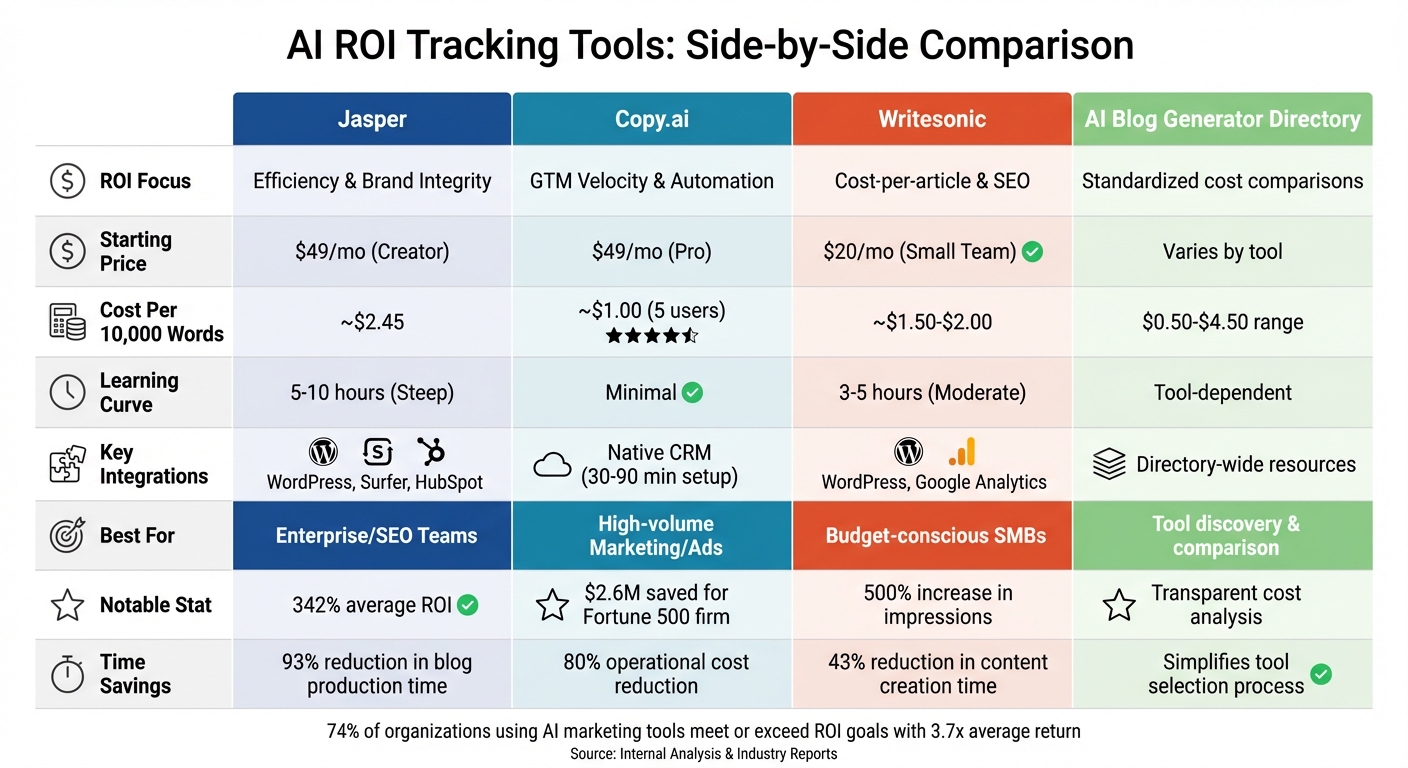
AI Content ROI Tools Comparison: Features, Pricing and Best Use Cases
Each platform comes with its own mix of strengths and limitations when it comes to tracking ROI for AI-driven content. Here's a closer look at how these tools simplify complex data into actionable insights.
Jasper is a powerhouse for enterprise-level collaboration. It stands out with advanced brand voice training and role-based dashboards, making it a go-to for large teams. However, it does have a steeper learning curve. A notable success story is Webster First Federal Credit Union, which cut blog production time by 93% and quadrupled output without adding staff. On the flip side, over 58% of AI-generated content requires an extra 15 minutes of human editing per 500 words, which can eat into the anticipated time savings by as much as 30–40%.
Copy.ai shines with its user-friendly interface, making it a breeze to get started quickly. It also integrates seamlessly with CRM systems, reducing setup time from the typical 40–60 hours for a custom API to just 30–90 minutes. However, its native SEO support is limited, often requiring additional tools to fully optimize content.
Writesonic is a budget-friendly choice, particularly appealing to smaller teams. It includes built-in SEO tools through its Sonic Editor, which can save costs on external freelancers. For instance, Ryan Watts eliminated $100-per-blog freelance expenses by switching to Writesonic. Its learning curve, clocking in at 3–5 hours, strikes a balance between Jasper’s complexity and Copy.ai’s simplicity. That said, its tiered word caps mean users need to plan their monthly usage carefully.
Here’s a quick comparison of key features across the platforms:
| Feature | AI Blog Generator Directory | Jasper | Copy.ai | Writesonic |
|---|---|---|---|---|
| ROI Focus | Standardized cost comparisons | Efficiency & Brand Integrity | GTM Velocity & Automation | Cost-per-article & SEO |
| Starting Price | Varies by tool | $49/mo (Creator) | $49/mo (Pro) | $20/mo (Small Team) |
| Cost Per 10,000 Words | $0.50–$4.50 range | ~$2.45 | ~$1.00 (5 users) | ~$1.50–$2.00 |
| Learning Curve | Tool-dependent | 5–10 hours (Steep) | Minimal | 3–5 hours (Moderate) |
| Integration Strength | Directory-wide resources | WordPress, Surfer, HubSpot | Native CRM (30–90 min setup) | WordPress, Google Analytics |
| Best For | Tool discovery & comparison | Enterprise/SEO Teams | High-volume Marketing/Ads | Budget-conscious SMBs |
Jasper is ideal for teams looking for rapid ROI through even small efficiency gains, while Writesonic proves its value at just $16/month if it saves 20 minutes of time each month. Choosing the best AI content generator tools for your business depends on your priorities - whether you need enterprise-level features, ease of use, or cost-effective SEO capabilities.
Conclusion
Picking the right AI tool to track content ROI boils down to understanding your budget, workflow priorities, and how well the tool fits into your existing systems. The real challenge? Identifying the specific factors driving your ROI. Once you’ve nailed that, choosing a tool that aligns with your operational needs becomes much easier.
For teams on a tight budget but managing large volumes, Writesonic provides an affordable solution, reducing the cost per word significantly. If boosting SEO is your top priority, following proven tips for writing blogs with AI, its built-in SERP analysis and content scoring features help eliminate the need for extra optimization tools. On the other hand, enterprise teams prioritizing brand consistency might find Jasper or Copy.ai more fitting. Both are priced at $49/month and offer collaborative workflows and brand voice training found in advanced AI tools for blog content creation, cutting down on editing time.
As Emily Walker from Ad Times aptly points out:
"The 'best' AI blog generator isn't the one with the lowest price tag... It's the one that delivers the highest return on investment for your specific workflow, goals, and budget".
This sentiment is echoed by the fact that 74% of organizations using AI marketing tools report meeting or exceeding their ROI goals, with an average return of 3.7x. By aligning a tool’s features with your team’s needs, you can achieve measurable results and long-term growth.
To make an informed decision, consider running an 8–12 week trial. This allows time to evaluate SEO indexing and the cumulative effects of publishing . Many tools break even within 60–90 days, but the real ROI becomes clear when factoring in time saved and the reduced "quality tax" from human oversight .
If you’re just starting out, the AI Blog Generator Directory (https://aibloggenerators.com) is a helpful resource. It provides a curated list of tools with transparent cost comparisons, making it easier to find a solution tailored to your needs.
Ultimately, success lies in addressing your workflow bottlenecks with the right tool - not just chasing the lowest price tag.
FAQs
What metrics best demonstrate AI content ROI?
When evaluating the return on investment (ROI) for AI-generated content, there are several key metrics to keep in mind:
- Incremental revenue: How much additional income is directly tied to the AI content efforts.
- Cost savings: The reduction in expenses, such as lower costs for content creation or operational efficiencies.
- Productivity improvements: Gains in efficiency, like faster content production or streamlined workflows.
- Search rankings: The impact of AI content on improving visibility in search engine results.
- Pipeline contribution: How AI content supports lead generation and contributes to the sales pipeline.
These metrics can be validated using experiments, attribution models, and detailed KPI analysis. Together, they help measure the overall business impact, including revenue growth and the expansion of your sales pipeline.
How do I include human editing costs in ROI?
To factor in human editing costs when calculating ROI, start by tracking the time editors spend reviewing AI-generated content. Multiply this time by their hourly rates to determine the labor costs. Be sure to add these expenses to your total investment. Including human oversight costs is essential since AI tools often rely on editors to ensure content quality and accuracy.
How long should an AI ROI tracking trial run?
An AI ROI tracking trial usually spans 4 to 6 weeks. This timeframe gives you the opportunity to gather sufficient data and identify patterns or results that matter in your content creation processes.