AI is transforming email marketing in 2026 by enabling highly personalized campaigns that outperform traditional approaches. Here's what you need to know:
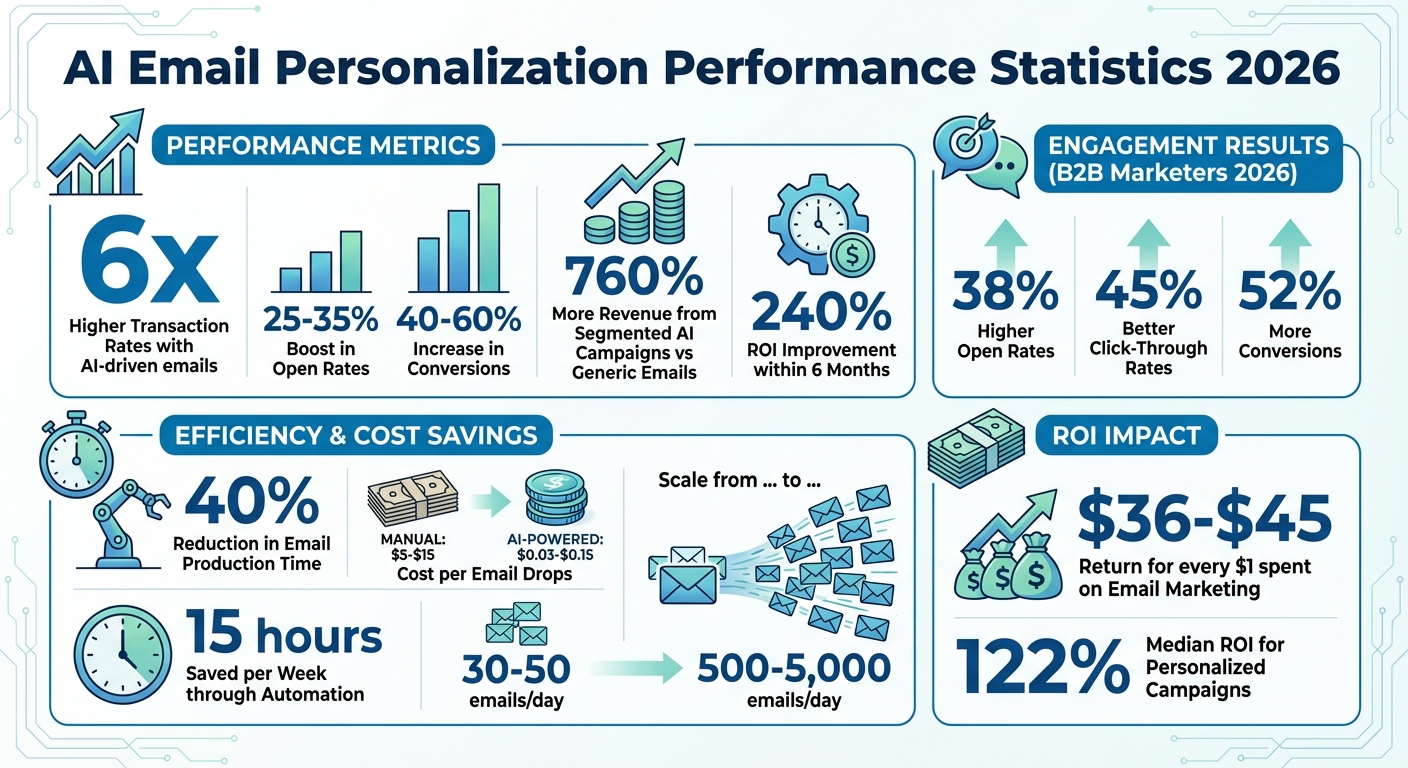
- Personalized Emails Perform Better: AI-driven emails achieve 6x higher transaction rates, boost open rates by 25–35%, and increase conversions by 40–60%.
- Revenue Impact: Segmented AI campaigns generate 760% more revenue than generic emails, with companies reporting ROI improvements of 240% within six months.
- Efficiency Gains: AI reduces email production time by 40% and cuts costs from $5–$15 per email to as low as $0.03–$0.15.
- Key Features: Predictive analytics, behavioral triggers, send-time optimization, and dynamic content ensure every email feels tailored to the recipient.
AI tools like Sintra AI and Mailsoftly help businesses scale campaigns, refine strategies, and save time. The future of email marketing lies in combining AI's precision with human oversight to create messages that resonate with individuals on a deeper level.
AI Email Personalization Performance Statistics 2026
Master AI-Powered Personalization Campaigns: Automate Leads & Cold Email Success
sbb-itb-a759a2a
Benefits of AI Email Personalization
AI-driven email personalization offers three core advantages that directly influence your business outcomes: increased engagement, improved conversion rates, and reduced costs. These benefits are supported by measurable results from companies successfully using these systems in 2026.
Better Customer Engagement
AI takes email marketing beyond broad demographic targeting, enabling highly individualized "segment-of-one" strategies. A great example is Virgin Holidays, which adopted Phrasee's AI-powered subject line technology in 2025. By identifying linguistic patterns that resonated with their audience, they saw a 30% boost in email open rates. Similarly, Chase bank leveraged Persado's AI marketing language platform to refine their email copy, achieving a 45% increase in open rates compared to human-written subject lines.
Unlike static rules, AI employs predictive models to anticipate customer behavior. In fact, B2B marketers using AI email optimization in 2026 reported 38% higher open rates, 45% better click-through rates, and 52% more conversions. Jack Gonzalez, an Email Marketer at Sharpinbox, highlights the transformative potential:
"AI-powered personalization represents the next frontier in email marketing effectiveness... driving higher engagement, stronger customer loyalty, and ultimately greater revenue."
This deeper engagement naturally lays the groundwork for stronger conversion rates.
Higher Conversion Rates
Sephora offers a great case study in how AI can boost conversions. By analyzing browsing history and purchase behavior, they craft personalized subject lines like "You left something behind - here's 20% off!" These emails, paired with dynamically updated images, call-to-action buttons, and product recommendations, consistently outperform generic promotions.
Predictive segmentation also plays a key role, delivering 10–25% higher conversions compared to traditional rules-based approaches. AI identifies the optimal time to connect with each recipient through a personalized "Time of Likely Engagement" model, replacing static sending schedules. This method has proven highly effective, with segmented campaigns generating 760% more revenue than non-segmented ones and personalized campaigns achieving a 122% median ROI.
While engagement and conversions improve, AI also reduces the time and cost of email marketing efforts.
Saves Time and Money
AI doesn’t just personalize and convert - it also simplifies email production by automating repetitive tasks. Consider this: in 2025, only 6% of marketing teams needed two weeks or more to produce an email, a sharp drop from 62% in 2024. AI automation reduces the time spent per prospect from 10–15 minutes to just 15–60 seconds. Meanwhile, the cost per email plummets from $5.00–$15.00 for manual efforts to just $0.03–$0.15 for AI-powered campaigns.
Marketers also save significant time, with automation freeing up 15 hours per week. Small teams can now scale their efforts dramatically, jumping from 30–50 emails per day to as many as 500–5,000 emails daily. With email marketing yielding an average ROI of $36 to $45 for every $1 spent - and AI boosting ROI by 240% within six months - the financial benefits are undeniable. By automating tasks like A/B testing and scheduling, AI allows teams to focus on strategic and creative content writing.
Strategies for AI Email Personalization
Personalizing emails with AI isn't just about adding a first name to a subject line. It’s about creating a system that adjusts to individual behaviors, ensuring every interaction feels relevant. To do this effectively, you need to focus on three key areas: gathering and organizing data, customizing content in real time, and automating responses based on customer actions. These strategies work together to deliver a seamless, individualized experience.
Data Collection and Audience Segmentation
AI thrives on data. By pulling information from your CRM, website activity, purchase history, and even social media, it builds detailed profiles of your subscribers. Unlike traditional methods that group people by general traits like age or location, AI uses predictive segmentation. This approach identifies patterns and groups users based on likely future behaviors, such as how soon they might make a purchase, their risk of leaving, or their overall value as a customer.
Behavioral data is the real game-changer here. Actions like browsing a product page or adding items to a cart are far more telling than broad demographic categories. To make the most of this, regularly audit your CRM and email lists. Smart sign-up forms can help you gather essential details upfront, while progressive profiling lets you collect more data over time without overwhelming users. This detailed segmentation lays the groundwork for the next step: crafting highly tailored content.
Dynamic Content and Subject Lines
AI can do more than just suggest subject lines - it can create multiple variations, from questions to urgency-driven phrases, and analyze which ones perform best. Personalized subject lines alone can boost open rates by 26% and click rates by over 20%. Dynamic content takes this a step further, allowing you to adjust headlines, images, and offers within a single email template to match each recipient’s interests or lifecycle stage. AI can even calculate the smallest discount needed to convert a subscriber, helping you protect your profit margins.
For best results, keep subject lines short - 30 to 50 characters works well for mobile users - and email copy concise, aiming for around 100 words. Frameworks like AIDA (Attention, Interest, Desire, Action) or PAS (Problem, Agitate, Solution) can guide AI in drafting compelling content using free AI writing tools. Always review AI-generated drafts to ensure they align with your brand’s tone. Since tools like Gmail and Apple Mail now summarize emails using AI, make sure your main value points and calls to action are front and center.
Once your content is personalized, the final piece is automating responses based on user behavior.
Behavioral Triggers and Automation
AI doesn’t just react; it anticipates. By tracking engagement trends, it can identify subscribers who are at risk of leaving and trigger personalized win-back campaigns. With Apple’s Mail Privacy Protection making open rates less reliable, platforms have shifted to using clicks and conversions to gauge engagement. AI can now pinpoint the best time to reach each recipient, using historical data to optimize send times.
Behavioral triggers are powerful, leading to a 41% increase in revenue per email. For example, when a subscriber’s engagement score drops below a certain threshold - say, 30 out of 100 - AI can automatically send a “We’ve missed you” email. Advanced tools like Klaviyo’s K:AI or HubSpot’s Breeze can even build entire email sequences or handle customer support tasks without human input. If you’re just starting out, focus on simpler features like send-time optimization and subject line testing before diving into full automation workflows.
AI Tools for Email Personalization in 2026
The right platform can turn mass emailing into meaningful, personalized connections. By 2026, AI email tools have advanced to remember past interactions, tailor content on the fly, and improve campaigns with detailed insights. The real challenge? Finding a tool that fits your campaign needs, technical skills, and budget. Below is a breakdown of the top AI platforms for email personalization in 2026.
AI Tool Comparison
Different advanced AI tools bring different strengths to the table. Some are built for handling high-volume outreach, while others focus on detailed analytics to refine your strategy. Here's a quick look at five leading platforms:
| Tool | Automation Depth | Dynamic Content Capabilities | Integration Support |
|---|---|---|---|
| Sintra AI | High – autonomous AI team | Deep (Brain AI memory, LinkedIn/News research) | 15+ integrations (CRM, Social, etc.) |
| Braze | High – behavioral triggers | Real-time (Liquid Assistant, 1:1 decisioning) | Cross-channel (Web, App, Email) |
| Mailsoftly | Moderate – AI Agents | Moderate (Template & Engagement Agents) | CRM, Landing Pages, SMS |
| Mailtrap | Low – focus on delivery | Moderate (Supports AI tool integration) | SMTP, API, Testing tools |
| Blaze.ai | Moderate – workflow automation | High (Behavioral & Predictive variations) | CRM, CMS (WordPress, Shopify) |
Pricing varies significantly. Sintra AI starts at $39/month for one assistant or $97/month for full access to all 12 assistants. Braze typically begins at $1,500/month for mid-market plans, while Blaze.ai offers entry-level plans starting at $29/month.
Sintra AI for Large-Scale Campaigns
Sintra AI is designed for businesses juggling thousands of prospects across multiple campaigns. This platform treats email as an ongoing conversation rather than a one-off interaction. Its "Brain AI" system acts as a shared memory, storing your brand voice, customer insights, and campaign history to maintain consistency as your audience grows.
The platform uses fully automated AI generators and specialized assistants to streamline tasks. For example, Emmie focuses on crafting emails and managing follow-ups, while Milli dives into prospect research, analyzing LinkedIn activity and recent company news. One SaaS company saw a 340% boost in conversion rates thanks to Sintra AI's autonomous features. Content creator Leyla Preston also credited the platform for saving her five hours per week, which helped her double her monthly income.
For agencies, the Brain AI feature is a game-changer. It eliminates the hassle of retraining the system when switching between clients. The pricing starts at $39/month for one assistant, with full access to all 12 assistants available for $97/month.
Mailsoftly AI for Strategy Refinement
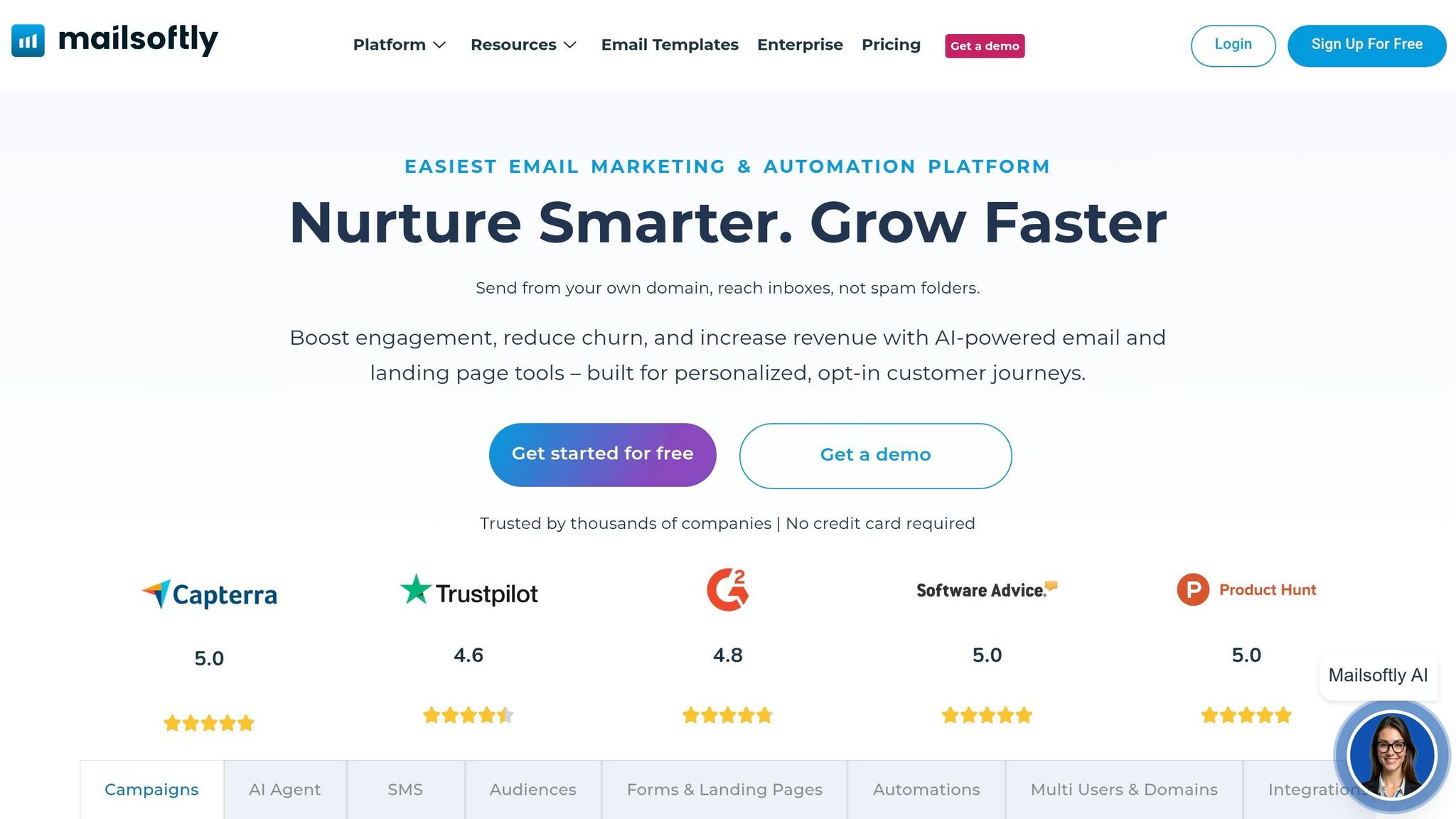
Mailsoftly is ideal for small and medium-sized businesses aiming to fine-tune their email strategies without a full-scale marketing team. It offers two AI agents: one for generating campaign ideas based on customer lifecycle stages and another for creating responsive templates - no coding required.
The platform goes beyond basic analytics with its Actionable Analytics feature. Instead of just reporting open rates, it provides specific recommendations. For instance, if your subject lines perform poorly on mobile devices, the system will suggest shorter alternatives. Businesses using Mailsoftly's AI-driven features report delivery rates of 95% and open rates between 35–38%.
"Mailsoftly streamlines email marketing with its intuitive interface and comprehensive solutions, making it a breeze to navigate while providing invaluable tips and information for campaign success."
- Hugh Plitt, Marketing Agency Owner, Huge Health Fitness
Mailsoftly has earned glowing reviews, with a 5.0/5 rating on G2 and Capterra. Users often praise its fast customer support. It also offers a free tier - no credit card required - making it a great entry point for businesses new to AI email personalization. Combining email with SMS and WhatsApp workflows can increase engagement by 40–46% compared to email-only campaigns.
These tools highlight the evolving landscape of AI-driven email personalization, paving the way for deeper predictive analytics and hyper-personalized strategies in the near future.
Future Trends in AI Email Personalization
AI tools are advancing rapidly, and email personalization is heading toward a future of unmatched precision and adaptability. By 2026, over 64% of organizations are expected to integrate AI into their email marketing workflows, shifting the focus from reactive strategies to anticipatory ones. This evolution moves beyond basic automation, diving into intelligent decision-making that can predict and respond to customer behaviors in real-time.
Predictive Analytics
AI is becoming a master at predicting customer behavior. By analyzing patterns, predictive analytics can identify customer needs before they even arise. For instance, subscription businesses using these tools to detect at-risk customers have slashed churn rates by up to 67%. The system monitors signs like fewer email opens or declining click rates, automatically triggering win-back campaigns to re-engage users before they fully disengage.
AI also excels at suggesting the most relevant products or AI-generated content for individual customers based on their journey. Take open-time personalization, for example. This feature updates email content right when the recipient opens it, tailoring the message to reflect their most recent activity. If someone browses winter coats in the morning and opens your email in the afternoon, the email can dynamically adjust to showcase relevant items, current stock levels, or even the local weather.
Send-time optimization has also evolved. Instead of relying on list-wide averages, AI determines the best time to send emails for each subscriber individually. This hyper-targeted timing leads to a 7–15% increase in open rates and a 10–20% boost in click rates. High-performing marketing teams are nearly five times more likely to use AI in their email strategies compared to less successful teams, and this advantage is growing as predictive tools become more advanced.
While predictive analytics focuses on refining timing and content based on historical data, machine learning takes personalization to the next level by adapting in real time.
Hyper-Personalization with Machine Learning
Machine learning enables a "segment-of-one" approach, where every recipient receives a uniquely tailored email experience. These systems use real-time behavioral data - like a browsing session just minutes ago - to craft highly personalized messages. Campaigns built this way see conversion rates 13 times higher than standard campaigns, with a 2.11% placed order rate compared to just 0.16% for bulk emails.
"If {first_name} in a subject line is your personalization strategy, you're a decade behind." - Prospeo Team
Autonomous AI workflows are also gaining traction. Tools like Klaviyo's K:AI and HubSpot's Breeze can create entire email sequences without human input. By analyzing CRM data, firmographics, and behavioral signals, these systems decide what content to send and when. AI-personalized cold emails deliver reply rates of 4–12%, far outperforming the 1–3% seen with generic templates. B2B marketers leveraging this level of optimization report 38% higher open rates and 52% more conversions.
A growing challenge in this space is "Email SEO" - optimizing emails for AI-generated previews in platforms like Gmail and Apple Mail. These inbox summarizers often display snippets of the email before it’s opened, so marketers are now prioritizing key value propositions in the first few sentences. This shift highlights a new reality: email marketing isn’t just about connecting with human recipients anymore - it’s also about communicating effectively with the AI tools that help filter and summarize messages.
Performance Metrics and Optimization
Tracking the right metrics is essential for measuring email marketing success. By 2026, traditional open rates have become less reliable due to changes like Apple Mail Privacy Protection, which pre-loads email content and inflates open rates by 15–30%. As Erwann Lefevre from La Growth Machine puts it:
"Tracking the right email marketing KPIs separates profitable campaigns from guesswork. In 2026, email marketing KPIs matter more than ever because Apple Mail Privacy Protection now pre-loads email content... artificially inflating open rates".
This has shifted the focus to action-based metrics that better reflect real engagement. Metrics like Click-Through Rate (CTR) and Click-to-Open Rate (CTOR) are now more reliable indicators of performance. Data shows AI-generated emails achieve an average CTR of 9.44%, compared to 8.46% for manually crafted campaigns, while automated emails drive 320% more revenue than non-automated ones. Metrics like Revenue Per Recipient and overall Email ROI are crucial for understanding the business impact of campaigns.
Predictive metrics, such as churn risk and purchase likelihood, also play a role in refining strategies. Deliverability metrics remain critical - keeping bounce rates under 2% and monitoring inbox placement ensures emails actually reach recipients. These operational metrics not only protect sender reputation but also create opportunities for real-time adjustments and ongoing improvements.
Tracking Engagement and Conversions
The most successful email strategies connect engagement metrics directly to revenue. For instance, in 2025, Brooklinen's AI-driven abandoned-cart emails achieved a 62% conversion rate by using time-sensitive offers tailored with AI. Similarly, HelloFresh reduced its unsubscribe rate by 23% by introducing an AI-powered preference center that allowed customers to manage meal and email preferences.
Conversion Rate is a key metric, measuring how many recipients complete a desired action. AI-driven personalization can increase conversion rates by 40–60% through behavioral triggers and predictive logic. For example, Asana boosted webinar registrations by 32% by linking emails to personalized landing pages.
Revenue metrics provide a clear view of campaign effectiveness. Metrics like Revenue Per Email and multi-touch attribution help marketers assess the entire customer journey, from welcome emails to abandoned-cart reminders, rather than focusing solely on the final click. Companies leading in personalization often see revenue increases of 5–15%, while AI-driven programs can improve marketing efficiency by 10–30%.
Another valuable metric is engagement velocity, which tracks how interest changes over time. Weighted scoring systems - assigning points for actions like opens, clicks, and purchases - can help identify when subscribers are losing interest and trigger reactivation efforts. This approach keeps campaigns fresh and relevant.
A/B Testing with AI
AI has transformed A/B testing, making it faster and more effective. It can run 3–10 test variants at once, allocating traffic dynamically to the best-performing option. Brands that consistently A/B test their emails achieve an 82% higher ROI.
The key to effective testing is isolating variables. Test one element at a time, like subject lines or call-to-action buttons, to pinpoint what drives results. Use sample sizes of 1,000–5,000 subscribers per group and wait 24–72 hours to capture a complete response.
Dr. Amy Cook, Chief Marketing Officer & Co-Founder of Fullcast, shares an important lesson:
"When I'm writing marketing materials, the number of times I've written an ad or a subject line that I thought, 'this is so boring, it's not gonna work,' and I A/B tested it against something that I thought was really creative and made me look all clever and cute and all that stuff, and lost that A/B test".
This highlights the importance of trusting data over instincts - simple, straightforward copy often performs better than overly clever alternatives.
AI-powered send-time optimization (STO) is another game-changer. By analyzing individual behavior patterns, STO sends emails at the times recipients are most likely to engage, improving open rates by 15–20%. In 2025, Airbnb saw a 10.2% increase in open rates by timing emails to match recipients' local time zones. Unlike outdated open-rate data, STO relies on click and conversion signals, fine-tuning delivery for each subscriber.
AI also reduces campaign production time by 40%, letting teams focus more on strategy. Using the winning variant from one test as the baseline for the next ensures continuous improvement. This iterative process has been shown to increase open rates by 38% and conversions by 52%.
Conclusion
Email marketing in 2026 has evolved far beyond the days of generic mass emails. With inboxes overflowing with hundreds of messages daily, AI-powered personalization has become the key to standing out. The shift from one-size-fits-all templates to tailored content means recipients now expect emails that reflect their unique behaviors, preferences, and where they are in their customer journey.
The numbers speak for themselves. AI personalization can drive up to 760% more revenue, while also improving open rates, click-throughs, and conversions. These changes translate into revenue increases of 5–15% and efficiency gains of 10–30%.
A gradual approach can help you embrace AI-enhanced email marketing without feeling overwhelmed. Start with quick wins like send-time optimization and AI-assisted subject line testing, which can increase open rates by 15–20% with minimal effort. Once those are in place, move on to behavioral triggers, such as cart abandonment emails, and later incorporate predictive analytics to anticipate customer churn. This step-by-step process allows your AI tools to learn from recipient behavior over 30–60 days, making each phase more effective.
To maintain long-term success, it’s essential to balance automation with a personal touch. As Klaviyo aptly puts it:
"The brands that win will combine AI's precision with human authenticity".
Human oversight is critical here - spot-checking 10–20% of AI-generated outputs can help catch errors, which occur at a rate of 3–8%. Transparency is equally important. While 73% of consumers are willing to share their data for personalized experiences, they expect brands to be clear about how that data is used. By striking this balance, businesses can embrace a future where email marketing feels both human and data-driven.
FAQs
What data do I need before using AI personalization?
Before diving into AI-powered email personalization, it's essential to collect and study key customer data. Pay attention to details like customer behavior, preferences, and how they engage with your brand. This information allows you to create precise audience segments, craft tailored content, and fine-tune campaigns in real time. By leveraging this data, AI tools can predict customer actions and send well-timed, targeted emails that hit the mark.
How can I personalize emails without relying on open rates?
To make emails feel more personal without depending on open rates, you can tap into AI-powered strategies that prioritize relevance and customer understanding. Start by analyzing customer data to craft content that speaks directly to their preferences. Break your audience into smaller, targeted groups to ensure your messages align with their specific needs.
You can also use predictive analytics to anticipate what customers might do next. AI tools make it possible to create messages tailored to individual interests, past behaviors, or recent actions. This approach helps increase engagement while steering clear of open rate metrics as the primary focus.
How can I keep AI-generated emails on-brand?
To keep AI-generated emails aligned with your brand, it's essential to combine AI capabilities with human oversight. Start by training the AI with your brand’s specific style, tone, and guidelines. Then, spot-check the content to catch any inaccuracies or mismatched tone. Regular reviews of the outputs are also crucial to ensure consistency and avoid errors. By taking these steps, you can safeguard your brand identity while still using AI to deliver personalized communication.