Quick answer
A blog topic generator is the right tool when your team needs better angles, faster ideation, and a repeatable way to turn audience questions into article briefs. It is not automatically the right answer when you need a complete publish-ready draft. In 2026, the strongest tools in this category help you generate topics that are specific, differentiated, and easy to hand off into a larger writing workflow.
The easiest way to decide if a tool is worth buying is to test three things: the quality of its ideas, how well those ideas align with your real audience, and whether the output moves cleanly into briefing and drafting. If the ideas are generic, repetitive, or disconnected from your publishing plan, even a free blog topic generator can become a bottleneck instead of a time-saver.
This guide will help you compare options, understand the difference between topic generation and full draft creation, and choose when to move from idea tools into a broader AI writing stack.
sbb-itb-a759a2a
Why this matters in 2026
Topic generation looks simple until you try to scale it. Many teams think the hardest part of content creation is drafting. In practice, a weak topic selection process creates just as much waste as a weak draft. If the angle is bland, duplicated, or detached from what readers actually want, no amount of polishing will make the article strategic.
That is why the blog topic generator category matters more now than it did a few years ago. Teams are publishing more often, search intent is more competitive, and editorial calendars are packed with near-duplicates unless the idea stage is handled well.
Three changes make this category more important in 2026:
- content teams need topic ideas that map cleanly to intent, not just catchy headlines
- AI writing tools are faster, which makes weak topic selection more dangerous because bad ideas can now become full articles very quickly
- more free tools are available, but many of them generate volume rather than quality
A buyer-focused evaluation has to answer one simple question: will this generator produce topics your team can actually build into useful articles?
What a blog topic generator should actually do
A real blog topic generator should do more than spit out title variations. At a minimum, it should help your team with one or more of these jobs.
| Job | What good output looks like | Common failure mode |
|---|---|---|
| Idea discovery | Fresh angles tied to audience pain points | Generic listicle ideas with no clear audience fit |
| Search-intent framing | Topics that reflect what readers are really trying to solve | Keyword-shaped headlines with weak article substance |
| Topic expansion | Clear supporting angles, FAQs, and subtopics | Repetitive ideas that say the same thing five ways |
| Prioritization support | Ideas that are easy to score by relevance, business fit, and uniqueness | Too much volume and no signal on what matters most |
| Handoff into writing | Topics that can become outlines and briefs without starting over | Ideas that sound clever but are impossible to structure |
That distinction matters because this page should stay focused on blog topic generator, not drift into becoming the owner for blog post generator or best free ai blog writer. Those pages can talk more deeply about full-draft production. This one should help readers choose a topic-generation system and understand when it is time to move to the next stage.
Practical framework: how to evaluate a blog topic generator
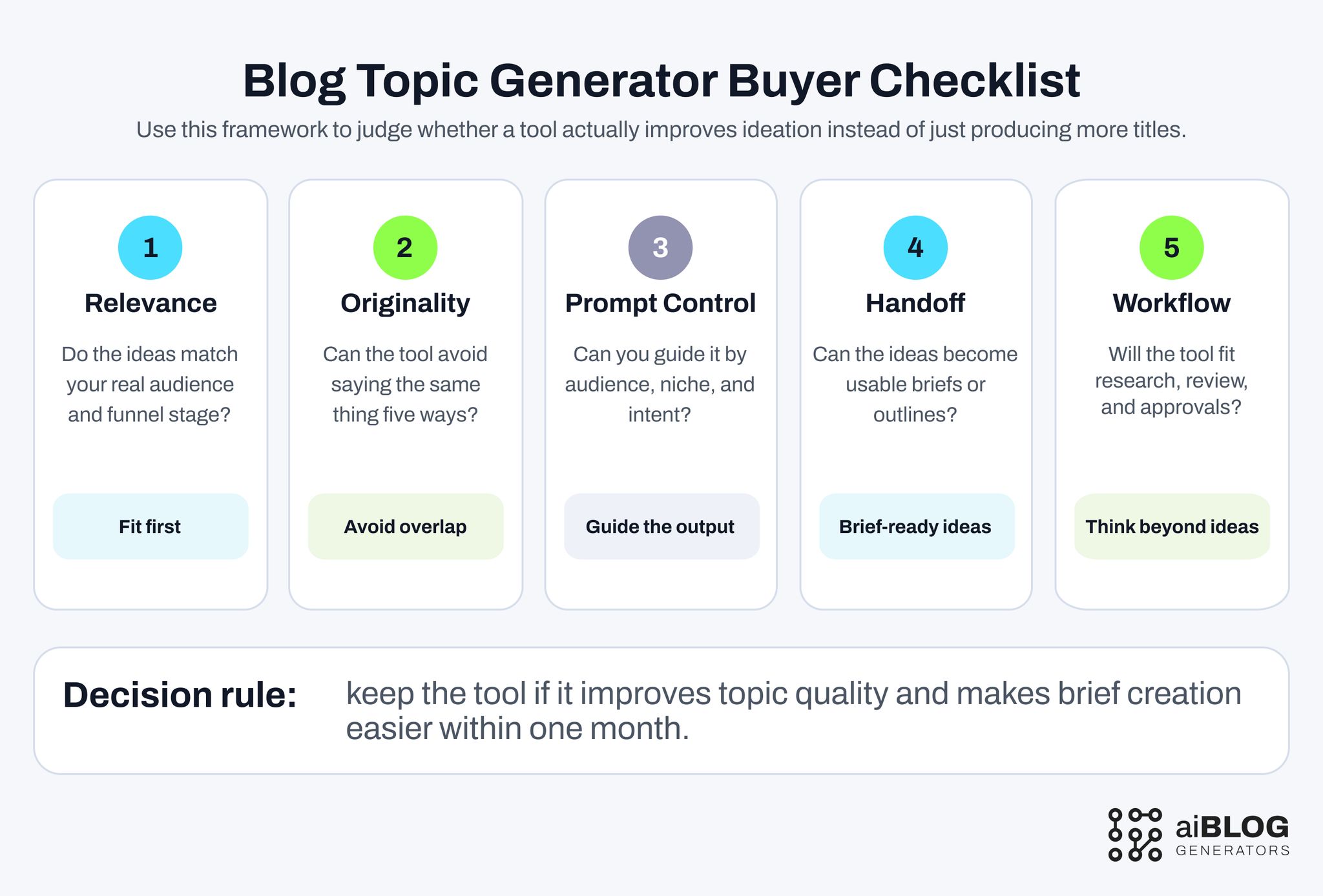
If you are comparing tools, use the checklist below instead of relying on feature pages alone.
| Criterion | What to test | Why it matters |
|---|---|---|
| Topic relevance | Do the ideas match your audience, niche, and funnel stage? | A long idea list is useless if most suggestions are irrelevant |
| Idea originality | Are the topics distinct enough to avoid internal duplication? | Repetitive ideas create cannibalization and weak editorial planning |
| Prompt control | Can you guide the tool by audience, product, vertical, or intent? | Good controls increase repeatability and reduce cleanup |
| Handoff quality | Can the ideas turn into usable briefs or outlines? | Strong ideation tools shorten the path to article production |
| Workflow fit | Does the tool fit your research, briefing, and approval process? | Good ideas still fail if the workflow is awkward |
Blog Topic Generator Buyer Checklist
A practical scoring rule works well here. If the tool creates relevant ideas but weak handoff quality, keep it in the idea lane only. If it produces good topics and good structure suggestions, it may be strong enough to sit at the front of a larger content workflow.
External examples and tools worth studying
These examples are useful because they show different ways the market approaches ideation, structure, and draft generation.
| Example | Type | Why it fits this guide | Best for | URL |
|---|---|---|---|---|
| RyRob Blog Idea Generator | Idea tool | Good benchmark for creator-focused idea generation and quick entry into topic prompts | Solo creators and niche bloggers | https://www.ryrob.com/blog-idea-generator/ |
| QuillBot AI Blog Post Generator | Draft tool | Useful comparison point for what happens after topic generation ends and full drafting begins | Teams deciding whether they need ideation or full drafting | https://quillbot.com/ai-writing-tools/ai-blog-post-generator |
| AIOSEO Best AI Blog Post Generators | Comparison content | Good shortlist-style article for buyer language, pros and cons, and evaluation logic | Buyers building a short list before trials | https://aioseo.com/best-ai-blog-post-generators/ |
| Blaze AI Blog Post Generator | Workflow tool | Helpful example of how a broader AI writing stack positions content planning and generation together | Marketing teams with repeatable campaign workflows | https://www.blaze.ai/ai-writer/ai-blog-post-generator |
| AnswerThePublic | Research tool | Strong for audience-question discovery and intent expansion when you want broader ideation inputs | Teams focused on search questions and content research | https://answerthepublic.com/ |
These examples matter because they show the category boundaries clearly. Some are true idea tools. Some are closer to a full writing workflow. Buyers usually make better decisions when they compare both types side by side.
The difference between a topic generator and a full AI writing stack
This is the decision most teams need to get right.
A blog topic generator is ideal when:
- your main bottleneck is deciding what to write about
- your editorial team already has a clear drafting process
- you need faster angle exploration without replacing the rest of the workflow
- you want to improve idea quality before expanding production
A full AI writing stack is better when:
- you also need outlines, drafts, and revision support
- your team wants one system for ideation plus drafting
- your editorial process is already stable enough to support automation
- the handoff from topic to article keeps slowing the team down
The key is not to force one tool to do every job. Many teams get better results by pairing a blog topic generator tool with a separate writing workflow instead of expecting the idea engine to become a complete authoring platform.
Examples of prompts and use cases to test first
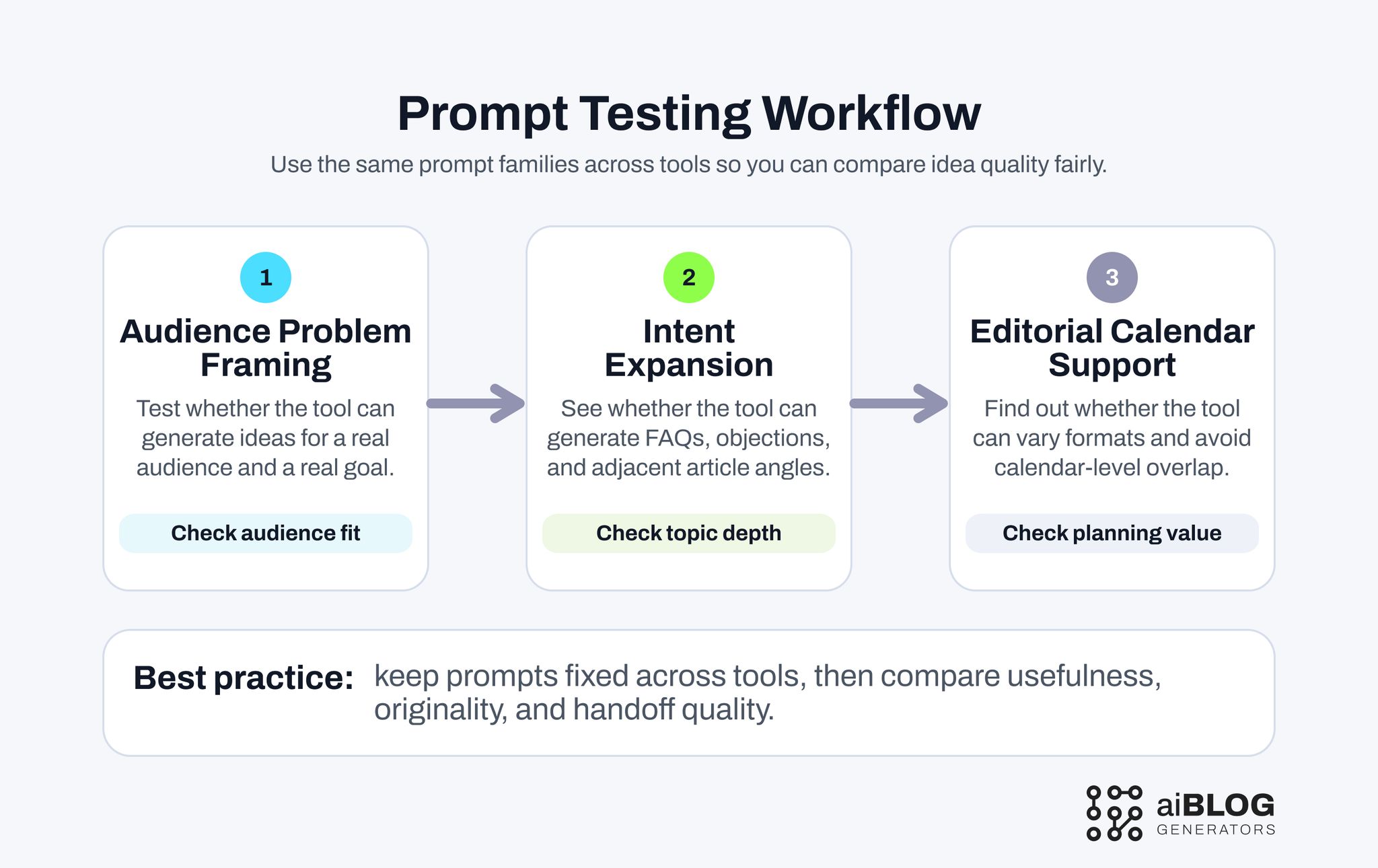
A buyer-focused evaluation should test prompt quality, not just tool output volume. Use a fixed set of prompts so you can compare results cleanly across tools.
Prompt type 1: audience problem framing
Use this when you want to see whether the generator understands pain points.
Example: “Generate 12 blog topic ideas for B2B SaaS founders who need more product-led blog traffic but have a small content team. Group ideas by funnel stage and remove generic listicle angles.”
What to check:
- does the tool understand the audience?
- do the ideas show different levels of awareness?
- are the angles specific enough to brief writers quickly?
Prompt type 2: intent expansion
Use this when you want better coverage around a core keyword.
Example: “Generate topic ideas related to blog topic generator for buyers comparing tools, including FAQs, objections, and comparison angles.”
What to check:
- are the ideas truly adjacent, or are they repetitive keyword variants?
- do the suggestions create clear article paths?
- can you see which topics belong on separate pages?
Prompt type 3: editorial calendar support
Use this when you want to see whether the tool can support planning, not just one article.
Example: “Create a 4-week article plan for an AI tools directory targeting creators, marketers, and startup teams. Include one BOFU topic, one comparison topic, one workflow topic, and one FAQ-style topic each week.”
What to check:
- does the generator vary the format?
- does it avoid cannibalization?
- does it create a balanced mix of content types?
Prompt Testing Workflow
When to move from topic generation into full draft creation
This is where buyers often overspend or over-automate.
Move to a full writing stack when:
- your topic ideas are already strong and consistent
- your editors spend too much time turning briefs into outlines
- you need faster first drafts for multiple articles per week
- your team has a quality-control process strong enough to handle faster output
Stay in the topic-generation stage longer when:
- your content strategy is still unclear
- your team keeps producing overlapping ideas
- article quality issues usually start with weak angles, not slow drafting
- your editors still need human judgment to define the real article direction
A useful rule is this: if the generator produces strong topics but your articles still fail later, the problem is not ideation anymore. That is the moment to test a stronger drafting or editorial layer.
Step-by-step implementation plan for a real buyer test
If you are comparing blog topics generator tools seriously, run a short but controlled evaluation.
Step 1: choose one niche and one audience
Do not test with broad, abstract prompts. Pick a real audience and one content goal.
Example:
- creators launching a newsletter
- SaaS teams building an SEO content calendar
- agencies that need article angles for clients in one vertical
Step 2: create one standard prompt set
Use the same prompts for every tool. Include:
- audience description
- funnel stage
- content objective
- desired output format
- exclusions or banned angles
This removes a lot of bias from the comparison.
Step 3: score the ideas on usefulness, not entertainment value
Track:
- how many ideas are usable without rewriting
- how many are duplicates of existing plans
- how many create a clear brief-ready angle
- how many naturally connect to FAQs or subtopics
Step 4: test handoff quality into a brief
Take the best three topic ideas from each tool and try turning them into article briefs. If the ideas collapse under structure pressure, the generator is not strong enough for your workflow.
Step 5: connect the winning tool to the editorial system
Once one tool consistently creates useful ideas, define where it sits in the process:
- topic discovery only
- discovery plus outline support
- discovery plus drafting handoff
That final step is what turns a clever tool into a practical system.
Common mistakes buyers make
Mistake 1: treating headline volume as evidence of topic quality
A generator can produce fifty titles quickly and still be strategically weak.
Fix: judge ideas by relevance, uniqueness, and ease of handoff into a real article.
Mistake 2: expecting a topic tool to replace content strategy
A blog topic generator can support planning, but it cannot decide your actual business priorities on its own.
Fix: use the tool to accelerate options, then let the team choose what matters.
Mistake 3: confusing ideation with research
Some tools are good at idea generation but weak at surfacing search questions, objections, and examples.
Fix: pair ideation with a research step before you build the article brief.
Mistake 4: jumping into full draft generation too early
If the topic itself is weak, a faster draft only creates faster waste.
Fix: stabilize the idea stage before upgrading the writing stage.
Mistake 5: using the same generator prompt forever
What worked for one audience may become stale and repetitive over time.
Fix: refresh prompts based on funnel stage, audience segment, and content performance.
Quality control and human review still decide whether the tool helps
Even a strong free blog topic generator needs editorial review. A human should still confirm:
- whether the topic really matches reader intent
- whether the idea duplicates something already planned or published
- whether the angle has enough substance for a complete article
- whether the topic fits the site’s internal-link and CTA structure
- whether the idea should stay in ideation or move into drafting
This review step is usually what separates useful generator output from content clutter.
Where AIBlogGenerators fits
AIBlogGenerators is useful here as a comparison and discovery layer when you are researching categories, tools, and adjacent workflows before committing to one stack.
Helpful internal paths for this topic:
- explore the main content hub at Blog
- review writing-focused tools at AI Writer
- compare publishing-oriented workflows at AI Blog
That makes the site a practical bridge between ideation research and tool selection. You can compare categories, understand where topic generation ends, and decide whether your next step should be briefing, drafting, or a broader AI writing workflow.
If you are sorting ideation tools by job, it also helps to compare Blog Topic Generator Tool when you want a tool-selection angle instead of a broader category guide, Free Blog Topic Generator when price sensitivity is part of the decision, and Blog Topic Idea Generator when the real need is angle discovery rather than a full topic workflow.
A simple 30-day rollout for a topic-generation tool
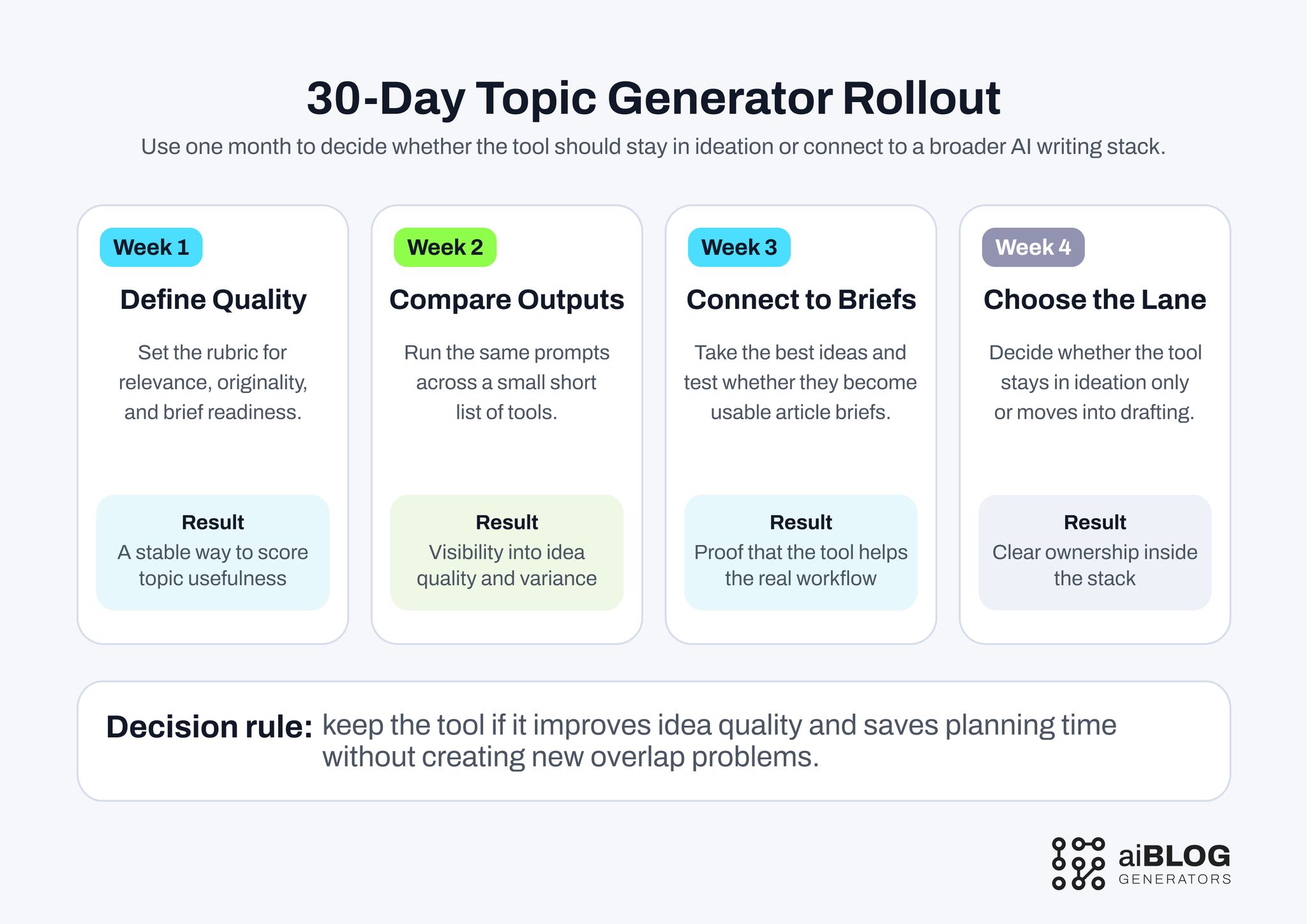
The easiest way to judge a topic generator is to use it inside one narrow workflow for a month.
Week 1: define what counts as a good topic
Set a rubric for relevance, originality, and brief readiness.
Week 2: compare outputs across one short list
Run the same prompt set across multiple tools and score the outputs.
Week 3: connect the winning tool to your briefing process
Take the strongest ideas and test whether they become usable article briefs.
Week 4: decide whether to keep the tool in ideation only or connect it to a larger writing stack
This is the moment to decide whether the tool should stay at the front of the funnel or hand off directly into drafting.
30-Day Topic Generator Rollout
If the tool improves topic quality but not draft quality, keep it in the ideation lane. That is still a win if it removes blank-page friction and improves article selection.
FAQ
What is a blog topic generator?
A blog topic generator is a tool that helps create article ideas, angles, titles, or subtopics based on prompts, keywords, or audience inputs.
How is a blog topic generator different from a blog post generator?
A blog topic generator focuses on ideation and topic selection, while a blog post generator is more focused on creating larger sections or complete drafts.
When should I use a free blog topic generator?
Use a free blog topic generator when you want to validate the category, test prompt quality, or improve ideation before paying for a larger workflow tool.
How do I know when to move to a full AI writer?
Move to a full AI writer when topic quality is already stable and your next bottleneck is turning briefs into outlines and full drafts.
Can a blog topics generator help with SEO?
Yes, if the ideas map to real search intent and are reviewed for uniqueness, relevance, and internal overlap before the content is drafted.
What should I test first when comparing tools?
Test topic relevance, originality, prompt control, and how easily the ideas turn into article briefs.