Quick answer
A free blog topic generator is useful when your main problem is figuring out what to write next, not drafting the whole article. In 2026, the better free options help you brainstorm angles, find audience questions, expand one seed topic into several article directions, and reduce blank-page friction without forcing you into a paid plan immediately.
That is the real buying lens. If you only need fast ideation, a free blog topic generator can be enough. If you need stronger planning, clearer clustering, or a cleaner handoff from idea generation into outlines and drafts, the free layer can start to feel limited very quickly.
The strongest free tools are not always the ones that generate the most ideas. They are usually the ones that generate useful ideas with clear intent, decent variety, and just enough structure to support editorial decisions.
This guide explains how to compare free blog topic generator options honestly, where free tools help most, what limits matter, and when it makes sense to move into a broader AI writing workflow.
sbb-itb-a759a2a
Why this category matters now
A lot of content teams do not actually have a writing-speed problem first. They have a topic-selection problem.
That shows up in familiar ways:
- the backlog is full of vague ideas
- several people pitch nearly identical article angles
- content calendars get built around weak topics that never become strong briefs
- editors spend more time rejecting or reshaping ideas than creating forward motion
That is why a free blog topic generator matters. It gives teams a low-risk way to test whether better idea generation can improve planning before they commit to a paid content workflow.
The category matters even more now because AI drafting tools are everywhere. Once writing gets faster, topic quality becomes the bottleneck. Weak topics just create more weak content at higher speed. Stronger topic discovery improves everything downstream, from outlines to drafts to internal linking.
What a free blog topic generator should actually do
A useful free tool should create editorial clarity, not just a pile of catchy titles.
| Job | What a strong free tool should do | What weak free tools usually do |
|---|---|---|
| Topic discovery | Turn one broad seed topic into several distinct article directions | Repeat the same concept with tiny wording changes |
| Intent shaping | Suggest ideas that map to clear reader needs | Generate titles that sound nice but solve no obvious problem |
| Planning support | Give ideas that can become briefs or cluster candidates | Produce random inspiration without structure |
| Variation | Offer different formats, angles, and audience positions | Create ten versions of the same headline |
| Low-risk evaluation | Let you test the workflow before paying | Hide meaningful usage behind tiny quotas or vague caps |
That is the real standard. A free blog topic generator does not need to replace your editor, strategist, or writer. It does need to prove that it can improve what happens before drafting begins.
Practical framework: how to evaluate a free blog topic generator
The fastest way to compare free tools is to score them by usefulness, not novelty.
| Criterion | What to check | Why it matters |
|---|---|---|
| Relevance | Do the ideas fit your niche, audience, and business model? | Irrelevant ideas create noise instead of momentum |
| Variety | Are the ideas meaningfully different from one another? | Repetition creates editorial waste |
| Intent clarity | Can you tell what reader problem each topic addresses? | Clear intent leads to stronger briefs and better search fit |
| Free-plan transparency | Are the limits clear before you invest time? | Hidden caps make comparison unreliable |
| Handoff value | Can the ideas move cleanly into outlines or briefs? | Good ideation should lower planning friction |
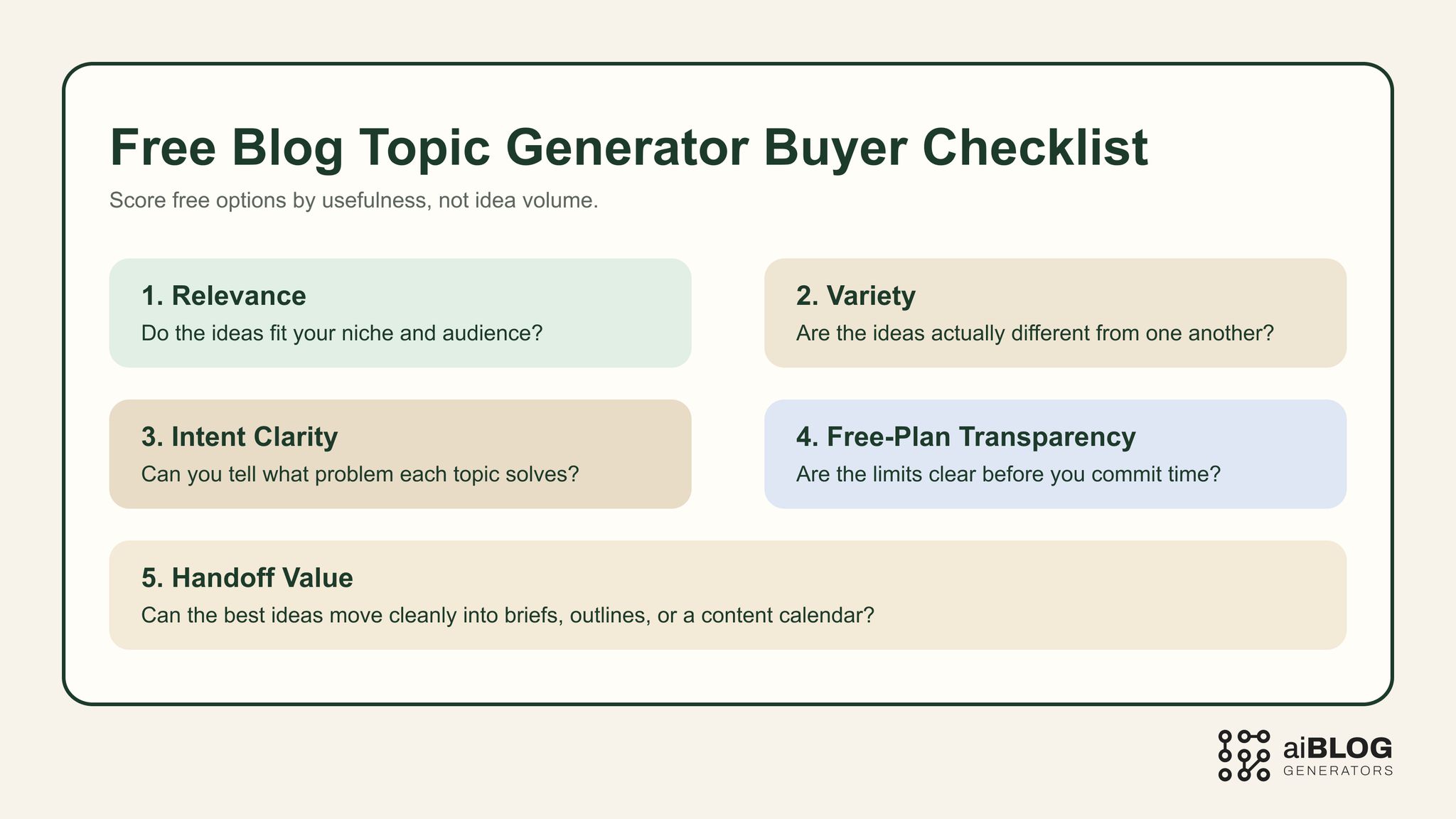
Free Blog Topic Generator Buyer Checklist
A good buying rule is simple: judge the tool by how many ideas survive editorial review, not by how many ideas it can produce in one burst.
External examples and tools worth studying
You do not need a giant list of tools. You need a shortlist that shows how different products handle free ideation.
| Example | Type | Why it belongs in this guide | URL |
|---|---|---|---|
| RyRob Blog Idea Generator | Lightweight idea generator | Strong benchmark for creator-friendly topic prompts and low-friction brainstorming | https://www.ryrob.com/blog-idea-generator/ |
| QuillBot AI Blog Post Generator | Broader AI writing tool | Useful contrast point for when topic generation should hand off into article drafting | https://quillbot.com/ai-writing-tools/ai-blog-post-generator |
| AIOSEO Best AI Blog Post Generators | Comparison article | Helpful benchmark for shortlist framing, buyer language, and pros/cons structure | https://aioseo.com/best-ai-blog-post-generators/ |
| RyRob Free AI Article Writer | Adjacent AI writer tool | Good reference for when free ideation is no longer enough and drafting becomes the bottleneck | https://www.ryrob.com/ai-article-writer/ |
| Copy.ai Blog Post Wizard | Guided workflow tool | Useful for understanding how some buyers move from idea generation into structured article workflows | https://www.copy.ai/tools/blog-post-wizard |
| Writesonic AI Article Writer | Broader content workflow | Good comparison point for buyers evaluating whether they need ideation only or a wider writing stack | https://writesonic.com/ai-article-writer |
The goal is not to find one perfect free option. The goal is to understand what kind of free experience each tool is really offering.
What free usually means in this category
Not every free blog topic generator offers the same kind of value.
1. Free but lightweight
These tools are best for simple brainstorming and early ideation.
Good when:
- you need quick topic bursts
- you are working solo
- your team wants to test interest before buying anything
2. Free as a trial layer
These tools feel usable, but the real workflow opens up only after payment.
Good when:
- you already expect to upgrade if the experience is strong
- you want to compare premium products before committing
3. Free feature inside a broader AI tool
In this model, topic generation is only one part of the product.
Good when:
- ideation is only one of several bottlenecks
- you want topic ideas, outlines, and drafts in one workflow
- you already know your process may outgrow pure ideation tools quickly
This is why buyers should stop treating free as one category. Free can mean open-ended access, a limited testing layer, or a small piece of a larger workflow.
The free-plan limits that matter most
A free blog topic generator often looks useful in a demo and then breaks in real usage because of small but important restrictions.
Usage caps
Some tools limit how many topic runs, prompts, or generations you can do.
Why it matters:
- you may not get enough repetitions to compare output quality honestly
- you may waste your free allowance before testing real content workflows
Low topic diversity
Some free tools produce ideas that look different on the surface but are basically the same angle.
Why it matters:
- it inflates the feeling of productivity
- it does not actually improve editorial planning
Missing cluster support
A free tool may create titles but not help you expand the topic into FAQs, subtopics, or funnel variants.
Why it matters:
- you still have to do the hardest planning work manually
- the tool becomes a spark, not a workflow improvement
Weak export or workflow handoff
A free tool may not make it easy to move your best ideas into a planning system.
Why it matters:
- even decent ideas can lose value when handoff is messy
- friction between ideation and planning reduces adoption
Upsell pressure too early
Some free products push buyers into upgrade prompts before the value is clear.
Why it matters:
- you never get a fair test of the workflow
- the tool feels more like a teaser than a true free layer
When a free blog topic generator is enough
A free option is often enough when:
- your team only needs ideation help
- one person handles strategy and writing
- your publishing cadence is light
- you want to test niches, formats, or angle variations
- you already have a strong human review process after ideation
In those situations, free can be the correct answer. The goal is not scale yet. The goal is proving that better topic discovery can improve your workflow.
When free stops being enough
A free blog topic generator usually stops being enough when:
- the team needs more predictable topic quality every week
- multiple writers need shared planning structure
- the same ideas keep repeating across prompts
- editorial review takes too long because ideas are vague
- topic generation is no longer the only bottleneck
That is the moment when buyers should ask a better question: do we need a better free topic tool, or do we need a broader AI writing stack that includes ideation, outlining, and drafting?
Free topic generator versus broader AI writing workflow
This is where many teams get stuck.
Choose a free blog topic generator when:
- the biggest problem is choosing topics
- drafting is already manageable
- you want low-risk experimentation
- you only need better idea flow, not full content production
Choose a broader AI writing workflow when:
- you also need outlines and first drafts
- the team wants fewer handoff steps
- editorial throughput is blocked after ideation, not before it
- you want one system that supports several stages of content creation
That distinction matters because the wrong tool category creates frustration. Buyers often think they need better topic generation when they really need better end-to-end workflow support.
Topic prompts buyers should test before choosing
A useful evaluation process should test realistic ideation jobs, not only generic prompts.
Prompt test 1: audience-specific ideas
Example: “Generate 15 blog topic ideas for solo ecommerce founders who want more organic traffic but only publish twice per month. Group them by funnel stage and avoid generic listicles.”
What to look for:
- whether the ideas fit the audience
- whether funnel grouping is meaningful
- whether the free tool avoids obvious filler
Prompt test 2: cluster expansion
Example: “Create topic ideas related to free blog topic generator for buyers comparing tools. Include comparison angles, FAQs, use cases, and objections.”
What to look for:
- whether the tool creates distinct article directions
- whether the ideas could become a real content cluster
- whether the expansion helps planning, not just title generation
Prompt test 3: editorial calendar support
Example: “Build a 4-week content plan for an AI tools directory with one BOFU comparison post, one educational post, one FAQ article, and one workflow guide per week.”
What to look for:
- whether the formats vary usefully
- whether the plan shows topic overlap or real progression
- whether the free tool can support planning, not just ideation
Prompt test 4: topic-to-brief handoff
Example: “For the best 5 ideas, add the reader problem, likely search intent, and a suggested brief angle.”
What to look for:
- whether the output is ready for editorial handoff
- whether the tool helps reduce strategist workload
- whether the free version gives enough structure to support real use
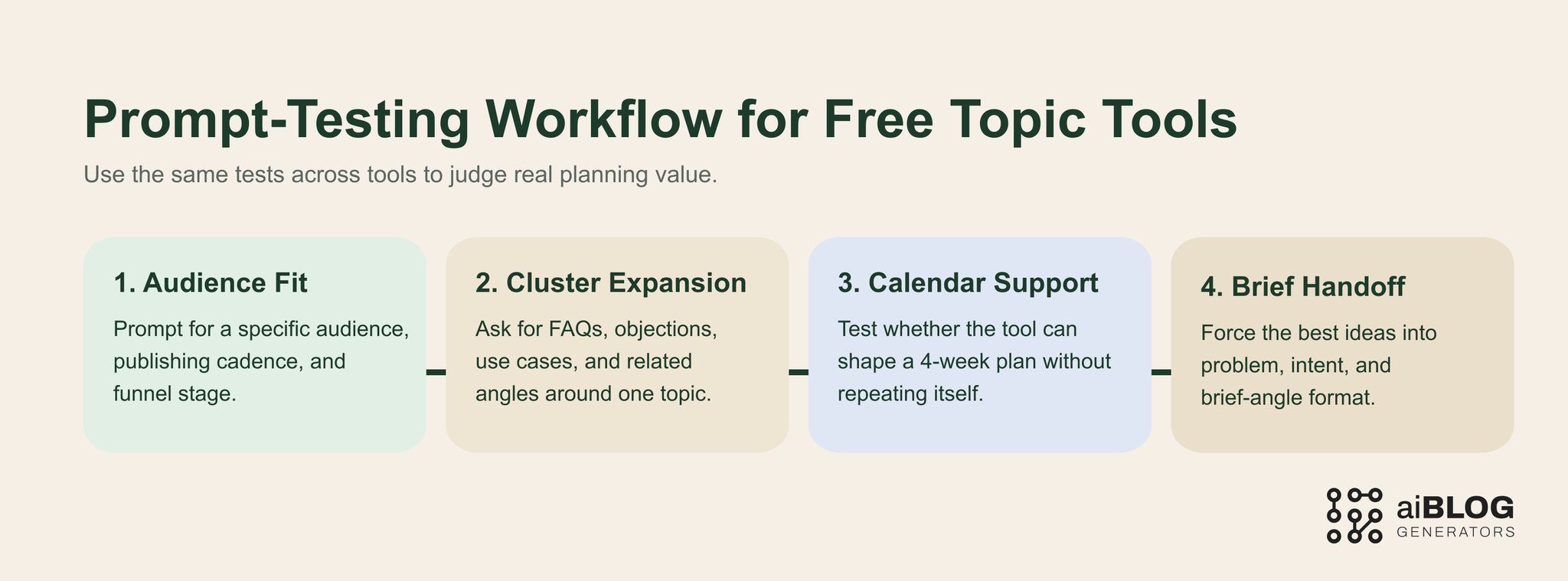
Prompt-Testing Workflow for Free Topic Tools
Quality control still matters
Free topic generators can create momentum, but they can also create bad planning if no one validates the output.
That is why human review should still check:
- whether the idea matches the audience
- whether the angle is too broad or too weak
- whether the topic overlaps with something already in the queue
- whether the idea has clear search or content intent
- whether the output can become a usable brief
This is where many free tools fail quietly. They help you generate more ideas, but not necessarily better editorial decisions.
Practical implementation plan for real teams
Step 1: define what the free tool needs to prove
Choose one main evaluation goal:
- faster ideation
- better topic quality
- stronger cluster building
- better editorial planning
Step 2: test small batches, not giant dumps
Ask for 10 to 15 ideas at a time. Smaller batches make it easier to judge quality and duplication honestly.
Step 3: score ideas before saving them
Use a simple review filter:
- strong fit
- maybe useful
- discard
Step 4: force a handoff test
Take the best 3 ideas and turn them into short briefs. If the ideas fall apart during handoff, the tool is weaker than it first appeared.
Step 5: decide whether the next tool should still be ideation-only
If your new bottleneck becomes outlining, drafting, or rewrite effort, it may be time to move beyond free ideation and into a wider AI writing workflow.
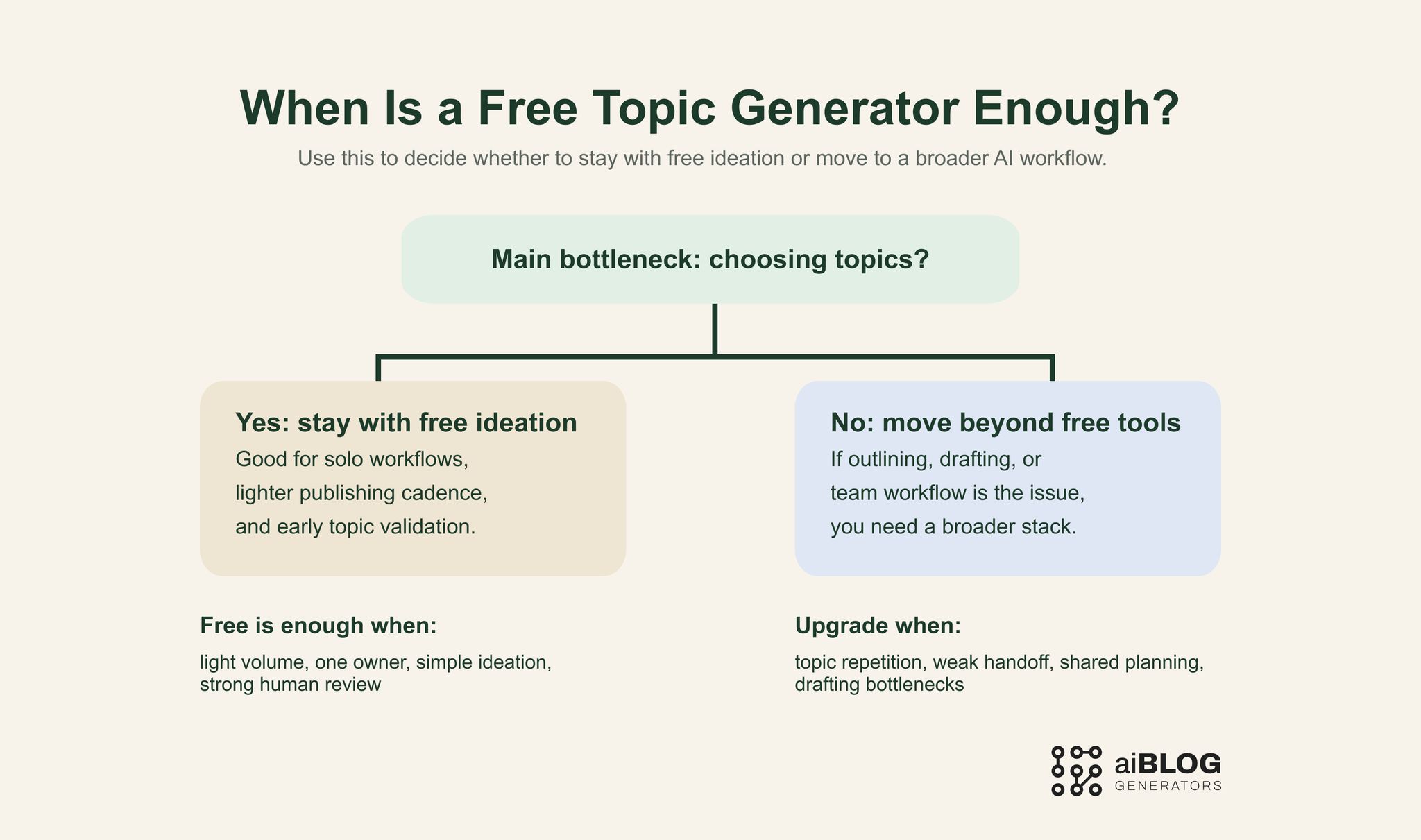
When Is a Free Topic Generator Enough?
Common mistakes buyers make
Mistake 1: judging by volume alone
More ideas do not automatically mean better ideas.
Better move: score how many ideas are actually usable.
Mistake 2: skipping the intent check
A topic can sound interesting and still have weak reader fit.
Better move: ask what problem the topic solves and who it is for.
Mistake 3: using free tools without editorial guardrails
Free tools can multiply weak planning if no one filters the output.
Better move: add a short quality-control step before topics enter the calendar.
Mistake 4: expecting topic generation to solve drafting problems
Idea generation and article writing are related, but they are not the same workflow stage.
Better move: identify whether the real bottleneck is before drafting or during drafting.
Where AIBlogGenerators fits
AIBlogGenerators is most useful when a team wants a simpler path from ideation to execution without jumping too early into a heavy workflow.
That makes it a useful fit for buyers who want to:
- discover article angles faster
- keep topic planning moving without manual brainstorm sessions every time
- reduce the gap between topic ideas and the next content step
- evaluate when a focused ideation workflow is enough and when a broader writing system is needed
The strongest fit is usually not “replace all human strategy.” It is “make topic discovery more consistent and easier to operationalize.”
If you are testing the free end of the ideation market, it also helps to compare Blog Topic Generator for the broader buyer guide, Blog Topic Generator Tool when the main question is tool selection rather than free-plan limits, and Blog Topic Idea Generator when you want angle generation more than general topic coverage.
FAQ
What is the difference between a free blog topic generator and a blog writer?
A free blog topic generator helps you decide what to write about. A blog writer helps create the actual article draft. The first is mainly about ideation and planning. The second is about content production.
Is a free blog topic generator enough for a content team?
It can be enough for lighter workflows, early research, or small teams. Once multiple writers, editors, or weekly publishing targets are involved, the free layer often becomes too limited.
How do I know if a free tool is actually useful?
Test whether the ideas are relevant, varied, and easy to turn into briefs. If the output sounds repetitive or vague, the free tool is not helping enough.
What should I test before upgrading?
Test audience fit, topic variety, cluster expansion, and brief handoff. Those checks tell you more than a feature list ever will.
When should I move from a topic generator to a broader AI writing tool?
Move when ideation is no longer the main bottleneck and the team needs help with outlining, drafting, rewrites, or repeatable editorial throughput.