Quick answer
A blog topic idea generator is the right tool when your team needs better article angles, faster brainstorming, and clearer starting points before anyone writes a full draft. In 2026, the strongest tools do more than produce catchy titles. They help you generate ideas with audience fit, intent clarity, and enough structure to move cleanly into briefs, outlines, or a broader AI writing workflow.
That is the key buying lens. If your team keeps getting stuck at the “what should we write next?” stage, a topic idea generator can save real time. If your real bottleneck starts after the idea phase, then a pure ideation tool may not be enough. The best choice depends on whether you need more idea variety, better topic prioritization, or a broader content stack that also handles outlines and drafts.
This guide explains how to compare blog topic idea generator tools, what examples are worth studying, which prompt tests reveal real quality, and when it makes sense to move from ideation into full article generation.
sbb-itb-a759a2a
Why this category matters in 2026
A lot of content teams assume drafting is the hardest part of publishing. In practice, poor idea selection often creates just as much waste as poor writing.
That shows up in familiar ways:
- several people propose nearly identical article concepts
- content calendars fill with vague topics that never become strong briefs
- editors spend more time reshaping ideas than moving articles forward
- keyword variants get mistaken for distinct angles
- fast drafting tools produce more content, but not better content, because the original idea was weak
That is why the blog topic idea generator category matters now. When content creation gets faster, idea quality becomes more important, not less. A weak concept can become a weak article much more quickly than before. A strong idea process improves everything downstream: outlines, drafts, FAQs, internal linking, and editorial prioritization.
This page should stay focused on that ideation job. It is not the same as a general blog topic generator page, and it is not the same as a full AI writing page. It is specifically about choosing the right tool for idea generation and knowing when that stage ends.
What a blog topic idea generator should actually do
A useful tool in this category should help create direction, not just output volume.
| Job | What strong tools do | What weak tools do |
|---|---|---|
| Idea discovery | Generate angles tied to audience pain points and publishing goals | Repeat generic title patterns with little audience fit |
| Intent framing | Suggest ideas that clearly reflect a reader problem or search goal | Produce keyword-shaped titles with weak article substance |
| Variation | Offer different formats, objections, FAQs, and use cases | Create ten versions of the same concept |
| Prioritization support | Make it easier to tell which ideas deserve a brief first | Dump lists with no signal on usefulness |
| Handoff quality | Produce ideas that can become briefs, outlines, or cluster pages | Create ideas that sound good but collapse under structure |
That final point matters most. A buyer should not judge the category only by novelty. The real test is whether the ideas turn into usable content plans.
Practical framework: how to evaluate a blog topic idea generator
The fastest way to compare tools is to score them by usefulness inside a real editorial process.
| Criterion | What to test | Why it matters |
|---|---|---|
| Idea relevance | Do the suggestions fit your niche, audience, and funnel stage? | Irrelevant ideas create noise, not momentum |
| Angle originality | Are the ideas distinct enough to avoid duplication? | Repetitive ideas weaken editorial planning |
| Prompt control | Can you guide the tool by audience, business model, or intent? | Better controls create repeatable results |
| Brief-readiness | Can the idea move quickly into an outline or article brief? | Handoff value is what saves teams time |
| Workflow fit | Does the tool actually improve planning, not just brainstorming? | A clever tool is not valuable if it slows the process |
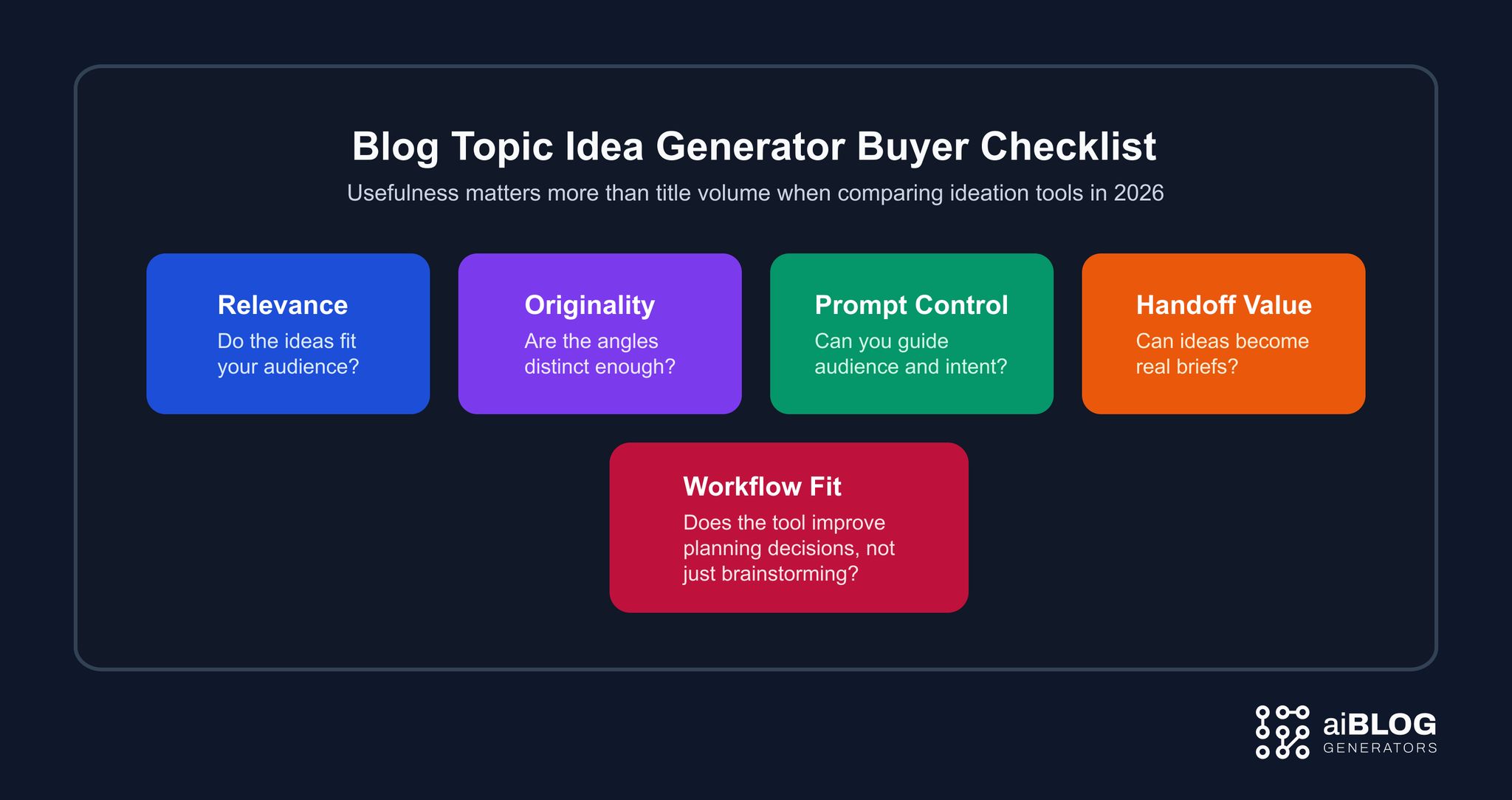
Buyer Checklist for Evaluating a Blog Topic Idea Generator
A useful decision rule is simple: count how many generated ideas survive editorial review without major rewriting. If only one or two out of twenty feel usable, the tool is not solving the real problem.
External examples and tools worth studying
These examples are useful because they represent different ideation and workflow models.
| Example | Type | Why it belongs in this guide | URL |
|---|---|---|---|
| RyRob Blog Idea Generator | Lightweight idea tool | Strong benchmark for creator-friendly brainstorming and quick topic expansion | https://www.ryrob.com/blog-idea-generator/ |
| QuillBot AI Blog Post Generator | Broader AI writing tool | Useful contrast point for when ideation should hand off into article drafting | https://quillbot.com/ai-writing-tools/ai-blog-post-generator |
| AIOSEO Best AI Blog Post Generators | Comparison article | Helpful benchmark for shortlist framing, buyer language, and pros-and-cons structure | https://aioseo.com/best-ai-blog-post-generators/ |
| Copy.ai Blog Post Wizard | Guided content workflow | Useful for understanding when a buyer may need more than idea generation | https://www.copy.ai/tools/blog-post-wizard |
| Writesonic AI Article Writer | Broader AI content tool | Good comparison point for buyers who may outgrow pure ideation tools quickly | https://writesonic.com/ai-article-writer |
| Jasper AI Blog Post Writer | Premium AI writing workflow | Useful for evaluating the point where ideation becomes part of a larger editorial system | https://www.jasper.ai/tools/ai-blog-post-writer |
The goal is not to find the tool with the most ideas. It is to understand which product format best fits your planning workflow.
Where this query differs from nearby pages
This keyword overlaps with several related searches, but the job is more specific.
Blog topic generator
This is the broader category page and can cover ideation, structure, and initial planning in a wider sense.
Blog topic generator tool
This often leans more toward comparing software options and their features.
Free blog topic generator
This is the pricing-and-limits version of the same buying problem.
Blog topics generator
This is mostly a phrasing variant but often points to idea variety and cluster planning.
Best free AI blog writer
That is a wider AI-writing evaluation problem and should not take over this page.
That is why this article should stay centered on choosing a topic idea generator specifically. It should help buyers understand when ideation is enough and when they need to step into a broader workflow.
What buyers should test before choosing
A good evaluation process should test realistic ideation jobs, not only one-line demos.
Prompt test 1: audience-specific idea generation
Example: “Generate 12 blog topic ideas for solo ecommerce founders who want more organic traffic but only publish twice per month. Group the ideas by funnel stage and avoid generic listicles.”
What to check:
- whether the ideas fit the audience
- whether the funnel grouping is useful
- whether the tool avoids bland title templates
Prompt test 2: cluster expansion
Example: “Create topic ideas related to blog topic idea generator for buyers comparing tools. Include comparison angles, FAQs, objections, and use cases.”
What to check:
- whether the ideas become real article directions
- whether the tool creates distinct branches instead of synonyms
- whether the output helps you see cluster structure clearly
Prompt test 3: editorial calendar support
Example: “Build a 4-week content plan for an AI tools directory with one BOFU comparison post, one educational post, one FAQ article, and one workflow guide per week.”
What to check:
- whether the tool varies the format usefully
- whether the ideas show progression instead of repetition
- whether the output helps actual planning decisions
Prompt test 4: handoff into briefing
Example: “Turn these three topic ideas into brief-ready angles with reader problem, article promise, and suggested H2 sections.”
What to check:
- whether the tool can move from titles into planning structure
- whether the brief suggestions stay coherent
- whether the team can use the output without starting over
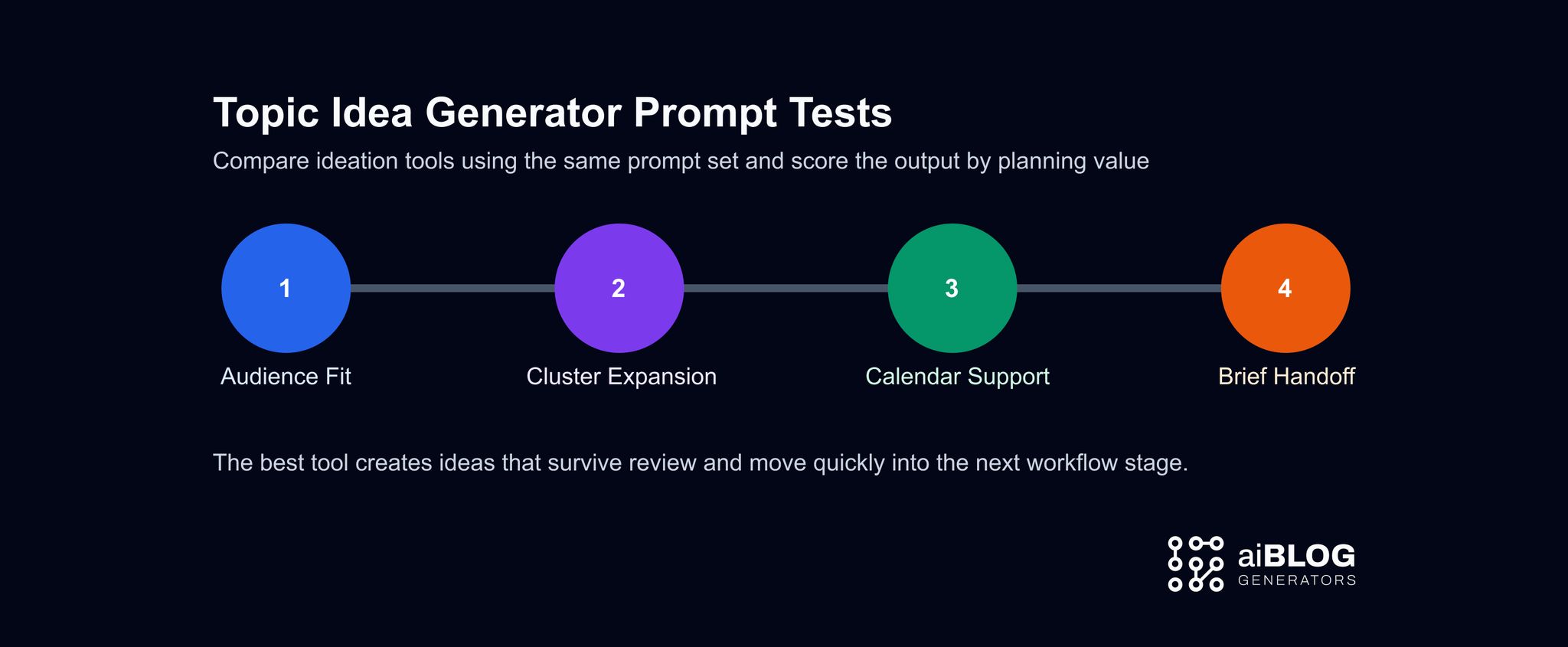
Topic Idea Generator Prompt Tests
When ideation is enough and when it is not
This is where buyers often make the wrong tool decision.
A blog topic idea generator is enough when:
- the main bottleneck is choosing what to write
- the team already has a strong writing and editing process
- article quality problems usually begin with weak angles
- you want faster brainstorming without changing the whole content stack
A broader AI writing workflow is a better fit when:
- your team also needs outlines and first drafts
- editorial handoff from idea to article is still too slow
- the problem is no longer ideation, but production speed
- you want one system that supports planning, drafting, and revision together
That distinction matters because many buyers are not actually choosing between two tools. They are choosing between two levels of workflow maturity.
What a strong handoff into full draft creation looks like
The best ideation tools do not stop at title generation. They create cleaner transitions into the next stage.
A strong handoff usually means the topic output already includes:
- a clear reader problem
- a distinct article promise
- angle differentiation from nearby topics
- subtopic or FAQ suggestions
- enough structure to support a brief quickly
If the generator only gives a headline list, your team still has to do the hard planning work manually. That does not always make the tool bad, but it does limit how much time it really saves.
That is also the moment when a team may move from a topic idea generator into a broader AI stack. Once ideation is stable, the next efficiency win usually comes from outline support and draft acceleration.
Step-by-step implementation plan for a real buyer test
If you want to test this category seriously, run a short controlled evaluation instead of relying on surface impressions.
Step 1: choose one audience and one content goal
Do not start with broad prompts. Pick a real audience and one clear publishing objective.
Examples:
- B2B SaaS founders building a lean SEO program
- newsletter creators looking for weekly content ideas
- agencies planning article clusters for one client vertical
Step 2: use one standard prompt set across every tool
Your standard prompt set should include:
- audience description
- funnel stage
- content objective
- desired output format
- exclusions or angles to avoid
This makes the comparison fair.
Step 3: score the ideas by editorial usefulness
Track:
- how many ideas are usable without major rewriting
- how many are duplicates of existing plans
- how many create a brief-ready angle
- how many naturally expand into FAQs or subtopics
Step 4: test the handoff into a brief
Take the three best ideas from each tool and try turning them into article briefs. If they collapse once structure is required, the generator is weaker than it first appeared.
Step 5: define the tool’s role in the workflow
Once you identify the strongest option, decide whether it should be used for:
- brainstorming only
- brainstorming plus brief support
- brainstorming plus outline handoff into a drafting tool
That final step is what turns a clever generator into a practical editorial system.
Common mistakes buyers make
Mistake 1: confusing idea volume with idea quality
A tool can generate dozens of titles quickly and still be strategically weak.
Fix: score ideas by relevance, uniqueness, and brief-readiness.
Mistake 2: expecting a topic idea generator to replace content strategy
The tool can accelerate option discovery, but it cannot decide business priorities for you.
Fix: use it to widen the option set, then let the team choose what matters.
Mistake 3: moving to full draft generation too early
If the idea itself is weak, a faster draft only creates faster waste.
Fix: stabilize the idea stage before upgrading the drafting stage.
Mistake 4: never refreshing the prompt model
What worked once for one audience can become stale and repetitive.
Fix: rotate prompts by funnel stage, audience segment, and content objective.
Mistake 5: buying a broader stack when the real need is still ideation
Some teams overspend because they assume more product depth will solve a planning issue.
Fix: identify whether the real bottleneck is ideation, briefing, or drafting before upgrading.
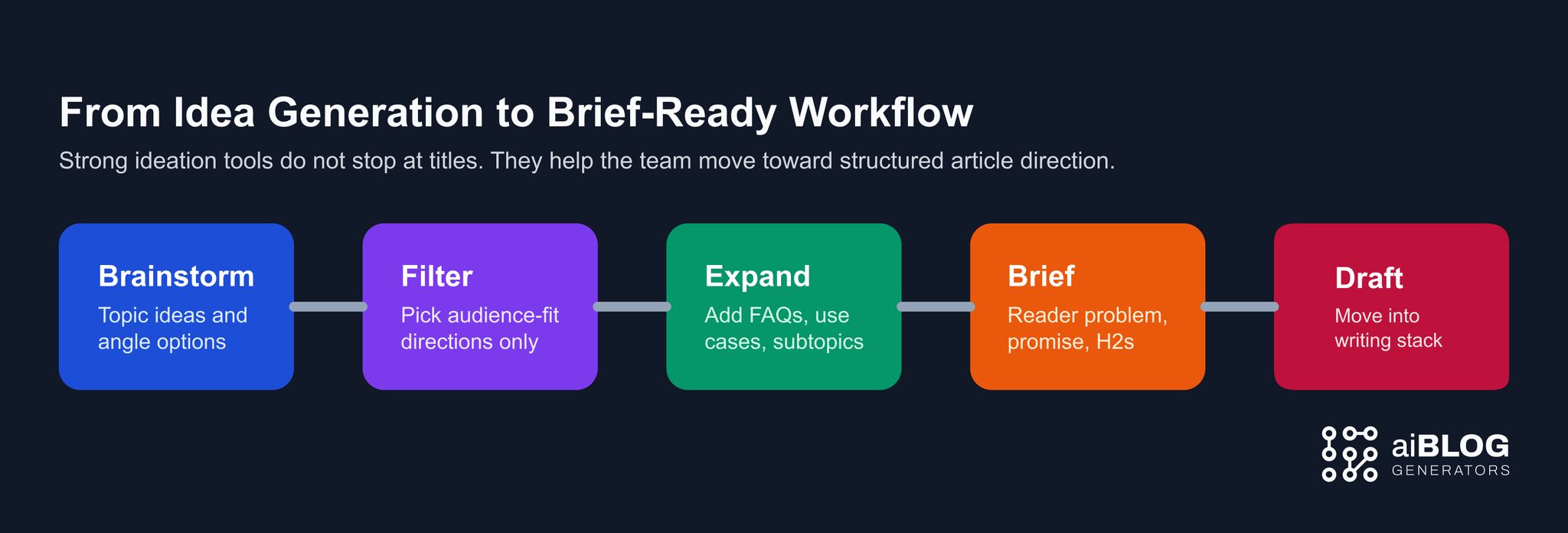
From Idea Generation to Brief-Ready Workflow
Quality control and human review still matter
Even the best idea tool can create weak directions if nobody reviews the output with editorial judgment.
A strong review layer checks:
- whether the idea matches a real reader problem
- whether the angle is distinct enough to deserve its own article
- whether the topic maps to the correct funnel stage
- whether the handoff into a brief is realistic
- whether the idea overlaps too heavily with existing plans
That is why strong teams still use human review at the idea stage. Better brainstorming is useful, but better selection is what creates momentum.
Where AIBlogGenerators fits in this workflow
AIBlogGenerators is most useful when you want to compare ideation workflows and understand which tools are best for moving from brainstorming into a more structured publishing system.
Use AI Writer when you are already moving beyond ideas and need stronger draft support. Use Blog when you want to explore the broader content workflow and compare related tool categories.
That is the right transition point. A topic idea generator should improve the planning stage. Once your team outgrows that stage, the next decision is usually about outlines, drafts, and workflow control.
If you are tightening the ideation layer rather than the writing layer, it also helps to compare Blog Topic Generator for the broader category guide, Blog Topics Generator when you need wider planning across multiple themes, and Free Blog Topic Generator when you want to test the category without paying first.
FAQ
What is a blog topic idea generator?
A blog topic idea generator is a tool that helps create possible article angles, headline directions, or content concepts before the drafting stage. The stronger options also help with intent framing and brief-readiness.
How is a blog topic idea generator different from a blog topic generator?
The overlap is strong, but blog topic idea generator usually emphasizes brainstorming and angle generation more directly, while blog topic generator can imply a slightly broader planning role.
Are free topic idea generators good enough?
They can be good enough for lightweight ideation, solo publishing, and early-stage planning. They are usually weaker when a team needs stronger handoff quality, less repetition, and more structured workflow support.
What should I test before choosing one?
Test idea relevance, angle originality, prompt control, brief-readiness, and whether the output supports real editorial planning instead of only title generation.
When should I move from ideation into a broader AI writing stack?
Move when topic quality is already stable and the bottleneck shifts into outlining, drafting, or repeated editorial production.