Quick answer
A blog topics generator is worth using when your team needs more than a few isolated ideas. In 2026, the strongest tools in this category help you generate topic sets, organize them into usable editorial lanes, and reduce overlap before those topics turn into outlines or drafts.
That is the key buying difference. A single-topic generator may be enough for quick brainstorming. A blog topics generator should be better at handling broader planning needs such as content clusters, weekly publishing calendars, and theme expansion across multiple audience needs.
If your team keeps ending up with repetitive article ideas, unclear topic priorities, or a backlog full of vague concepts, this category can be useful. If the real problem starts after topics are chosen, though, you may need a broader AI writing stack instead of another ideation tool.
This guide explains how to compare blog topics generator options, what formats buyers should test, when free tools are enough, and how to decide whether the purchase should stay at the ideation layer or move into a wider workflow.
sbb-itb-a759a2a
Why buyers care about this category now
As AI content tools improved, the planning bottleneck became easier to notice. Many teams now realize they are not short on words. They are short on well-structured topic decisions.
That is why the blog topics generator category matters more now than it did a year ago. The value is not just in producing ideas quickly. The value is in producing a set of ideas that can support real publishing momentum.
A strong tool in this category can help a team:
- build topic banks faster
- group ideas by funnel stage or audience segment
- expand one theme into several useful article paths
- spot duplication before writers start drafting
- support cluster-based planning instead of isolated article picking
This matters because weak ideation systems now create bigger downstream problems. AI makes it easy to produce more content, which means it is also easier to publish repetitive, poorly differentiated articles if the topic layer is weak.
What a good blog topics generator should actually do
A useful blog topics generator should act more like a planning assistant than a novelty machine.
| Job | What strong tools do | What weak tools do |
|---|---|---|
| Topic breadth | Produce multiple distinct content directions around one theme | Repeat the same concept with small wording changes |
| Cluster support | Generate supporting angles, FAQs, and adjacent topics | Treat every idea as a flat, isolated article |
| Editorial planning | Help build multi-week or multi-format content sequences | Output random lists that are hard to prioritize |
| Overlap control | Make duplication easier to detect before publishing | Create many topics that compete for the same demand |
| Handoff readiness | Produce ideas that can become briefs quickly | Create attractive-sounding ideas that break during outlining |
That is why buyers should evaluate this category differently from simple title generators. The goal is not more topic volume. The goal is a cleaner planning system.
Practical framework: how to evaluate a blog topics generator
Use this scorecard before choosing a tool.
| Criterion | What to check | Why it matters |
|---|---|---|
| Topic range | Does the tool create genuinely different content directions? | Better range makes the backlog more strategic |
| Cluster logic | Can it expand a theme into supporting angles and related questions? | Strong clustering leads to better topical authority planning |
| Prioritization value | Does the output help editors choose what to publish first? | Planning only improves if the team can act on the results |
| Duplicate-risk control | Does the tool make overlap easier to spot? | Reducing cannibalization is part of the product value |
| Workflow fit | Can your team sort, label, and hand off the output quickly? | A tool that does not fit the workflow will not stick |
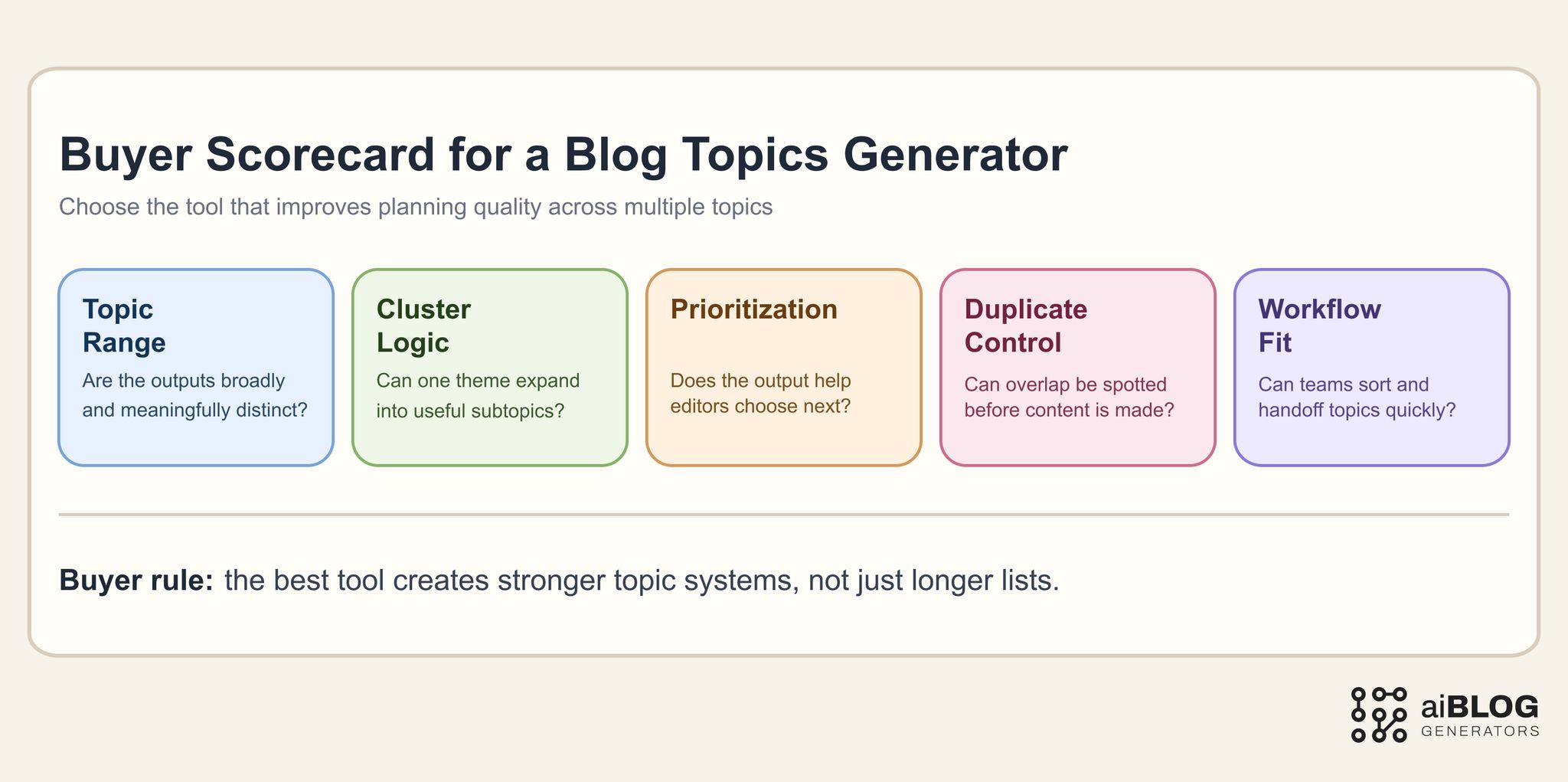
Buyer Scorecard for a Blog Topics Generator
A useful buying rule is simple: the best tool is the one that gives your editors the clearest next publishing decisions, not the longest idea dump.
Tool formats buyers should compare
The category includes several useful formats, and buyers should not assume they all solve the same problem.
1. Simple topic generators
These are best when the team wants fast idea sets from one theme.
Good fit when:
- you need quick batches of topics
- one person owns planning
- the team is still early in ideation
Weak fit when:
- you need topic clusters with stronger structure
- you already have too many loose ideas
2. Question and research expansion tools
These are useful when your team needs better visibility into how users phrase related questions and what supporting angles exist.
Good fit when:
- you want better FAQ discovery
- you need supporting-question mapping
- you want to build topic clusters around real user phrasing
Weak fit when:
- the team wants one interface for ideation and drafting
3. Broader AI writing suites with planning features
These are often the better buy when topic generation is only one layer of the workflow.
Good fit when:
- your team needs ideas, outlines, and drafts in one system
- the next bottleneck is already moving beyond ideation
- you want one vendor to support more of the pipeline
Weak fit when:
- the main pain is still just topic selection
- the team wants a lower-cost ideation-first tool
That is often the real decision. Buyers are not only choosing a blog topics generator. They are choosing how much of the content workflow they want one tool to own.
External examples and tools worth studying
A useful shortlist should show different approaches to topic generation and planning.
| Example | Type | Why it belongs in this guide | URL |
|---|---|---|---|
| RyRob Blog Idea Generator | Idea generator | Strong benchmark for creator-friendly ideation flow and topic prompt simplicity | https://www.ryrob.com/blog-idea-generator/ |
| AnswerThePublic | Question discovery tool | Useful for surfacing topic sets from audience phrasing and search questions | https://answerthepublic.com/ |
| AlsoAsked | Topic mapping tool | Helpful for follow-up question trees and supporting-topic discovery | https://alsoasked.com/ |
| QuillBot AI Blog Post Generator | Broader writing tool | Useful contrast point for deciding when ideation should hand off into drafting | https://quillbot.com/ai-writing-tools/ai-blog-post-generator |
| AIOSEO Best AI Blog Post Generators | Comparison article | Good benchmark for shortlist logic, buyer framing, and tool comparisons | https://aioseo.com/best-ai-blog-post-generators/ |
| RyRob Free AI Article Writer | AI writer benchmark | Helpful reference for deciding when topic planning is no longer the main bottleneck | https://www.ryrob.com/ai-article-writer/ |
A stronger buying process compares at least one lightweight topic tool, one question-expansion system, and one broader AI writing product. That reveals whether the real need is ideation only or a wider writing workflow.
When a blog topics generator is enough and when it is not
This is the decision buyers often get wrong.
A blog topics generator is usually enough when:
- the team already has a reliable writing process
- editorial planning is messy or repetitive
- content clusters are weak or underdeveloped
- the calendar needs stronger theme expansion before drafting starts
It is usually not enough when:
- topic selection is fine but outlines are weak
- drafts take too long after topics are chosen
- the team needs one workflow that goes from ideation to full article output
- editors want more control over tone, structure, and section creation
That is why this category works best when buyers evaluate the bottleneck honestly. If the pain is upstream, a focused topic generator can help. If the pain is downstream, the better investment may be a broader AI writer workflow.
Prompt examples buyers should test before choosing
A serious buying process should test the same prompt types across the shortlist.
Prompt test 1: theme expansion
Example: “Generate 20 blog topics for a startup landing page platform. Group the results by audience type and remove obvious duplicates.”
What to look for:
- whether the topics actually vary
- whether audience grouping is useful
- whether duplicates are easy to detect
Prompt test 2: cluster building
Example: “Build a content cluster around blog topics generator for buyers comparing software. Include core pages, supporting questions, and related comparison angles.”
What to look for:
- whether the tool produces a coherent cluster
- whether supporting topics feel useful instead of padded
- whether the output can support a real editorial roadmap
Prompt test 3: calendar planning
Example: “Create a 4-week blog calendar for an AI content tools directory. Include one BOFU comparison, one educational article, one FAQ page, and one workflow guide each week.”
What to look for:
- whether the output balances formats well
- whether weekly ideas overlap too much
- whether the plan feels publishable instead of theoretical
Prompt test 4: handoff quality
Example: “For the best 5 topics, add likely reader intent, one short brief angle, and the best content format for each.”
What to look for:
- whether the tool helps editors move into briefing quickly
- whether the brief angles feel specific enough to use
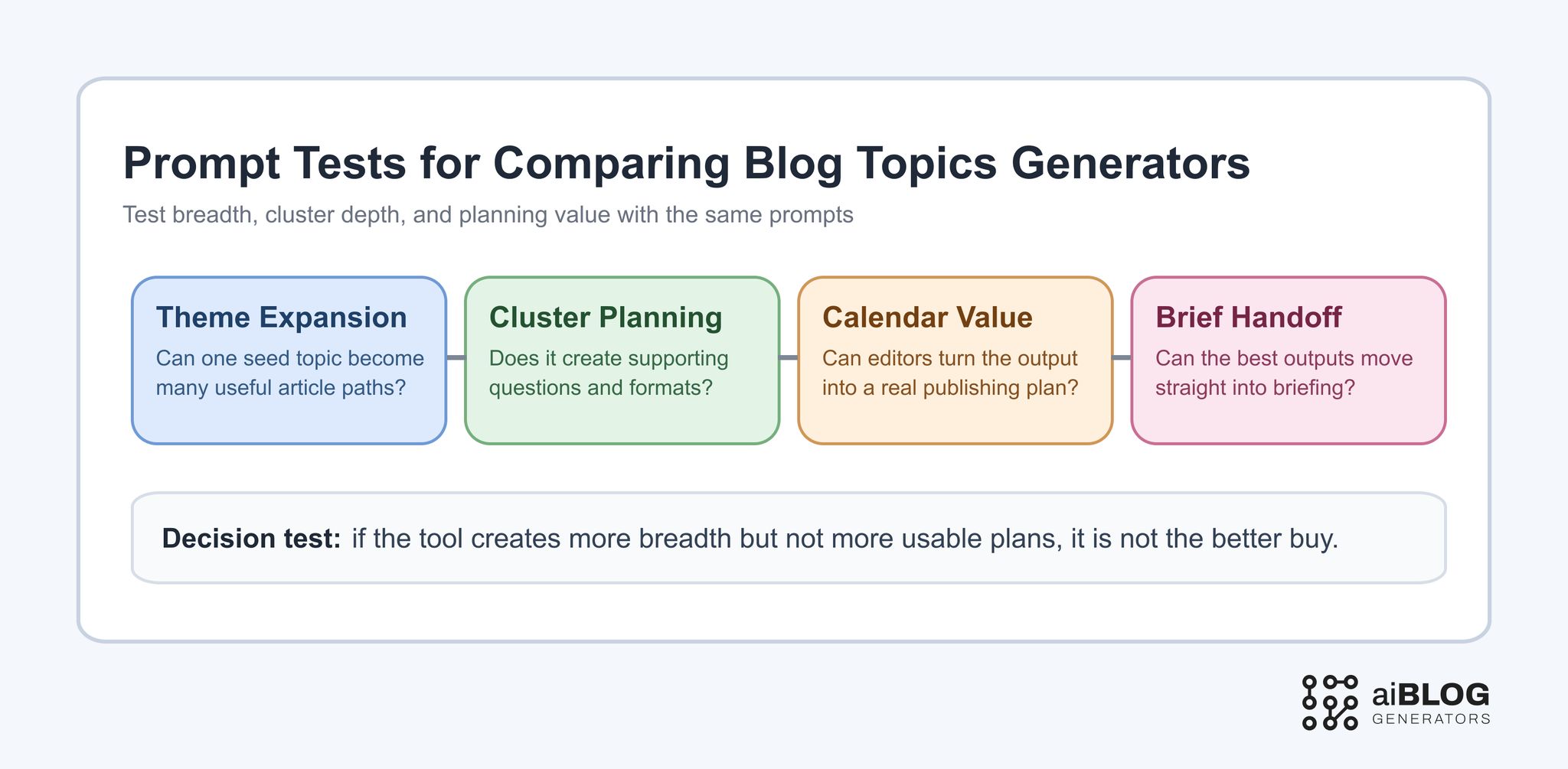
Prompt Tests for Comparing Blog Topics Generator
Free tools versus paid tools: what changes for buyers
A free blog topic generator can be good enough for experimentation, light ideation, and solo workflows. Buyers usually hit the limits when they try to scale planning quality.
Free tools are often good for:
- basic brainstorming
- early topic exploration
- one-off headline or article idea sessions
- lightweight creator workflows
Paid options usually become more attractive when you need:
- stronger prompt control
- better topic differentiation
- easier cluster building
- workflow organization for editors or teams
- broader AI writing features beyond ideation
That does not mean every team should upgrade immediately. It means the value of paid tools often appears when the team wants ideation to connect more cleanly to the rest of the publishing system.
A practical implementation plan for real teams
Step 1: define the planning problem clearly
Decide whether the tool must help with:
- topic discovery
- content cluster building
- editorial sequencing
- reducing duplication
- preparing brief-ready topics
Without that step, comparisons stay too abstract.
Step 2: use one scoring system
Have editors score the same things:
- topic quality
- idea range
- cluster usefulness
- ease of handoff
- duplicate-risk control
Step 3: compare smaller batches
Test 10 to 20 topics at a time. Huge output sets can make weak tools look stronger than they are.
Step 4: force a handoff into briefs or calendars
Take the best 3 to 5 ideas and turn them into brief skeletons or a one-week plan. If the output breaks there, the tool is weaker than it first looked.
Step 5: decide whether the next purchase should still be ideation-focused
If the next bottleneck becomes outlining, drafting, or rewriting, buyers should consider moving up the stack instead of over-optimizing the topic tool layer.
Common mistakes buyers make
Mistake 1: buying based on volume
More topics do not automatically mean better planning.
Better approach: score the usefulness of the best ideas, not the total output count.
Mistake 2: skipping cluster evaluation
A tool can create decent single ideas and still fail at theme expansion.
Better approach: test whether the tool can support multiple related articles around one theme.
Mistake 3: ignoring duplicate risk
Weak tools often create different-sounding topics that still compete for the same reader need.
Better approach: review output for angle, audience, and format overlap before approval.
Mistake 4: choosing a full AI suite too early
Some teams buy a broader system when their real problem is still just topic planning.
Better approach: match the product scope to the current bottleneck.
Mistake 5: assuming topics alone solve production problems
Better topics do not fix weak briefs, weak drafts, or weak editing systems.
Better approach: treat the tool as one part of the workflow, not the whole solution.
Quality control still matters before the tool pays off
A blog topics generator only creates real value when the team reviews the output strategically.
A strong review pass should ask:
- does this topic solve a real audience need?
- is it distinct from nearby topics already planned?
- does it support current content priorities?
- can it become a brief without a full reset?
- should this topic stay at the ideation layer, or is it already ready for drafting?
That is the difference between interesting output and operational value.
Where AIBlogGenerators fits in this decision
AIBlogGenerators is most useful when you are deciding whether your content system still needs a dedicated topic-planning layer or whether the team is ready for a broader AI writing stack.
Useful internal paths:
That is especially useful for buyers who want to understand the next best investment in the workflow instead of simply collecting more tools.
If you are organizing topic work across several adjacent searches, it also helps to compare Blog Topic Generator for the broader buyer guide to the category, Blog Topic Generator Tool when the main question is which product format fits your process, and Blog Topic Idea Generator when you need tighter angle generation rather than broader topic coverage.
A 30-day rollout plan for choosing the right tool
Week 1: define the evaluation jobs
Clarify whether the tool should improve brainstorming, clustering, prioritization, or brief handoff.
Week 2: compare outputs on shared prompts
Run the same theme, cluster, and calendar prompts across the shortlist.
Week 3: test real editorial handoff
Move the best ideas into short briefs or a sample publishing plan.
Week 4: decide whether to keep a focused topic generator or move up the stack
If the next bottleneck is drafting and editing, the better next purchase may be a broader AI writing workflow.
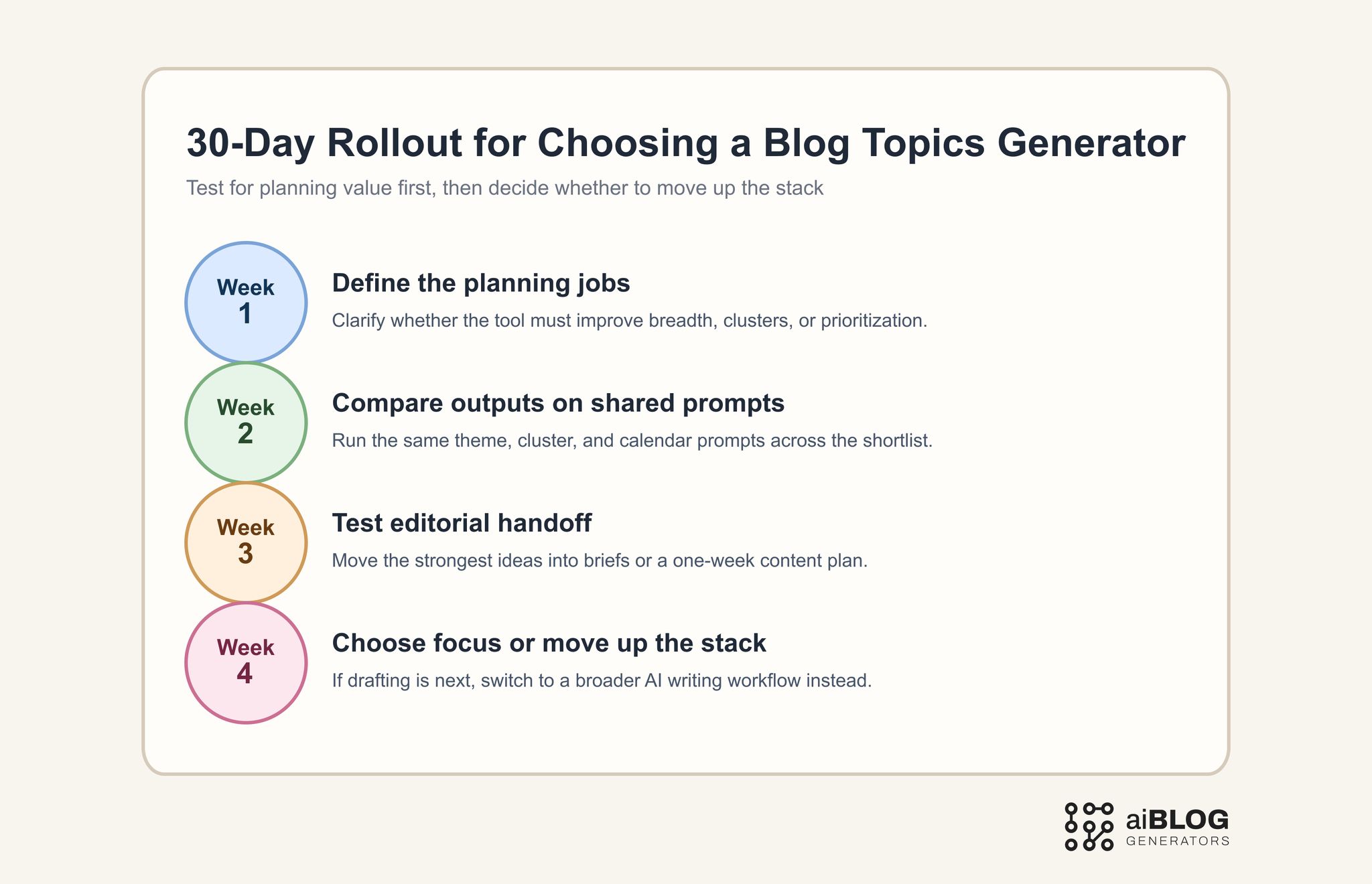
30-Day Rollout for Choosing a Blog Topics Generator
The strongest buyers in this category do not ask which tool creates the most topics. They ask which tool creates the strongest next publishing decisions.
FAQ
What is a blog topics generator?
A blog topics generator is a tool that helps create sets of article ideas, supporting angles, and related content directions around a niche, theme, or audience need.
How is a blog topics generator different from a blog topic generator tool?
The terms overlap heavily, but blog topics generator often implies broader multi-topic planning, while blog topic generator tool can sound more like a specific product category decision.
Is a free blog topic generator enough?
A free tool can be enough for lightweight ideation and solo workflows. Teams often need more structure once they scale editorial planning and handoff.
When should I move from topic generation to a broader AI writing stack?
Move up the stack when ideation is no longer the bottleneck and the team needs more help with outlines, drafting, rewriting, or content operations.
What should I compare when buying a blog topics generator?
Compare topic range, cluster-building quality, prioritization value, duplicate-risk control, and how well the tool fits your workflow.
Can a blog topics generator help reduce cannibalization?
Yes, if the team actively reviews output for angle, audience, and format overlap before approving topics for production.