Quick answer
An automatic blog generator is useful when your team wants to reduce manual steps between brief, draft, and publish-ready review. In 2026, the stronger tools are not the ones that remove humans completely. They are the ones that automate the repeatable parts of the workflow while still giving editors enough control to catch weak structure, weak facts, or weak brand fit before anything goes live.
That is the key decision point. A blog generator can help with drafting. An automatic blog generator promises something broader: less hands-on work across the workflow. That only creates value when the automation layer is paired with review checkpoints, prompt rules, and clear publishing controls. If the system creates posts quickly but forces editors to rebuild or fact-check everything from scratch, the automation is not really helping.
This guide explains how to compare automatic blog generator options, what automation is actually safe to delegate, where human review remains mandatory, and how to build a workflow that gains speed without lowering quality.
sbb-itb-a759a2a
Why this category matters in 2026
The category matters because many teams have already tested AI drafting. Their next question is whether more of the workflow can be automated without creating hidden risk.
That question has become more urgent because content operations now move faster than before:
- topic selection can be AI-assisted
- outlines can be generated quickly
- first drafts can appear in minutes
- rewrites can be handled in the same workflow
- publishing systems can connect these steps with very little manual effort
That sounds efficient, but it creates a new risk. When several steps are automated at once, weak assumptions can move through the workflow much faster too. A vague brief becomes a vague outline. A vague outline becomes a shallow post. A shallow post can reach the publishing stage before anyone notices the article never answered the real question.
That is why this page should stay focused on automation governance. The real buyer is not only asking “can this tool generate a post?” They are asking “which parts of the blogging workflow can safely run on autopilot, and which parts still need humans?”
What an automatic blog generator should actually do
A strong automatic blog generator should automate repeatable tasks while preserving editorial control where it matters most.
| Job | What strong tools do | What weak tools do |
|---|---|---|
| Triggering content workflows | Turn approved briefs or templates into structured draft runs | Fire off content too early with weak inputs |
| Template reuse | Apply repeatable prompt logic across similar article types | Automate output without enough context or control |
| Draft assembly | Build usable drafts from approved structure and source inputs | Create long posts that still need major rebuilding |
| Review routing | Make it clear where human approval must happen | Blur the boundary between generation and publication |
| Workflow visibility | Show what was generated, changed, and approved | Hide key decision points inside a black-box process |
That is the core distinction. Automation is not only about speed. It is about whether the workflow becomes more reliable or more fragile once it runs faster.
Practical framework: how to evaluate an automatic blog generator
The best way to compare tools is to score how safely they automate the workflow.
| Criterion | What to check | Why it matters |
|---|---|---|
| Workflow automation value | Which steps are actually automated well? | Real value comes from reducing useful manual work, not creating new cleanup |
| Input discipline | Can the workflow enforce clear briefs, prompts, or templates? | Bad inputs make automated content scale the wrong thing |
| Review checkpoint clarity | Are approval points easy to see and control? | Human review is the safety layer, not an afterthought |
| Output reliability | Are drafts directionally usable across repeated runs? | Automation only helps when quality stays stable |
| Publish safety | Can the team stop weak content before it goes live? | Full automation without control creates avoidable risk |
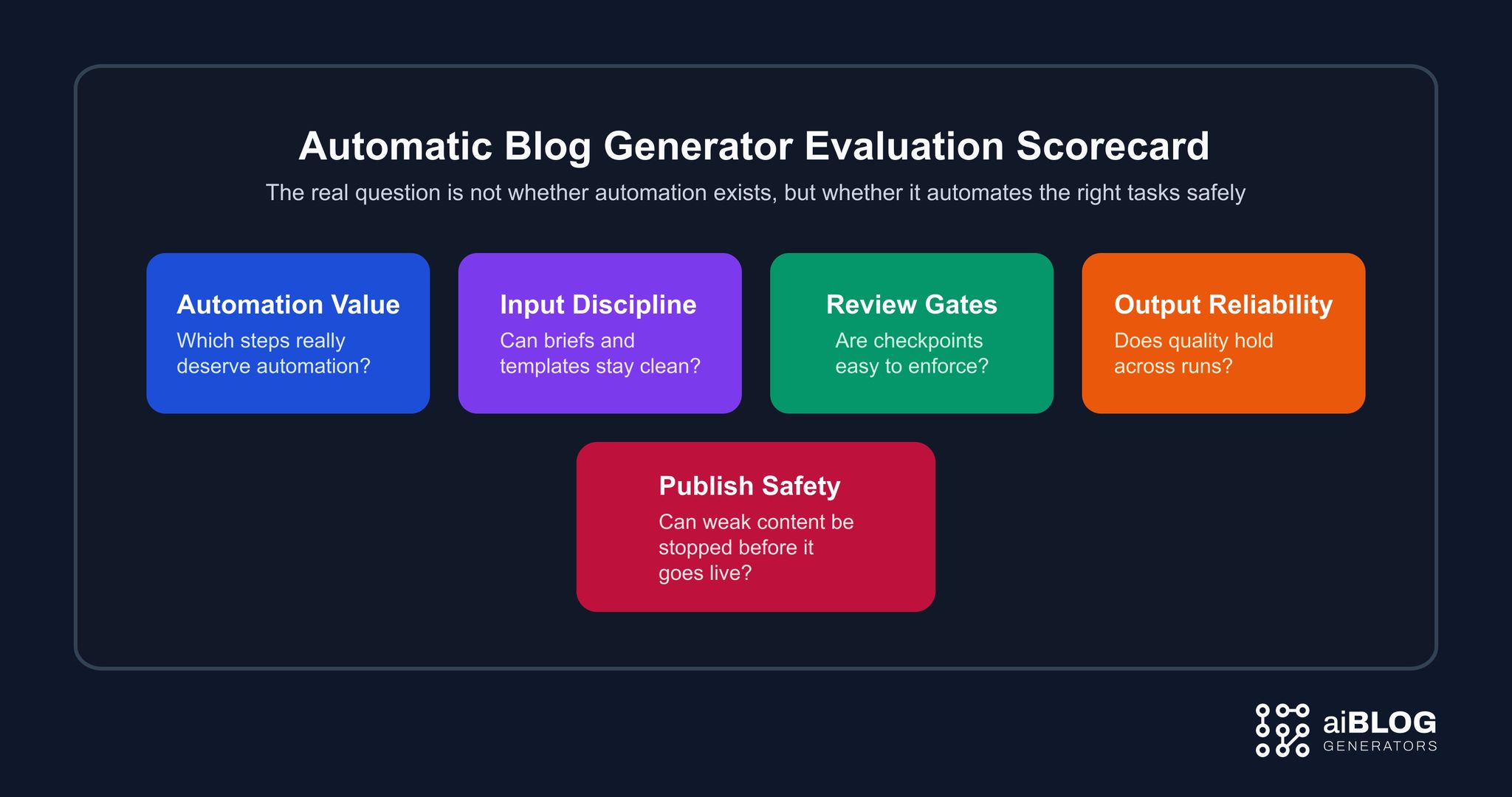
Automatic Blog Generator Evaluation Scorecard
A simple decision rule works well here: do not ask whether the workflow is automatic. Ask whether the automated part actually deserves to be automated.
External examples and tools worth studying
A useful shortlist should show different ways the market frames automated content workflows.
| Example | Type | Why it belongs in this guide | URL |
|---|---|---|---|
| QuillBot AI Blog Post Generator | Direct drafting tool | Useful benchmark for simple generation flow and accessible article automation framing | https://quillbot.com/ai-writing-tools/ai-blog-post-generator |
| RyRob Free AI Article Writer | Creator-focused AI workflow | Strong benchmark for practical framing, clear use cases, and workflow-level caution | https://www.ryrob.com/ai-article-writer/ |
| AIOSEO Best AI Blog Post Generators | Comparison article | Helpful for buyer language, shortlist logic, and tool comparison structure | https://aioseo.com/best-ai-blog-post-generators/ |
| Copy.ai Blog Post Wizard | Guided workflow | Useful for understanding structured generation steps instead of raw one-shot automation | https://www.copy.ai/tools/blog-post-wizard |
| Writesonic AI Article Writer | SEO-oriented workflow | Good benchmark for buyers who want scalable article production without losing search alignment | https://writesonic.com/ai-article-writer |
| Jasper AI Blog Post Writer | Premium writing workflow | Useful for understanding where automation becomes part of a wider editorial system | https://www.jasper.ai/tools/ai-blog-post-writer |
The goal is not to copy these workflows. It is to understand which product shapes automation with enough guardrails to be useful.
Where this query differs from nearby pages
This page overlaps with several related searches, but the workflow promise is different.
Blog generator
That is the broader category page and should cover the general workflow value of blog generation.
Blog post generator
That is narrower and usually focused on first-draft post creation rather than automation across several steps.
Blog ideas generator
That belongs earlier in the workflow and is mostly about ideation.
Blog content generator
That usually leans more toward section generation, rewriting, and content expansion.
Automatic blog post generator
That is the closest sibling term, but this page should still stay a little broader by discussing how automatic generation affects the blogging workflow overall.
That is why this article should stay centered on workflow automation. The main question is not only how to generate content. The main question is how to automate enough of the process without automating the wrong decisions.
Which parts of the workflow are safe to automate
This is the most important evaluation question.
Usually safe to automate first
These tasks often respond well to automation:
- converting approved briefs into outline drafts
- generating first-pass intros or FAQ blocks
- expanding a reviewed outline into a rough article structure
- rewriting repetitive or weak internal draft sections
- repurposing already-reviewed source material into another format
Usually risky to automate fully
These tasks usually still need stronger human oversight:
- final angle selection for important articles
- factual comparisons involving tools, pricing, or claims
- brand-sensitive messaging and positioning
- final publish approval
- deciding whether an article truly matches search intent
That difference matters because many teams do not fail at automation itself. They fail by automating judgment tasks instead of execution tasks.
Review checkpoints teams should require before publishing
If a team wants to use an automatic blog generator safely, the workflow needs checkpoints that are hard to skip.
Checkpoint 1: brief approval
The workflow should only start after someone confirms:
- target reader
- article goal
- content type
- required sections
- claims that need verification
Checkpoint 2: outline approval
The team should confirm that the generated structure:
- answers the right question
- uses the right section order
- fits the audience and funnel stage
- avoids obvious overlap with existing content
Checkpoint 3: factual review
Before the post moves toward publish-ready status, someone should check:
- examples
- product references
- procedural claims
- anything that sounds precise enough to mislead if wrong
Checkpoint 4: final editorial review
Before publishing, the final pass should still confirm:
- first-screen clarity
- tone consistency
- CTA fit
- internal links
- brand and policy alignment
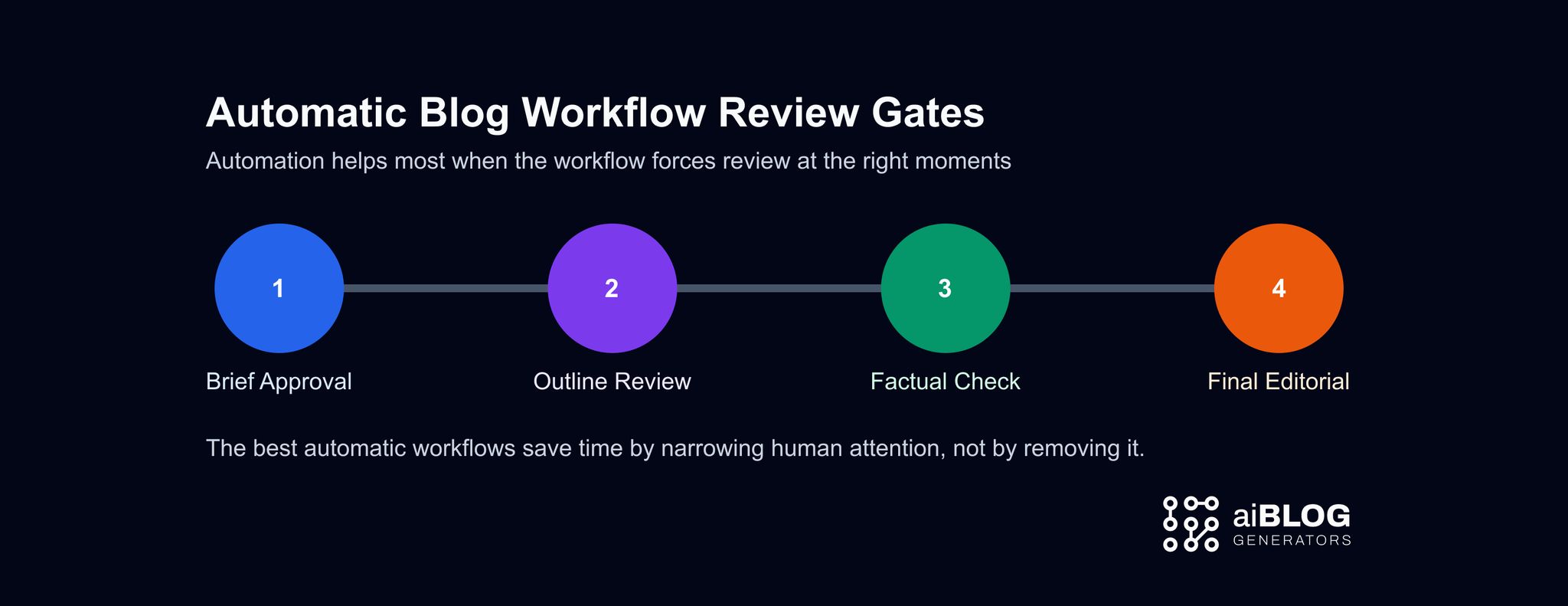
Automatic Blog Workflow Review Gates
Prompt tests buyers should run before choosing
Automation should be tested with repeatable workflow prompts, not one-off demos.
Prompt test 1: brief-to-outline automation
Example: “Using this approved brief, generate a blog outline with one decision framework, one mistakes section, and a four-question FAQ. Keep the audience B2B founders.”
What to look for:
- whether the workflow respects the brief
- whether the section order is logically usable
- whether the output can move into review without restructuring
Prompt test 2: outline-to-draft automation
Example: “Expand this approved outline into a rough article draft. Keep the tone direct, avoid filler, and mark any uncertain claims for review.”
What to look for:
- whether the system produces a useful draft instead of a long generic one
- whether the uncertainty handling is visible
- whether the automation respects the approved structure
Prompt test 3: rewrite automation
Example: “Rewrite this weak section to reduce repetition, improve clarity, and make it more useful for a startup content lead.”
What to look for:
- whether the rewrite improves the section instead of just changing wording
- whether it stays aligned with the article goal
Prompt test 4: multi-run reliability
Example: “Run this same workflow on three article briefs in the same niche and compare the outputs for structure quality, repetition, and edit burden.”
What to look for:
- whether quality remains stable across runs
- whether the workflow becomes repetitive
- whether the review layer can still keep up
When not to publish automatically generated output
This is where many teams need more discipline.
Do not publish automatically generated output without manual approval when:
- the article makes specific product comparisons
- the content relies on changing facts, pricing, or features
- the page targets a commercially important query
- the draft contains strong claims with no clear source validation
- the automation produces content that still feels generic after one review pass
The problem is not that automatic generation always fails. The problem is that the cost of being wrong is often higher than the time saved by skipping review.
Step-by-step implementation plan for a real team
If you want to test automatic blogging seriously, use a staged rollout rather than full automation on day one.
Step 1: automate one article type only
Pick one repeatable content pattern first, such as:
- FAQ explainers
- low-risk educational posts
- structured comparison updates
- simple workflow guides
Step 2: standardize the brief template
Your automation layer should only run on briefs that define:
- audience
- article goal
- section rules
- tone rules
- claim sensitivity
- CTA policy
Step 3: add a mandatory outline gate
Do not automate directly from brief to publish-ready draft without a stop in between. The outline review catches a lot of structural mistakes early.
Step 4: measure edit burden across runs
Track:
- time to approve the outline
- time to fix the draft
- number of factual corrections needed
- how often the system repeats itself
- whether the workflow actually reduces manual work
Step 5: widen automation only after review stability exists
If the team cannot review the outputs cleanly and consistently, scaling the automation only scales confusion.
Common mistakes and risk controls
Mistake 1: automating weak briefs
A weak brief creates weak automation output faster.
Risk control: require template discipline before generation starts.
Mistake 2: automating publishing instead of drafting
Many teams automate too far too early.
Risk control: automate draft creation first, not final release.
Mistake 3: treating consistency as quality
An automated workflow can be consistently mediocre.
Risk control: review for usefulness, not only format compliance.
Mistake 4: assuming the same workflow works for every article type
Different content formats carry different risk.
Risk control: test automation by article archetype, not across the entire content system at once.
Mistake 5: removing the human checkpoint because the output “looks fine”
Fluent text can still be structurally wrong or factually weak.
Risk control: keep review gates mandatory even when the draft looks polished.
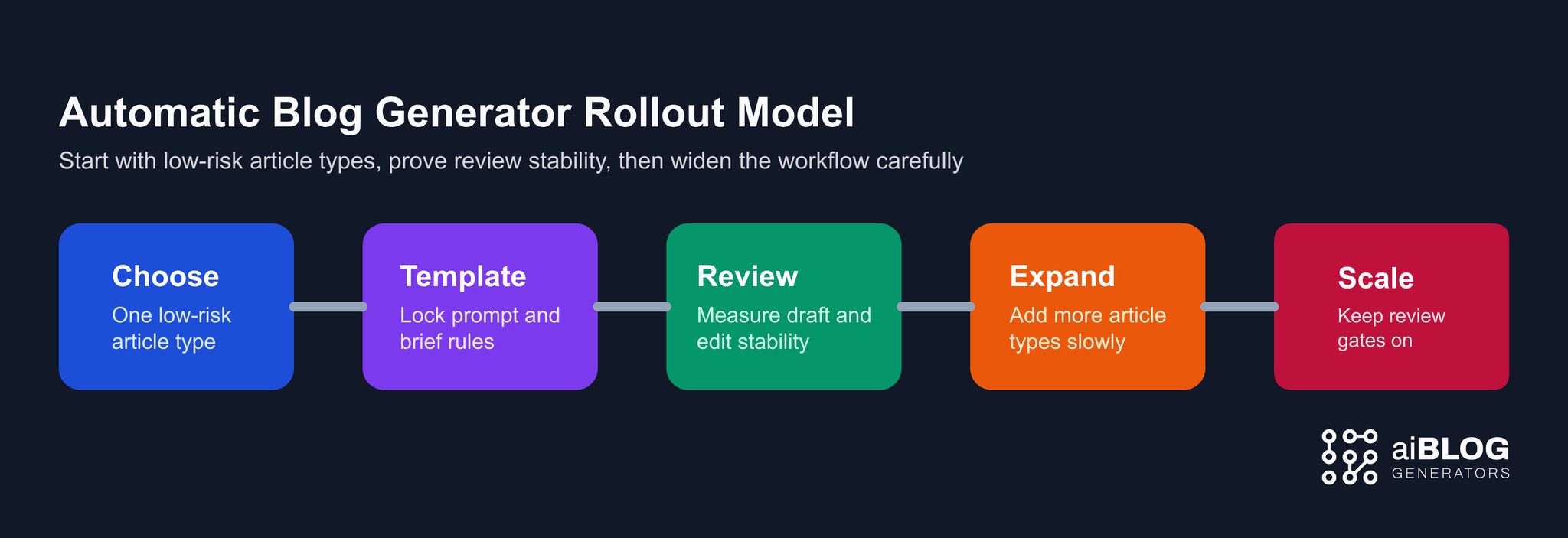
Automatic Blog Generator Rollout Model
Quality control and human review are the real advantage
The value of an automatic blog generator is not that it removes humans. The value is that it makes human attention more targeted.
A strong review layer still needs to check:
- whether the article answers the right question early enough
- whether section order supports the intent
- whether examples and claims are believable
- whether the post fits brand and audience expectations
- whether the final CTA still makes sense for the article stage
That is why the best automated workflows still depend on human review. The real improvement is not “no human work.” It is “better human work in the right places.”
Where AIBlogGenerators fits in this workflow
AIBlogGenerators is most useful when you are comparing generator categories and trying to understand which parts of the blogging workflow should be automated versus reviewed manually.
Use AI Writer when the main need is stronger drafting support. Use AI Blog when you want the broader view of AI-assisted blog workflows and how the pieces fit together.
That distinction matters because automation is rarely one tool decision. It is usually a workflow design decision.
If automation depth is the main decision point, it also helps to compare Blog Generator for the broader category view without the automation-first framing, AI Blog Generator when the workflow needs to stay AI-first rather than automation-first, and Automatic Blog Post Generator when you want the narrower one-post version of this automation workflow.
FAQ
What is an automatic blog generator?
An automatic blog generator is a tool or workflow that automates one or more parts of blog creation, such as outline generation, draft building, rewriting, or content assembly. The stronger systems automate execution while keeping human review at key decision points.
How is it different from a blog generator?
A blog generator is the broader category. An automatic blog generator usually implies more workflow automation and less manual intervention between the initial prompt and the draft output.
Can you publish automatically generated blog posts without review?
For low-risk internal experiments, maybe. For most public publishing workflows, review is still necessary because automation can scale weak structure, vague claims, and poor intent fit very quickly.
What should I automate first?
Start with low-risk tasks like outline drafting, FAQ generation, or rough first-pass expansion of approved structures. Do not automate the final publish decision first.
What should I test before choosing one?
Test brief-to-outline flow, outline-to-draft quality, rewrite usefulness, multi-run consistency, and how easy it is to stop weak content before it reaches publication.